

One common mistake creators make is assuming AI will magically produce great content without guidance. That rarely works. Without clear instructions, even the best tools generate generic outputs.
That’s why ai writing prompts examples matter more than most people realize. The difference between average and high-quality blog posts often comes down to how you frame the prompt, not the tool itself.
Over the last year, AI has become deeply embedded in content workflows. Bloggers, marketers, and niche site builders are using prompts daily to speed up blog posts and improve consistency.
But here’s the issue. Most prompt lists online feel theoretical. They look good, but they’re rarely tested in real publishing workflows.
This guide focuses on prompts that actually work. No fluff. Just tested examples you can use immediately.
My Tested AI Prompt Framework
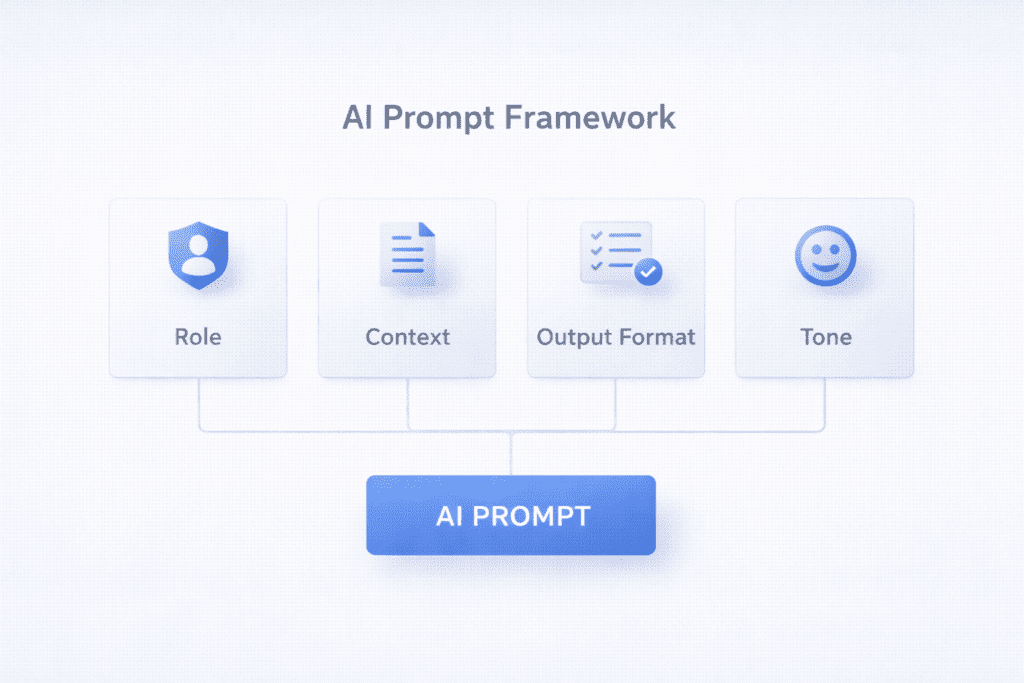
Instead of randomly experimenting, I developed a simple framework for crafting prompts that consistently produce usable outputs.
Personal prompt workflow
My workflow evolved through trial and error. Early prompts were vague and produced messy drafts. Over time, adding structure made outputs dramatically better.
Clear instructions almost always lead to better blog posts.
How prompts evolved through testing
Initially, prompts were short and generic. But testing showed that layered prompts, with context and goals, produced stronger drafts.
The shift from short prompts to structured ones changed everything.
Framework used for blog content
The framework I now follow includes role, context, output format, and tone. This combination helps guide AI toward more relevant responses.
It also improves readability and structure.
Real-world application
This framework works across niches, from affiliate blogs to SaaS content. It adapts easily because it focuses on clarity rather than complexity.
In most cases, small prompt tweaks produce noticeable improvements.
How I Tested These AI Writing Prompts
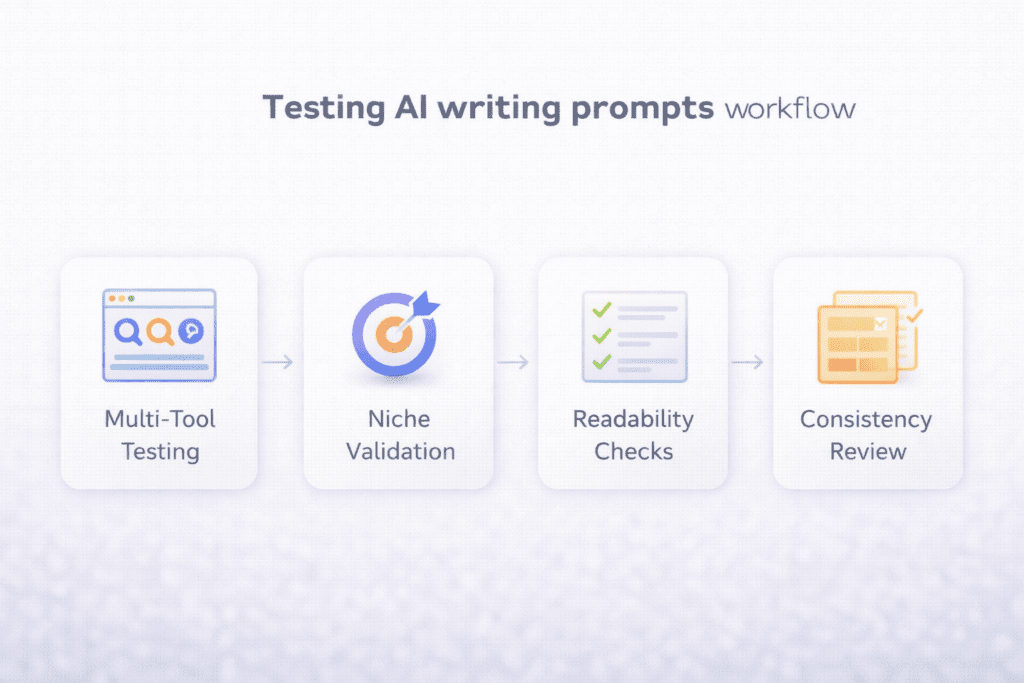
To make this guide practical, I validated prompts across multiple scenarios rather than relying on theory.
Testing across multiple AI tools
Prompts were tested across tools like chatgpt and other ai platforms. This helped ensure outputs remained consistent regardless of tool differences.
That consistency was important for reliability.
Blog niches used for validation
I tested prompts across different niches, including marketing, software, and informational blogs. Each niche has different content expectations.
This helped refine prompts for broader use cases.
SEO and readability evaluation
Each output was reviewed for seo structure, clarity, and readability. The goal wasn’t just generation, but usable blog writing.
If a draft required heavy rewriting, the prompt needed improvement.
Output consistency checks
Consistency mattered most. Prompts that produced stable results across multiple runs were prioritized.
Because realistically, repeatability is what makes prompts valuable.
Next, we’ll break down what AI writing prompts actually are and why they’ve become essential for modern blog workflows.
What Are AI Writing Prompts?
At a basic level, ai writing prompts examples are structured instructions you give an AI model to guide the output. Instead of asking vague questions, you provide clear direction on what to generate.
Think of a prompt as a blueprint. The clearer the blueprint, the better the result.
Simple definition of a prompt in AI writing
A prompt is the input that tells AI what to create. It can include topic, tone, format, and target audience details.
Stronger prompts reduce randomness and produce more usable blog posts.
How prompts guide content creation
AI models rely heavily on context. When prompts include goals and structure, the output becomes more focused and readable.
That’s why prompt quality directly affects blog writing quality.
Role of artificial intelligence in blog writing
Artificial intelligence handles pattern recognition well. It can generate outlines, paragraphs, and ideas quickly when guided properly.
But without clear prompts, results often feel generic.
Why prompts matter for quality blog posts
Better prompts lead to better structure, clarity, and flow. They help generate drafts that need less editing.
In many cases, improving the prompt improves the output more than switching tools.
Why AI Writing Prompts Matter for Bloggers in 2026
Prompts are becoming a core skill for modern creators. As AI usage grows, knowing how to structure prompts is turning into a real advantage.
Scaling blog posts faster
Well-structured prompts make it easier to write blog posts consistently. Instead of starting from scratch, you generate structured drafts quickly using prompts to write.
This is especially useful for solo creators.
SEO-driven content creation
Prompts can guide keyword placement, headings, and formatting. This helps align outputs with search engines without constant manual optimization.
It makes SEO workflows smoother.
Smarter ChatGPT usage
Tools like chatgpt are powerful, but only when used correctly. Clear prompts unlock more value from the same AI.
That’s something many creators overlook.
Future of AI for content creators
As AI evolves, prompt quality will matter even more. Those who learn how to structure prompts now will likely have an edge.
It’s becoming a practical skill, not just a technical one.
ChatGPT vs Other AI Tools for Prompts
Different tools respond differently to the same prompt. Understanding these differences helps set better expectations.
Prompt flexibility differences
ChatGPT tends to be highly flexible. It adapts well to layered prompts and multi-step instructions.
Other tools may require shorter, more structured inputs.
Output style variations
Some AI tools generate more formal content, while others lean conversational. The same prompt can produce noticeably different tones.
This is normal across AI platforms.
SEO capability comparison
ChatGPT works well for drafting but may need external tools for deeper SEO optimization. Dedicated platforms sometimes include built-in scoring.
Choosing the right workflow matters.
Workflow adaptability
ChatGPT fits flexible workflows. Other tools may feel more structured or template-driven.
It really depends on how you prefer to work.
AI Prompt Structure That Consistently Produces Better Blog Outputs
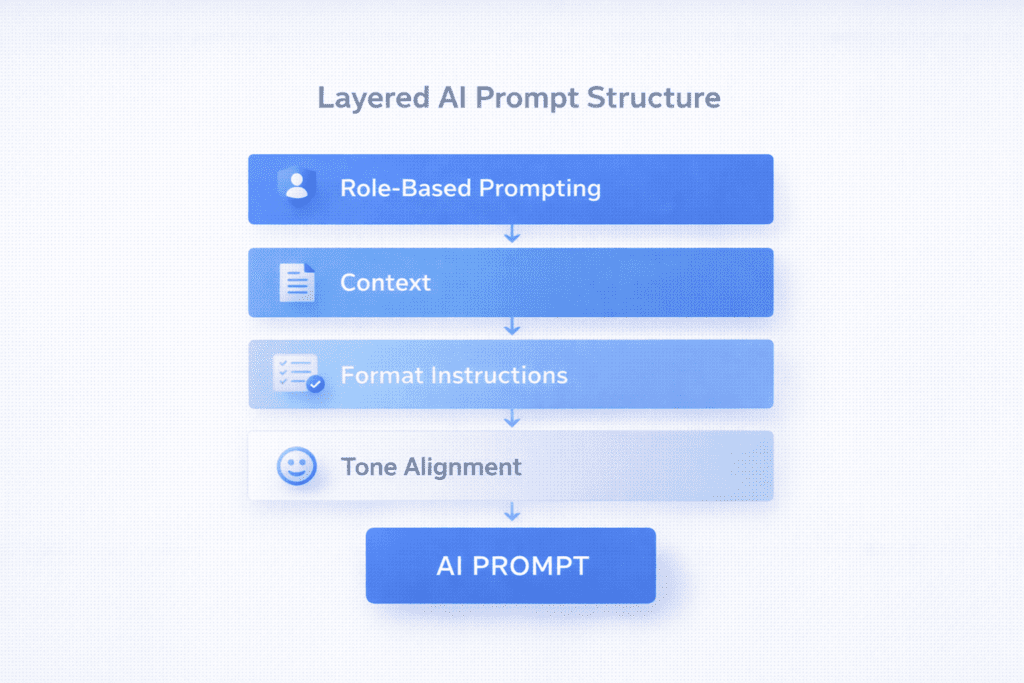
After testing hundreds of prompts, certain structures consistently produce stronger results.
Role-based prompting
Assigning a role improves clarity. For example, asking AI to act as an SEO writer often leads to more structured outputs.
This simple tweak can improve relevance.
Context and goal framework
Providing context and a clear goal helps narrow the output. Instead of vague drafts, you get more focused responses.
Clarity here makes a big difference.
Format instructions
Specifying format improves structure. For example, requesting subheadings or bullet points guides organization.
This reduces editing time later.
Tone and audience alignment
Defining tone and target audience improves readability. A beginner-friendly tone, for instance, produces simpler explanations.
This helps match content to reader expectations.
Next, we’ll move into practical usage, including templates and real prompts you can copy and use immediately.
How to Use AI Writing Prompts Effectively
Knowing ai writing prompts examples is useful, but using them correctly makes the real difference. Small adjustments in how you structure prompts can drastically improve outputs.
From testing, effectiveness usually comes down to clarity and iteration.
Choosing the right prompt structure
Start with a clear structure. Define the role, topic, and expected output. This helps AI generate more focused blog posts.
Loose prompts often lead to scattered drafts.
Using ChatGPT prompts strategically
Chatgpt works best when prompts are layered. Instead of asking everything at once, build outputs step by step.
This approach improves control over the writing process.
Combining prompts with human editing
AI should be treated as a drafting partner. Use it to generate structure and ideas, then refine tone and clarity manually.
This balance improves content quality significantly.
Using AI tool workflows
Some creators use multiple tools together. For example, generate drafts in one AI tool and refine structure using SEO tools.
This hybrid approach often produces stronger results.
Avoiding generic outputs
Generic prompts lead to generic blog posts. Adding context, audience details, and goals makes outputs more unique.
Specificity is the easiest way to improve results.
Copy-Paste Prompt Templates You Can Use
To make things practical, here are templates you can reuse. These are adaptable across niches and blog styles.
Universal blog prompt template
Use this when you want a clean starting point to create a blog post for most blog posts.
Prompt:
“Act as an experienced blog writer. Write a comprehensive article on [topic] for a [target audience]. Include a clear introduction, structured subheadings, and actionable insights. Keep the tone conversational and easy to read.”
This template works well across informational topics.
SEO outline template
Ideal for building structured blog post outlines.
Prompt:
“Act as an SEO content strategist. Create a detailed blog post outline for the keyword [keyword]. Include optimized H2 and H3 subheadings, logical structure, and sections that match search intent.”
This helps generate structured outlines quickly.
Long-form writing template
Useful when you want deeper articles.
Prompt:
“Act as an expert writer. Write a long-form blog post on [topic] that includes clear explanations, real-world examples, and structured headings. Keep the tone beginner-friendly and informative.”
Works well for authority content.
Rewrite and humanize template
Helpful for improving AI drafts.
Prompt:
“Rewrite the following article to sound more human and natural. Improve readability, simplify complex sentences, and maintain the original meaning.”
Great for polishing ai-generated content.
50 Best AI Writing Prompts for Blogging Post Ideas and SEO Topics
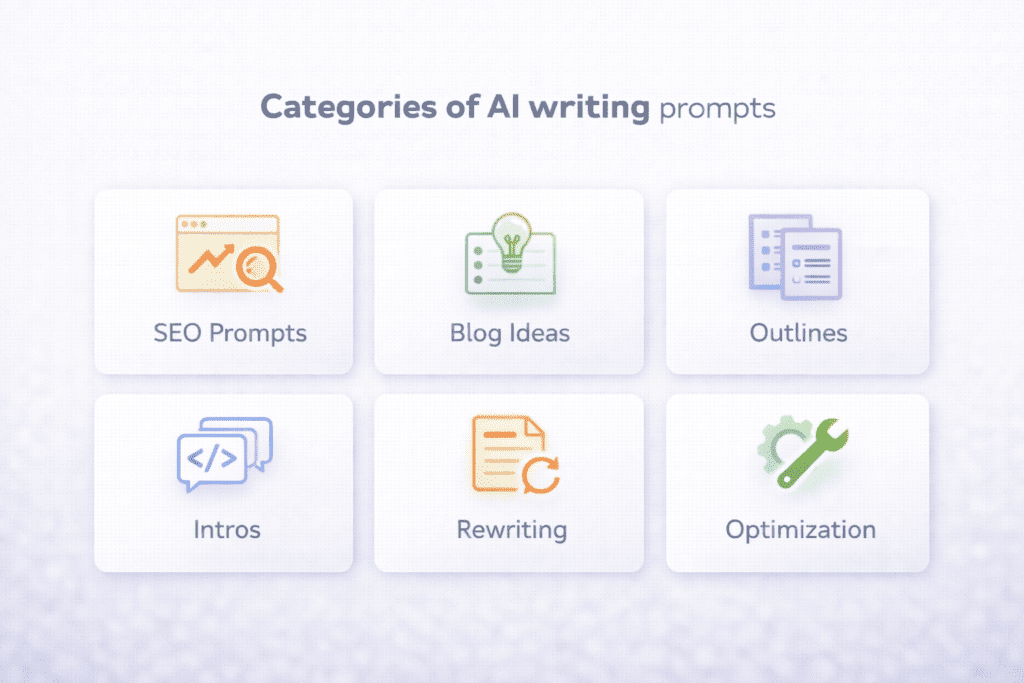
Now let’s move into real categories of prompts you can use in daily workflows.
Blog post idea generation prompts
Use these when brainstorming topics.
• Idea prompt: “Generate 10 blog post ideas related to [niche] that are useful and engaging.”
• Niche prompt: “Suggest blog topics for a blog focused on [specific niche].”
• Topic clustering prompt: “Create topic clusters around the keyword [keyword] for content planning.”
• Evergreen prompt: “List evergreen blog post ideas that stay relevant long term.”
• Trending topic prompt: “Suggest trending blog topics in [industry] for this year.”
These help overcome writer’s block quickly.
SEO blog prompts
Designed for search-focused content.
• SEO outline prompt: “Create an SEO-friendly outline targeting the keyword [keyword].”
• Keyword prompt: “Generate blog ideas based on the keyword [keyword].”
• Search intent prompt: “Create a blog outline that matches informational search intent.”
• Snippet prompt for OpenAI: “Write a paragraph optimized for featured snippets about [topic].”
• Long-tail prompt: “Generate long-tail keyword blog ideas based on [keyword].”
These help align prompts with SEO workflows.
How-to blog prompts
Best for instructional content.
• Step-by-step prompt: “Write a step-by-step how-to guide on [topic].”
• Beginner guide prompt: “Explain [topic] in a beginner-friendly way.”
• Process prompt: “Break down the process of [task] into simple steps.”
• Tutorial prompt: “Write a tutorial-style blog post on [topic].”
• Instructional prompt: “Create a detailed instructional blog framework for [topic].”
These are useful for evergreen educational posts that create content over time.
Next, we’ll continue expanding the prompt library with outlines, intros, and advanced prompt workflows.
Blog Post Outline Prompts
Strong outlines make writing easier. These ai writing prompts examples help generate structured frameworks quickly.
Outline creation prompts
Use these when planning blog structures.
• Detailed outline prompt: “Create a detailed blog outline for [topic] with logical flow and clear sections.”
• Structured H2/H3 prompt: “Generate an outline with optimized H2 and H3 headings for [keyword].”
• Authority outline prompt: “Create an authority-style blog outline covering beginner to advanced insights.”
• SEO silo prompt: “Build an SEO silo structure around the topic [topic].”
• Internal linking prompt: “Suggest internal linking opportunities for a blog about [topic].”
These help produce better content structure from the start.
Blog Introduction Prompts
Introductions shape reader engagement. These prompts help generate stronger openings.
Intro generation prompts
• Hook-driven prompt: “Write an engaging blog introduction with a strong hook about [topic].”
• Story-based prompt with case studies: “Write a story-based intro that relates to [topic].”
• PAS prompt: “Write a problem-agitate-solution introduction about [topic].”
• Data-backed prompt: “Write an introduction that includes a surprising statistic about [topic].”
• Conversational prompt: “Write a friendly, conversational intro for a blog post about [topic].”
These help improve reader engagement early.
Long-Form Blog Writing Prompts
When you want complete articles, structured prompts help produce more coherent drafts.
Full writing prompts
• Full blog prompt: “Write a full blog post about [topic] with clear sections and actionable insights.”
• Section-by-section prompt: “Write the blog post section by section, starting with the introduction.”
• Expert tone prompt: “Write a blog post on [topic] using an expert but simple tone.”
• Beginner-friendly prompt: “Write a beginner-friendly blog post explaining [topic].”
• Authority-style prompt: “Write an authority-level article on [topic] with depth and clarity.”
These prompts are useful for scaling long-form blog posts.
Content Expansion Prompts
These prompts help deepen existing content.
Expansion prompts
• Expansion prompt: “Expand this article with more examples and explanations.”
• Examples prompt: “Add real-world examples to improve clarity.”
• Statistics prompt: “Add relevant statistics to support the key points.”
• Insights prompt: “Add expert insights to improve credibility.”
• Depth prompt: “Expand this section to make it more comprehensive.”
These are helpful for improving existing drafts.
Content Rewriting Prompts
Rewriting prompts help improve clarity and tone.
Rewriting prompts
• Clarity prompt: “Rewrite this article to improve clarity and flow.”
• Humanize prompt: “Rewrite this AI text to sound more natural and human.”
• Simplification prompt: “Simplify this article for better readability.”
• Readability prompt: “Improve readability while maintaining meaning.”
• Tone prompt for creating engaging content: “Adjust the tone to sound more conversational.”
These are useful when refining ai-generated drafts.
Blog Optimization Prompts
Optimization prompts help improve performance and structure.
Optimization prompts
• SEO optimization prompt: “Optimize this article for SEO without changing meaning.”
• On-page prompt: “Improve on-page SEO structure for this blog post.”
• Snippet prompt: “Rewrite this section for featured snippet optimization.”
• Internal linking prompt: “Suggest internal linking improvements.”
• Meta prompt: “Write an SEO-friendly meta description for this blog post.”
These help align prompts with search engines.
Advanced AI Prompts for Content Creators
Once you’re comfortable with basics, advanced prompts unlock deeper workflows.
Advanced prompt workflows
• Multi-step prompt: “Create a step-by-step workflow to write a complete blog post.”
• Authority prompt: “Generate an authority blog post with expert insights and structure.”
• Prompt chaining: “Create a prompt chain for ideation, outlining, and writing.”
• SEO prompt: “Generate an advanced SEO blog post using structured headings.”
• Conversion prompt: “Write a high-conversion blog post with persuasive structure.”
These are useful for scaling content production.
Real Example: Prompt to Output Transformation
To make this practical, here’s a simple transformation example using real workflows and generative AI.
Raw prompt:
“Write a blog post about productivity tips.”
This produces generic output most of the time.
Improved prompt:
“Act as a productivity expert. Write a structured blog post about productivity tips for remote workers. Include actionable advice and a friendly tone.”
The second prompt typically produces clearer, more useful results. Small changes in structure often lead to big improvements.
SEO Benefits of Using AI Writing Prompts
Using structured prompts isn’t just about speed. It also improves content quality and structure.
Key SEO advantages
• Faster content production
• Better keyword placement
• Structured blog posts
• Improved optimization workflows
When prompts include structure and clarity, outputs align better with search engines.
Next, we’ll explore customization, mistakes to avoid, and how to build your own prompt library.
How to Customize AI Writing Prompts for Better Results
Using ai writing prompts examples as-is works, but customization unlocks better outputs. Small tweaks can make prompts far more relevant to your niche.
Adjust prompts for niche topics
Generic prompts produce generic blog posts. Adding niche context improves relevance immediately.
For example, specifying industry or audience type often leads to more targeted outputs.
Adding brand voice instructions
Including tone guidelines helps maintain consistency. You can ask AI to write in a conversational, professional, or friendly voice.
This works well for maintaining brand identity.
Using role-based prompts
Assigning a role improves clarity. Asking AI to act as an SEO strategist or blog editor often produces more structured results.
This small tweak has a big impact.
Iterating prompts for better output
Prompt writing is iterative. Slight refinements based on output quality help improve results over time.
Testing variations usually reveals what works best.
How to Build Your Own AI Prompt Library
Creating a personal prompt library saves time and improves consistency.
Saving high-performing prompts
Whenever a prompt produces strong results, save it. Over time, you’ll build a reliable library.
This becomes a valuable asset.
Categorizing by use case
Organize prompts by purpose. For example, separate prompts for outlines, intros, and rewriting.
This makes them easier to reuse.
Iterating based on results
Not every prompt works perfectly the first time. Refining prompts based on outcomes improves reliability.
Small iterations compound over time.
Scaling prompt workflows
Once you have a library, workflows become faster. You can mix and match prompts for different blog posts.
This makes scaling content easier.
Mistakes That Kill AI Prompt Results
Even good tools produce poor outputs with weak prompts. Avoiding these mistakes can dramatically improve quality.
Overcomplicated prompts
Long, cluttered prompts can confuse AI. Clarity usually beats complexity.
Simple, structured prompts perform better.
Vague instructions
Vague prompts lead to vague outputs. Without context, AI fills gaps randomly.
Specific instructions improve results.
Lack of iteration
One-shot prompts rarely produce perfect results, which is a key point to remember in AI usage. Iteration is part of the process.
Refinement improves quality.
Ignoring output refinement
Even strong prompts benefit from editing. Skipping refinement often leads to weaker blog posts.
Editing still matters.
Common Mistakes When Using AI Writing Prompts
Some mistakes show up repeatedly among creators.
• Using vague prompts
• Over-relying on AI outputs
• Ignoring SEO intent
• Not editing ai-generated drafts
• Reusing the same prompts repeatedly can hinder your ability to create a blog post effectively.
Avoiding these helps maintain quality over time.
Tips to Get Better Results from AI Prompts
A few practical tips can improve outputs immediately.
Be specific with instructions
Specific prompts lead to clearer responses. Including audience, tone, and structure helps.
Clarity improves output quality.
Use step-by-step prompts
Breaking prompts into steps gives better control. This works well for long-form blog writing.
It also improves consistency.
Combine prompts with editing
AI handles drafting well, but editing adds polish. This balance creates stronger content.
It’s a practical workflow.
Use AI as a collaborator
Treat AI as a partner, not a replacement, to transform your writing. Asking follow-up questions often improves results.
This creates a more interactive process.
Test and refine prompts
Testing variations reveals what works best. Even small tweaks can produce better blog posts.
Iteration is key.
Free vs Paid Prompt Libraries
Prompt libraries vary widely in quality. Understanding the difference helps set expectations.
Free prompt resources
Free resources are easy to find and useful for experimentation. Many creators share prompts online.
They’re good starting points.
Premium prompt databases
Paid libraries often include curated, tested prompts. These can save time if you want ready-to-use frameworks for prompt engineering.
Quality tends to be more consistent.
Quality differences
Free prompts vary in quality, while premium ones are often more structured.
That consistency can be valuable.
When paid libraries make sense
Paid libraries make sense if you produce content frequently. For occasional users, free resources may be enough.
It depends on usage, especially when utilizing generative AI.
The Future of AI Writing Prompts
AI prompts are evolving quickly as artificial intelligence improves.
Smarter artificial intelligence prompts
Future prompts may become more dynamic and context-aware. AI could adapt based on previous interactions.
This would improve efficiency.
Rise of AI agents
AI agents may automate prompt workflows entirely. Instead of writing prompts manually, systems could generate them automatically.
We’re already seeing early versions.
Prompt automation workflows
Automation may reduce repetitive prompting. Structured workflows could streamline content production further.
This could save time for creators.
AI-native content creation
Content creation may become more AI-native over time. Prompts will likely remain central to guiding outputs.
The role of prompts isn’t going away.
Evolution of AI tool ecosystems
AI tools will continue evolving alongside prompts. Better integrations may simplify workflows further.
This could reshape how content is created.
FAQs About AI Writing Prompts
What are the best ai writing prompts examples for beginners?
Simple prompts with clear structure work best. Start with templates that include role, topic, and tone.
These provide a strong foundation.
Can ChatGPT write full blog posts using prompts?
Yes, tools like chatgpt can generate full drafts. However, editing is still important for clarity and originality.
AI handles structure, but refinement adds quality.
How do I create better AI prompts for blog posts?
Focus on clarity and structure. Include context, goals, and audience details in your prompt.
Iteration helps improve results.
Are AI writing prompts good for SEO content?
Yes, structured prompts can support SEO workflows. They help generate organized content aligned with search intent.
Optimization still requires review.
Do AI prompts work for all niches?
Most niches can benefit from prompts. However, customization improves relevance significantly.
Niche context matters.
Should creators rely fully on AI prompts?
Not entirely. AI works best when combined with human editing and strategy.
Balance is important.
What are the best ai writing prompts for blogging?
Best AI writing prompts for blogging are clear, topic-focused instructions that help GPT create engaging blog content and content marketing ideas quickly.
How can prompts help me create a detailed outline?
Prompts can help generate a content outline by asking the AI to list headings, subpoints, and examples to enhance readability and structure.
Can AI suggest engaging blog post ideas for my niche and target audience?
Yes, AI can suggest engaging blog post ideas tailored to your niche and target audience when you give context and goals.
Should I ask the AI for credible sources and content optimization?
Ask the AI for credible sources, but always verify citations yourself to make your content reliable and optimized for search.
How do I use prompts to create social media posts and a content calendar?
Use prompts that shorten blog points into social media captions and request a weekly content calendar to plan creating posts and promotion.
What are best practices for making your content visually appealing and reader engagement?
Use prompts to add bullet points, images suggestions, and calls to action to boost reader engagement and discussion.
Can AI help new to blogging users craft a content creation process?
AI can outline steps, suggest types of blog posts, and help you choose a relevant topic to build a simple content creation process.
Is AI a tool to help or will ai may replace human writers?
AI is going to be a tool to help with research and drafting, but human edits are needed to add voice, credibility, and final polish.
My Recommendation

If you’re getting started, begin with structured ai writing prompts examples rather than random experimentation.
Use AI for speed, but rely on human editing for refinement. That combination usually produces the best results.
Over time, build a personal prompt library based on what works for your blog posts. Saving strong prompts and refining them gradually can dramatically improve consistency.
And most importantly, keep iterating. Prompt quality improves with testing, and the creators who refine their prompts consistently tend to produce stronger content in the long run.