

Are ai writing tools for seo actually worth using today, or are they just another trend that sounds better than it works?
That question comes up a lot, especially among bloggers and niche site builders trying to scale content without burning out. SEO has always been time-heavy. Writing, editing, optimization, internal linking. It adds up quickly.
Now AI is stepping into that workflow. Not as a replacement for strategy, but more like an extra layer that helps speed up the content creation process. From outlines to optimization, the shift is becoming hard to ignore.
From my testing, some tools genuinely improve publishing speed and seo optimization. Others feel impressive at first but fall short once you try to create long-form content consistently.
This guide breaks down what actually works in 2026. No hype. Just practical insights based on real workflows.
Quick Picks: Best AI Writing Tools for SEO in 2026
If you just want the short version, here are the standout tools based on performance and usability.
Quick Recommendation: AI Writing Tools for SEO Snapshot (2026)
Best overall ai writing tool: Surfer AI
Best for: Bloggers who want built-in SEO scoring while generating content
Best budget seo ai tool: NeuronWriter
Best for: Bloggers who want solid SEO optimization without premium pricing
Best for long-form seo content: Jasper AI
Best for: Bloggers publishing detailed guides, pillar posts, and authority content
Best All-in-One AI SEO Platform: Scalenut
Best for: Bloggers who want research, writing, and optimization in one platform
Most users in the around the world end up choosing based on workflow compatibility, not just features. That’s an important distinction.
My Testing Methodology for Ranking AI Writing Tools
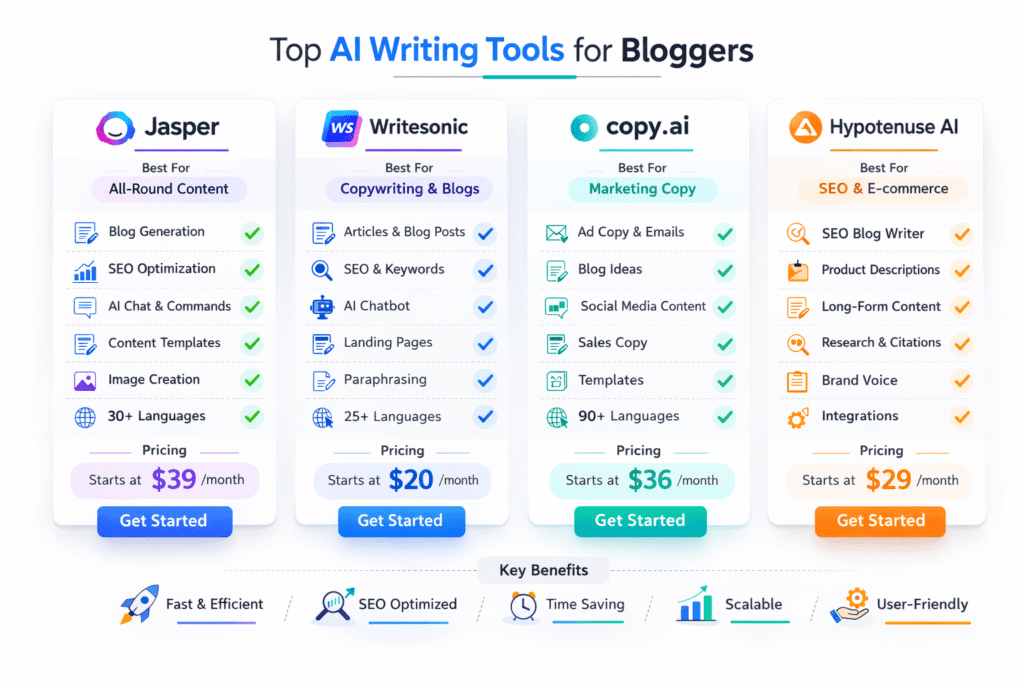
Instead of relying on feature lists, I focused on real-world usage. The goal was to see how each ai tool performs inside an actual seo content workflow.
Hands-on testing process
I used each platform to generate blog posts, outlines, and content briefs. This included testing optimization suggestions and editing drafts into publish-ready content.
Tools that required less cleanup ranked higher.
Evaluation criteria
Each seo tool was evaluated across usability, ai writing quality, optimization accuracy, and output consistency.
I also considered how well the tools support different content types like blog posts and landing pages.
SEO performance analysis
To measure impact, I compared how well tools supported keyword placement, structure, and content optimization.
Some tools provide real-time seo scoring, which makes refinement easier.
AI writing quality comparison
Output quality matters. I reviewed readability, tone, and how natural the ai content felt after light editing.
In many cases, the difference between tools was obvious within minutes.
Real-world workflows
I also tested how tools fit into daily publishing routines. That includes drafting, editing, optimizing, and exporting content into CMS platforms.
Because realistically, a good ai writing tool should simplify the workflow, not complicate it.
Why AI Writing Tools for SEO Are Growing Fast
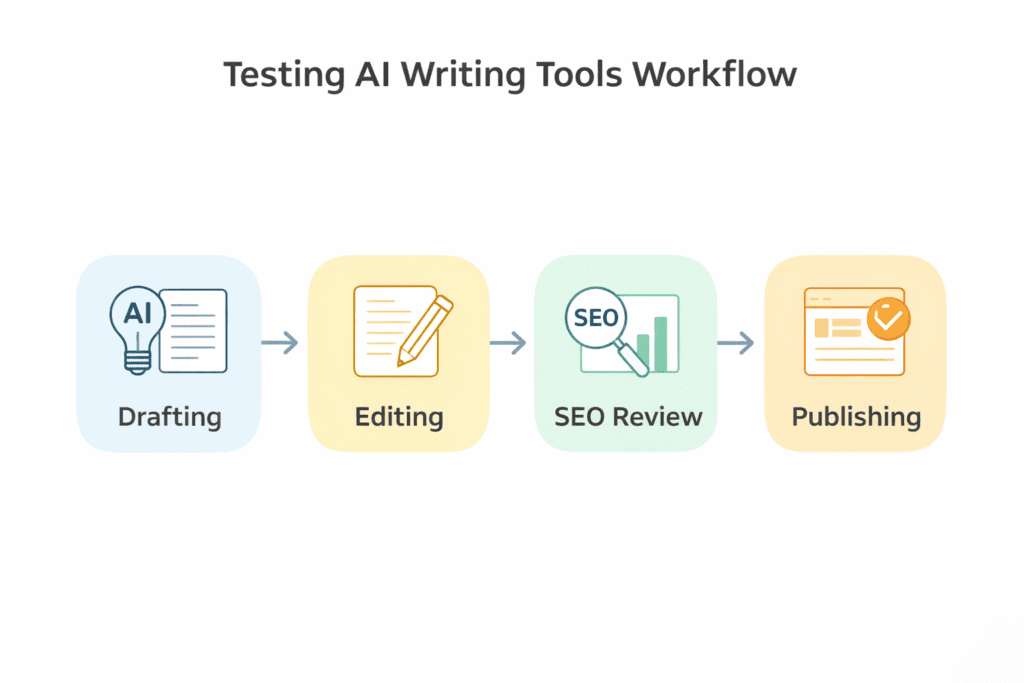
The rise of AI in seo isn’t random. It’s tied to how content marketing itself is evolving.
Growth of AI in SEO content creation
Over the last few years, AI has moved from experimental to practical. Many content marketers now use ai writing assistants as part of their regular stack.
It’s becoming less of an experiment and more of a standard layer.
Demand for scalable content workflows
Publishing frequency keeps rising. That pressure pushes creators toward tools that help generate content faster without sacrificing structure.
AI helps close that gap between speed and quality.
AI-powered search optimization
Another shift is data-driven optimization. Tools now analyze seo data in real time and suggest structural improvements instantly.
That wasn’t possible with older manual workflows.
Future of AI-driven SEO writing
Looking ahead, the future of ai writing feels less about replacing writers and more about augmenting them. Expect deeper integrations with search data and smarter optimization layers.
And honestly, that direction makes sense as SEO continues evolving.
What Are AI Writing Tools for SEO?
At their core, ai writing tools for seo are platforms that combine content generation with optimization insights. Instead of writing and optimizing separately, these tools merge both steps into one workflow.
They’re built to help generate content faster while keeping SEO structure intact.
Definition of AI writing tools for SEO
An ai writing tool uses machine learning to create drafts, outlines, and optimized content. Unlike basic writing assistants, these platforms often integrate keyword data and structural suggestions.
That’s what makes them useful for seo content creation rather than just general writing.
How AI helps SEO content creation
AI reduces the friction of starting from scratch. It can create outlines, suggest headings, and generate paragraphs based on target keywords.
For many bloggers, this speeds up the content creation process significantly.
Some tools also optimize content in real time, helping refine structure while you write.
Difference between AI writers and traditional SEO tools
Traditional SEO tools focus mostly on research. They provide keyword data, competitor insights, and technical SEO optimization suggestions, but they don’t actually write content.
AI writing tools do both. They combine writing and optimization into a single environment.
That shift changes how workflows operate.
Role of AI in modern SEO workflows
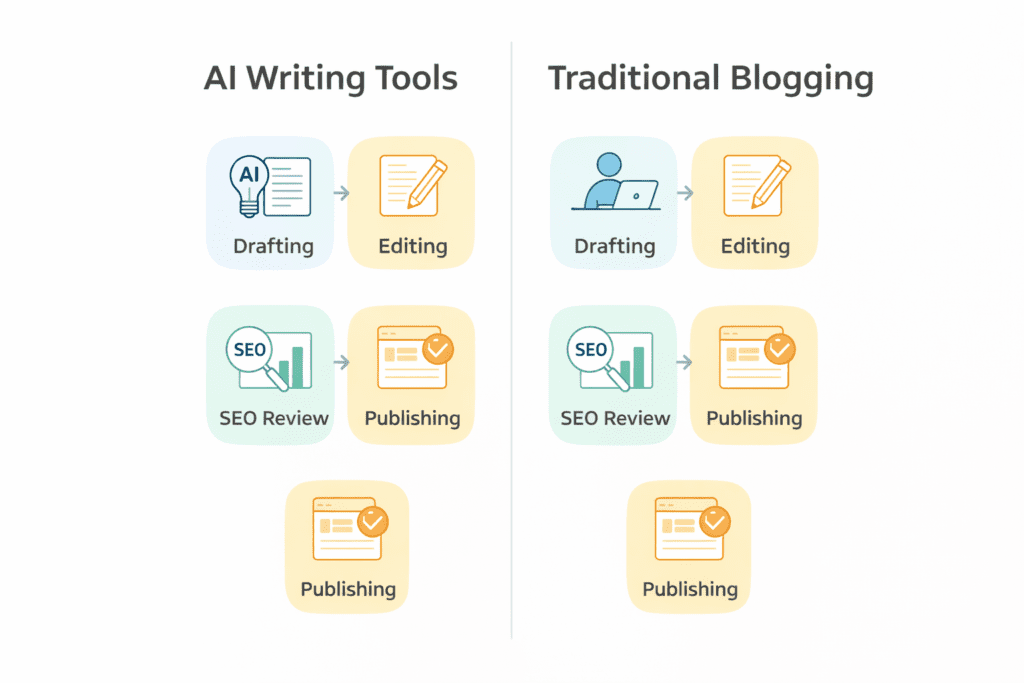
Today, AI sits at multiple stages of the publishing cycle. It helps with ideation, drafting, editing, and optimization.
In most cases, it acts like an ai assistant rather than a replacement for a content writer.
Used well, it simply removes repetitive effort.
AI Writing Tools vs Traditional SEO Tools
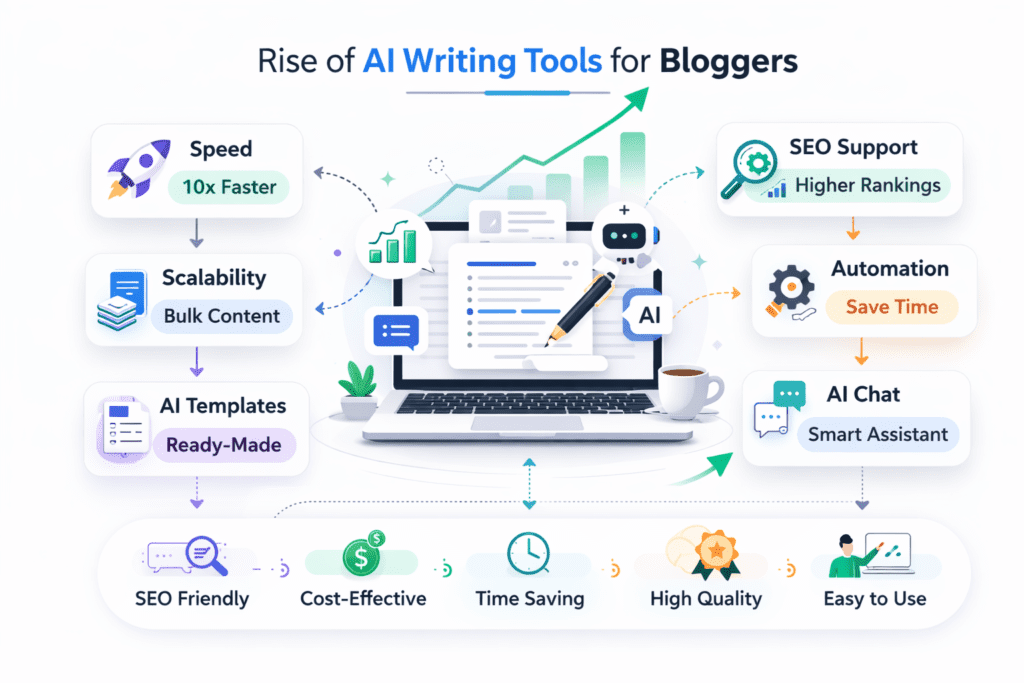
The gap between AI tools and older SEO platforms keeps widening. Each serves a different purpose, but AI is clearly reshaping the landscape.
Automation differences
Traditional tools require manual execution. You research keywords, create a content brief, and write everything yourself.
AI tools automate large portions of that workflow, making them invaluable for content creators. They can generate outlines and even full drafts in minutes.
That speed is one of the biggest appeals.
Optimization depth
Older SEO tools rely heavily on static metrics. You analyze data and manually optimize content afterward.
AI tools provide real-time seo optimization suggestions. Some even update scoring dynamically as you write.
This makes refinement much faster.
Workflow efficiency
Here’s where AI really stands out. Instead of jumping between research tools, editors, and optimization dashboards, everything happens in one place.
For content teams, that consolidation saves hours every week.
Data-driven SEO vs manual methods
Traditional workflows depend heavily on manual interpretation. AI tools analyze patterns automatically and surface actionable suggestions.
That doesn’t eliminate human judgment, but it reduces the guesswork.
From my experience, that’s where most productivity gains come from.
How AI Writing Tools Improve SEO Performance
AI doesn’t just speed things up. When used properly, it can improve actual SEO outcomes.
Faster content production
The most obvious benefit is speed. AI helps create blog posts and outlines quickly, allowing creators to publish more consistently.
Publishing frequency still matters in many niches.
Keyword optimization assistance
AI tools analyze keyword placement and density automatically. This makes it easier to optimize content without constantly checking external tools.
It simplifies the technical side of writing.
AI-generated outlines and drafts
Outlines are often the hardest part of starting. AI removes that friction by generating structured drafts instantly.
Even if you edit heavily, the starting point saves time.
On-page SEO automation
Some platforms offer built-in scoring systems that guide seo optimization in real time. These insights help refine headings, structure, and keyword usage.
It’s like having a built-in editor focused on SEO.
Content scaling benefits
For teams managing multiple sites, scaling becomes easier. AI allows you to generate content faster while maintaining structural consistency.
That’s especially useful for large content marketing strategies.
Real Results: How AI Writing Tools Impact SEO Performance
The real question is whether AI actually moves the needle. Based on testing and industry trends, the answer is usually yes, with a few caveats.
Faster ranking timelines
Some users report quicker indexing and ranking improvements when publishing consistently optimized content.
This isn’t guaranteed, but it’s a common observation.
Content output growth
AI makes it easier to publish more content without burning out. That alone can increase overall traffic potential.
More content means more entry points into search.
Traffic scaling potential
With consistent publishing and optimization, traffic often scales gradually. AI helps maintain that output without overwhelming writers.
It’s less about shortcuts and more about sustainability.
Publishing efficiency
Beyond rankings, efficiency gains are significant. AI reduces time spent drafting and optimizing, allowing creators to focus on strategy.
And honestly, that shift may be the biggest long-term benefit.
Who Should Use AI Writing Tools for SEO
Not everyone needs advanced ai writing tools for seo, but certain users benefit more than others. It usually comes down to publishing volume and workflow complexity.
Bloggers and niche site builders
Solo bloggers often use AI to speed up blog posts and outlines. It helps maintain consistency without spending hours on every draft.
For affiliate sites, this can make scaling content marketing more realistic.
SEO agencies
Agencies handle multiple clients and deadlines. AI helps streamline research, drafting, and optimization across campaigns.
That efficiency is hard to replicate manually.
SaaS companies and startups
SaaS brands rely heavily on educational content. AI supports faster content generation for onboarding, awareness, and product-led growth.
It also helps maintain steady publishing cycles.
Content teams
Larger teams benefit from workflow automation. AI tools make collaboration easier by generating briefs, drafts, and optimization insights in one place.
This improves coordination across writers and editors.
Key SEO Features to Look for in AI Writing Tools
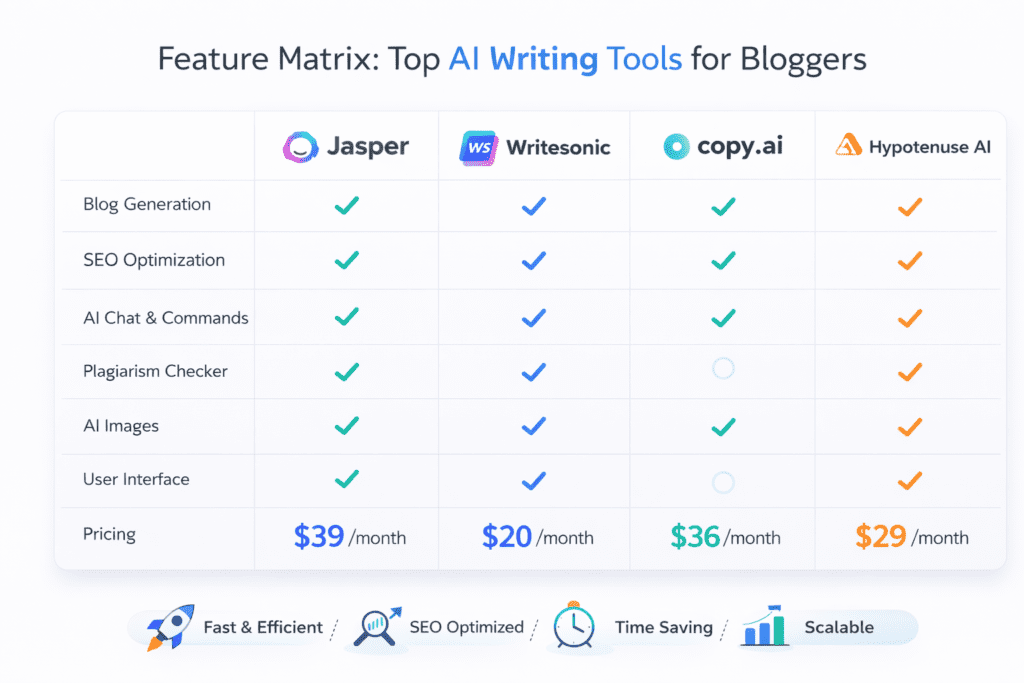
Not all AI tools are built the same. Some focus on writing quality, while others lean heavily into optimization and data.
Here’s what actually matters when choosing a reliable seo tool.
NLP-based optimization
Natural language processing helps tools analyze keyword relevance and context. This allows smarter optimization instead of basic keyword stuffing.
It’s one of the main reasons AI-driven SEO feels more natural.
SERP data integration
Strong tools pull real-time search results into the editor. This helps create content based on what’s already ranking.
From my experience, this feature alone can improve seo optimization significantly.
Content scoring systems
Many platforms include built-in scoring dashboards. These provide feedback on structure, keyword usage, and readability.
A clear seo score makes refinement easier, especially for beginners.
Long-form writing quality
If you plan to publish long-form content, output quality matters. Some tools handle short drafts well but struggle with deeper articles.
Testing this early can save frustration later.
Workflow automation
The best tools support the entire workflow. That includes generating content briefs, drafting posts, and optimizing in real time.
End-to-end support often makes the biggest difference.
Comparison Table: Best AI Writing Tools for SEO
Here’s a high-level comparison of the top tools based on SEO capabilities and usability.
| Tool | SEO Features | AI Quality | Pricing | Best For |
|---|---|---|---|---|
| Surfer AI | Real-time scoring and SERP data are essential for identifying content gaps. | Very High | $89/month+ | SEO professionals |
| Jasper AI | Brand voice control, workflows | High | $49/month+ | Marketing teams |
| ChatGPT | Flexible writing, prompts | High | Free – $20/month | Bloggers |
| Writesonic | Article automation, SEO tools | Medium-High | $16/month+ | Niche sites |
| Frase | Research + writing combo | High | $45/month+ | Content strategists |
| Scalenut | End-to-end SEO workflows | High | $39/month+ | Authority sites |
| Copy.ai | Short-form focused | Medium | Free – $36/month | Beginners |
| NeuronWriter | NLP optimization | Medium | $23/month+ | Budget SEOs |
| Outranking | Planning + scoring | High | $79/month+ | Agencies |
| Rytr | Entry-level AI writer | Medium | Free – $9/month | Beginners |
If you’re unsure where to begin, start with tools that match your workflow rather than chasing the most advanced features.
Surfer AI: Best AI Writing Tool for On-Page SEO
Surfer AI is built specifically for data-driven optimization. Among ai writing tools for seo, it stands out for tightly combining writing and real-time scoring.
If you care about on-page seo optimization, Surfer is often one of the first tools people try.
Overview
Surfer AI focuses heavily on structure and keyword relevance. Instead of just generating drafts, it guides optimization as you write.
This makes it especially useful for users who prioritize rankings over raw writing speed.
SEO-first optimization engine
The platform pulls live SERP data into the editor and provides real-time seo scoring. You can adjust headings, keyword usage, and structure while drafting.
That feedback loop makes refinement much faster.
Data-driven content creation
Surfer excels at building structured outlines based on competitor data. It helps create content briefs aligned with what’s already ranking.
For SEO professionals, this data layer is a major advantage.
Key Features
• Real-time seo scoring
• NLP keyword suggestions
• SERP-driven outlines
• Content editor integration
Pricing
Surfer AI does not offer a permanent free plan.
Paid plans start at $89/month for basic tiers.
Higher tiers with expanded usage can reach $179/month+ depending on limits.
It’s positioned as a premium seo platform.
Pros
• Excellent on-page optimization
• Accurate SERP data
• Structured content guidance
Cons
• Higher pricing than most tools
• Learning curve for beginners
Best For
• SEO professionals
• Agencies focused on rankings
If you want strong optimization insights baked into the writing process, Surfer AI is one of the most reliable options.
Jasper AI: Best AI Writing Tool for Marketing Teams
Jasper AI leans more toward branding and long-form writing quality. While not purely an seo tool, it’s widely used in content marketing workflows.
Among ai writing tools, Jasper is known for output quality and brand voice control.
Overview
Jasper focuses on producing polished drafts quickly. It’s designed for teams that create large volumes of blog posts, landing pages, and campaigns.
That flexibility makes it popular among agencies.
Strong long-form writing
Jasper performs well with long-form content and structured blog posts. It maintains tone consistency better than many competitors.
This makes it ideal for marketing-focused teams.
Brand voice and workflows
One standout feature is brand voice customization. You can train Jasper to match your style across content types.
For teams managing multiple writers, this is valuable.
Key Features
• Brand voice customization
• Long-form blog workflows
• Campaign writing tools
• AI templates
Pricing
Jasper does not offer a permanent free plan.
Paid plans start at $49/month for Creator tiers.
Pro tiers begin around $69/month, with business plans scaling higher based on usage.
Costs increase with advanced features.
Pros
• High-quality outputs
• Strong brand consistency
• Great for teams
Cons
• Expensive for solo creators
• Less built-in SEO scoring
Best For
• Marketing teams
• Agencies producing high-volume content
If your focus is polished content rather than deep seo scoring, Jasper is a strong contender.
ChatGPT: Most Versatile AI Writing Tool for SEO
ChatGPT has become one of the most widely used ai tools across industries. While it’s not an SEO platform by default, its flexibility makes it a powerful ai writing assistant.
Many creators use it as the backbone of their content workflow.
Overview
ChatGPT is highly adaptable. It can generate outlines, rewrite drafts, brainstorm content ideas, and assist with optimization strategies.
That versatility makes it appealing to solo creators and bloggers.
Flexible content generation
The biggest strength is customization. With the right prompts, you can generate blog posts, outlines, and even content briefs tailored to your workflow.
It’s less structured but highly flexible.
SEO workflow compatibility
ChatGPT works best when paired with dedicated seo tools. You generate drafts here, then optimize using external platforms.
This hybrid approach is common among experienced SEOs.
Key Features
• Content ideation and outlines
• Draft generation
• Prompt-based workflows
• Multi-purpose writing support
Pricing
ChatGPT offers a free plan with basic access.
Paid plans start at $20/month for Plus tiers.
Advanced versions like Team or Pro plans can cost $25–$30/user/month depending on features.
It’s one of the most accessible AI platforms available.
Pros
• Extremely versatile for various content writing applications.
• Constant updates
• Affordable entry point
Cons
• Requires manual SEO optimization
• No built-in scoring
Best For
• Bloggers and solopreneurs
• Flexible content workflows
If you want a flexible ai assistant that adapts to your workflow, ChatGPT remains one of the most practical choices.
Writesonic: Best AI Writing Tool for SEO Blog Posts
Writesonic is designed for speed. Among ai writing tools for seo, it focuses on generating blog posts quickly while still offering built-in optimization features.
It’s especially popular with bloggers and niche site builders who want faster publishing cycles.
Overview
Writesonic blends content generation with lightweight SEO guidance. It’s not as data-heavy as some platforms, but it balances usability and automation well.
For users who want quick drafts, it’s a practical option.
AI article generation
The platform includes an AI article writer that can generate structured blog posts in minutes. It supports outlines, intros, and full drafts.
This makes scaling content production easier.
Built-in optimization tools
Writesonic includes basic SEO suggestions and keyword support. While not as deep as Surfer, it still helps guide structure and headings.
That middle-ground approach works well for many users.
Key Features
• AI article generator
• SEO optimization suggestions
• Content rewriting tools
• Bulk generation support
Pricing
Writesonic offers a limited free trial for testing.
Paid plans start at $16/month for basic tiers.
Professional plans begin around $79/month, depending on usage and features.
Pricing scales with generation limits.
Pros
• Fast content generation
• Easy to use
• Good for blog posts
Cons
• Output consistency varies
• Lighter SEO data
Best For
• Bloggers
• Niche site builders
If speed is your top priority, Writesonic delivers strong value.
Frase: Best AI Tool for SEO Research and Writing
Frase takes a research-first approach. Instead of focusing only on writing, it blends SERP analysis with drafting tools.
For users who value structured research, it’s one of the more balanced ai writing tools.
Overview
Frase helps generate content briefs based on real search results. It analyzes competitor content and surfaces key topics automatically.
This makes planning much easier.
Research-driven workflows
The platform excels at creating detailed content briefs. You can build outlines based on questions, headings, and competitor insights.
This research layer is where Frase shines.
Writing and optimization combo
Frase also includes an AI writing assistant for drafting content. While output quality is solid, the real value comes from the research integration.
It’s built for structured SEO workflows.
Key Features
• SERP-based research
• Automated content briefs
• AI writing assistant
• Question-based optimization
Pricing
Frase offers a free trial but no permanent free plan.
Paid plans start at $45/month for Solo tiers.
Team plans begin around $115/month, depending on usage.
Mid-range pricing compared to competitors.
Pros
• Strong research layer
• Excellent content briefs
• Useful optimization insights
Cons
• Learning curve for beginners
• Interface feels dense at first
Best For
• Content strategists
• SEO writers
If you value research and structure, Frase is a strong choice.
Scalenut: Best AI Writing Tool for SEO Content Clusters
Scalenut positions itself as an end-to-end SEO platform. It combines keyword research, content generation, and optimization into one workflow.
Among ai writing tools for seo, it’s one of the more complete ecosystems.
Overview
Scalenut focuses heavily on topic clusters and authority building. It helps plan content strategies rather than just generating individual posts.
This makes it appealing for long-term SEO projects.
End-to-end workflow support
The platform includes keyword planning, content briefs, and AI writing tools in one dashboard. That reduces the need for multiple subscriptions.
For authority sites, this integration is valuable.
Optimization and clustering
Scalenut also supports topic clustering and internal linking strategies. These features help scale content marketing beyond individual articles.
It’s built with growth in mind.
Key Features
• Keyword planning tools and content writing tools
• AI long-form writer
• SEO content briefs
• Optimization dashboards
Pricing
Scalenut offers a free trial for new users.
Paid plans start at $39/month for essential tiers.
Pro plans begin around $79/month, with higher tiers available for teams.
Pricing is competitive for an all-in-one platform.
Pros
• Full SEO workflow support
• Strong value for price
• Good for scaling content
Cons
• Output needs editing
• Interface can feel busy
Best For
• Authority sites
• Content teams
If you want an all-in-one SEO workflow, Scalenut is worth considering.
Copy.ai: Best AI Tool for Short-Form SEO Content
Copy.ai focuses on simplicity and speed. Among ai writing tools for seo, it’s best known for generating short-form content quickly without a steep learning curve.
It’s not built for heavy optimization, but it works well for lighter workflows.
Overview
Copy.ai is designed for fast drafting. It helps create intros, meta descriptions, and short blog sections with minimal setup.
That makes it appealing for beginners and marketers.
Short-form content strength
The platform excels at generating short-form content like product descriptions and snippets. It’s especially useful for ecommerce SEO workflows.
For quick content needs, it performs reliably.
Ease of use
Copy.ai has one of the simplest interfaces among ai writing tools. Most users can start generating content within minutes.
That accessibility is a big selling point.
Key Features
• Short-form content generation
• Blog intros and meta writing
• Marketing copy tools
• Beginner-friendly templates
Pricing
Copy.ai offers a free plan with limited usage.
Paid plans start at $36/month for Pro tiers.
Team plans can scale beyond $100/month depending on seats and features.
It’s positioned as an accessible entry-level ai platform.
Pros
• Very easy to use
• Fast generation
• Beginner-friendly
Cons
• Limited long-form strength
• Minimal built-in SEO data
Best For
• Beginners
• Ecommerce SEO use cases
If you mainly need short-form content, Copy.ai keeps things simple.
NeuronWriter: Best Budget AI Writing Tool for SEO Optimization
NeuronWriter is often recommended for users who want strong optimization without high costs. It’s one of the most budget-friendly ai writing tools for seo focused on scoring and NLP suggestions.
From a value perspective, it punches above its price range.
Overview
NeuronWriter centers around optimization rather than raw writing power. It provides NLP keyword insights and competitor analysis in one dashboard.
This makes it appealing for budget-conscious SEOs.
Optimization-first approach
The tool analyzes top-ranking pages and suggests relevant keywords and structure. This helps improve seo optimization without complex setups.
It’s especially useful for refining drafts.
Affordable alternative
Compared to premium tools, NeuronWriter delivers similar scoring features at a lower price. That affordability makes it popular among indie site owners.
It’s not flashy, but it’s practical.
Key Features
• NLP keyword suggestions
• Content scoring dashboards
• Competitor analysis
• Optimization editor
Pricing
NeuronWriter offers affordable paid tiers with frequent deals.
Plans typically start around $23/month.
Lifetime deals are sometimes available between $99–$299 one-time depending on promotions.
One of the lowest-cost optimization tools available.
Pros
• Affordable pricing
• Strong optimization insights
• Good value for SEO
Cons
• Basic AI writing
• Interface feels dated
Best For
• Budget SEOs
• Indie site owners
If you want optimization without premium pricing, NeuronWriter is a solid pick.
Outranking: Best AI SEO Writing Tool for Content Planning
Outranking takes a strategy-first approach. Instead of focusing only on writing, it emphasizes planning and structured optimization.
Among ai writing tools for seo, it’s popular with agencies and advanced users.
Overview
Outranking helps create detailed content plans based on search intent and competitor insights. It’s built for users who care about structure and consistency.
That makes it more strategic than most tools.
Content planning focus
The platform excels at generating content briefs and optimization outlines. It helps align topics with real search demand.
For structured SEO strategies, this is valuable.
Workflow automation
Outranking also includes automation features for briefs and scoring. This helps streamline planning across multiple projects.
It’s especially useful for agencies managing scale.
Key Features
• SEO content briefs
• Planning dashboards
• Optimization scoring
• Workflow automation
Pricing
Outranking does not offer a permanent free plan.
Paid plans start at $79/month.
Higher tiers can exceed $159/month depending on usage and features.
Mid-to-premium pricing range.
Pros
• Strong planning features
• Data-driven insights
• Good for agencies
Cons
• Less beginner-friendly
• Interface learning curve
Best For
• Agencies
• Advanced SEOs
If planning and structure matter most, Outranking is worth exploring.
Rytr: Best Free AI Writing Tool for SEO Beginners
Rytr is one of the simplest ai writing tools available. It’s designed for beginners who want an easy entry into AI-assisted content creation.
While not the most powerful, it’s accessible and affordable.
Overview
Rytr focuses on basic drafting tasks like blog ideas, short articles, and meta content. It’s lightweight and easy to learn.
That simplicity makes it ideal for side projects.
Beginner-friendly writing
The tool helps generate short blog posts and outlines quickly. It doesn’t provide deep optimization, but it works well for basic workflows in content writing.
For casual users, that’s often enough.
Affordable entry point
Rytr is one of the most affordable ai tools available today. It provides usable functionality without a big investment.
This lowers the barrier to experimenting with AI.
Key Features
• Blog idea generation
• Short article drafting
• SEO meta writing
• Basic templates
Pricing
Rytr offers a free plan with limited monthly characters.
Paid plans start at $9/month for Saver tiers.
Unlimited plans typically cost around $29/month.
One of the lowest-cost AI writing tools available.
Pros
• Very affordable
• Easy onboarding
• Great for beginners
Cons
• Limited depth
• Not ideal for long-form content
Best For
• Beginners
• Side projects can benefit from AI search techniques.
If you want a simple starting point, Rytr is an easy way to explore AI writing.
AI Writing Quality Comparison
Not all ai writing tools for seo produce the same level of output. Some generate structured drafts that need minimal edits, while others require heavier refinement.
From testing multiple platforms, the difference becomes obvious once you start producing long-form content consistently.
Output depth differences
Tools like Jasper and Surfer AI tend to generate more structured blog posts with clearer flow. Their drafts often feel closer to publish-ready.
Lighter tools usually produce shorter, less cohesive outputs.
Editing required per tool
Most AI drafts still need editing to meet quality standards in content writing. The key difference is how much cleanup is required.
Some tools only need light polishing, while others require restructuring and rewriting sections entirely.
Long-form quality comparison
Long-form content exposes weaknesses quickly. Tools that perform well with short drafts don’t always scale to deeper articles.
If you plan to publish detailed blog posts, testing long-form quality early is important.
AI consistency
Consistency also matters in creating high-quality content. Strong tools maintain tone and structure across multiple pieces of content.
That reliability becomes valuable when scaling content marketing.
AI Writing Tools for SEO by Use Case
Different users need different capabilities. The best tool often depends on your workflow rather than raw features.
Bloggers and affiliate sites
Bloggers often prioritize speed and simplicity. Tools that generate outlines and drafts quickly tend to work best here.
Consistency usually matters more than advanced optimization.
Agencies and client SEO
Agencies need scalability. They benefit from tools that support content briefs, optimization scoring, and workflow automation.
These features help manage multiple clients efficiently.
SaaS content teams
SaaS brands rely on educational content. Tools with structured workflows and long-form support work well for this use case.
Maintaining consistent publishing cycles is key.
Authority niche sites
Authority builders need tools that support topic clustering and optimization. Platforms with end-to-end workflows perform better here.
Scaling content depth becomes the priority.
How to Choose the Best AI Writing Tools for SEO
Choosing the right platform doesn’t have to be complicated. It usually comes down to matching features with your goals.
Content goals and scale
Start by defining your publishing volume. If you plan to publish frequently, scalability matters more than advanced features.
Your workflow should guide the decision.
Optimization depth needed
Some users need deep seo optimization insights, while others only need basic suggestions.
Understanding this early can narrow down your options quickly.
Budget considerations
Pricing varies widely across ai tools. Premium platforms offer deeper data, but mid-tier tools often deliver strong value.
It depends on how much optimization you need.
Ease of use
Usability matters more than people expect. A complex tool that slows your workflow may not be worth the extra features.
Simple tools often win for solo creators.
Integration with SEO workflows
Think about how the tool fits into your existing stack. Some platforms replace multiple subscriptions, while others work best alongside dedicated seo tools.
Compatibility makes a difference long term.
Free vs Paid AI Writing Tools for SEO
Here’s a simple breakdown of what you typically get at different pricing levels.
| Feature Area in content writing tools | Free Tools | Paid Tools |
|---|---|---|
| Writing quality | Basic drafts | Higher consistency |
| SEO depth | Limited optimization | Advanced scoring |
| Content scaling | Restricted usage | Scalable workflows |
| Workflow automation | Minimal | Full automation |
| Support level | Community support | Dedicated support |
Free tools are great for testing and learning. But paid tools usually unlock deeper optimization and scalability.
If you plan to publish consistently, upgrading often makes sense.
Limitations of AI Writing Tools for SEO
While ai writing tools for seo offer major advantages, they’re not perfect. Understanding the limitations helps set realistic expectations.
Generic content risks
AI can sometimes produce generic outputs, especially without strong prompts for content writing. This is more noticeable in competitive niches.
Editing helps add originality and depth.
Need for human editing
Even the best ai writing tools still require human oversight. Polishing tone, adding insights, and refining structure are still important.
AI speeds up writing, but editing remains essential.
Brand voice limitations
Maintaining a distinct voice can be tricky. AI often defaults to neutral tone unless trained carefully.
That’s why many teams still rely on manual refinement.
Over-automation risks
Too much automation can hurt quality. Publishing large volumes without review may lead to thin content.
Balance is still key.
Common Mistakes When Choosing AI SEO Writing Tools
A few common mistakes keep showing up among new users. Avoiding these can save time and money.
• Choosing tools without strong seo data
• Ignoring editing requirements
• Overpaying for unnecessary features
• Not matching tools to workflow needs
• Relying fully on AI without oversight
Small decisions early on can affect long-term results.
AI SEO Content Risks and Safety
AI content raises questions around quality and search guidelines. It’s important to approach this thoughtfully.
AI content and Google guidelines
Search engines focus on value, not how content is produced. AI-generated content can perform well if it provides genuine value.
Quality still matters most.
Over-reliance on automation
Publishing without editing can lead to weak content. Over time, this may affect trust and rankings.
Moderation helps maintain quality in AI-powered content.
Thin content risks
Short, surface-level articles are more likely to underperform. AI should be used to support depth, not replace it.
Substance still wins.
Safe AI usage practices
Use AI as a drafting assistant, not a replacement for strategy. Combine automation with human insights for better outcomes.
That hybrid approach tends to work best.
How to Use AI Writing Tools for SEO Effectively
If you want the best results, using AI strategically makes a big difference.
Combine AI with human editing
AI works best as a starting point. Editing adds clarity, originality, and nuance.
This balance improves overall quality.
Use structured prompts
Clear prompts lead to better outputs. Providing context helps generate more relevant drafts.
Prompt quality matters more than most people realize.
Optimize with SEO tools
Pair AI writing with dedicated seo tools when possible. This helps refine structure and keyword placement.
It strengthens the final result.
Build content clusters
AI makes it easier to scale content clusters. Publishing related topics improves topical authority over time.
This supports long-term growth.
Maintain quality control
Consistency matters. Reviewing content before publishing helps avoid common pitfalls.
Quality control should never be skipped.
The Future of AI Writing Tools for SEO

The future of ai writing looks less experimental and more integrated into everyday workflows.
Smarter AI content optimization
AI tools are becoming better at analyzing intent and structure. Expect more real-time optimization insights.
This will likely improve efficiency further.
Integration with search data
Future platforms will likely connect directly with live search data. That could make optimization even more dynamic.
We’re already seeing early signs of this.
Rise of AI agents in SEO
AI agents may automate repetitive seo tasks like content updates and internal linking.
This could reshape how workflows operate.
Automated content workflows
Publishing pipelines may become more automated. From ideation to optimization, AI could handle more stages.
Though human strategy will still matter.
Evolution of AI-driven publishing
As AI evolves, workflows will likely become more hybrid. Humans guide strategy while AI handles execution layers.
That balance seems sustainable.
FAQs About AI Writing Tools for SEO
What are the best ai writing tools for seo in 2026?
Top tools include Surfer AI, Jasper, and Scalenut. Each serves different needs depending on optimization depth and workflow style.
Are there free AI writing tools for SEO?
Yes, tools like ChatGPT and Rytr offer free tiers. However, advanced features usually require paid plans.
Do AI writing tools help with SEO rankings?
They can help indirectly. Faster publishing and better optimization often support improved performance.
But content quality still matters most.
Which AI writing tools are best for beginners?
Rytr, Copy.ai, and ChatGPT are beginner-friendly options. They offer simple interfaces and low entry costs.
Can AI replace human SEO writers?
Not entirely. AI helps with drafting and structure, but human insights remain important for quality and originality.
How accurate are AI SEO writing tools?
Accuracy varies by tool. Premium platforms usually offer better optimization and consistency.
Testing is key.
What is the best AI tool for long-form SEO content?
Jasper and Scalenut perform well for long-form content. They handle structure better than most lightweight tools.
Are paid AI SEO tools worth it?
In many cases, yes. Paid tools often provide deeper data and stronger optimization features.
It depends on how heavily you rely on SEO.
What are AI writing tools for SEO and how do they help create content that ranks?
AI writing tools for SEO help you plan and write content that targets keywords and search intent, so you can create content that ranks faster and at scale.
Can AI content writing tools replace an SEO expert?
AI can speed up research and drafts, but an SEO expert adds strategy, editing, and checking for things like google and ai search nuances.
Which are some of the best AI tools for writing for SEO?
Popular ai writing platforms and ai-powered writing tools include ones that integrate with surfer seo and offer ai overviews for topic planning.
How do I use AI tools to optimize existing content?
Use tools to analyze gaps, add keywords from research and content, and rewrite sections to match search intent and seo content creation workflow.
Are AI answers and ai search engines reliable for research and content?
AI search engines like those that power ai overviews are good for quick facts, but always verify claims with trusted sources before publishing.
What types of content work best with AI writing tools?
AI handles a wide range of content types, from short-form content like ads to long guides, but you should focus on quality and intent.
How do content writing tools fit into my content planning and topic research?
Tools can help with keyword ideas, content planning and topic lists, and crafting outlines that match what users search for.
What are the limits of AI-powered content for SEO and Google and AI updates?
Keep in mind that ai may produce errors or generic text and must be edited to meet E-E-A-T and adapt to google and ai algorithm changes.
Can AI tools help with short-form content like ads and social posts?
Yes, many of the tools are great for short-form content and speed up drafts for ads, captions, and meta descriptions.
How should I mix AI tools with human editing to make great content?
Use AI to draft and research, then have humans refine voice, check facts, and align with SEO and brand goals for the best results.
Are AI Writing Tools Worth It for SEO?
This is the question most users eventually ask. Are these tools actually worth the investment?
ROI considerations
AI can improve efficiency and output, but ROI depends on usage. Heavy publishers tend to see the most value in AI-powered content strategies.
Occasional users may see smaller gains.
Time vs cost analysis
If AI saves hours each week, the cost often feels justified. Time savings alone can make a strong case.
This is especially true for solo creators.
Scaling advantages
AI makes scaling content production easier. It reduces the bottleneck of starting from scratch every time.
That scalability can compound over time.
When AI tools make sense
AI works best when you publish consistently or manage multiple sites. Higher volume usually means higher value.
That’s where the benefits become clear.

Final Verdict: Best AI Writing Tools for SEO
After testing multiple platforms, a few clear patterns emerge.
Best overall pick
Surfer AI stands out for strong optimization and structured workflows. It’s ideal for data-driven SEO users.
Best budget option
NeuronWriter delivers solid optimization at a lower price point. It offers strong value for budget-conscious users.
Best for agencies
Jasper and Outranking work well for teams managing multiple projects. Their workflow features support scalability.
Best for beginners
Rytr and Copy.ai provide simple entry points into AI writing. They’re easy to learn and affordable.
Choosing based on SEO goals
Bottom line? The best choice depends on your workflow. Start with your goals, then match them with the platform’s strengths.
If you’re focused on scaling content and improving efficiency, AI tools can be a valuable addition to your SEO stack.