

You open your dashboard, queue up a few campaigns, and realize something’s off with your marketing email strategy. The emails look fine, but results feel random. That’s usually when people start exploring ai tools for email marketing to bring some consistency and smarter insights into the process.
Here’s the thing. Email still works in the US, but expectations are higher now. People want relevance, timing, and personalization that actually feels real. That’s where modern AI steps in quietly and starts changing how campaigns are built.
In this guide, I’ll walk through the top tools, what they do well, and where they fall short. From my research and testing, not every platform handles automation or personalization the same way. Some lean heavy on CRM integration. Others focus more on copy and workflows.
Let’s start with quick picks if you’re short on time.
Quick Picks: AI Tools for Email Marketing
If you just want the highlights, here’s how the top tools stack up based on usability and real-world performance.
Quick Recommendation: AI Tools for Email Marketing Snapshot (2026)
Best Overall: HubSpot
Best for: Businesses that want email marketing, CRM, and automation in one ecosystem
Best for Scalability: Brevo
Best for: Small businesses and startups needing affordable email automation
Best for Beginners: Klaviyo
Best for: Ecommerce brands focused on segmentation, flows, and revenue tracking
Most people in the US choose based on ecosystem, not just features, especially when selecting the best email marketing tools. That’s something beginners often overlook.
How I Tested These AI Tools for Email Marketing
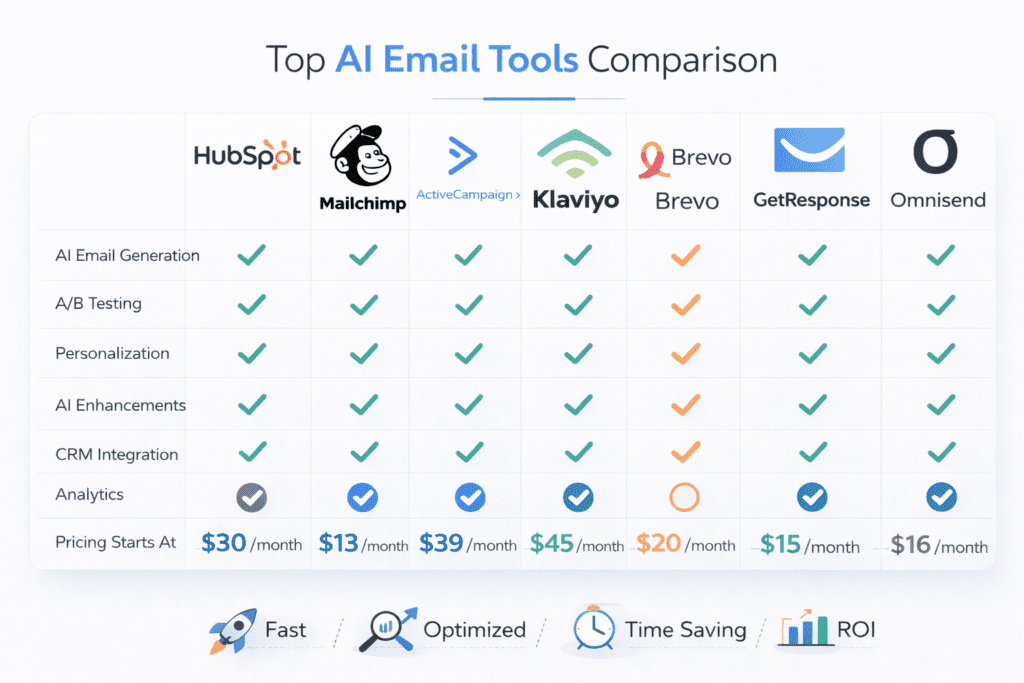
Before ranking anything, I wanted a fair comparison. So instead of relying on feature lists, I looked at how each platform performs in everyday marketing workflows.
Hands-on testing approach
I focused on building actual campaigns, not demos. That included writing email copy, creating automation flows, and reviewing built-in analytics tools. Tools that felt smooth in real usage ranked higher among the 8 best options for email marketing.
Evaluation criteria
Each platform was scored across usability, automation depth, and how well the AI handled real email marketing tasks. I also checked how easy it was to automate segmentation and campaign setup.
Automation and AI depth analysis
Not all AI is equal. Some tools rely on simple suggestions, while others run predictive logic across email addresses and behavior. I paid attention to where AI actually saves time.
Real-world marketing use
From small newsletters to product launches, I tested multiple scenarios. In most cases, platforms with stronger marketing automation performed better over time.
Why AI Tools for Email Marketing Are Growing Fast
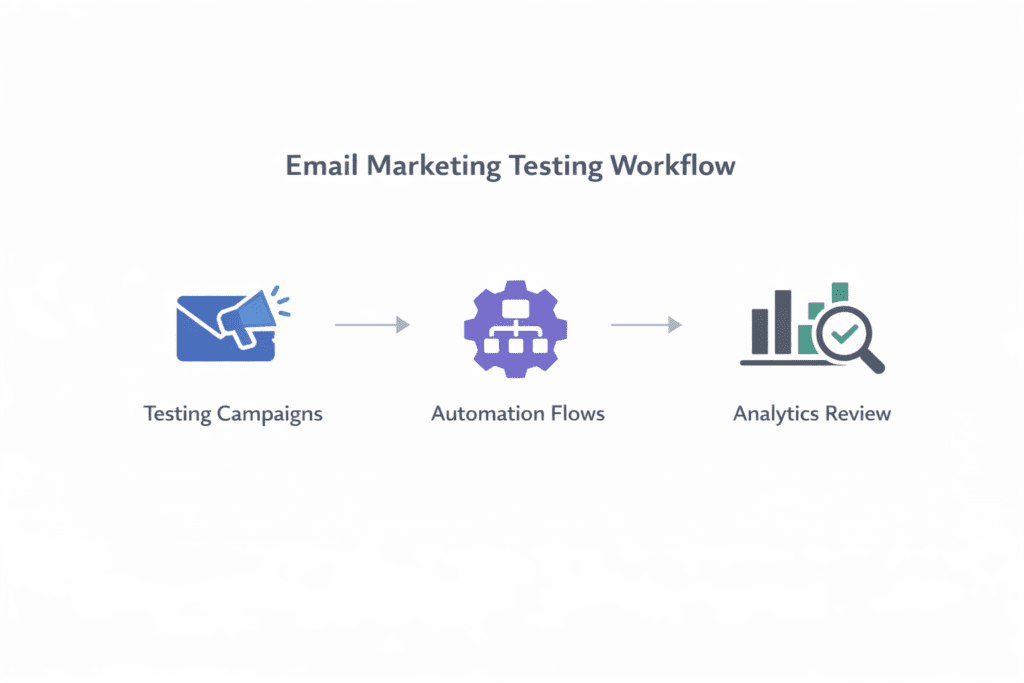
AI adoption isn’t just hype anymore. It’s slowly becoming the default layer across modern marketing software.
Growth of AI in email marketing
Over the last few years, ai in email marketing has shifted from experiments to everyday use. Even small US-based brands now expect built-in intelligence inside their email marketing platform.
Smarter automation and personalization
This is where AI really shines. Instead of blasting one message to everyone, tools now adjust content and timing automatically. That leads to more relevant email campaigns without manual tweaks.
Shift toward AI-driven marketing and sales
Another pattern I noticed is tighter integration between marketing and sales. Platforms with built-in CRM systems are using AI to align messaging across the funnel, not just one email.
Future direction of AI in email marketing
Looking ahead, the future of ai feels less flashy and more practical. Expect smarter workflows, better predictions, and tools that quietly handle repetitive tasks so marketers can focus on strategy.
That sets the foundation. Next, we’ll break down what these tools actually are and how they differ from traditional platforms.
What Are AI Tools for Email Marketing?
At a basic level, ai tools for email marketing are platforms that use machine learning to improve how campaigns are created, sent, and optimized. Instead of relying only on manual setup, these tools analyze behavior and automate decisions in the background.
Definition of AI email marketing tools
An AI-powered email marketing tool combines traditional email marketing software with predictive logic. It helps generate content, optimize timing, and personalize messaging based on user actions.
Some platforms lean more toward automation, while others focus on ai writing or analytics. That’s why capabilities vary more than most people expect.
How AI enhances email marketing workflows
AI reduces repetitive work. It can generate subject lines, suggest segments, and optimize delivery windows automatically. For small US-based teams, that alone can save hours every week.
More advanced platforms even use ai content generation to test multiple variations of one email and adjust based on performance.
Difference between traditional email marketing software and AI tools
Traditional tools mostly rely on rules. You create segments manually, schedule campaigns, and analyze results after sending.
AI changes that flow. It predicts outcomes before sending and adjusts dynamically. That shift turns a reactive process into a proactive one.
Role of AI technology in modern email campaigns
Today, ai technology sits across the entire lifecycle. From building email templates to refining targeting, AI touches nearly every stage of campaign execution.
That said, it’s not about replacing marketers. It’s more about helping them move faster and make better decisions with less guesswork.
AI Tools for Email Marketing vs Traditional Email Platforms
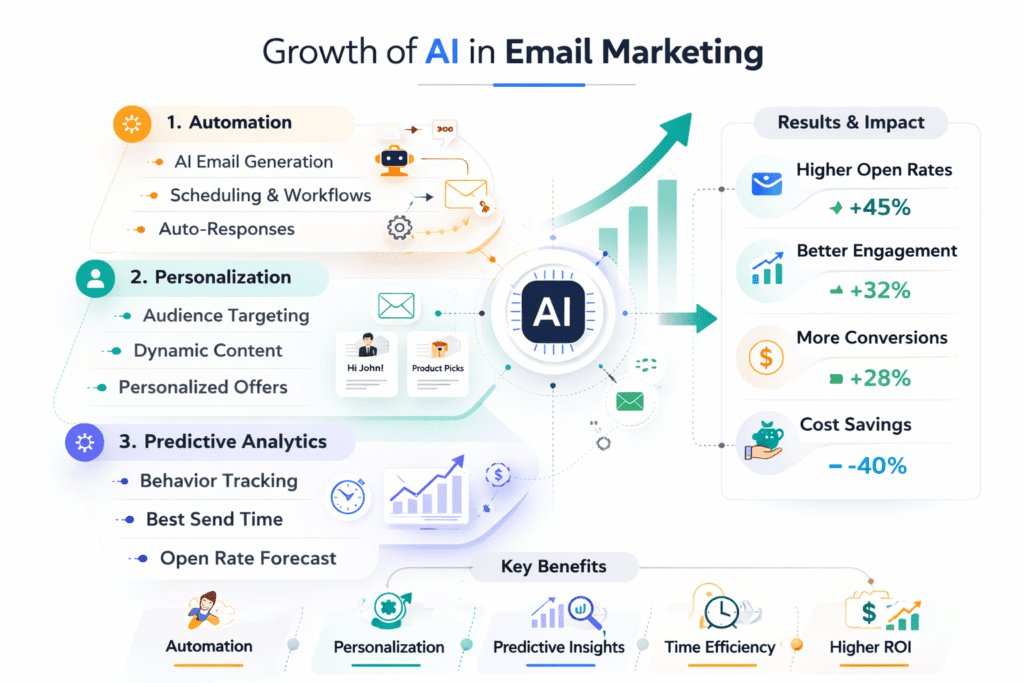
This is where things get clearer regarding the best email marketing practices. The gap between older email platforms and modern AI-driven tools keeps widening.
Automation differences
Traditional systems automate basic triggers like welcome emails. AI tools go further. They adapt flows based on engagement patterns and behavior changes over time.
In most cases, that leads to smarter automated email sequences without constant manual edits.
Personalization depth
Older tools personalize using names or simple segments. AI builds deeper profiles by analyzing browsing, clicks, and purchase patterns.
That’s why ai-powered email marketing often feels more relevant without extra effort.
Workflow efficiency
Here’s something people don’t realize right away. AI shortens the build-test-optimize cycle dramatically. Instead of tweaking one campaign at a time, you get ongoing optimization across email campaigns.
For marketers managing multiple lists, that efficiency adds up quickly in terms of email outreach effectiveness.
AI capabilities comparison
Some tools offer light ai functionality like subject line suggestions. Others include predictive scoring, segmentation models, and built-in ai assistant features.
The key difference usually comes down to how deeply AI is embedded into the marketing platform.
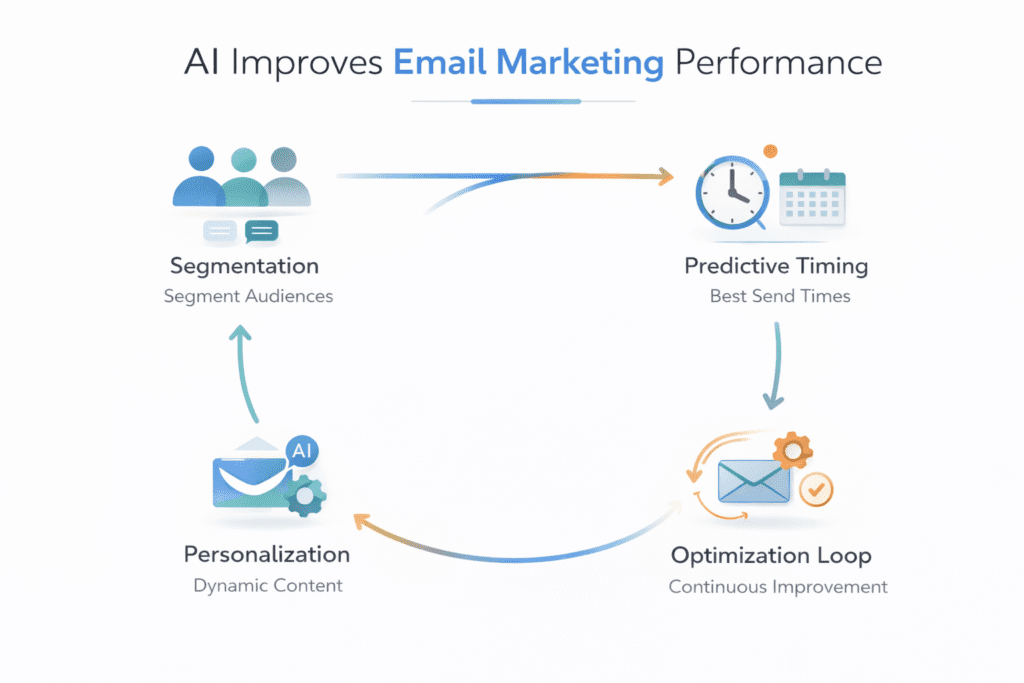
How AI Improves Email Marketing Performance
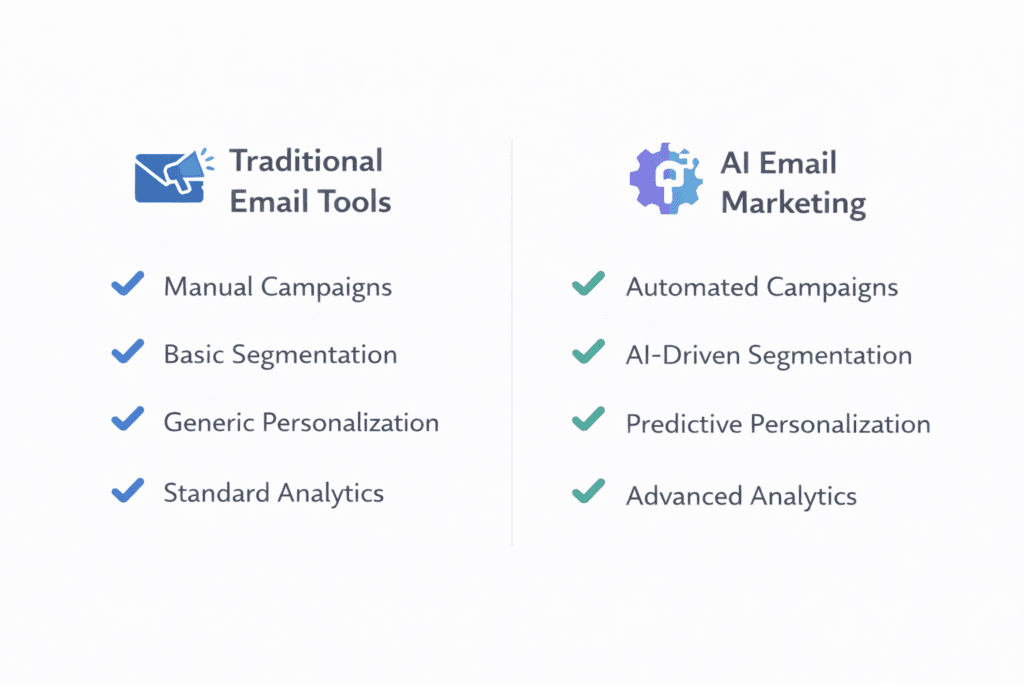
This is where the real value shows up. When used well, AI doesn’t just save time. It improves results.
Personalization at scale
AI analyzes patterns across thousands of email addresses and creates micro-segments automatically. That makes personalization possible even with large lists.
Most beginners underestimate how hard this is to do manually.
Predictive email automation
Instead of guessing when to send, AI predicts optimal timing. It studies open patterns and schedules messages when people are most likely to engage.
This usually works well, though results vary depending on audience size.
Smart segmentation using AI
Segmentation used to be static. Now, AI updates segments dynamically as behavior changes. That keeps campaigns relevant without constant rebuilding.
From my research, this is one of the biggest hidden advantages.
AI-generated email copy
Many platforms now include built-in ai writing tools. These can generate email copy, subject lines, and previews in seconds.
It’s not perfect every time, but it’s surprisingly usable with light editing.
AI help for email marketers
For solo creators and small teams, AI acts like an extra layer of support. It suggests improvements, flags weak performance, and recommends adjustments based on real data.
That kind of ai help makes advanced tactics more accessible.
Real Results: How AI Impacts Email Metrics
So what actually changes when you start using AI? Let’s look at the numbers that matter most.
Open rate improvements
AI-driven subject testing often leads to noticeable open rate lifts. Even small tweaks in tone or timing can move results over time.
Most people in the US report steady improvements rather than overnight spikes.
Click-through rate increases
Better segmentation usually leads to higher engagement. When content aligns more closely with intent, clicks naturally improve.
This is especially true for product-focused campaigns.
Conversion optimization
AI can identify patterns across previous campaigns and highlight what drives conversions. That helps refine targeting and messaging without constant guesswork.
In many cases, conversion gains come from better relevance, not more emails.
Automation efficiency gains
Beyond metrics, efficiency is a big win. Teams can automate repetitive email marketing tasks and focus more on creative strategy.
And honestly, that shift alone makes AI worth exploring for many marketers.
Who Should Use AI Tools for Email Marketing
Not every platform fits every user. The right ai tools for email marketing depend a lot on experience level and goals.
Beginners and small businesses
If you’re just starting out, simplicity matters. Beginner-friendly tools usually include guided workflows and basic automation.
Many US solopreneurs start here because they want to automate without building a complex marketing stack.
Ecommerce brands
Ecommerce teams often get the biggest upside from using the best email marketing tools available. AI helps optimize ecommerce email timing, product recommendations, and lifecycle flows.
That’s especially useful if you’re managing large email accounts with frequent campaigns in your digital marketing efforts.
Agencies and marketers
Agencies benefit from scalability. AI makes it easier to manage multiple clients, automate reporting, and maintain consistent performance across lists.
For a growing marketing agency, that efficiency can compound fast.
SaaS companies and creators
SaaS brands rely heavily on lifecycle messaging. AI can refine onboarding sequences and retention flows automatically.
Creators and newsletter publishers also benefit from smarter segmentation and adaptive email content.
Key AI Features to Look for in Email Marketing Tools
Not all AI is equally useful. Some features sound impressive but add little real value. Here’s what actually matters.
AI email automation
Strong ai automation handles triggers, timing, and flow optimization without constant manual edits.
If a tool can’t automate intelligently, it may feel dated quickly.
Predictive segmentation
This is where powerful ai starts to show. Predictive models group subscribers based on likely behavior, not just past actions.
That leads to more effective email campaigns over time.
AI-generated email copy
Built-in ai writing assistant tools can speed up drafting. While you’ll still want to edit, they help overcome blank-page syndrome.
This is especially helpful for teams producing frequent marketing content.
CRM and marketing automation integration
Deep CRM integration makes a big difference in the effectiveness of digital marketing strategies. Tools that connect marketing and sales data tend to deliver better insights.
If your funnel spans multiple touchpoints, this becomes essential.
AI prompts and agents
Some platforms now include ai agents that suggest workflows or campaign ideas. It’s still evolving, but the direction looks promising.
In most cases, these features feel like early versions of smarter assistants.
Comparison Table: Best AI Tools for Email Marketing
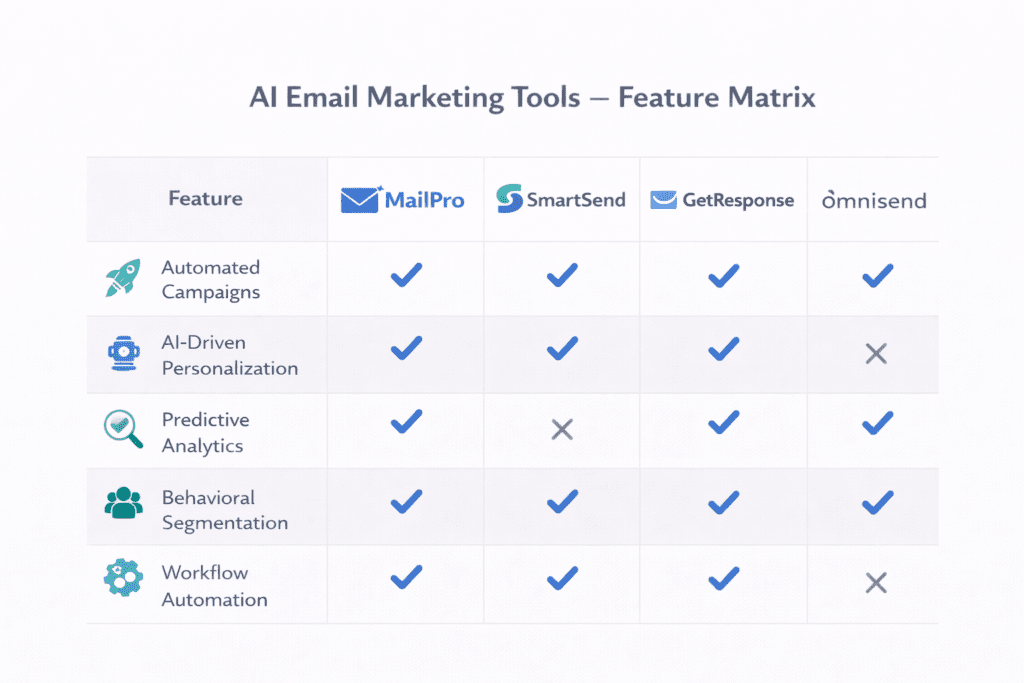
Here’s a quick comparison of how the leading tools stack up across core decision factors.
| Tool | AI Features | Automation Depth | Free Plan | Best For |
|---|---|---|---|---|
| HubSpot | Advanced AI workflows, CRM insights | Very High | Yes | All-in-one marketing teams |
| Mailchimp | Beginner AI suggestions | Medium | Yes | Beginners and small brands |
| ActiveCampaign | Predictive automation | Very High | No | Advanced email marketers |
| Klaviyo | Ecommerce-focused AI | High | Yes | Ecommerce brands |
| Brevo | Lightweight AI tools | Medium | Yes | Budget users |
| GetResponse | Funnel-driven AI workflows | High | Yes | Funnel builders |
| Omnisend | Omnichannel ecommerce AI | High | Yes | DTC ecommerce brands |
If you’re unsure where to start, tools like HubSpot and Mailchimp tend to be the safest entry points. That said, niche-focused platforms often perform better within specific use cases.
Next, let’s dive deeper into the individual tools and see how they perform in real scenarios.
HubSpot: Best All-in-One AI Email Marketing Platform
HubSpot is often the first name that comes up when discussing ai tools for email marketing that go beyond simple campaigns. It’s more than an email tool. It’s a full ecosystem combining CRM, automation, and analytics in one place.
From my testing, HubSpot works best for teams that want a unified system instead of stacking multiple tools.
Overview
HubSpot blends email marketing services with deep CRM data. That connection allows smarter personalization since marketing and sales activity live in one dashboard.
Few platforms offer this level of integration across the entire funnel.
AI capabilities and automation depth
HubSpot uses AI across workflows, segmentation, and content suggestions. It can generate subject lines, optimize send times, and create ai generated drafts inside the editor.
The predictive insights are especially useful for prioritizing high-intent contacts.
Marketing automation and sales integration
The built-in CRM links email engagement directly with pipeline stages. That gives better visibility into what actually drives conversions.
For marketing teams focused on revenue, this alignment matters.
Key Features
• AI-driven automation workflows
• Smart CRM integration
• Advanced email builder
• AI prompts for optimization
Pricing
HubSpot offers a free plan with basic email tools.
Paid plans start at $20/month for Starter tiers.
Professional plans begin around $890/month depending on contacts and features.
Larger teams should expect higher costs as usage grows.
Pros
• All-in-one marketing ecosystem
• Deep CRM integration
• Strong automation depth
Cons
• Pricing increases quickly
• Can feel complex at first
Best For
• Growing marketing teams
• Businesses wanting an all-in-one platform
If you want a single platform that connects your entire marketing stack, HubSpot is hard to beat.
Mailchimp: Best Beginner-Friendly AI Email Marketing Tool
Mailchimp has evolved from a basic newsletter tool into a more modern AI-powered email marketing platform. While not the most advanced, it remains one of the easiest ways to start using AI.
Many US small businesses still prefer it for simplicity.
Overview
Mailchimp focuses on accessibility. The interface is clean, and the onboarding is beginner-friendly. Its AI tools are lightweight but practical for everyday campaigns.
It doesn’t try to be overly complex, which actually helps beginners.
AI features for beginners
Mailchimp includes ai writing suggestions, subject line optimization, and basic segmentation support.
These features aren’t cutting-edge, but they reduce manual work significantly.
Ease of use and ecosystem
The drag-and-drop email editor and prebuilt email templates make campaign setup quick. Most users can launch a campaign within minutes.
That usability is still one of Mailchimp’s biggest strengths.
Key Features
• Simple automation
• AI-assisted email copy suggestions
• Free email tier
• Ecommerce integrations
Pricing
Mailchimp offers a free plan for up to 500 contacts.
Paid plans start at $13/month for Essentials.
Standard plans begin around $20/month, scaling based on list size.
Pricing rises as your subscriber count grows.
Pros
• Very beginner-friendly
• Strong template library
• Easy learning curve
Cons
• Limited advanced AI features
• Costs increase with large lists
Best For
• Beginners and creators
• Small marketing teams
If you want something easy and reliable, Mailchimp remains a safe entry point.
ActiveCampaign: Best for Advanced Email Automation
ActiveCampaign takes a more advanced approach. Instead of prioritizing simplicity, it focuses on automation depth and behavioral workflows.
For users who value precision, it’s one of the most powerful ai tools for email marketing available.
Overview
ActiveCampaign is built around automation-first thinking. It allows highly customizable workflows that adapt based on user behavior.
This makes it popular among SaaS companies and funnel-driven businesses.
Deep AI-driven automation
ActiveCampaign includes predictive sending, dynamic segmentation, and intelligent triggers. These tools allow campaigns to evolve automatically over time.
It’s not the easiest platform to learn, but the flexibility is impressive.
CRM and marketing automation
The built-in CRM connects engagement data with lifecycle messaging. That enables deeper personalization across multiple touchpoints.
If your funnel is complex, this level of control becomes valuable.
Key Features
• Advanced automation workflows
• Predictive sending optimization
• Integrated CRM
• Detailed campaign analytics
Pricing
ActiveCampaign does not offer a permanent free plan.
Paid plans start at $29/month for Starter tiers.
Plus plans begin around $49/month, with higher tiers increasing based on features and contacts.
Costs scale as automation needs grow.
Pros
• Extremely powerful automation
• Advanced segmentation
• Strong analytics tools
Cons
• Learning curve
• No free long-term plan
Best For
• Advanced email marketers
• Sales-driven funnels
If you’re willing to invest time learning it, ActiveCampaign delivers some of the most advanced automation available today.
Klaviyo: Best AI Tool for Ecommerce Email Marketing
Klaviyo is built specifically for ecommerce brands, which makes it one of the strongest ai tools for email marketing in the retail space. Instead of trying to serve everyone, it focuses heavily on behavior-driven messaging and customer data.
From what I’ve seen, ecommerce stores tend to get faster results with Klaviyo compared to general-purpose tools.
Overview
Klaviyo connects deeply with ecommerce platforms like Shopify and WooCommerce. That tight integration allows campaigns to react to browsing behavior, purchases, and cart activity automatically.
It’s very data-first, which is why many DTC brands prefer it.
AI-powered ecommerce insights
Klaviyo uses AI to predict purchase behavior and recommend products dynamically. These insights help tailor ecommerce email flows without manual segmentation.
For stores with large product catalogs, that automation can be a big time saver.
Lifecycle automation focus
The platform shines in lifecycle messaging. From welcome flows to win-back campaigns, automation feels built for online stores rather than generic newsletters.
That specialization is where Klaviyo stands apart.
Key Features
• Ecommerce-focused automation
• AI-driven product recommendations
• Customer lifecycle flows
• Advanced segmentation
Pricing
Klaviyo offers a free plan for up to 250 contacts.
Paid plans start at around $20/month for small lists.
Pricing scales based on subscriber count and features, often reaching $150+/month for growing stores.
Costs rise with list size, but ecommerce ROI often offsets it.
Pros
• Built specifically for ecommerce
• Strong personalization
• Deep Shopify integrations
Cons
• Less useful outside ecommerce
• Pricing scales quickly
Best For
• Ecommerce brands
• Shopify and DTC stores
If you run an online store, Klaviyo is usually one of the most natural fits.
Brevo (Sendinblue): Best Budget AI Email Marketing Software
Brevo, formerly Sendinblue, focuses on affordability. It’s a solid option for users who want ai tools for email marketing without committing to high monthly costs.
While it doesn’t have the deepest AI, it offers strong value for budget-conscious teams.
Overview
Brevo combines email, SMS, and basic automation into one lightweight platform. It’s not overly complex, which makes it appealing for startups and small teams.
The simplicity actually works in its favor.
AI features and simplicity
Brevo includes light AI features like send-time optimization and content suggestions. It’s not packed with advanced models, but it handles core automation reliably.
If you want straightforward functionality without heavy setup, Brevo fits well.
Multi-channel advantage
One thing Brevo does differently is combining email and SMS in one dashboard. That helps manage outreach across multiple channels without juggling tools.
For small businesses, that flexibility matters.
Key Features
• Email and SMS automation
• Lightweight AI tools
• Simple campaign builder
• Multi-channel messaging
Pricing
Brevo offers a free plan with 300 emails per day.
Paid plans start at $9/month for Starter tiers.
Business plans begin around $18/month, scaling with features and sending limits.
It’s one of the most affordable options in this space.
Pros
• Budget-friendly pricing
• Multi-channel support
• Easy to learn
Cons
• Limited advanced AI features
• Basic automation depth
Best For
• Startups and solopreneurs
• Budget-conscious users
If cost is your main concern, Brevo delivers strong value.
GetResponse: Best AI Tool for Funnels and Automation
GetResponse stands out because it blends email marketing with funnel-building tools, making it a top contender among the 8 best email marketing platforms. It’s designed for creators and marketers who want more than just newsletters.
Among ai tools for email marketing, it’s one of the few that leans heavily into funnels.
Overview
GetResponse combines email automation, landing pages, and webinars into one system. This makes it especially useful for digital product sellers and course creators.
It’s less about simple broadcasts and more about structured funnels.
AI-driven funnel workflows
The platform includes AI-assisted email builders and automation templates. These help create structured campaigns faster without building flows from scratch.
For funnel builders, that saves a lot of setup time.
Webinar and automation combo
GetResponse also includes built-in webinar hosting. That’s a unique advantage if you run educational or sales-driven funnels.
Few competitors bundle this natively.
Key Features
• Funnel-based automation
• AI email builder
• Webinar hosting
• Campaign automation templates
Pricing
GetResponse offers a free plan for up to 500 contacts.
Paid plans start at $19/month for Email Marketing tiers.
Automation-focused plans begin around $59/month, with higher tiers scaling based on features.
Pricing depends heavily on funnel features.
Pros
• Strong funnel builder
• Built-in webinars
• Solid automation tools
Cons
• Interface can feel busy
• Some features locked in higher tiers
Best For
• Funnel builders
• Course creators and coaches
If you sell digital products, GetResponse is worth a close look.
Omnisend: Best AI Email Marketing Tool for Ecommerce Automation
Omnisend is another ecommerce-focused platform, but with a stronger emphasis on omnichannel messaging. It blends email, SMS, and push notifications into one automation system.
For ecommerce brands wanting multi-channel flows, it’s one of the more practical options.
Overview
Omnisend is designed for ecommerce-first use cases. It integrates tightly with Shopify and other store platforms, making automation easier to deploy.
Many DTC brands choose it for simplicity and speed.
Omnichannel AI workflows
Omnisend uses AI to optimize messaging across channels. Instead of managing email separately, you can build workflows that span SMS and push notifications.
That creates more cohesive customer journeys.
Campaign optimization focus
The platform also includes campaign suggestions and performance insights. While not the most advanced AI, it handles ecommerce automation reliably, making it a strong choice for the best email marketing tool.
It’s especially strong for lifecycle messaging.
Key Features
• Email and SMS automation
• Ecommerce-focused workflows
• Omnichannel messaging
• Campaign optimization tools
Pricing
Omnisend offers a free plan for up to 250 contacts with limited sends.
Paid plans start at $16/month for Standard tiers.
Pro plans begin around $59/month, depending on subscriber count.
Pricing scales based on contacts and channels used.
Pros
• Strong ecommerce automation
• Easy setup
• Multi-channel messaging
Cons
• Limited B2B use cases
• Less advanced outside ecommerce
Best For
• Ecommerce brands
• DTC stores
If you want ecommerce automation without complexity, Omnisend is a solid contender.
AI Email Writing Quality Comparison
Not all ai tools for email marketing generate the same quality output. Some produce surprisingly usable drafts, while others still need heavy editing, especially when it comes to the best email marketing strategies.
From my testing, tools with deeper ai writing capabilities tend to create more natural email copy.
Copy quality differences
Platforms like HubSpot and GetResponse generate cleaner first drafts. Their tone feels closer to human writing, especially for promotional email campaigns.
Lighter tools usually create usable but generic drafts.
Tone personalization depth
More advanced tools adjust tone based on audience data. That helps maintain a consistent brand voice across email marketing campaigns.
In simpler tools, tone often feels templated.
Editing required per tool
Here’s what I noticed. Most AI drafts still need light editing, but the amount varies widely. Some require quick polishing. Others need restructuring.
This usually depends on how mature the ai writing assistant is.
AI output consistency
Consistency is another factor. Tools with stronger models produce stable output across multiple campaigns, which matters if you send emails frequently.
That reliability can save time long term.
AI Email Marketing Use Cases by Industry
Different industries use AI differently. The right platform often depends on your business model.
Ecommerce automation
Retail brands rely heavily on lifecycle automation. AI helps personalize ecommerce email flows like cart recovery and product recommendations.
This is where data-driven segmentation shines.
SaaS lifecycle emails
SaaS companies use AI to automate onboarding, retention, and reactivation campaigns. Behavioral triggers make lifecycle messaging more adaptive.
For subscription businesses, this is a big advantage.
Agencies and client campaigns
Agencies benefit from scale. AI makes it easier to manage multiple email accounts and maintain consistent performance across clients.
Automation reduces manual reporting work significantly.
Creator newsletters
Creators use AI for drafting and segmentation. It helps maintain consistent publishing without spending hours writing each newsletter.
This is especially helpful for solo operators.
How to Choose the Right AI Tool for Email Marketing
Choosing between tools can feel overwhelming. But it gets easier if you focus on a few practical factors.
Define your goals first
Start with outcomes. Do you want better automation, smarter segmentation, or easier campaign creation?
Your main goal should guide the decision.
Automation vs simplicity
Some platforms prioritize simplicity. Others offer deep automation layers. The best choice depends on how complex your email marketing strategy is.
Beginners usually prefer simpler interfaces.
CRM and ecosystem needs
If your funnel spans multiple stages, CRM integration becomes critical. Tools with built-in CRM often deliver better long-term insights.
This is where all-in-one platforms stand out as some of the best email marketing tools available.
AI capabilities vs budget
Advanced AI often comes at a higher cost. That said, not everyone needs enterprise-level automation.
For many small US businesses, mid-tier tools offer a good balance.
Free plan vs scalability
Free plans are useful for testing. But long term, scalability matters more than starting cost.
It’s worth thinking beyond the trial phase.
Free vs Paid AI Email Marketing Tools
Here’s a simple comparison of what you typically get at different pricing levels.
| Feature Area | Free Plans | Paid Tools |
|---|---|---|
| Automation depth | Basic triggers | Advanced workflows |
| AI capabilities | Limited suggestions | Predictive optimization |
| Sending limits | Restricted | Higher or unlimited |
| Analytics tools | Basic reports | Advanced insights |
| Support level | Community help | Priority support |
Free tools are great for learning. But paid tiers usually unlock deeper automation and stronger analytics tools.
Limitations of AI in Email Marketing
AI isn’t perfect. While it improves efficiency, it still has boundaries.
Creativity limits
AI can generate structured drafts, but originality can vary. Truly unique storytelling still benefits from human input.
This is especially true for brand-driven campaigns.
Brand voice challenges
Maintaining a distinct voice can be tricky. AI sometimes defaults to neutral tone unless guided carefully.
That’s why editing remains important.
Over-automation risks
Too much automation can feel impersonal. Audiences may notice if every message sounds overly optimized.
Balance still matters, particularly in crafting effective email outreach campaigns.
Need for human oversight
AI works best as a support layer, not a replacement. Human strategy and judgment are still essential.
Most experienced email marketers treat AI as an assistant.
Common Mistakes When Choosing AI Email Marketing Tools
Many people rush this decision and regret it later. A few common pitfalls keep showing up.
• Choosing tools without real automation depth
• Ignoring CRM integrations
• Overlooking actual AI capabilities
• Picking tools without scalability
• Focusing only on free plans
Avoiding these mistakes can save a lot of frustration.
AI Email Compliance and Deliverability Considerations
As AI becomes more common, compliance and deliverability matter even more.
Spam filters and AI content
Some AI-generated content can trigger filters if overused. That’s why moderation and testing are important.
Balanced messaging usually performs better.
Deliverability best practices
Warm up new domains, clean email addresses regularly, and monitor engagement. These basics still apply even with AI.
Technology doesn’t replace fundamentals.
Compliance and privacy
Regulations like CAN-SPAM and GDPR still apply. AI tools don’t remove compliance responsibilities, especially in the context of digital marketing.
Always verify opt-ins and data usage policies.
Ethical AI usage
Using AI responsibly builds trust. Transparency and respectful targeting go a long way in maintaining credibility.
Long-term trust always beats short-term gains.
How to Use AI in Email Marketing Effectively
If you’re new to AI, start simple. You don’t need complex workflows on day one.
Use AI for drafting
AI is great for generating first drafts. It removes the blank page problem and speeds up ideation.
You can refine the message afterward.
Automate segmentation
Let AI group subscribers based on behavior. This keeps campaigns relevant without constant manual sorting.
It’s one of the easiest wins.
Optimize send times
Predictive timing helps improve engagement naturally. AI studies patterns and schedules emails more strategically.
This usually delivers steady improvements.
Use AI prompts for campaigns
AI prompts can spark campaign ideas or subject lines. Even experienced marketers use this trick.
It’s surprisingly useful.
Test and iterate
AI works best with testing. Run variations and analyze results over time.
Small optimizations compound quickly.
The Future of AI in Email Marketing
The future of ai looks less flashy and more embedded into everyday workflows.
Rise of AI agents
AI agents will likely handle more repetitive tasks. Expect smarter workflow automation and campaign suggestions.
We’re already seeing early versions of this.
Smarter marketing automation platforms
Platforms will continue blending data, automation, and content generation. The gap between tools may widen based on ecosystem strength.
All-in-one solutions may dominate.
Hyper-personalized campaigns
AI will push personalization further. Messaging could adapt dynamically based on behavior and preferences.
That level of relevance is becoming more realistic.
AI that understands intent
Future systems may better interpret context and intent, not just behavior. That could improve targeting significantly.
Though it’s still evolving.
FAQs About AI Tools for Email Marketing
What are the best ai tools for email marketing in 2026?
Top platforms include HubSpot, ActiveCampaign, and Klaviyo. Each serves different needs depending on automation depth and use case.
Are there free AI email marketing tools available?
Yes, several tools offer a free plan. However, most advanced features unlock in paid tiers.
How does AI improve email marketing results?
AI improves targeting, timing, and segmentation. These factors often lead to better engagement and efficiency.
Which tools are best for ecommerce email?
Klaviyo and Omnisend are strong options for ecommerce brands. They offer specialized automation for retail workflows.
Can beginners use AI email tools?
Absolutely. Tools like Mailchimp and Brevo are beginner-friendly and easy to learn, making them ideal for those new to email outreach.
Do AI tools replace marketers?
Not really. AI supports execution, but strategy and creativity still rely on humans.
What is the best tool with strong automation?
ActiveCampaign stands out for advanced automation. It’s ideal for users who want deeper control.
Is AI email marketing worth it for small businesses?
In most cases, yes. Even basic automation can save time and improve consistency.
What are ai tools for email marketing and how do they help ai marketing?
AI tools for email marketing use generative AI to write subject lines, personalize content, and suggest send times to boost open rates.
Can ai tools improve my email list quality and cold email results?
Yes, they can clean and segment your email list and craft better cold email templates to raise reply rates.
How does email marketing with ai work for professional email campaigns?
AI analyzes past email data and creates professional email copy, subject lines, and A/B tests to improve performance.
Are there ai tools specifically designed for email marketing that also handle ai sales tasks?
Some platforms pair email marketing features with ai sales functions to score leads and suggest follow-up sequences.
Can I connect your email marketing tools to platforms like Notion AI or all-in-one marketing suites?
Many tools offer integrations so you can connect your email marketing with Notion AI and other all-in-one marketing systems.
Do ai image generator features help enhance your email marketing visuals?
Yes, an ai image generator can make custom images for emails and support your ai brand kit for consistent design.
What email marketing features should marketing teams look for in the best email marketing tool?
Teams should seek automation, segmentation, analytics, and generative ai content features for smarter campaigns.
Are there free email or best email options that include ai that actually writes emails?
Some free email plans offer basic ai that actually helps draft emails, but paid plans usually have fuller features.
How do I manage multiple email accounts and connect your email marketing workflows?
Use platforms that support multiple email accounts, syncing, and automation to connect your email marketing across channels.
Are AI Tools for Email Marketing Worth It?
This is the question most people eventually ask. Are these tools actually worth the investment?
ROI considerations
AI can improve efficiency and results, but ROI depends on usage. Teams that actively use automation usually see better returns.
Passive users may see smaller gains.
Time vs cost tradeoff
If AI saves hours each week, the cost often feels justified. For busy marketers, time savings alone can make a difference.
This is especially true for solo operators.
When AI makes sense
AI tools make the most sense when you run frequent campaigns or manage large lists. The more volume you handle, the more value AI adds.
That’s where automation compounds.
When simpler tools are enough
If you send occasional newsletters, advanced AI may not be necessary. Basic tools can still perform well for low-frequency sending.
It depends on your workflow.

Final Verdict: Best AI Tools for Email Marketing
After testing multiple platforms, a few clear patterns stand out.
Best overall
HubSpot offers the most complete ecosystem. It combines CRM, automation, and analytics into one platform.
Best for beginners
Mailchimp remains the easiest entry point. It balances simplicity with practical AI features.
Best for ecommerce
Klaviyo leads in ecommerce personalization. Its data-driven approach fits online stores well.
Best for advanced automation
ActiveCampaign stands out for automation depth. It’s ideal for complex funnels and lifecycle messaging.
Choosing the right tool
Bottom line? The best choice depends on your goals. Start with your use case, then match it with the platform’s strengths.
If you’re in the US and just starting out, begin with a beginner-friendly tool and scale into more advanced automation over time.