

Ever read something generated by AI and thought it felt technically correct but strangely lifeless? That’s the gap most creators run into when learning how to humanize AI content. The structure is there, the grammar is fine, but the writing doesn’t quite connect.
This problem is everywhere now. AI content is faster than ever, yet much of it still sounds robotic. If you’re figuring out how to write SEO content with AI, humanization is the missing layer that makes everything click.
The goal isn’t to fight AI. It’s to refine it. Once you understand how to humanize AI output properly, your content starts sounding more natural, more relatable, and far more engaging.
My Workflow for Humanizing AI Content
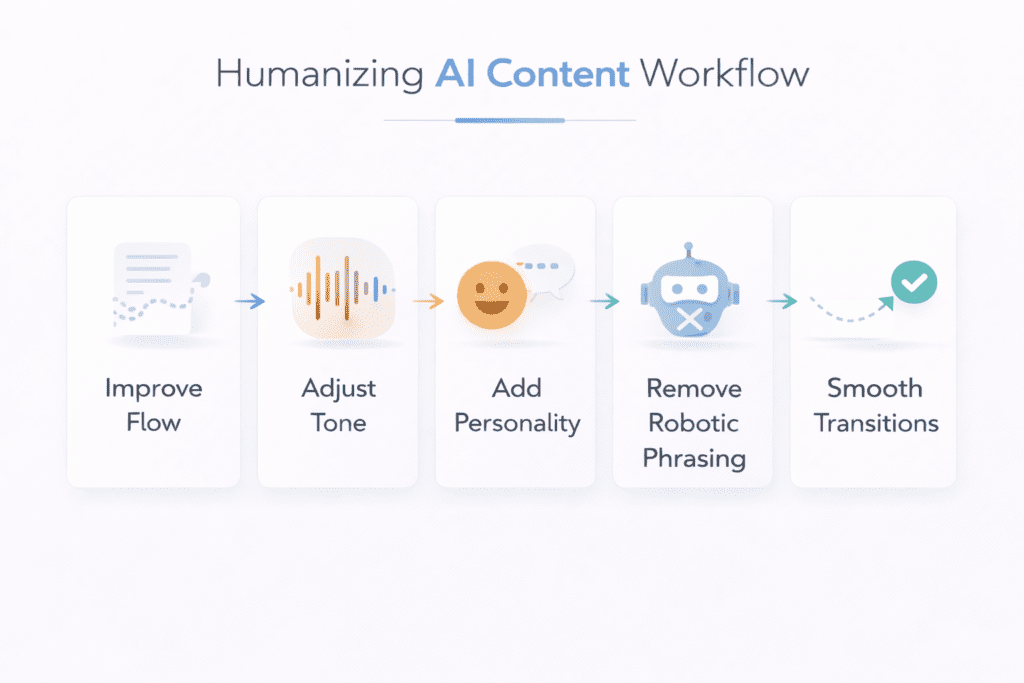
Here’s what I’ve noticed after working with AI drafts consistently. The first version almost never feels publish ready. Even when using strong prompts, the text from ChatGPT or similar AI tools often needs shaping.
My workflow is simple but intentional. I treat AI as a drafting assistant, not a final writer. That mindset alone changes how the editing process feels.
Typically, I start by reviewing flow. AI-generated text tends to sound overly structured, so I focus on rhythm first. Then I refine tone, remove stiffness, and add subtle personality where needed.
Over time, a few patterns became clear:
• AI drafts improve with layered editing
• Human phrasing changes how content sounds instantly
• Small tone shifts make AI text feel natural
• Context matters more than fancy prompts
From my experience, humanization isn’t about rewriting everything. It’s about shaping the writing so it feels authentic without losing clarity.
What Does It Mean to Humanize AI Content?
To humanize AI content simply means making AI-generated text sound more like something a real person would write. Not dramatic. Not theatrical. Just natural.
AI writing is usually readable, but not always relatable. It explains things clearly, yet it often lacks nuance. That’s the difference between human text and machine patterns.
When you humanize AI text, you’re adjusting tone, rhythm, and voice. You’re making the content sound like someone thinking through ideas, not just assembling sentences.
Another way to look at it is this. Humanized content feels less predictable. The phrasing varies. Transitions feel smoother. The writing style becomes more conversational without losing clarity.
Why Humanizing AI Content Matters in 2026
Humanization matters more now than it did even a year ago. AI-generated content is everywhere, and readers are getting better at recognizing robotic patterns.
You can see it in how people respond. Content that feels stiff gets skimmed. Content that feels natural holds attention longer. That difference affects engagement more than many realize.
Search engines are also evolving. As detection systems improve, the quality of writing and user experience matter more than ever. Human-like writing helps content feel trustworthy, which indirectly supports SEO performance.
Another factor is saturation, which can make it challenging to bypass AI detectors effectively. When thousands of creators use AI writing tools, originality becomes the real differentiator. That’s where humanization creates an edge.
Bottom line, learning how to humanize AI isn’t just about style anymore. It’s becoming a practical advantage in modern content creation.
AI Content vs Human Text: Key Differences
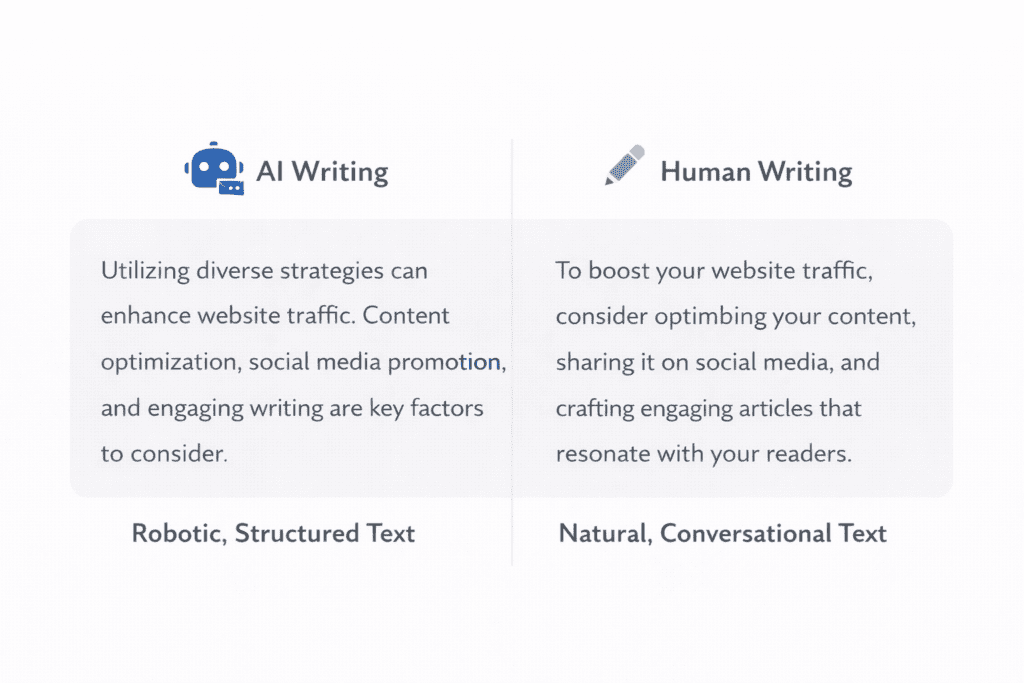
At a glance, AI text and human writing can look similar. Both can be clear and grammatically correct. But once you read closely, the differences become obvious.
Human text tends to feel more fluid. It shifts rhythm naturally and carries subtle emotional cues. AI-generated text, on the other hand, often follows predictable structure patterns.
Tone is another giveaway. Human writing usually includes small imperfections, mild opinions, or casual phrasing. AI writing leans toward polished neutrality, which can feel distant.
Intent clarity also plays a role. Humans write with lived context, even when explaining simple ideas. AI text explains logically but sometimes lacks that subtle connection.
These differences matter when you want content that resonates. If the goal is writing that sounds natural, recognizing these contrasts helps you know where to humanize.
Why AI Content Sounds Robotic
To understand how to humanize AI, it helps to know why AI text sounds robotic in the first place. The root cause isn’t laziness or bad prompts. It’s how AI models work.
AI writing is probability driven. It predicts the most likely next word based on patterns in data. That makes output clear, but also predictable. Over time, those patterns create repetition.
Another factor is generalization. AI models are trained on massive datasets, so they often default to safe, widely applicable phrasing. That’s why AI-generated writing can feel generic.
Clarity optimization adds to the issue, particularly when trying to ensure the writing sounds natural. Many AI tools are designed to avoid ambiguity, which leads to overly structured sentences. While readable, this structure can feel mechanical.
There’s also one thing AI lacks. Lived experience. That absence is why AI text often explains ideas well but struggles with nuance or subtle personality.
Common Signs AI Content Needs Humanization
Once you know what to look for, spotting robotic writing becomes easier. Certain patterns show up again and again in AI-generated content.
Repetitive phrasing is one of the clearest signals. AI often reuses similar sentence structures, especially in longer articles.
Another sign is overly structured flow. If every paragraph feels perfectly balanced, it may lack natural variation, making it harder for an AI detector to identify it as human-written.
Here are some common indicators:
• Repeated sentence patterns
• Generic or neutral tone
• Mechanical transitions between ideas
• Lack of personality in phrasing
• Predictable paragraph rhythm
When these signals appear together, it’s usually time to humanize AI text before publishing.
Signs Your AI Content Already Feels Human
Not all AI drafts need heavy editing. Sometimes the foundation is already strong, especially when prompts are well crafted.
A good sign is natural rhythm. If the text flows smoothly without sounding stiff, you’re already close to human-like writing.
Unique phrasing is another positive indicator. When AI-generated text includes unexpected yet clear wording, it often feels more authentic.
You may also notice voice consistency. If the tone stays steady without feeling overly polished, that’s a strong base for humanization, which can be enhanced by using a humanize AI tool.
Look for these signals:
• Natural flow and readability
• Slight variation in sentence length
• Conversational transitions
• Clear but relaxed tone
When AI drafts show these traits, the humanization process becomes much faster. Often, you’re just refining rather than rewriting.
Step by Step: How to Humanize AI Content
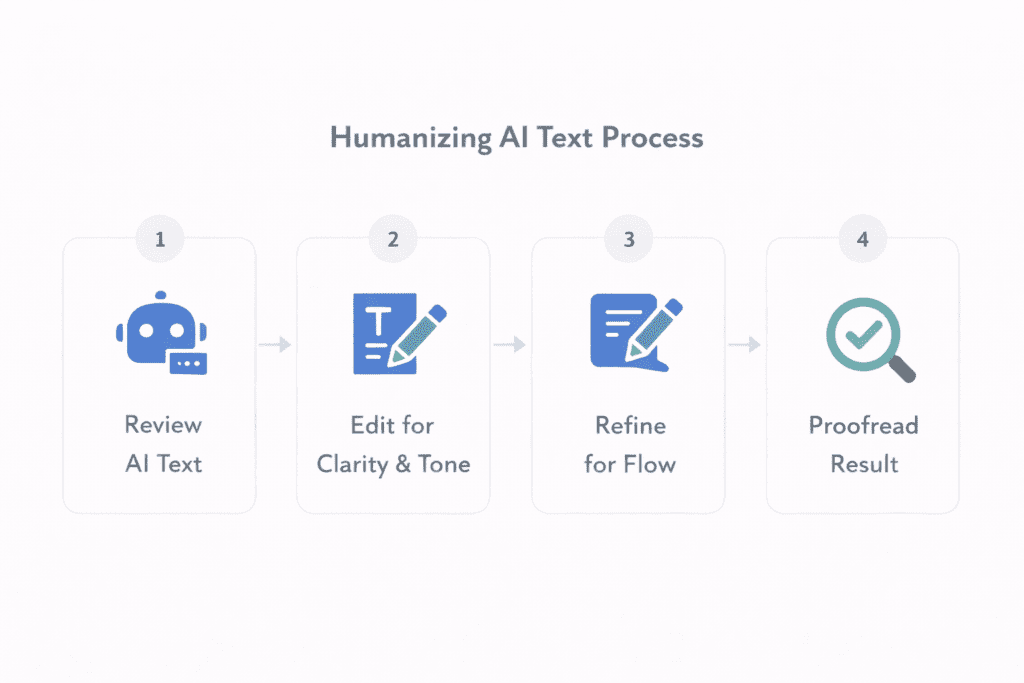
If you want a repeatable method, the best approach is breaking humanization into small steps. Instead of rewriting everything, you refine the AI text layer by layer.
Step 1: Start With Better AI Writing Inputs
Humanization actually begins before editing. Strong prompts reduce robotic patterns from the start. When you guide AI writing tools with tone and context, the output improves immediately.
For example, instead of asking for a generic draft, include voice direction. Mention conversational tone or audience type. This helps tools like ChatGPT produce more usable AI drafts.
Clear inputs don’t eliminate editing, but they reduce friction later. Better raw material always makes it easier to humanize.
Step 2: Break Predictable AI Sentence Patterns
AI text often follows repetitive rhythm. You’ll notice long sentences stacked together or overly uniform structures. This is where manual editing makes a big difference.
Start by shortening overly long lines. Then combine fragments where needed. The goal is to vary rhythm so the writing style feels less mechanical.
Even small adjustments can transform AI-generated text into something more natural. You’re not changing meaning. You’re reshaping flow.
Step 3: Add Real Human Language
This step is where AI text starts sounding more alive. Human language includes contractions, casual transitions, and subtle emphasis.
Replace stiff phrasing with conversational alternatives. Instead of formal connectors, use natural bridges between ideas. These small tweaks help content sound more relatable.
This is also where tone shifts. Once the wording feels conversational, the writing begins to sound human rather than synthetic.
Step 4: Inject Personality and Micro Opinions
Pure AI writing tends to avoid opinions. It stays neutral by design. Humans don’t. Even informative content usually carries subtle perspective.
Add light opinions where appropriate. Not strong takes. Just small signals that a real person is thinking through the topic.
A short phrase like “This usually works, but not always” can change the entire feel of a paragraph. These micro touches are powerful when learning how to humanize AI content.
Step 5: Remove AI Writing Artifacts
AI-generated writing often includes filler patterns. Repetitive summaries, overly safe transitions, or redundant clarity phrases show up frequently.
During this stage, trim anything that feels unnecessary. If a sentence repeats an idea, tighten it. If a paragraph overexplains something obvious, simplify it.
This cleanup step is critical. Removing AI artifacts instantly makes writing feel more natural without adding extra words.
Step 6: Add Real Context and Experience
This is where human text truly separates itself. AI can explain ideas, but it rarely provides grounded nuance. Adding context changes that.
You don’t need dramatic stories. Even simple examples or practical observations help transform AI-generated text into natural writing.
A short real world reference can make content feel more authentic. It signals thoughtfulness rather than automation.
Step 7: Final Flow Editing
The last step is smoothing everything out. Read the text slowly and listen to how it sounds. This helps catch awkward transitions or unnatural phrasing.
Many writers use a simple trick here. Reading content aloud reveals rhythm issues instantly. If something feels clunky when spoken, it usually needs refinement.
By the end of this step, the writing should feel cohesive. Not perfect. Just natural and easy to read.
Real Example: Before vs After Humanizing AI Content
Let’s keep it simple with a quick transformation example.
Imagine an AI-generated paragraph explaining productivity tools. The structure might be clear, but the tone feels stiff and overly structured.
After humanizing, the same paragraph flows differently. Sentences vary more. Transitions feel relaxed. The message stays intact, but the delivery feels more authentic.
This kind of transformation is common. You’re not changing the core information. You’re reshaping how it sounds so readers connect with it more easily.
How AI Writing Tools Impact Humanization
AI writing tools play a dual role in this process. They can both create the problem and help solve it.
On one hand, raw AI writing often sounds robotic because of structured output patterns. On the other hand, advanced AI tools can assist during editing by suggesting smoother phrasing.
The key is knowing when to rely on AI and when to step in manually. AI assistance works well for drafting and restructuring. Human judgment works best for tone and nuance.
This balance is becoming the new norm in content creation. AI speeds up production, while human editing ensures writing that sounds natural and can bypass AI detectors.
AI Humanizer Tools: Do They Actually Work?
AI humanizer tools are designed to rewrite AI-generated text so it sounds more human. In theory, they simplify the humanization process.
Some tools can help refine tone quickly. They adjust sentence rhythm and reduce obvious patterns. For light editing, this can be useful.
But they have limits. Automation can smooth structure, yet it rarely adds true personality. That’s why many creators still rely on manual editing even after using an AI humanizer.
In practice, these tools work best as helpers, not replacements. They can speed up early refinement, but human input is still what makes writing feel authentic.
Types of AI Humanizer Tools Available
Not all tools that humanize AI work the same way. Some focus on rewriting tone, while others refine structure or readability. Understanding the differences helps you choose the right approach.
AI Humanizer Tools
Dedicated AI humanizer platforms are built specifically to rewrite AI text. These tools analyze patterns and attempt to make the content sound more natural.
They usually work by adjusting sentence rhythm and reducing predictable phrasing. A typical ai humanizer tool focuses on surface level improvements rather than deep rewriting.
AI to Human Text Converters
These tools aim to convert AI-generated writing into human text automatically. Many position themselves as AI to human text converter solutions.
They often rely on automated rewriting engines. While convenient, the results can vary depending on how rigid the original AI-generated content is.
Built in AI Writing Editors
Some modern AI writing tools include built in editing features. Instead of exporting text, you refine it inside the same workspace.
This approach can be efficient because it keeps drafting and editing connected. However, even advanced AI tools still benefit from manual review.
Tools That Help You Humanize AI Content Faster
Beyond dedicated humanizers, several tools can support the editing process. These tools don’t replace human judgment, but they make refinement faster.
Readability analyzers help identify awkward phrasing or overly complex sentences. Grammar tools refine clarity and improve natural writing flow.
Tone checkers are also useful. They highlight overly formal language and suggest more conversational alternatives. For many creators, combining these tools creates a smoother workflow.
When used correctly, these helpers speed up content creation without sacrificing authenticity.
Free AI Humanizer vs Paid Tools
Free tools are a popular starting point, especially for beginners. A free AI humanizer can help simplify obvious robotic phrasing and adjust tone slightly.
That said, free tools often rely on limited rewriting models. They may handle short AI text well but struggle with longer or more complex content.
Paid tools usually offer deeper refinement. Some include advanced rewriting modes or better control over writing style. Still, cost doesn’t automatically guarantee better results.
In many cases, the biggest improvement still comes from manual editing. Tools assist the process, but they rarely replace human nuance.
How to Humanize AI Text Without Tools
You don’t actually need software to humanize AI text. Many experienced writers rely entirely on manual editing.
A simple workflow works well. First, read through the draft slowly and adjust rhythm to ensure it can bypass AI detectors. Then replace formal phrasing with conversational alternatives. Finally, smooth transitions so the writing flows naturally.
Another useful trick is simplifying structure. If a sentence feels overly polished, rewriting it casually can instantly make the content sound more human.
Manual editing takes longer, but it offers full control. That control often leads to more authentic results.
How Long Does It Take to Humanize AI Content?
The time required varies depending on experience and content length. Short AI drafts might take only a few minutes to refine, especially if the structure is already strong.
Longer articles require more effort. Editing tone, rhythm, and transitions across multiple sections naturally takes longer.
Beginners usually spend more time at first. As editing skills improve, the process becomes faster and more intuitive.
In most cases, humanizing AI content becomes quicker with repetition. Once you recognize common patterns in AI-generated writing, refining them feels almost automatic.
Best Use Cases for Humanizing AI Content
Humanization isn’t necessary for every type of content, but it becomes valuable in formats where tone and clarity matter. The more your writing relies on reader connection, the more important it is to humanize.
Blog posts and SEO articles are the most obvious examples. When readers spend time on long content, natural writing helps maintain engagement.
Email marketing also benefits from a human touch. Messages that sound conversational tend to build stronger trust than rigid AI-generated writing, especially when using a humanize AI tool.
Social media content is another area where humanized content performs well. Short posts rely heavily on tone, so even small edits can make AI text feel more relatable and help it bypass AI detectors.
Website copy also improves with humanization. Landing pages and about sections feel more credible when the writing style sounds authentic.
Humanizing AI Content for Different Niches
Not all niches require the same level of refinement. Some industries demand stronger human tone, while others can tolerate lighter editing.
SEO blogs and authority sites usually benefit from deeper humanization. Readers expect clear insights, so natural writing improves credibility.
Email marketing often needs a warmer tone. Subtle conversational phrasing helps messages feel more personal without sounding forced.
Social media humanization focuses on rhythm and brevity. Short sentences and relaxed transitions make AI-generated text feel more natural in fast scrolling environments.
YMYL niches require extra care. When topics involve health or finance, human editing becomes critical to ensure clarity and trust.
Mistakes to Avoid When Trying to Humanize AI Content
Humanization helps, but it can go wrong if done carelessly. Some edits make content feel less natural instead of more.
One common mistake is over editing. Trying too hard to add personality can make writing awkward. Natural writing usually stays simple.
Relying only on AI humanizer tools is another issue. Automation can smooth structure, but it rarely replaces human nuance.
Losing clarity is also risky. Adding too many conversational elements can dilute the original message. The goal is balance, not transformation.
Ignoring audience expectations can create mismatch. Writing style should always reflect who the content is for.
How Humanized Content Helps SEO
Humanization doesn’t directly change algorithms, but it influences signals that matter for SEO. Writing that sounds natural tends to hold attention longer.
Improved dwell time is one benefit. Readers are more likely to stay when content flows smoothly and feels relatable.
Engagement also increases. Natural writing encourages scrolling, sharing, and deeper reading. These patterns often align with stronger performance.
Better readability signals can also emerge. When text feels intuitive, readers process information faster and interact more naturally.
Over time, humanized content helps build trust. That trust strengthens authority, which indirectly supports long term rankings.
Can Google Detect Humanized AI Content?
This question comes up often, especially with the rise of AI detection tools. While detection systems exist, their impact on rankings is often misunderstood.
Humanized AI text tends to be harder to classify because it blends patterns. Once AI-generated writing is refined, it starts resembling natural writing more closely.
That said, detection isn’t the same as ranking. Even if detection tools identify AI influence, it doesn’t automatically mean the content will perform poorly.
In practical terms, usefulness still matters most. If content is engaging and helpful, it can perform well regardless of its origin.
How Humanization Fits Into Writing SEO Content With AI
Humanization is the bridge between automation and authenticity. AI helps generate structure quickly, but refinement creates connection.
A common workflow today is layered writing. AI produces the first draft, and humans shape the final version. This hybrid model combines efficiency with natural tone.
For creators learning how to write SEO content with AI, this balance is key. Pure automation rarely delivers authenticity, while pure manual writing takes more time.
Blending both approaches creates a sustainable system. You keep speed without losing depth.
Humanized AI Content vs Fully Human Writing
There’s an ongoing debate about whether humanized AI can match fully human writing. The answer usually depends on context.
Human writing still leads in originality and emotional nuance. Personal stories and lived experiences are difficult to replicate fully.
However, humanized AI content can come surprisingly close in informational formats. When editing is done well, the difference becomes subtle.
The biggest advantage of hybrid writing is efficiency. You can produce quality content faster while maintaining a natural tone.
This is why many modern creators lean toward blended workflows rather than choosing one side.
The Future of Humanizing AI Content
Looking ahead, humanization will likely remain a key skill. AI models are improving, but natural tone still benefits from human refinement.
Future tools may reduce obvious robotic patterns, yet originality will continue to stand out. As AI content grows, authentic writing becomes more valuable.
We’re also seeing shifts in how content creators work, often incorporating AI tools to enhance their writing. Collaboration between AI and humans is becoming standard across content creation workflows.
This evolution doesn’t remove the need to humanize AI. Instead, it makes the skill more strategic as competition increases.
Key Takeaways: Humanizing AI Content That Feels Real
The core idea is simple. AI provides speed, but humans provide nuance.
Editing matters more than generation. A well-refined draft often outperforms a perfectly structured but robotic one, especially when an AI humanizer helps to humanize AI text.
Tools can support the process, but they rarely replace human judgment. The final polish usually comes from thoughtful editing.
When done right, humanized content feels natural, engaging, and trustworthy.
FAQs About Humanizing AI Content
How do you humanize AI content quickly?
Start by adjusting tone and sentence rhythm. Small edits like contractions and natural transitions can make a big difference quickly.
Can AI humanizer tools fully replace editing?
Not entirely. They can assist with structure, but manual refinement still adds authenticity.
What is the best way to humanize AI text?
Layered editing works best. Refine flow first, then adjust tone, and finally smooth transitions.
Do AI humanizer tools improve SEO?
Indirectly, yes. If humanization improves engagement and readability, it can support stronger performance.
Can ChatGPT create human-like content?
It can generate strong drafts, especially with good prompts. Most outputs still benefit from light human editing.
Is humanized content better for SEO?
Content that feels natural often performs better because readers engage with it more easily.
What does it mean to humanize ai content?
Humanizing ai content means turning ai-generated content into human-like, natural writing that reads smoothly and reflects real voice without changing the facts.
How can a humanize ai tool help me make ai content more natural?
An ai humanizer uses advanced ai to rewrite sentences, add natural phrasing, and make your content into human-like text while preserving your main ideas.
Can I humanize ai text instantly with a free humanizer?
Yes, many free online tools let you humanize ai text instantly, though paid options often offer better control and higher-quality results.
Will humanizing ai content help bypass ai detection systems?
Humanizing can reduce detection scores, but it’s not guaranteed to bypass ai detection systems and you should not rely on it to hide ai use.
Should I acknowledge ai assistance after using an ai humanizer?
Yes, it’s best practice to acknowledge ai assistance or cite ai use so readers know how the content was created and to stay transparent.
How do ai humanizers transform ai text without changing my meaning?
They rewrite phrasing, adjust tone, and add variety while keeping key facts and the original structure intact to preserve meaning.
Can ai tools make ai writing sound more like my voice?
Yes, advanced ai tools can learn your preferred style and help make ai-generated content match your voice over time.
Is it safe to use ai to generate first drafts and then humanize them?
Absolutely, many writers use ai to generate first drafts and then transform ai-generated content into natural, polished copy during the writing process.
What features should I look for in an ai humanizer to humanize my content?
Look for tools that use advanced ai, offer style controls, preserve factual accuracy, and help you humanize your content while ensuring you can cite ai use.
Who Should Not Rely on AI Humanization Alone
Some creators may need to rely less on AI, even with strong humanization techniques.
Writers focused on deeply personal storytelling often benefit from fully manual writing. Voice driven content relies heavily on unique perspective.
Ultra expert niches may also require stronger human input. When credibility depends on lived experience, automation has limits.
Creators who avoid editing altogether should also be cautious. Humanization only works when refinement actually happens.
Final Thoughts: Mastering How to Write SEO Content With AI
Learning how to humanize AI is really about understanding balance. AI can generate structure quickly, but connection comes from refinement.
Mastering how to write SEO content with AI means knowing when to lean on automation and when to step in manually. That balance defines modern content workflows.
The future likely belongs to creators who blend both worlds. Speed from AI, depth from human editing.
When you combine those strengths, your content becomes both efficient and authentic.

My Recommendation for You
If you’re serious about improving your writing, start practicing humanization intentionally. Take a few AI drafts and edit them manually to see how tone changes.
Experiment with different workflows. Some creators prefer light editing, while others rebuild drafts more deeply. Finding your style takes time.
You can also explore related areas like AI SEO writing or content quality frameworks. These skills naturally connect and improve overall results, particularly when using an AI humanizer to make it sound more authentic.
The key is simple. Don’t just generate content. Shape it. That’s where real improvement happens.