

AI Tools for Long Form Content are now used by many content creators to reduce writing time and improve consistency across long-form articles. Instead of spending hours writing from scratch, creators use an AI writing tool to generate structured drafts and refine them into publish-ready content.
Here’s what I noticed.
Writing long-form content manually can take anywhere from 5 to 8 hours for a single article. But when you use AI tools for long form content, that same process can drop to a couple of hours, depending on how you use the tool.
Quick Picks: Best AI Tools for Long Form Content in 2026
If you don’t want to test dozens of tools, here’s a quick snapshot of what actually works.
Top picks:
Best Overall: Jasper
Best for: Structured long-form content with consistent tone and flow
Best for SEO Agencies: Scalenut
Best for: Content optimization, keyword planning, and SEO-focused articles
Best Budget Option: Writesonic
Best for: Fast content creation at an affordable price
Best for Workflow Automation: ChatGPT
Best for: Flexible writing, outlining, and refining long-form content
Now this is where people get confused.
They assume one AI tool can handle everything. But in most cases, content creators combine multiple tools to create better long-form content.
Why Content Creators Use AI Tools for Long Form Content
Long-form content requires more than just writing.
It needs structure, consistency, and a clear content strategy. That’s where AI tools for long form content start to help.
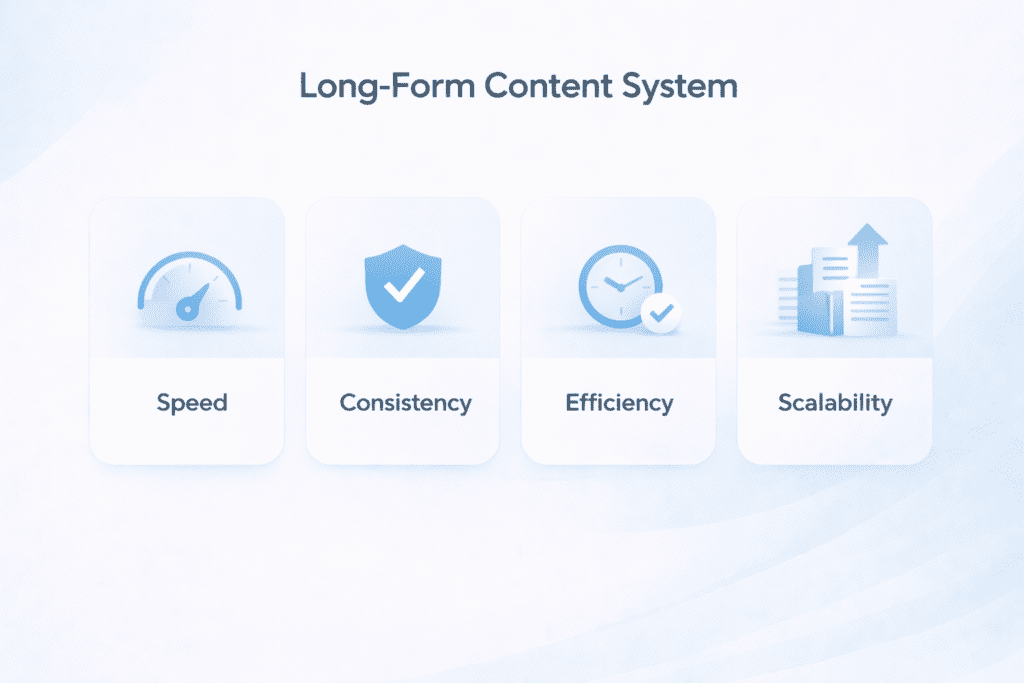
Why creators use AI tools:
• Speed: Helps generate content faster
• Consistency: Maintains structure across long-form content
• Efficiency: Reduces time spent on repetitive writing
• Scalability: Supports content creation at scale
For example, a blogger writing a 3000-word article might use ChatGPT to create an outline, Jasper to generate the draft, and Scalenut to optimize the content.
That combination can speed up the content creation process significantly.
What You’ll Learn from This Guide
This guide focuses on helping you choose the best AI tools for long form content based on real use cases.
Instead of just listing features, we’ll look at how these tools actually perform when creating long-form content.
What this guide covers:
• Tool comparison: Side-by-side breakdown of top tools
• Real usage: How content creators use AI tools
• Workflow systems: Step-by-step process for long-form content
• Tool selection: How to choose based on your needs
That said, not every tool will fit your workflow.
Comparison Table of AI Tools for Long Form Content
Before choosing from different AI Tools for Long Form Content, it helps to compare them side by side.
Because honestly, most content creators don’t just look at features. They look at how well a tool fits their content creation workflow.
| Tool | Free Plan | Paid Pricing | Best For | Key Feature |
|---|---|---|---|---|
| Jasper AI | No | $69/month | Long-form blogs | AI writing assistant |
| Scalenut | No | $39/month | SEO content | Optimization tools |
| Writesonic | Yes | $16/month | Fast content | AI content generator |
| ChatGPT | Yes | $20/month | Flexible writing | AI text generator |
| Notion AI | Yes | $10/month | Workflow | Writing assistance |
| Copy.AI | Yes | $49/month | Marketing | Automation |
| Frase | No | $14/month | Research | SEO writing |
From my research, pricing usually reflects how specialized the tool is.
For example, tools like Scalenut and Frase focus more on SEO and research, while tools like Writesonic are designed for faster content generation.
What Are AI Tools for Long Form Content and How They Work
AI Tools for Long Form Content are designed to help content creators generate structured articles using an AI model.
Let’s keep it simple.
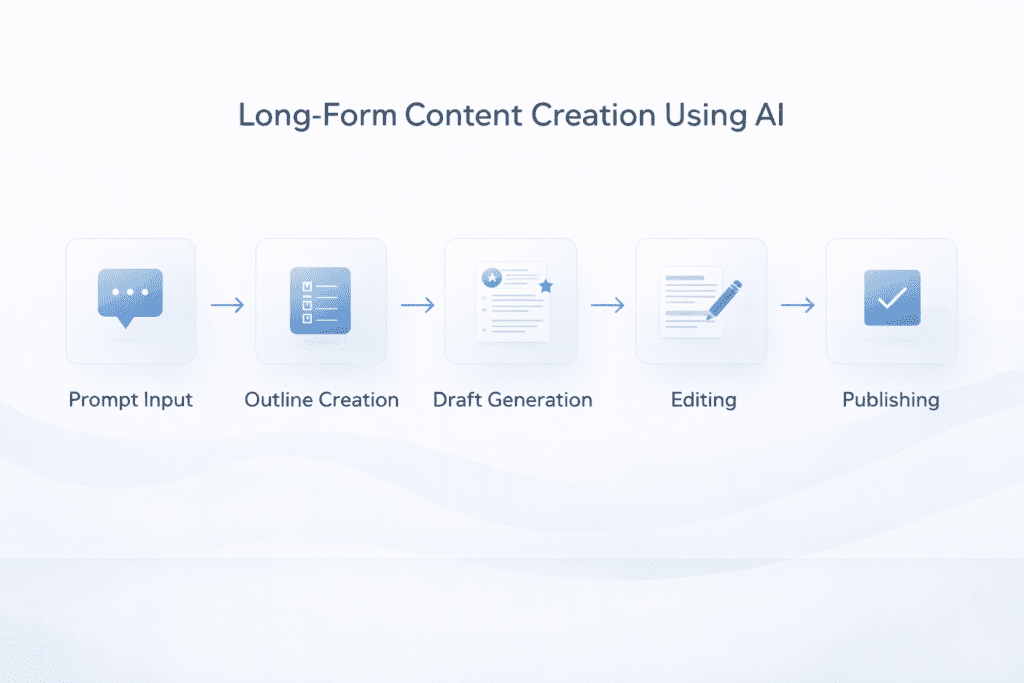
Instead of writing everything manually, you provide a prompt, and the AI writing tool generates content based on patterns it has learned.
Core functions:
• Content generation: Helps generate long-form content quickly
• Writing assistance: Supports editing and improving drafts
• Structure support: Maintains logical flow across long-form content
• Scalability: Helps create content at scale
Here’s the thing.
These tools don’t replace human writing. They support it.
Most content creators use AI writing tools to generate drafts and then refine them to match their brand voice and content needs.
7 Best AI Tools for Long Form Content
Now let’s get into the tools.
Not every AI writing tool is built for long-form content. Some are better for short-form tasks, while others are designed specifically for creating structured articles.
Here are the tools that actually work for long-form content creation.
Jasper AI
Jasper is one of the best AI writing tool options for long-form content.

It’s designed for content creators who need structured articles with consistent flow.
Key features:
• Long-form content: Helps generate detailed blog posts
• Templates: Speeds up the writing process
• AI writing assistant: Supports structured content creation
Pricing:
• Paid plans: Starts at $69/month
Pros and cons:
• Pros: Produces high-quality content
• Cons: Higher pricing
From my research, many content creators use Jasper when they want more control over structure and output quality.
Scalenut
Scalenut is built for SEO-focused long-form content.
If your goal is ranking on search engines, this tool becomes more relevant.
Key features:
• SEO optimization: Helps structure content for rankings
• AI content generation: Supports long-form drafts
• Research tools: Helps build content outlines
Pricing:
• Paid plans: Starts around $39/month
Pros and cons:
• Pros: Strong SEO capabilities
• Cons: Takes time to learn
Here’s what I noticed.
Content creators focused on SEO often prefer tools like Scalenut because they combine writing with optimization.
Writesonic
Writesonic is a faster AI content generator that works well for long-form drafts.
It focuses on speed rather than deep structure.
Key features:
• AI content generator: Produces drafts quickly
• Templates: Helps generate different content types
• Chat writing: Supports interactive content creation
Pricing:
• Free plan: Available
• Paid plan: Starts at $16/month
Pros and cons:
• Pros: Fast output
• Cons: Needs editing
Now this is where people get confused.
Faster tools don’t always produce better long-form content. They help generate drafts, but you still need to refine them for quality.
ChatGPT
ChatGPT is one of the most flexible AI writing tools available.
It doesn’t rely on templates like other tools. Instead, it works based on prompts, which gives you more control over how you generate content.
Key features:
• AI model: Supports multiple content formats
• Prompt-based writing: Allows flexible content generation
• Multi-purpose: Works for blogs, emails, and research
Pricing:
• Free plan: Available
• Paid plan: Starts at $20/month
Pros and cons:
• Pros: Highly flexible and adaptable
• Cons: Output depends heavily on prompt quality
Here’s what I noticed.
If you know how to guide the tool properly, it can generate high-quality content. But if your prompts are weak, the output will feel generic.
Notion AI
Notion AI is not a traditional AI content generator, but it plays an important role in long-form content workflows.
It focuses more on organizing and improving content rather than generating full articles.
Key features:
• Writing assistance: Helps refine and improve drafts
• Workflow integration: Works inside content management systems
• Collaboration: Supports team-based editing
Pricing:
• Free version: Available
• Paid add-on: Around $10/month
Pros and cons:
• Pros: Strong for managing long-form content
• Cons: Not a full AI writing tool
From my research, many content creators use Notion AI alongside other tools instead of relying on it alone.
Copy.AI
Copy.AI is built more for marketing workflows, but it still supports long-form content.
It focuses on automation and structured content creation.
Key features:
• Workflow automation: Helps manage content processes
• Templates: Supports different types of content
• AI writing assistant: Speeds up writing
Pricing:
• Free plan: Available
• Paid plan: Starts at $49/month
Pros and cons:
• Pros: Good for structured workflows
• Cons: Not as strong for deep long-form content
Now this is where people get confused.
They expect all tools to perform the same for long-form content. But tools like Copy.AI are better suited for marketing-focused content rather than deep blog writing.
Frase
Frase is a research-focused AI writing tool that helps with long-form content planning.
It combines content research with writing, which makes it useful for SEO-focused content.
Key features:
• SEO research: Helps analyze top content
• Content briefs: Builds structured outlines
• AI writing: Supports content generation
Pricing:
• Paid plans: Starts at $14/month
Pros and cons:
• Pros: Strong for research and planning
• Cons: Requires learning time
For content creators who focus on SEO, tools like Frase help improve content quality by adding structure and research support.
Which AI Tool Writes the Best Long Form Content Based on Testing
To understand which AI Tools for Long Form Content actually perform well, a simple test was done.
The same prompt was used across different tools.
“Write a 2500 word SEO blog on SEO strategies”
Here’s what I noticed.
Each AI writing tool approached the task differently.
Test results:
• Structure: Jasper produced the most organized long-form content
• Depth: Scalenut added better SEO structure and keyword flow
• Speed: Writesonic generated content quickly but needed edits
• Flexibility: ChatGPT adapted based on prompts
• Research quality: Frase helped improve content depth
That said, this usually works, but not always.
Sometimes the output depends more on the prompt than the tool itself.
Best AI Tools for Long Form Content by Use Case
Not every content creator needs the same tool.
Choosing the right AI tool depends on your content type and workflow.
Best tools by use case:
• Bloggers: Jasper works well for structured long-form content
• SEO creators: Scalenut helps with optimization and rankings
• Beginners: ChatGPT is easy to start with
• Workflow management: Notion AI supports content organization
Here’s the thing.
Some creators use multiple tools together instead of relying on one. That approach often produces better long-form content.
Before vs After Using AI for Long Form Content
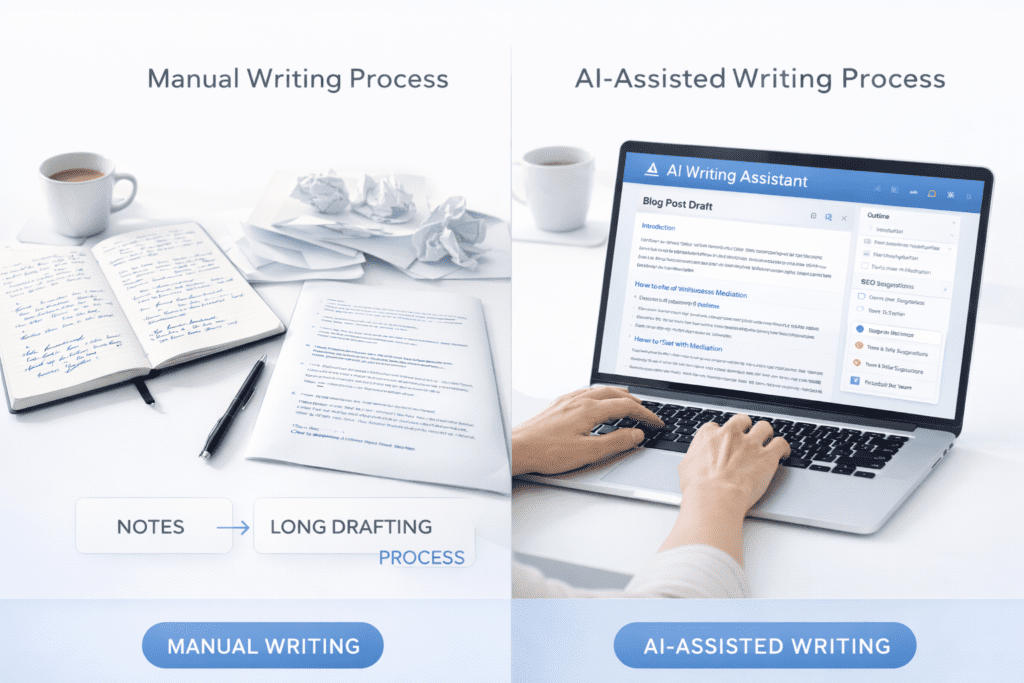
The difference becomes clearer when you compare the process.
Without AI, creating long-form content takes more time and effort.
With AI tools for long form content, the process becomes faster and more structured.
Before using AI:
• Time required: 5 to 8 hours per article
• Manual effort: High writing workload
• Output volume: Limited content production
After using AI:
• Time required: 1 to 2 hours for draft creation
• Efficiency: Faster content creation process
• Output volume: Ability to create more content
For example, a blogger writing a 3000-word article manually might spend an entire day on it. With AI tools, the draft can be generated much faster, leaving more time for editing and optimization.
Step by Step System to Create Long Form Content Using AI
Using AI without a system can lead to inconsistent results.
So let’s keep it simple.
A structured approach usually works better.
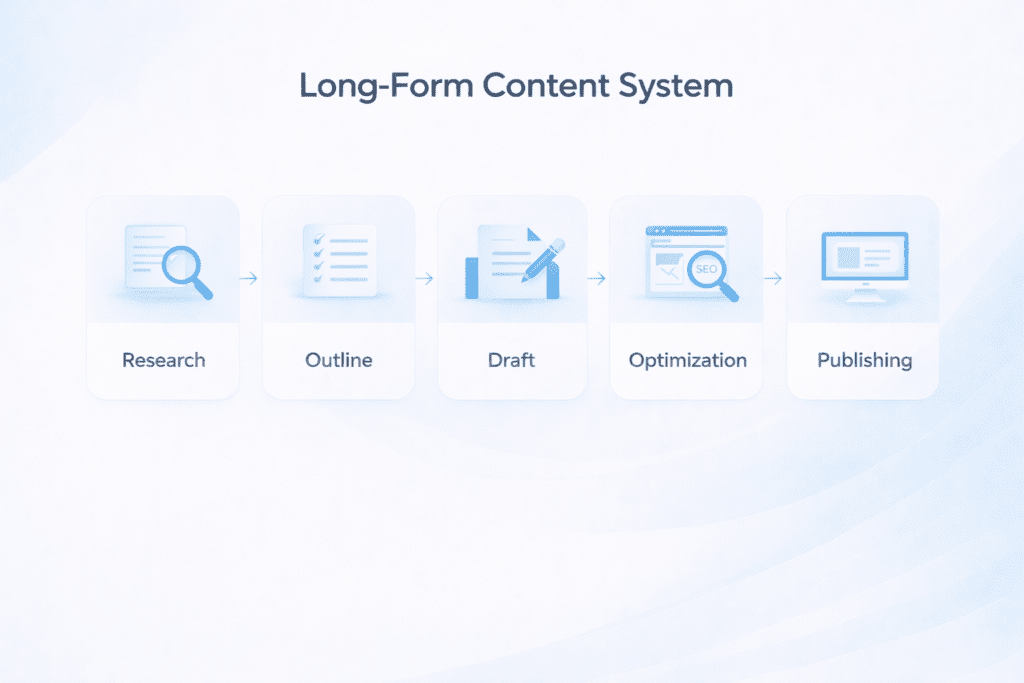
Step by step system:
• Research: Use AI to gather ideas and topics
• Outline: Build a clear structure
• Draft: Generate content using an AI writing tool
• Optimization: Improve SEO and readability
• Publishing: Finalize and publish
Here’s what I noticed.
Creators who follow a process tend to produce better content compared to those who just generate random drafts.
Best AI Tool Stack for Long Form Content Creation
Relying on just one AI writing tool can feel limiting.
Here’s what I noticed.
Most content creators who consistently publish long-form content don’t use a single tool. They combine multiple tools to improve their workflow.
Common tool stacks:
• Content stack: ChatGPT for ideas, Jasper for drafting, Frase for research
• SEO stack: Scalenut for optimization, Surfer for structure, Jasper for writing
• Budget stack: Writesonic plus ChatGPT for affordable content creation
This approach usually works better because each AI tool handles a specific part of the writing process.
Speed vs Depth: Which AI Tool Performs Better
Speed and depth are two different things.
And this is where people get confused.
Some tools generate content quickly, while others focus on producing more detailed output.
Comparison:
• Fast tools: Writesonic and ChatGPT generate drafts quickly
• Depth-focused tools: Jasper and Scalenut produce structured content
• Balanced tools: Frase combines research and writing
That said, faster tools often require more editing, while deeper tools take slightly longer but produce better results.
Best AI Tool for Different Long Form Content Types
Different types of content require different tools.
Choosing the right one depends on what you’re creating.
Content type recommendations:
• Blog content: Jasper works well for structured articles
• SEO articles: Scalenut and Frase support optimization
• Guides and tutorials: ChatGPT helps generate flexible drafts
• Marketing content: Copy.AI supports structured workflows
From my research, using the right tool for the right type of content improves overall quality.
How to Choose the Right AI Tool for Long Form Content
Choosing the right AI writing tool depends on your goals.
Not every tool fits every workflow.
What to consider:
• Content type: Blogs, SEO articles, or marketing content
• Budget: Free vs paid tools
• Features: Writing, research, or optimization
• Ease of use: Beginner-friendly or advanced
That said, the best AI writing tool is the one that fits your workflow, not the one with the most features.
Accuracy and Limitations of AI Writing Tools
AI writing tools are helpful, but they are not perfect.
Understanding their limitations is important.
Common limitations:
• AI hallucinations: Can generate incorrect information
• Prompt dependency: Output depends on input quality
• Editing required: Needs human refinement
For example, AI might generate statistics that sound correct but are not accurate. That’s why reviewing content is always necessary.
Who Should Not Use AI Tools for Long Form Content
AI tools are useful, but they are not for everyone.
In some cases, manual writing may be a better option.
Not suitable for:
• Highly technical content: Requires deep expertise
• Sensitive topics: Needs careful accuracy
• Creative storytelling: Requires unique human input
Common Mistakes When Using AI Writing Tools
Even the best AI writing tool can produce poor results if used incorrectly.
Common mistakes:
• Over-reliance on AI: Skipping editing
• Weak prompts: Poor input leads to poor output
• Generic content: Not adding unique insights
• Ignoring structure: Missing clear organization
Here’s what I noticed.
Most issues come from how the tool is used, not the tool itself.
What Most AI Long Form Content Tool Lists Miss
Most lists focus only on features.
But they miss some important factors.
What they overlook:
• Workflow matters more than tools
• Combining tools improves results
• Prompt quality impacts output
• Editing is still required
That’s why understanding how to use AI is just as important as choosing the tool.
FAQs About AI Tools for Long Form Content
What are the best AI tools for long form content?
The best AI writing tools help produce quality content fast, and many AI writing tools combine templates for different content types to speed up content creation.
Can an AI assistant write full long-form articles for me?
Yes, a versatile AI or AI writer can draft long-form pieces, but content still requires human editing to ensure the content aligns with your voice and facts.
How do platforms handle AI-generated content and detection?
Some platforms add labels and AI detection features, while others let you publish AI-generated content directly to your site with minimal checks.
Are AI content creation tools good for creative writing and fiction?
Many AI content tools support creative writing and writing fiction by suggesting scenes and dialogue, though final polish often needs a human touch.
Will using AI writing software hurt content marketing results?
Not if you use AI to create content that drives engagement and then refine it—AI is best when it speeds up content creation for content marketers and marketers and content teams.
Which tools on this list are best for content for social media?
Some AI assistants and AI content tools specialize in short social posts and templates, making them great for scaling content for social media across channels.
How do I test AI writing tools to find one that fits our team?
Try free trials, test specific topics, and compare output quality testing AI writing tools shows which tools offer the best AI content and templates for different content types.
Can AI help content marketers produce scalable content for different formats?
Yes, tools like AI agents and AI writer platforms can adapt a piece of content into blogs, emails, and social posts to help marketers and content teams scale.
What are the benefits of AI for long-form content creation in 2026?
By 2026, AI technology will speed up research and drafting, offer specialized AI features, and help businesses use AI to create professional content faster.
How do I make sure AI-generated content feels human and high quality?
Edit for tone, fact-check details, and combine AI writing with human insight so content feels real and aligns with your brand voice.
Are there many AI writing tools that focus on SEO and tools like Surfer?
Yes, dozens of AI writing tools integrate with SEO platforms like Surfer to produce content that’s optimized for search and ready to rank.
Should I worry about AI detection when using AI writer tools?
It’s best to be transparent; some AI content tools leave traces, so revise outputs to avoid flagged AI-generated content and ensure content that requires originality stays unique.

Final Verdict: Best AI Tools for Long Form Content
So what does this mean for you?
Choosing the right AI Tools for Long Form Content depends on your workflow and goals.
If you want structured content, Jasper is a strong choice. If you focus on SEO, Scalenut or Frase may work better. If you want flexibility, ChatGPT is a practical option.
Bottom line?
There isn’t a single best AI writing tool for everyone.
The best approach is to combine tools, build a workflow, and use AI to support your content creation process instead of replacing it.