

AI writing tools for bloggers are software platforms that use artificial intelligence to help generate, edit, and improve blog posts. Instead of starting with a blank page, bloggers can now use AI to brainstorm ideas, draft content, and refine structure faster than ever.
The rise of ai writing tools for bloggers has changed how content is created. What used to take hours can now take minutes with the right workflow. Still, not all tools deliver the same results.
Some focus on SEO blog posts. Others prioritize long-form content or brand voice. That’s why testing matters before choosing the right platform.
This guide breaks down the best tools based on real blogging workflows, not just feature lists. Every tool here was evaluated based on usability, writing quality, and long-term value for bloggers.
To make this guide genuinely useful, I didn’t rely on feature lists or marketing pages. I generated full blog drafts with each tool, tested prompt flexibility, and evaluated how much editing was required before publishing. Some tools looked impressive on paper but fell apart during long-form testing, while others quietly performed better than expected. That hands-on evaluation shaped the rankings you see below.
Quick Picks (2026)
If you’re short on time, here are the top choices based on specific blogging needs.
Quick Recommendation: AI Writing Tools for Bloggers Snapshot (2026)
Best Overall: Jasper
Best for: Bloggers who want versatile writing, research, and editing in one tool
Best for Scalability: Rytr
Best for: Beginners and budget bloggers testing AI writing without upfront cost
Best for Beginners: Surfer AI
Best for: Bloggers focused on ranking content with built-in SEO guidance
Each of these tools stands out for different reasons, depending on your blogging goals.
My Testing Methodology (How These Tools Were Ranked)
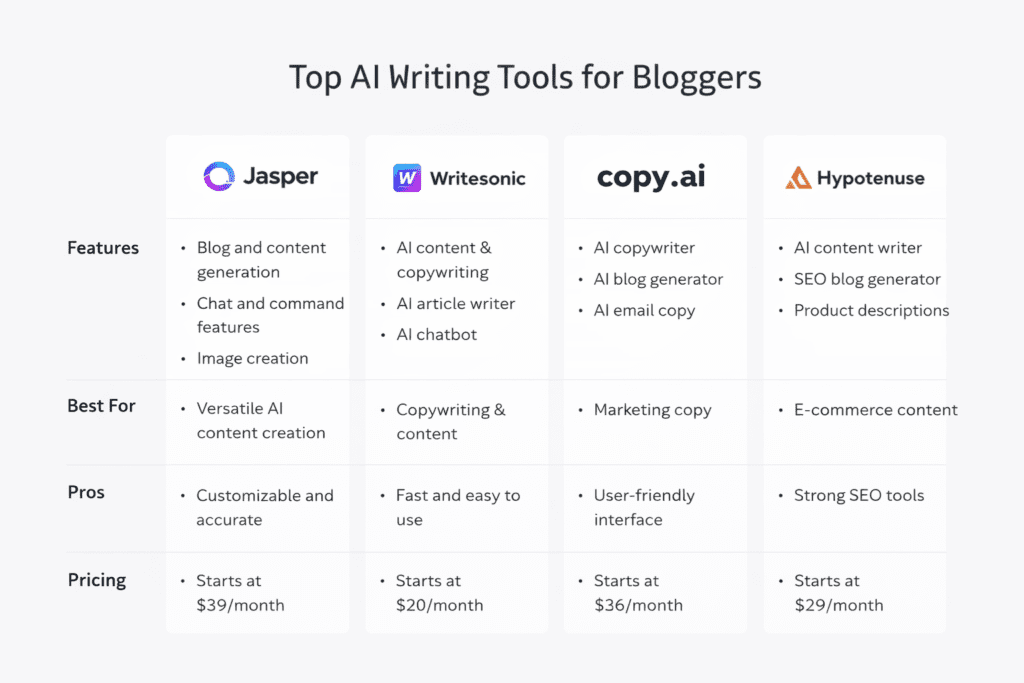
To rank these ai tools fairly, I tested them in real blogging workflows rather than relying on demos or marketing claims.
Hands-on testing process
Each platform was tested by generating blog posts across multiple niches. This helped evaluate consistency and usability.
Real usage reveals more than feature comparisons.
Blogging workflow evaluation
I tested how well each tool fits into a real content creation process. That included ideation, drafting, and editing stages.
Some tools work better at specific stages.
AI writing quality comparison
Outputs were evaluated for clarity, structure, and readability. The goal wasn’t perfection but usable drafts that don’t feel overly generic.
This is where major differences appeared.
SEO usefulness analysis
Since blogging and SEO go hand in hand, tools were also evaluated for optimization support.
Platforms with built-in seo features scored higher here.
Real-world blogging scenarios
Tools were tested across informational blogs, affiliate content, and educational posts. This ensured broader reliability.
Because blogging workflows vary widely.
One interesting pattern emerged during testing: tools that excel at short-form outputs don’t always scale well to long-form blogging. Several platforms produced great intros but struggled with structure beyond 1,500 words. On the other hand, tools built for SEO or research workflows often generated more structured drafts but required heavier editing for tone. This difference is important depending on whether you’re publishing quick articles or building authority content.
Why AI Writing Tools for Bloggers Are Dominating in 2026
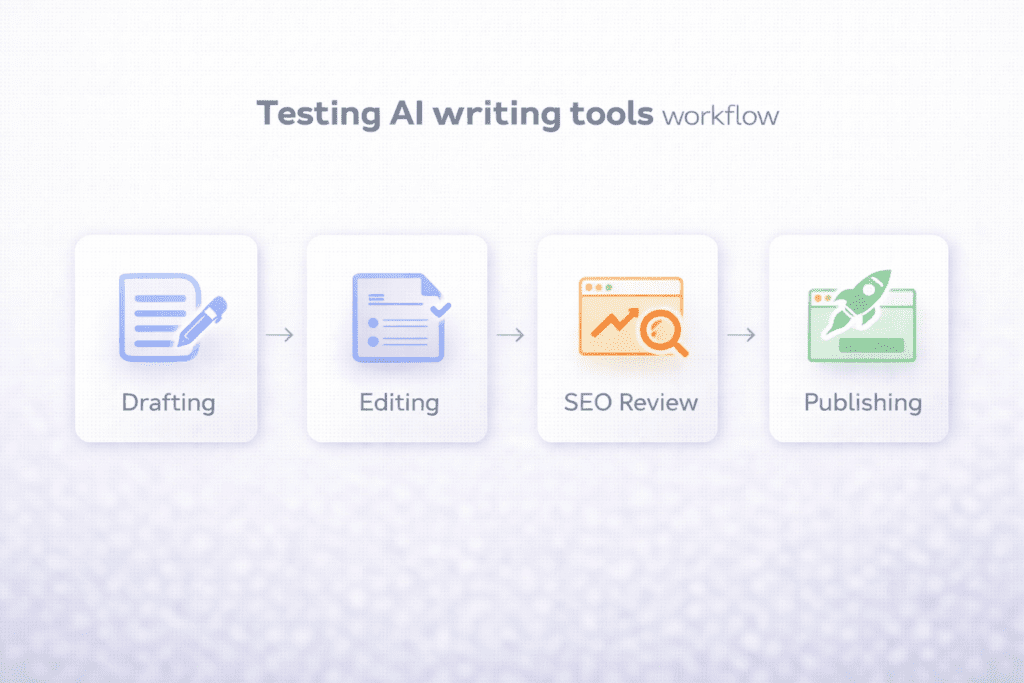
AI has moved from experimental to essential in blogging workflows. More bloggers are integrating AI into daily content creation.
Rise of AI in blogging workflows
Artificial intelligence is now embedded in many blogging tools. From ideation to editing, AI helps reduce repetitive tasks.
This shift has been rapid.
Faster AI blog writing production
Speed is one of the biggest advantages. Bloggers can now generate blog posts in seconds instead of hours.
That time savings compounds quickly.
AI-driven content marketing growth
Content marketing is expanding, and AI helps scale output. Bloggers can maintain consistency without burning out.
This is especially useful for solo creators.
Evolution of AI writing software
AI writing software is improving quickly. Outputs today are far more natural than early versions.
That improvement has increased adoption.
Blogging tools in 2026
Modern blogging tools often include built-in AI features. Even traditional platforms are integrating AI layers.
The ecosystem is evolving fast.
What Are AI Writing Tools for Bloggers?
At their core, ai writing tools for bloggers are platforms that use artificial intelligence to assist with creating and refining blog posts. Instead of writing everything manually, bloggers can rely on AI to speed up different parts of the process.
These tools are built to support the entire content creation process, not just drafting.
Definition of AI writing tools for bloggers
An AI writing tool uses machine learning models to generate or edit text. Bloggers use them to create outlines, expand sections, and polish final drafts.
The goal is faster and more consistent content creation.
Difference between AI writing assistant and writing software
An ai writing assistant usually focuses on drafting and editing. Writing software may include broader workflows like research, SEO, and planning.
Some platforms combine both into one ecosystem.
How bloggers use AI tool ecosystems
Many bloggers don’t rely on a single tool. They combine multiple ai tools for ideation, drafting, and optimization.
This layered approach often produces better results.
Role of artificial intelligence in modern blog workflows
Artificial intelligence now supports brainstorming, structuring, and editing. It reduces repetitive work while keeping creators focused on strategy.
That’s why adoption keeps growing.
AI Writing Tools vs Traditional Blogging Tools
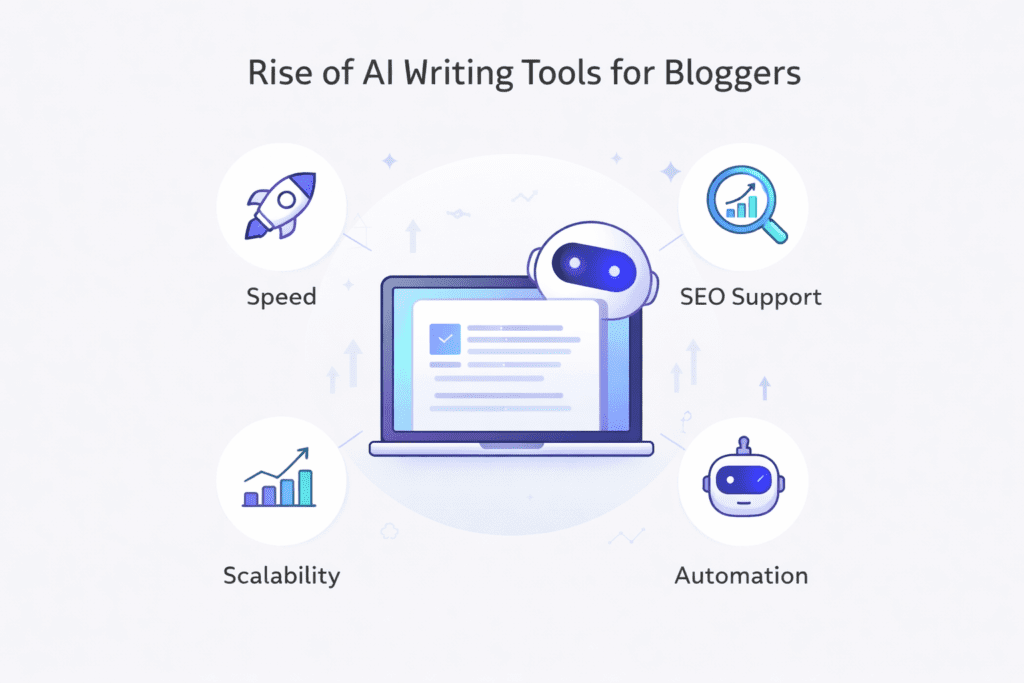
Understanding the difference between AI-powered tools and traditional blogging workflows helps set realistic expectations.
Manual writing vs AI workflows
Traditional blogging relies heavily on manual drafting. AI workflows introduce automation into ideation and writing.
This shifts how time is spent.
Speed differences
Manual writing takes longer, especially for long-form blog posts. AI tools can generate drafts quickly and reduce friction.
The speed gap is significant.
Content scaling ability
Scaling content manually is difficult. AI tools make it easier to publish consistently without increasing workload dramatically.
This is a major advantage.
Efficiency comparisons
AI reduces repetitive steps like rewriting and restructuring. Traditional tools still rely on more manual effort.
Efficiency is where AI stands out.
How AI Writing Tools Help Bloggers Grow Faster
Growth in blogging often depends on consistency. AI helps remove bottlenecks that slow down publishing.
Generate blog posts at scale
AI tools make it easier to generate blog posts consistently. This helps maintain publishing momentum.
Consistency often drives growth.
In practice, the biggest shift isn’t just speed it’s momentum. Once bloggers remove the friction of starting from scratch, publishing becomes more consistent almost automatically. Many creators don’t struggle with ideas; they struggle with execution. AI removes that bottleneck, which is why adoption tends to accelerate after the first few successful posts.
Improve your writing efficiency
AI speeds up drafting and editing. Instead of staring at a blank page, you refine existing drafts.
That alone improves workflow efficiency.
SEO optimization support
Many ai writing tools include built-in seo suggestions. These help structure content for search engines without deep technical knowledge.
This lowers the barrier for beginners.
AI content repurposing
AI can repurpose blog content into summaries, updates, or social media posts. This extends the value of each piece of content.
Repurposing saves time.
Content generators for blogging
Modern content generators can produce outlines, intros, and sections quickly. Bloggers can then refine and personalize outputs.
This hybrid approach works well.
Real Results: How AI Writing Tools Impact Blogging Growth
Beyond theory, AI tools can have measurable impact on blogging performance.
Faster publishing cycles
Bloggers using AI often publish more frequently. Shorter drafting cycles make consistency easier.
Frequency often affects growth.
Content volume increase
Higher output leads to more indexed content. Over time, this can increase visibility across search engines.
Volume plays a role in discoverability.
Traffic scaling potential
More content creates more opportunities to rank for keywords. This can support steady traffic growth.
Though quality still matters.
Productivity improvements
AI reduces the mental load of starting from scratch when using an ai blog writer. Bloggers can focus more on strategy and editing.
That shift improves productivity.
Who These AI Writing Tools Are Best For
Not every blogger needs the same level of functionality. The value of ai writing tools for bloggers depends on your goals and publishing style.
Different creators benefit in different ways.
Beginner bloggers
New bloggers often struggle with structure and consistency. AI helps generate outlines and draft blog posts quickly.
This reduces the learning curve.
Affiliate marketers
Affiliate bloggers rely heavily on SEO and publishing volume. AI tools make it easier to scale product reviews and comparison posts.
That consistency supports growth.
Niche site builders
Niche site builders often manage multiple sites. AI helps maintain publishing frequency without increasing workload dramatically.
This makes scaling more realistic.
Agencies and teams
Teams benefit from workflow automation and brand voice consistency. AI tools help streamline collaboration and drafting.
This improves efficiency across projects.
Key Features Bloggers Should Look for in AI Writing Tools
Not all AI tools are built the same. Some prioritize writing quality, while others lean heavily into SEO and workflows.
Understanding key features helps avoid choosing the wrong platform.
Long-form writing quality
If you publish long-form blog posts, output depth matters. Some tools generate surface-level drafts, while others handle structure better.
Testing long-form output is important.
SEO capabilities
Strong seo features help optimize headings, keywords, and structure. Tools with built-in optimization reduce manual work.
This is valuable for growth-focused bloggers.
Brand voice control
Maintaining a consistent brand voice can be challenging with AI. Some platforms allow tone training and customization.
This helps content feel more cohesive.
Prompt flexibility
Flexible prompt systems give you more control over outputs. Tools that support layered prompts often produce better results.
Control improves quality.
Workflow integrations
Some AI tools integrate with blogging platforms or SEO tools. This reduces friction in the content creation process.
Better integrations mean smoother workflows.
Comparison Table: Best AI Writing Tools for Bloggers
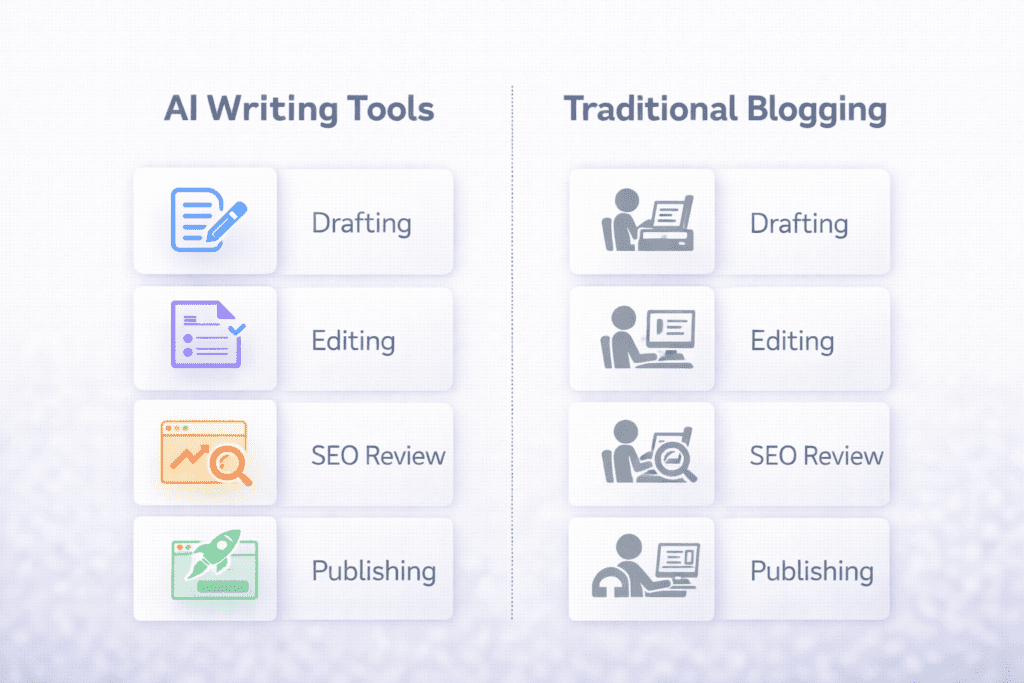
Here’s a quick comparison of the top platforms based on writing quality, SEO usefulness, and value.
| Tool | Writing Quality | SEO Features | Pricing | Best For |
|---|---|---|---|---|
| Jasper | Very High | Moderate | $49/month+ | Agencies |
| ChatGPT | High | Moderate | Free – $20/month | All bloggers |
| Writesonic | High | Strong | $16/month+ | SEO bloggers |
| Copy.ai | Medium | Basic | Free – $36/month | Beginners |
| Rytr | Medium | Basic | Free – $9/month | Budget bloggers |
| Surfer AI | High | Very Strong | $89/month+ | SEO sites |
| Scalenut | High | Strong | $39/month+ | Authority blogs |
| Frase | High | Strong | $45/month+ | Research blogs |
| Notion AI | Medium | Limited | $10/month+ | Workflow users |
| GrammarlyGO | Editing focused | Minimal | Free – $12/month | Editing support |
Use this as a starting point. The best choice depends on your blogging style and growth goals.
10 Best AI Writing Tools for Bloggers
Here are the best AI writing tools bloggers are using right now.
Jasper – Best Premium AI Writing Assistant
Jasper is widely known as a premium option among ai-powered writing tools. ai writing tools for bloggers. It focuses heavily on brand voice and polished outputs, which is why many agencies rely on it for high-quality content.
If you want refined, marketing-ready content, Jasper stands out.
Overview
Jasper is built for professional content workflows. It prioritizes brand consistency and structured outputs over raw flexibility.
This makes it popular among advanced bloggers and teams.
Premium positioning
Jasper sits firmly in the premium tier. It’s designed for marketers and agencies that publish content regularly.
That focus shows in its feature depth.
Strong brand voice control
One of Jasper’s biggest strengths is brand voice training. You can feed examples and maintain tone consistency across blog posts.
This helps create cohesive content.
Key Features
• Brand voice customization
• Long-form AI blog writing tools
• Content marketing workflows
• Templates for blog posts
Pricing
Jasper does not offer a free plan, but it includes a trial.
Pro plans typically start around $59–$69/month, with business tiers using custom pricing.
Enterprise pricing can scale significantly depending on team size.
Pros
• Polished outputs
• Strong brand voice control
• Built for professionals
Cons
• Expensive compared to most tools
• Overkill for casual bloggers
Best For
• Agencies
• Professional bloggers
If you need consistent, on-brand writing at scale, Jasper is one of the most reliable options.
ChatGPT – Best Overall AI Writing Tool for Bloggers
ChatGPT remains one of the most versatile ai tools available today. It’s widely used because of its flexibility and affordability.
For many creators, it’s the default starting point.
Overview
ChatGPT works well across multiple blogging workflows. It can generate blog posts, outlines, and even SEO drafts depending on prompts.
That versatility makes it appealing to beginners and pros.
Multi-purpose workflows
Unlike niche tools, ChatGPT adapts to different writing styles. You can use it for ideation, drafting, editing, and restructuring.
Few tools offer that flexibility.
Continuous improvements
Frequent updates have improved output quality significantly. It keeps getting better at generating human-like content.
That evolution has driven adoption.
Key Features
• Blog posts and outlines
• SEO blog posts support
• Custom AI prompts
• Long-form content creation
Pricing
ChatGPT offers a free version with basic capabilities.
Paid plans like Plus typically cost around $20/month, offering stronger models and features.
Higher tiers may cost more depending on usage.
Pros
• Highly flexible AI writer
• Affordable entry point
• Constant improvements
Cons
• Requires structured prompts
• No built-in SEO scoring
Best For
• Beginner and advanced bloggers
If you want a flexible best ai tool that adapts to your workflow, ChatGPT is hard to beat.
Writesonic – Best AI Writing Tool for SEO Bloggers
Writesonic focuses more on SEO-driven content than most general tools. It’s designed for bloggers who want fast outputs with optimization support.
This makes it popular among affiliate bloggers.
Overview
Writesonic blends content generation with SEO tools. It helps generate blog posts and refine them for search engines.
That dual focus gives it an edge in SEO workflows.
SEO-first writing approach
Unlike many AI tools, Writesonic emphasizes optimization. It includes tools for keyword-driven content and rewriting.
This is useful for SEO bloggers.
Fast content generation
Writesonic is known for speed. It can generate blog posts in seconds, which helps maintain publishing momentum.
That’s valuable for high-volume blogs.
Key Features
• AI article generator is a valuable tool for writing.
• Tools for SEO optimization
• Paraphrasing and rewriting
• Content generators
Pricing
Writesonic offers a limited free plan.
Paid plans typically start around $16–$20/month, with higher tiers unlocking advanced features.
Pricing scales based on usage and features.
Pros
• SEO-friendly outputs
• Fast generation
• Affordable plans
Cons
• Requires editing
• Output consistency varies
Best For
• Affiliate bloggers
• SEO-focused sites
If your focus is ranking content quickly, Writesonic is a strong SEO-first option.
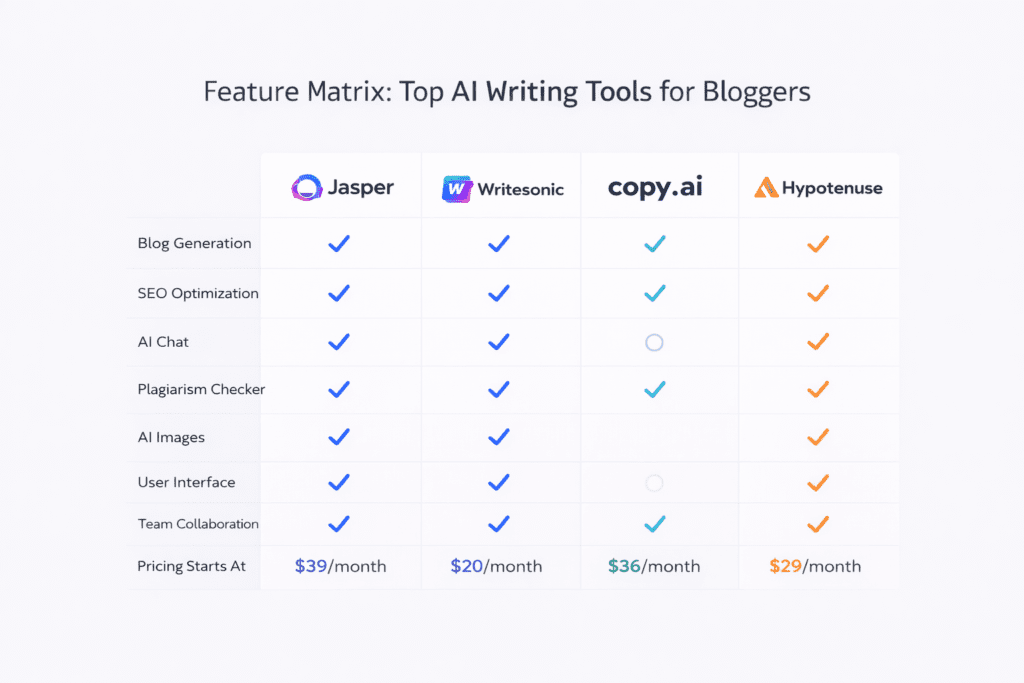
Copy.ai – Best Beginner AI Writing Tool
Copy.ai is one of the easiest entry points into ai writing tools for bloggers. It focuses on simplicity and quick outputs rather than deep optimization features.
If you’re just getting started with AI, it’s a comfortable place to begin.
Overview
Copy.ai is built for fast drafting. It helps generate intros, outlines, and short blog sections with minimal setup.
That simplicity makes it appealing for beginners.
Beginner-friendly experience
The interface is clean and easy to navigate. Most users can generate blog posts within minutes of signing up.
This lowers the barrier for new bloggers.
Focus on short-form content
Copy.ai performs best with short-form content and brainstorming tasks. It’s great for social media posts, intros, and marketing copy.
Long-form depth is more limited.
Key Features
• Blog intros and outlines
• Short-form AI content generation
• Marketing copy templates
• Simple workflows help content creators maximize efficiency.
Pricing
Copy.ai offers a free plan with limited credits.
Paid plans typically start around $36/month, with team tiers scaling higher depending on seats and usage.
This makes it accessible for most bloggers.
Pros
• Very easy to use
• Beginner-friendly
• Quick outputs
Cons
• Limited long-form depth
• Minimal built-in SEO features
Best For
• New bloggers
• Side projects
If you want a simple starting point, Copy.ai keeps things approachable.
Rytr – Best Budget AI Writing Software
Rytr is one of the most affordable options among ai writing tools. It delivers solid value for bloggers who want basic AI support without premium pricing.
It’s simple but practical.
Overview
Rytr focuses on lightweight AI writing assistance. It helps generate blog posts, rewrites, and basic drafts quickly.
That makes it useful for budget-conscious creators.
Affordable AI writing support
Rytr is known for its low-cost entry. Even paid tiers are cheaper than most competitors.
This makes experimentation easier.
Easy onboarding
The interface is simple and beginner-friendly. Most bloggers can learn it quickly without a steep learning curve.
Ease of use is a major advantage.
Key Features
• Blog post generation
• Rewriting tools
• Tone customization
• Lightweight templates
Pricing
Rytr offers a free plan with monthly limits.
Paid plans start around $9/month, while unlimited tiers typically cost $29/month for access to the AI-powered writing features..
One of the lowest-cost AI tools available.
Pros
• Very affordable
• Easy onboarding
• Good for beginners
Cons
• Limited advanced features
• Basic SEO capabilities
Best For
• Budget bloggers
• Beginners testing AI
If cost is a major factor, Rytr delivers strong value.
Surfer AI – Best AI Writing Tool for SEO Optimization
Surfer AI stands out for its SEO-first approach. It’s one of the most powerful ai tools for bloggers focused on search traffic.
This tool prioritizes optimization over simplicity.
Overview
Surfer AI integrates writing with real-time SEO scoring. It helps structure content based on what’s already ranking.
That makes it popular among SEO bloggers.
Data-driven writing approach
Surfer uses SERP data to guide structure and keyword usage. This helps create content aligned with search engines.
Few tools go this deep.
Built for SEO workflows
Surfer is designed for bloggers focused on rankings. It combines writing and optimization into a single workflow.
This reduces the need for multiple tools.
Key Features
• On-page SEO scoring
• NLP keyword suggestions
• SEO content editor
• Optimization workflows
Pricing
Surfer AI does not offer a free plan.
Paid plans typically start around $89/month, with higher tiers exceeding $179/month depending on usage.
It’s positioned as a premium SEO tool.
Pros
• Strong SEO performance
• Accurate optimization insights
• Built for rankings
Cons
• Higher pricing
• Not beginner-friendly
Best For
• SEO bloggers
• Affiliate sites
If ranking content is your top priority, Surfer AI is one of the strongest options available.
Scalenut – Best AI Tool for Content Marketing
Scalenut positions itself as an all-in-one platform among content creators. ai writing tools for bloggers. It combines keyword research, drafting, and optimization into a single workflow.
This makes it appealing for bloggers focused on long-term growth.
Overview
Scalenut is built for end-to-end content creation. Instead of using multiple tools, bloggers can manage research, writing, and optimization in one dashboard.
That integration is a big advantage.
Full content workflow support
The platform includes keyword planning, long-form generation, and optimization features. This helps streamline the entire content creation process.
Fewer tools mean fewer friction points.
Content marketing focus
Scalenut works well for bloggers building authority sites. It supports topic clustering and structured workflows.
That makes it useful for scaling content marketing.
Key Features
• Keyword planning tools
• Long-form content generator
• AI writing assistance
• Content marketing dashboards
Pricing
Scalenut offers a trial for new users.
Paid plans typically start around $39/month, with Pro tiers costing around $79/month or more depending on usage.
Pricing is mid-range compared to competitors.
Pros
• All-in-one workflow
• Good value for features
• Strong for scaling blogs
Cons
• Slight learning curve
• Output may need editing to ensure high-quality content.
Best For
• Authority bloggers
• Content teams
If you want a complete content ecosystem, Scalenut is a strong contender.
Frase – Best AI Writing Tool for Research-Driven Blogs
Frase stands out for its research-first approach. Among ai writing tools for bloggers, it focuses heavily on outlines and topic analysis.
It’s ideal for bloggers who value structured research.
Overview
Frase combines SERP research with drafting tools. It helps generate outlines based on real search data.
This makes planning easier.
Research-driven workflows
The platform analyzes top-ranking pages and extracts key insights. Bloggers can use this data to build stronger outlines.
This improves content depth.
Strong outline creation
Frase is especially good at generating structured outlines. That makes it useful for informational blogs and SEO content.
Planning is where it shines.
Key Features
• SERP research tools
• Blog post outlines
• AI writing assistant
• Question-based optimization
Pricing
Frase offers a trial but no permanent free plan.
Paid plans typically start around $45/month, with team tiers going beyond $115/month depending on features.
Mid-tier pricing overall.
Pros
• Strong research features
• Great outlines
• Useful for SEO blogs
Cons
• Learning curve for beginners
• Interface can feel dense
Best For
• SEO writers
• Research-heavy blogs
If you rely heavily on outlines and research, Frase is worth considering.
Notion AI – Best AI Tool for Blogging Workflows
Notion AI is different from most tools on this list, especially in its approach to content strategy. Instead of focusing purely on writing, it blends productivity and content creation.
It’s ideal for bloggers who want organization and drafting in one place.
Overview
Notion AI integrates directly into the Notion workspace. Bloggers can draft, organize ideas, and manage workflows without switching platforms.
This improves productivity.
Writing plus planning combo
Notion AI helps turn notes into blog posts quickly. It works well for brainstorming and structuring content ideas.
That flexibility is useful for solo creators.
Clean workflow integration
The biggest strength is integration. Bloggers can manage outlines, drafts, and planning in a single environment.
This simplifies workflows.
Key Features
• Blog drafting inside Notion
• Notes-to-blog conversion
• Workflow organization is crucial for an effective content strategy.
• Lightweight AI writing assistance
Pricing
Notion AI is offered as an add-on.
It typically costs around $10/month per user on top of standard Notion plans.
Some free plan options include limited AI usage.
Affordable for most users.
Pros
• Clean interface
• Strong workflow integration
• Great for productivity
Cons
• Limited SEO features
• Not a dedicated blog writer
Best For
• Solo bloggers
• Productivity-focused creators
If organization matters as much as writing, Notion AI is a strong fit.
GrammarlyGO – Best AI Writing Assistant for Editing
GrammarlyGO focuses on refinement rather than generation. Among ai tools, it works best as an editing companion.
It’s not a full writing platform, but it adds value at the polishing stage.
Overview
GrammarlyGO builds on Grammarly’s core editing strengths. It helps refine clarity, tone, and readability in blog posts.
This makes it useful for final edits.
Editing-focused AI support
Instead of generating full drafts, GrammarlyGO improves existing content. It suggests rewrites and tone adjustments.
This helps improve writing quality.
Strong integration
Grammarly integrates with browsers and writing platforms. That makes it easy to refine blog posts anywhere.
Convenience is a big advantage.
Key Features
• Rewrite suggestions
• Tone adjustments
• Grammar and clarity AI
• Editing integrations
Pricing
GrammarlyGO includes limited features in the free plan.
Premium plans typically start around $12/month, with higher tiers offering more advanced AI features.
Affordable editing support.
Pros
• Strong editing assistance
• Easy integration
• Improves clarity
Cons
• Not a full blog writer
• Limited content generation
Best For
• Editing blog posts
• Polishing AI content
If you want cleaner, more refined blog posts, GrammarlyGO works well as a companion tool.
AI Writing Quality Comparison
Not all ai writing tools for bloggers deliver the same output quality. Some generate polished drafts, while others require heavier editing.
Understanding these differences helps set expectations before choosing a platform.
Output depth differences
Premium tools like Jasper and Surfer AI usually generate more structured blog posts. Their drafts often feel closer to publish-ready.
Lighter tools may produce simpler outputs.
Editing required per tool
Editing needs vary widely. Some tools require only light polishing, while others need restructuring and rewriting.
This directly affects workflow efficiency.
Long-form quality comparison
Long-form content exposes weaknesses quickly. Tools that perform well with short drafts don’t always scale well to deeper articles.
Testing long-form output is important.
AI consistency
Consistency matters when scaling content. Strong tools maintain tone and structure across multiple blog posts.
That reliability saves time.
AI Writing Tools by Blogging Use Case
Different bloggers need different capabilities. Choosing the right tool often depends on your content goals.
Affiliate bloggers
Affiliate bloggers benefit from tools with strong SEO features to enhance their content strategy. Optimization and keyword structuring matter here.
SEO-focused platforms often perform better.
Personal bloggers
Personal bloggers may prioritize ease of use over deep features. Flexible tools like ChatGPT or Notion AI work well.
Simplicity can be more valuable than power.
Agencies and teams
Teams need scalability and brand voice consistency. Tools like Jasper or Scalenut often fit these workflows better.
Collaboration features matter here.
Niche authority sites
Authority builders benefit from tools that support long-form content and clustering. Platforms with deeper workflows perform better.
Scaling depth becomes the priority.
How to Choose the Best AI Writing Tools for Bloggers
Choosing the right platform doesn’t have to be complicated. It usually comes down to aligning features with your goals.
Blogging goals and scale
Start with your publishing frequency. High-volume bloggers benefit more from advanced tools.
Casual bloggers may not need premium features.
SEO requirements
If organic traffic is a priority, choose tools with strong SEO support. Built-in optimization reduces manual effort.
This can accelerate growth.
Brand voice needs
Maintaining a consistent brand voice matters for professional blogs. Some tools allow tone training and customization.
That helps content feel cohesive.
Long-form vs short-form focus
If you publish long-form content, prioritize depth and structure. Short-form bloggers may prefer simpler tools.
Matching format with tool strengths is important.
Budget considerations
Pricing varies widely across ai tools. Premium platforms offer deeper features, but mid-tier tools often deliver strong value.
Balance cost with usage.
If you’re unsure where to start, use this shortcut: beginners usually do best with flexible tools like ChatGPT, SEO-focused bloggers benefit most from Surfer AI or Writesonic, and scaling teams often gravitate toward Jasper or Scalenut. Starting with a tool that matches your publishing stage is far more important than choosing the most advanced platform immediately.
Free vs Paid AI Writing Tools
Many experienced bloggers don’t rely on just one platform. A common stack is using ChatGPT for ideation and drafting, Surfer or Frase for optimization, and Grammarly for polishing. This layered approach often produces better results than trying to find a single all-in-one solution, especially as content quality expectations continue rising.
Here’s a quick comparison of free and premium options to help you decide.
| Feature Area | Free AI Writing | Premium Writing Software |
|---|---|---|
| Writing quality | Basic drafts | More polished outputs |
| SEO depth | Limited | Strong optimization |
| Scalability | Usage limits can affect how effectively you generate content. | High scalability |
| Workflow tools | Minimal | Advanced integrations |
| Support | Community-based | Dedicated support |
Free tools are great for experimentation. But if you publish frequently, premium tools usually provide better scalability.
Limitations of AI Writing Tools for Bloggers
Even the best ai writing tools for bloggers come with trade-offs. Understanding limitations helps set realistic expectations.
Generic outputs risk
Some tools still produce generic ai-generated content, especially with weak prompts. This is more noticeable in competitive niches.
Editing helps reduce this issue.
Need for editing
AI rarely produces publish-ready blog posts every time. Human editing is still important for clarity and originality.
This hybrid approach works best.
Brand voice challenges
Maintaining a unique brand voice can be difficult. Many tools default to neutral tone unless trained carefully.
This is where customization matters.
Over-reliance risks
Relying too heavily on AI can reduce originality. Publishing without review may lead to thin content.
Balance is key.
Common Mistakes When Choosing AI Writing Tools
Some mistakes repeatedly show up among bloggers evaluating ai tools.
• Choosing tools without strong SEO features
• Overpaying for premium platforms unnecessarily
• Ignoring brand voice customization
• Using multiple ai tools without clear workflows
• Relying fully on AI writers without editing
Avoiding these mistakes saves time and money in your content strategy.
AI Content Safety and Google SEO Considerations
AI content and search engine guidelines are common concerns among bloggers.
AI content and Google guidelines
Search engines care more about value than how content is created. AI content can perform well if it generates quality content that provides helpful information.
Quality still matters most.
From what I’ve observed across multiple sites, AI content tends to perform well when it’s clearly edited, structured, and aligned with search intent. Pages that rely on raw AI outputs without adding depth or originality are far more likely to stagnate. In other words, AI itself isn’t the problem shallow execution is.
Over-automation risks
Publishing too much content too quickly can reduce quality. Over-automation may affect long-term trust.
Consistency should not come at the cost of depth.
Thin content issues
Short, shallow articles are more likely to struggle. AI should support depth, not replace it.
Substance still wins.
Safe AI blogging practices
Use AI as a writing assistant rather than a replacement. Combining AI drafting with human editing leads to better outcomes.
This balanced approach works best.
How Bloggers Should Use AI Writing Tools Effectively

Using AI strategically makes a big difference in long-term results.
Use AI for ideation and drafts
AI excels at brainstorming and drafting. Starting with structured drafts reduces friction in the writing process.
This speeds up publishing.
Maintain human editing
Editing adds clarity, nuance, and originality. AI handles structure, but humans refine tone.
That collaboration improves quality.
Optimize for search engines
Pair AI outputs with SEO tools when possible. This helps improve keyword placement and structure.
Optimization strengthens results.
Build repeatable workflows
Consistent workflows make AI more useful. Reusing templates and prompts improves efficiency.
This helps scale content sustainably.
Improve your writing over time
AI can act as a learning tool. Reviewing outputs and edits can improve your own writing process.
It becomes a feedback loop.
Future of AI Writing Tools for Bloggers
AI writing tools are evolving quickly, and blogging workflows are evolving with them.
Smarter AI writing assistants
Future tools will likely generate more context-aware outputs. This could reduce editing needs.
Quality is improving steadily.
Rise of AI agents
AI agents may automate repetitive blogging tasks like updates and repurposing.
This could reshape workflows.
Automated content pipelines
Publishing pipelines may become more automated. From ideation to optimization, AI could handle more stages.
Though strategy will remain human-led.
Better long-form AI writing
Long-form output quality is improving rapidly. Tools are getting better at structure and depth.
This will benefit authority blogs.
Evolution of best AI writing tools
Competition is driving innovation. New features are appearing across platforms regularly.
The ecosystem is still evolving.
Frequently Asked Questions
What are the best AI writing tools for bloggers in 2026?
Top options include ChatGPT, Jasper, and Surfer AI. Each excels in different areas like flexibility, branding, or SEO.
Your needs determine the best fit.
Are there free AI writing tools for bloggers?
Yes, tools like Rytr and ChatGPT offer free plans. However, premium features of the AI blogging tool often require paid upgrades.
Free tiers are good for testing.
Do AI writing tools help with SEO blog posts?
Yes, especially tools with built-in SEO features. They help structure content and optimize keywords.
But editing still matters.
Which AI writing tool is best for long-form content?
Jasper and Scalenut perform well for long-form blog posts. They handle structure better than most lightweight tools.
Depth matters here.
Can AI replace human blog writers?
Not entirely. AI handles drafting well, but human creativity and insights remain important.
Collaboration works best.
Is Jasper still one of the best AI writing tools?
Yes, Jasper remains a premium choice for professional bloggers. Its brand voice features keep it relevant.
It’s still widely used.
Are AI writing tools good for fiction writing?
Some tools support fiction writing, but most are optimized for informational content. Results vary depending on the platform.
Use cases differ.
What is the best AI writing tool for beginners?
ChatGPT, Copy.ai, and Rytr are beginner-friendly. They offer simple interfaces and low entry costs.
Ease of use matters early on.
What is an ai writer and how can it help me write a blog post?
An ai writer is a tool for writing that helps generate and edit blog article drafts fast, so you can get your content for online readers quickly.
Are ai blog writing tools good for content optimization?
Yes, many tools include content optimization features like keywords and readability checks to help your posts to help rank better.
Which is the best ai blog tool for small bloggers in 2025?
Look for the best ai blog options that offer content creation needs, SEO features, and affordable plans among dozens of ai writing tools.
How do dedicated ai platforms like these handle ai content detection concerns?
Some platforms include ai content detection tools or settings to help you revise text so it appears more human and less like ai output.
Can I use our ai to update an existing blog or write new posts to help grow traffic?
Yes, you can let ai update old posts and write new ones, which is a powerful tool to generate more content that ranks.
Do tools to streamline writing offer templates and features like outlines or titles?
Most writer tools include templates, outlines, and titles to speed up the process and make it easy to write a blog post.
Will every ai article writer work with platforms like WordPress or Medium?
Different ai tools often integrate with popular platforms like WordPress and Medium, but check each tool to generate content that fits your platform.
How do I choose between dozens of ai writing tools for my content creation needs?
Compare features like SEO, editing, pricing, and whether the tool helps create content that ranks for your niche.
Can I trust an ai writer to be my main writer to create blog article series?
Use ai as a writer to create drafts and ideas, but always review and personalize the content so it matches your voice and standards.
Are AI Writing Tools Worth It for Bloggers?
This is the question most bloggers eventually ask. Are these tools actually worth using long term?
Ultimately, the value of AI writing tools compounds over time. The first few articles might only save hours, but over dozens of posts, the efficiency gains become significant. That’s why many bloggers who start casually experimenting with AI eventually integrate it into their core workflow — not because it replaces writing, but because it removes friction at scale.
ROI considerations
AI tools save time, which can translate into higher output. For frequent bloggers, that efficiency adds up.
Usage level affects ROI.
Time vs cost comparison
If AI saves hours weekly, even paid tools can feel justified. Time savings often outweigh subscription costs.
Especially for consistent publishers.
Scaling advantages
AI makes scaling blog content easier. It reduces friction in the content creation process.
That scalability compounds over time.
When AI tools make sense
AI tools make the most sense if you publish regularly or manage multiple blogs. Higher volume increases value.
Occasional bloggers may see less benefit.

Final Verdict
After testing multiple platforms, clear patterns emerge among the best ai writing tools for bloggers.
Best AI Writing Tools for Bloggers by category
Different tools excel in different areas. Matching tool strengths with your goals is key.
There’s no universal winner.
Best overall best AI writing tool
ChatGPT stands out for versatility and value. It adapts well across blogging workflows.
That flexibility makes it a top pick.
Best budget AI writing software
Rytr offers strong value at a low cost. It’s a practical starting point for budget bloggers.
Affordable and simple.
Best for SEO bloggers
Surfer AI leads in optimization. Its data-driven approach supports ranking-focused blogs.
Ideal for SEO-first creators.
Best for long-form content
Jasper and Scalenut perform well for long-form writing. Their structured outputs support deeper articles.
Depth matters here.
Choosing based on blogging goals
Bottom line? The best choice depends on how you blog. Start with your goals, test a few tools, and refine your workflow over time.
Used strategically, AI writing tools can become powerful allies in building and scaling a successful blog.