

A surprisingly common mistake happens the moment someone starts using AI for writing. They assume the technology will automatically produce perfect articles, emails, or blog posts without much guidance. In reality, that rarely happens. Without the right prompt, editing, and review, the result often feels generic or slightly off.
That’s why understanding common AI writing mistakes matters more than most people realize. AI can generate content quickly, but speed doesn’t guarantee quality. In many cases, weak prompts, rushed publishing, or blind trust in AI output lead to content that lacks depth or clarity.
From my research, this tends to happen when people rely too heavily on AI-generated text without thinking about the writing process behind it. The AI models respond to the input they receive, so vague instructions usually lead to vague results.
That doesn’t mean AI writing tools are ineffective. Not at all. When used properly, AI can help writers brainstorm ideas, draft outlines, and produce content faster than traditional methods. The key is learning how to guide the AI instead of letting it run the entire process.
This article explores the most common AI writing mistakes people make when working with artificial intelligence. We’ll also look at why these mistakes happen and how to fix them with better prompts, smarter editing, and a more thoughtful workflow.
Why Common AI Writing Mistakes Reduce Content Quality
AI has changed how people approach content creation. Tools powered by artificial intelligence can generate paragraphs in seconds, suggest ideas, and even draft full articles. On the surface, that sounds impressive.
But here’s the thing. AI writing isn’t without limitations.
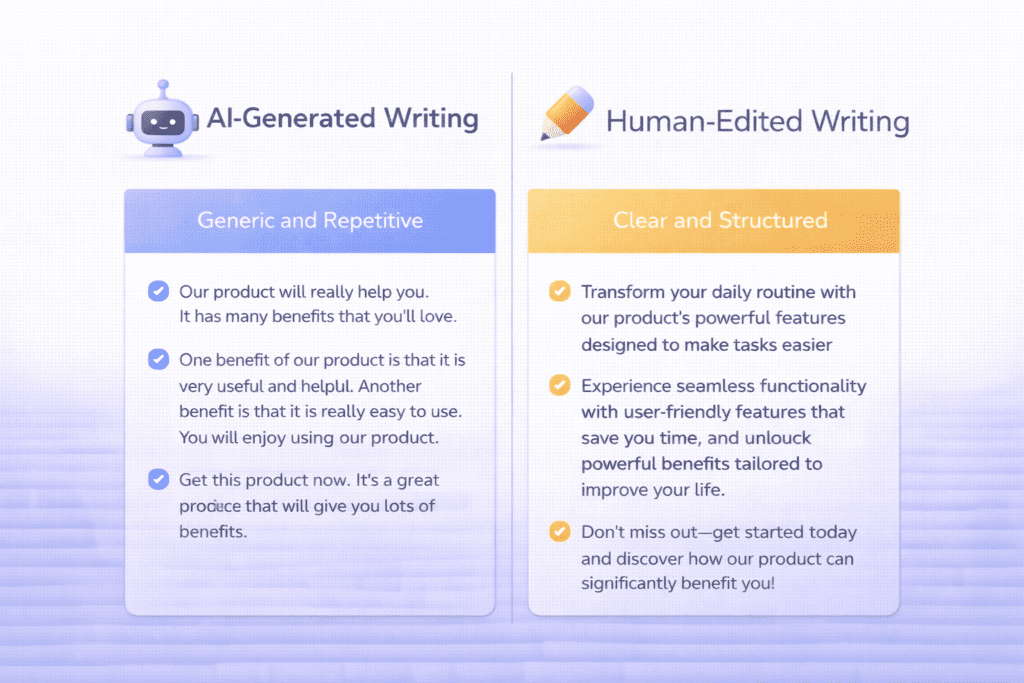
AI systems don’t truly understand the meaning behind what they generate, which can lead to mistakes to avoid. Instead, they analyze patterns in their training data and predict what words should appear next. Because of that, AI-generated text can sometimes feel repetitive or slightly disconnected from the intended message.
Another issue is that AI often prioritizes safe, predictable responses. The output may look grammatically correct, but it might lack personality, storytelling, or contextual accuracy.
Most beginners don’t notice this right away. They copy the AI output, publish it, and move on. Over time, though, the same pattern leads to weak articles that fail to engage readers or perform well in search engines.
That said, AI mistakes usually come from how the technology is used, not from the technology itself.
When writers learn how to guide the AI with clear prompts, review the output carefully, and apply human editing, the quality improves significantly.
How We Identified the Most Common AI Writing Mistakes
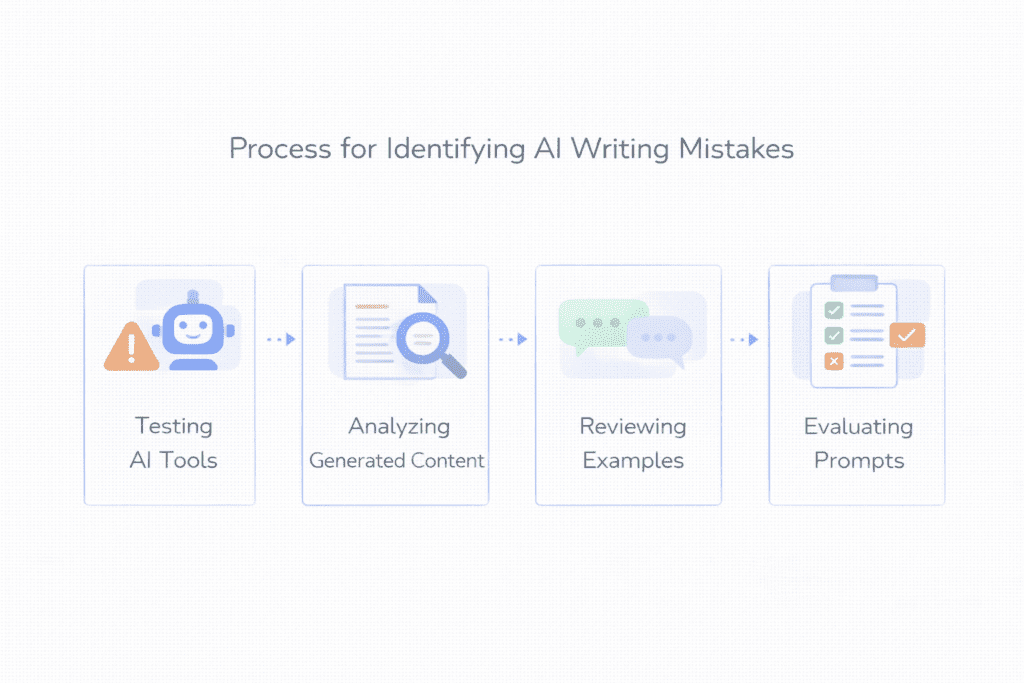
Understanding common mistakes of AI writing requires looking at how people actually use these tools in real situations.
From testing different AI models and reviewing examples of AI-generated content, several patterns become obvious. Some mistakes appear again and again, especially among new users experimenting with AI for the first time.
Researching common problems with AI generated content
One approach involved analyzing articles produced by popular AI writing tools. When comparing different outputs, certain patterns started to appear.
For instance, AI often repeats similar phrases or produces sections that sound polished but vague. This happens because the AI relies heavily on patterns from its dataset rather than true understanding.
Another observation is that AI might generate content that looks complete but misses important context. Without strong prompts or clear instructions, the AI simply predicts text based on probability.
Reviewing examples of poor AI generated text
Looking at weak AI-generated text reveals a few consistent signals. Repetitive phrases, generic explanations, and occasional inaccuracy appear frequently.
Sometimes the AI outputs information that sounds convincing but turns out to be outdated or incorrect. That’s why fact-checking becomes important when using AI-generated content.
There are also situations where the AI response appears polished at first glance but lacks concrete examples. The result feels slightly empty, even though the grammar looks fine.
Understanding how beginners use AI writing tools
Another pattern appears when beginners start using AI writing tools for the first time. They usually ask an AI to write a full article with minimal input.
For example, someone might open tools like ChatGPT and type a simple prompt such as “Write a blog about AI writing.” The AI can generate content, but the result often feels generic because the prompt lacks detail.
That’s where the common pitfall begins. AI works best when users guide the AI with specific prompts, clear audience context, and a defined structure.
Once writers understand how AI systems interpret prompts and produce output, the entire writing process becomes more effective.
Why Common AI Writing Mistakes Happen When People Use AI
AI can generate content quickly. That part is obvious. But speed sometimes hides a deeper issue. The technology follows patterns, not real understanding.
Because of that, common AI writing mistakes often appear when people expect AI to think like a human writer. AI models respond to the input they receive, so unclear instructions usually lead to generic responses.
From what I’ve noticed while testing different AI tools, the biggest issue isn’t the technology itself but the mistakes to avoid in the generated content. It’s how people interact with it.
How AI writing tools actually generate content
AI writing tools rely on machine learning and large datasets collected during AI training. These datasets contain massive amounts of text gathered from books, websites, and other sources.
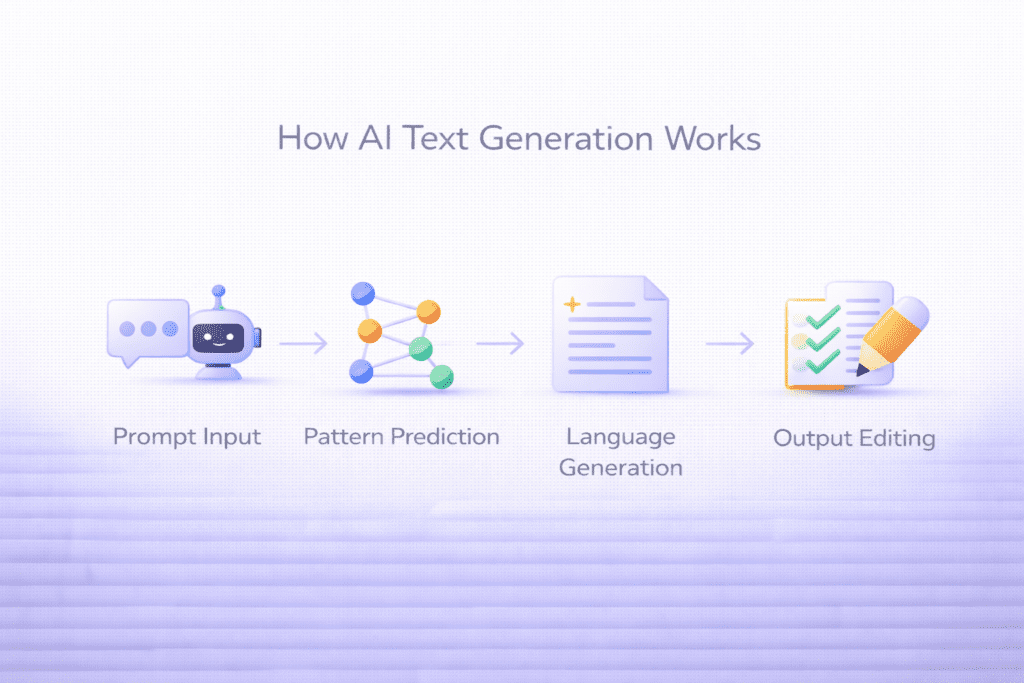
When someone enters a prompt, the AI analyzes patterns from that training data and predicts the most likely words to follow. It doesn’t actually understand the topic. It simply generates text based on probability.
This is why AI responses can sound confident even when the information isn’t completely accurate. The system is predicting language patterns, not verifying facts.
Another thing to keep in mind is that AI models don’t automatically check live information. If the dataset contains outdated or incorrect details, the AI might produce outdated or incorrect statements.
That’s why fact-checking is an important part of working with AI-generated content.
The gap between AI output and human writing
Human writers approach content differently. They connect ideas through experience, reasoning, and storytelling, which are essential skills in effective prompts.
AI, on the other hand, predicts sentences based on patterns. The output may look polished, but it can still feel slightly mechanical.
For instance, AI often struggles with subtle context. A paragraph might be grammatically correct but still miss the deeper meaning of the topic. This lack of contextual understanding is one reason AI-generated text sometimes feels generic.
Another issue is repetitive structure. AI often uses similar sentence patterns across different sections. If no human editing happens afterward, the article may sound predictable.
That said, AI still has enormous potential. When writers guide the AI with detailed prompts and review the output carefully, the results become far more useful.
Why learning to use AI properly matters
Understanding how AI works can change the entire writing process.
Instead of treating AI as a replacement for human writing, it’s more effective to treat AI as an assistant. AI can help generate ideas, organize thoughts, and draft sections quickly.
But the final product usually improves when human editing and strategy are involved. Writers who combine AI tools with their own judgment often produce stronger content.
For example, a writer might ask an AI to write a rough outline, then adjust the structure before drafting the article. This approach keeps the workflow efficient while still maintaining quality.
In most cases, the best results happen when people guide the AI clearly, review the output carefully, and refine the text afterward.
Types of AI Writing Tools That Often Lead to These Mistakes
Not all AI tools work the same way. Different tools are designed for different types of content creation.
Understanding how these tools function can help writers avoid common pitfalls when working with AI.
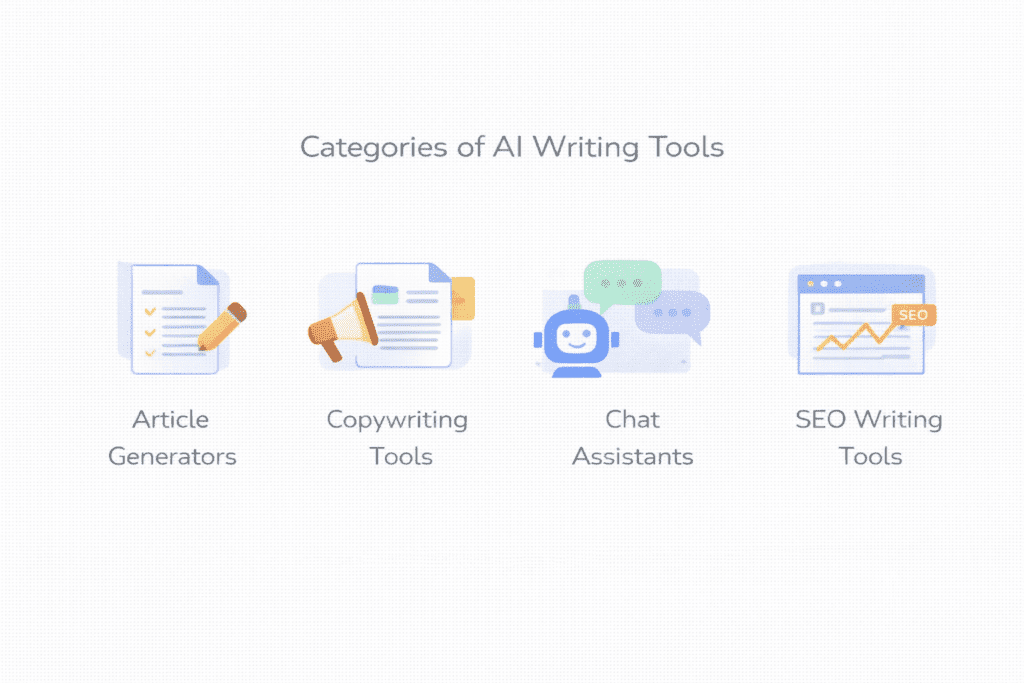
AI article generators
AI article generators focus on producing long-form content such as blog posts, guides, and informational articles.
These platforms can generate large sections of text quickly. However, the output may sometimes feel generic if the prompt lacks detail.
This happens because AI models attempt to cover the topic broadly rather than deeply. Without strong prompts or editing, the generated content may include repeated ideas or shallow explanations.
AI copywriting tools
AI copywriting tools are designed for marketing content such as ads, product descriptions, and email campaigns.
These tools often focus on persuasive language, but they can also produce content that contains false information. That can be helpful for marketing teams, but it sometimes leads to overly promotional writing.
If someone relies too heavily on AI-generated copy without adjusting the tone, the message may feel unnatural to readers and could include false information.
AI chat based writing assistants
Chat-based assistants have become extremely popular. Tools like ChatGPT allow users to ask an AI questions, request explanations, or generate content through conversation.
This format makes AI easier to use, but it also introduces a common mistake. Many users provide very short prompts and expect the AI to produce detailed content.
When the input lacks direction, the output often becomes broad and generic.
AI SEO writing tools
AI SEO writing platforms combine AI-generated content with search engine optimization features.
These systems can suggest keywords, headings, and structure while generating text. On paper, that sounds useful.
However, there’s a downside. AI sometimes overemphasizes keywords when following SEO instructions. The result can be repetitive language that feels unnatural to readers.
Let’s keep it simple. AI tools are powerful, but they work best when writers stay involved in the process. The technology can assist with generating content, yet human oversight still plays a major role in producing clear and engaging articles.
10 Common AI Writing Mistakes and How to Fix Them
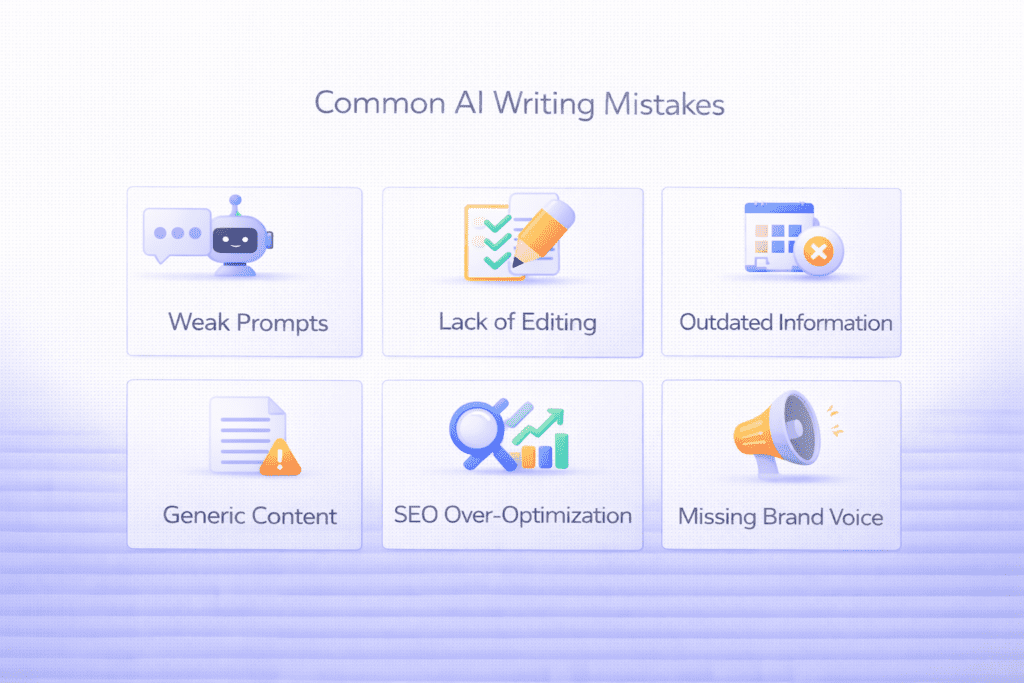
AI can speed up content creation, but the technology still depends on how people guide it. When the prompt lacks detail or the output isn’t reviewed carefully, several writing issues tend to appear.
From testing different tools and reviewing AI generated articles, a few patterns show up again and again. Let’s walk through some of the most common AI writing mistakes and practical ways to fix them.
1. Using weak or vague AI prompts
The Common Mistake
A frequent common mistake appears when someone enters a very short prompt and expects the AI to produce a detailed article.
For example, a writer might ask an AI to write about a broad topic without defining the audience or structure. The AI can generate text, but the result often feels generic.
Why It Happens
AI systems interpret prompts literally. When the input lacks context, the AI simply predicts safe, general language.
That’s why vague instructions usually produce repetitive phrases or shallow explanations.
How to Fix It
Stronger prompts usually lead to stronger results.
Instead of a short request, provide context about the topic, audience, and tone. Detailed prompts give the AI more signals to guide the output.
Over time, writers who practice crafting AI prompts tend to see better responses from the system.
2. Publishing AI generated text without editing
The Common Mistake
Another common pitfall happens when someone copies AI generated text and publishes it immediately.
The writing might look polished at first glance. But small issues often appear once you read the content closely.
Why It Happens
AI can produce grammatically correct sentences, which makes the text appear complete. Because of that, some writers skip the editing step.
The problem is that AI responses may include repetitive ideas or slightly awkward transitions.
How to Fix It
Human editing makes a huge difference.
Review the article carefully. Improve clarity, adjust tone, and remove repetitive phrases. Even small edits can turn average AI output into stronger writing.
3. Ignoring outdated information
The Common Mistake
Sometimes AI generated articles contain outdated information. This issue shows up more often when discussing statistics, trends, or tools.
The AI may generate a confident statement that turns out to be inaccurate.
Why It Happens
AI models rely on training data collected during the development process. If the dataset contains older information, the AI might generate outdated or incorrect claims.
This doesn’t happen every time, but it’s common enough that writers should stay cautious.
How to Fix It
Always fact check important claims.
Verify statistics, tools, and examples using reliable sources. Fact checking ensures the final product remains accurate and trustworthy.
4. Overusing AI writing tools for everything
The Common Mistake
Some writers rely entirely on AI writing tools for every step of the process. They ask the AI to research, outline, draft, and edit the article.
On the surface, this feels efficient. But the content may start sounding formulaic.
Why It Happens
AI tools make automation easy. When generating content becomes effortless, it’s tempting to let the system handle everything.
The downside is that AI responses often follow predictable patterns.
How to Fix It
Combine AI drafting with human strategy.
Let the AI generate ideas or outlines, then shape the article with your own insights. This balance keeps the workflow efficient while improving originality.
5. Producing generic AI content
The Common Mistake
One of the most noticeable AI mistakes appears when the article feels generic.
The sentences may be correct, but the content lacks personality, examples, or clear perspective.
Why It Happens
AI often generates safe answers that apply to many situations. The system tries to avoid strong opinions or specific claims unless prompted.
As a result, the content may sound neutral but forgettable.
How to Fix It
Add personal insights or concrete examples during editing.
For instance, imagine a small business owner in the US running a blog about digital marketing. If they rely entirely on AI generated text, the article might feel broad. But once they add their own experience about testing different AI prompts, the content suddenly becomes more relatable.
Small additions like that can make AI generated articles feel far more human.
6. Ignoring audience context
The Common Mistake
Sometimes AI generated articles don’t match the intended audience. The language might be correct, yet the tone feels slightly off.
For example, a beginner guide might suddenly include technical explanations that confuse new readers.
Why It Happens
This usually happens when the prompt doesn’t define the audience clearly.
AI systems generate responses based on the input they receive. If the prompt lacks audience details, the AI may produce broad content that tries to fit everyone.
How to Fix It
Define the audience directly in the prompt.
Mention who the article is for, such as beginners, marketers, or small business owners. This helps guide the AI toward clearer and more relevant responses.
7. Not reviewing AI generated structure
The Common Mistake
Another common mistake appears when writers accept the outline generated by AI without reviewing it.
The structure might look organized at first glance. But once you read the article carefully, some sections feel shallow or repetitive.
Why It Happens
AI models often generate logical structures based on common article formats. However, those outlines may lack depth or clear progression.
AI can generate headings quickly, yet it doesn’t always understand the best narrative flow.
How to Fix It
Treat the AI outline as a starting point.
Review the headings and adjust them to improve the structure. Sometimes merging sections or expanding a topic can make the article easier to follow.
8. Over optimizing content for SEO
The Common Mistake
Some writers focus so heavily on SEO that the article becomes difficult to read, which is a common mistake to avoid.
This often appears as repeated keywords throughout the content. AI might generate text that sounds unnatural because it tries to satisfy SEO instructions.
Why It Happens
AI responds directly to prompt instructions. When the prompt emphasizes keywords too strongly, the AI may repeat them excessively.
That’s why keyword heavy AI responses sometimes feel mechanical.
How to Fix It
Focus on readability first.
Use keywords naturally while maintaining clear sentences and helpful explanations to enhance AI text quality. In most cases, search engines reward content that helps readers rather than content that simply repeats phrases.
9. Ignoring tone and brand voice
The Common Mistake
Another issue appears when AI generated text sounds robotic.
Even though the sentences are grammatically correct, the writing may lack personality or consistency with a brand voice.
Why It Happens
Tone usually depends on the prompt.
If the instructions don’t mention tone or style, the AI tends to produce neutral language that feels slightly generic.
How to Fix It
Include tone guidance inside the prompt.
For example, specify whether the article should sound educational, conversational, or professional. This helps guide the AI toward more consistent writing.
10. Skipping the final human review
The Common Mistake
The final common pitfall occurs when writers publish AI drafts too quickly.
Because AI can generate content in seconds, it’s tempting to treat the output as a finished article.
Why It Happens
Speed creates the illusion that the writing process is complete.
However, AI responses may still contain minor inaccuracies, repeated ideas, or awkward phrasing.
How to Fix It
Always review the article before publishing.
Check the clarity of each section, confirm the facts, and adjust the language where necessary. This final step improves readability and ensures the article provides real value.
Real Examples of AI Writing Mistakes Before and After Editing
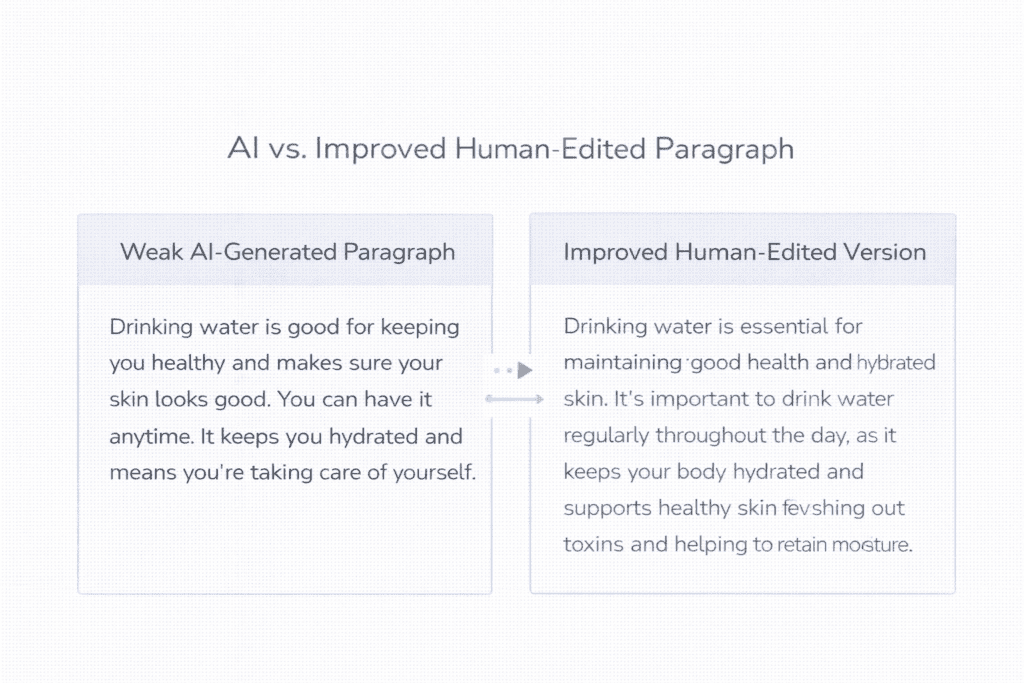
Seeing the difference between raw AI generated content and edited content can be surprisingly helpful.
In many cases, the original AI output looks fine on the surface but lacks clarity or specificity.
Example of weak AI generated content
Here’s a simplified example of how an AI generated paragraph might look.
“AI writing tools are useful for content creation. They help writers create articles quickly and easily. AI tools can generate ideas and improve writing productivity.”
At first glance, the paragraph appears correct. The sentences are clean and grammatically correct.
But something feels missing. The explanation is broad and doesn’t provide real insight.
Improved version after human editing
Now look at the same idea after editing and improving the context.
“AI writing tools can speed up content creation, especially when drafting outlines or brainstorming ideas. However, the first draft generated by AI often needs editing. Writers usually refine the structure, clarify examples, and adjust the tone before publishing.”
The meaning becomes clearer, and the writing feels more natural when effective prompts are utilized.
Lessons learned from the example
A few useful lessons appear from this comparison.
First, AI can generate solid starting points. The technology helps organize ideas and draft sections quickly.
Second, human editing plays an important role in shaping the final product.
When writers review AI responses carefully and improve the structure, the article becomes far more useful for readers.
Best Practices to Avoid Common AI Writing Mistakes
Avoiding common AI writing mistakes usually comes down to a few practical habits. AI can support the writing process, but the results improve when writers stay involved.
Let’s keep it simple. The goal isn’t to replace human writing. The goal is to use AI as a helpful assistant.
Use better AI prompts
The quality of AI responses often depends on the prompt.
Short instructions usually produce shallow answers. More detailed prompts tend to guide the AI toward clearer responses and better structure.
• Provide context: Explain the topic and goal of the content.
• Define the audience: Mention who the content is written for.
• Describe tone: Specify whether the article should sound educational, conversational, or professional.
Clear prompts help guide the AI toward more relevant output.
Combine AI tools with human editing
AI can generate ideas quickly, but human editing improves clarity and flow.
When reviewing AI generated content, look for sections that feel repetitive or overly broad. Small adjustments can improve readability and engagement, particularly when utilizing specific examples.
In most cases, AI works best when writers treat the output as a starting draft rather than the final product.
Always verify AI generated content
Another useful habit is verifying key information.
AI might generate statistics or examples that sound accurate but require confirmation. Checking sources and confirming details helps prevent inaccuracies.
This step becomes especially important when discussing data, research, or technical topics produced by AI.
Are AI Writing Mistakes Bad for SEO
Search engines evaluate content quality carefully. When AI generated content contains errors or generic explanations, it may struggle to rank well.
That said, using AI doesn’t automatically harm SEO. The outcome depends on how the technology is used.
How low quality AI content affects search rankings
Low quality articles often lack depth and useful information.
If AI generated text contains repeated phrases or vague explanations, readers may leave quickly. Search engines can detect these signals and adjust rankings accordingly.
Content that feels helpful and clear usually performs better.
Why search engines prioritize high quality content
Search engines aim to provide users with useful answers.
Articles that explain topics clearly, include examples, and maintain strong structure tend to perform well. This applies whether the content was written by humans or supported by AI.
Quality and usefulness remain the key factors.
How to use AI writing tools without hurting SEO
A balanced approach usually works best.
Use AI tools for drafting, brainstorming, and outlining ideas. Then review the content carefully to improve clarity and accuracy.
This process helps ensure the article remains helpful for readers while still benefiting from AI efficiency.
Tools That Help Reduce AI Writing Mistakes
Several tools can help writers improve AI generated content and reduce errors.
These tools don’t replace editing, but they can make the process easier.
AI editing tools
AI editing tools review text and suggest improvements for grammar, clarity, and readability.
They can identify awkward phrasing, repeated words, or sentences that feel too long.
Fact checking and research tools
Fact checking tools help verify information generated by AI.
When an AI response includes statistics or claims, research tools allow writers to confirm whether the information is accurate.
SEO optimization tools
SEO tools analyze content structure and keyword usage.
These platforms can help improve headings, readability, and overall optimization without forcing unnatural keyword repetition.
What Most Writers Misunderstand About AI Writing
One of the biggest misconceptions about AI writing is that the technology replaces human creativity.
In reality, AI works best as a support system.
AI can generate ideas, organize outlines, and draft sections quickly. However, the strongest articles usually come from combining AI assistance with human judgment.
From my experience researching different AI tools, the best results appear when writers guide the AI carefully and refine the output afterward.
The potential of AI becomes much clearer when people treat it as a partner in the writing process rather than a full replacement.
FAQ About Common AI Writing Mistakes
What are the most common AI writing mistakes beginners make?
Some common mistakes include using vague prompts, publishing AI generated text without editing, and relying too heavily on automation.
These issues often lead to generic or repetitive content.
Why does AI generated text sometimes sound robotic?
AI generates sentences based on patterns from training data.
Because of this process, the writing may lack nuance or natural flow unless the text is reviewed and edited by a human writer.
How can better AI prompts improve writing quality?
Clear prompts provide context, audience details, and tone instructions to maximize AI capabilities.
This helps guide the AI toward producing more relevant and structured responses.
Can AI writing tools replace human writers?
AI tools can assist with content creation, but they don’t replace human creativity.
Most high quality articles still require human editing, fact checking, and strategic thinking.
How do I fix poor AI generated content output?
Start by reviewing the structure and improving clarity.
Rewrite sections that feel repetitive, add examples where necessary, and adjust the tone to match the intended audience.
Do AI systems always provide accurate information?
No. AI responses sometimes include outdated information or incorrect claims.
Writers should verify important details before publishing.
What should you avoid when writing with AI?
Avoid relying entirely on AI generated drafts without review.
Clear prompts, careful editing, and fact checking help ensure the final article remains accurate and helpful.

Final Thoughts on Common AI Writing Mistakes
Understanding common AI writing mistakes can make a noticeable difference in content quality.
AI can generate text quickly, but strong results usually require thoughtful prompts, editing, and review.
Bottom line? AI works best when it supports the writing process rather than replacing it entirely.
Writers who combine AI tools with human judgment often produce clearer, more useful articles that readers actually enjoy.