

Imagine you are a small business owner with a folder full of brilliant ideas but only three hours of free time each week. You need to publish high-quality articles to grow your brand, but the “Quality vs. Quantity” dilemma is staring you in the face. If you write everything yourself, you’ll never scale. If you let a machine do it all, you might lose the trust of your audience.
In 2026, the internet is flooded with content, making it harder than ever to stand out. This has sparked a massive debate over ai writing tools vs human writers. Is one side better than the other, or do we need a new way of thinking? The most successful brands today don’t choose one over the other. Instead, they combine the speed of algorithms with the heart of human creators.
The most effective approach is a hybrid content strategy. This means using a generative ai tool to handle the heavy lifting while a human ensures the final piece has a soul. Let’s dive into the ultimate 2026 comparison to help you scale your content the right way.
What Are AI Writing Tools and How Do They Differ from Humans?
To understand the core of the ai writing tools vs human writers comparison, we have to look at how they process information. They are built on two completely different foundations. We call these the “Logic Layer” and the “Empathy Layer.”
AI writing tools represent the Logic Layer. They are software programs that predict text based on patterns found in vast amounts of data. They are incredibly computational and can produce coherent sentences in milliseconds. However, they are essentially guessing the next word based on math, not meaning.
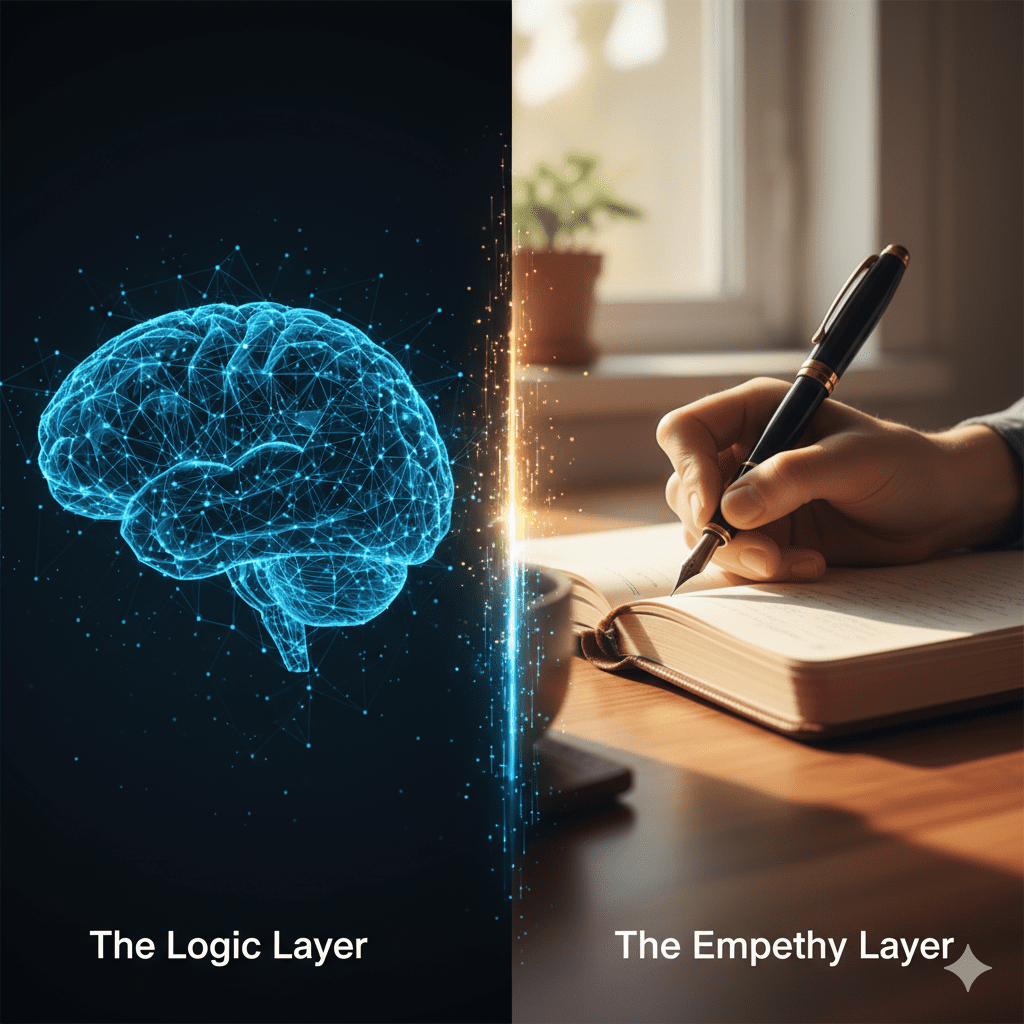
The Empathy Layer: Human Writers
Human writers bring the Empathy Layer. They use lived experience, emotion, and critical thinking to tell stories. While an ai model has read about the world, it has never “lived” in it. This is the fundamental gap between the two.
A human can understand cultural context and subtlety in a way that an algorithm cannot. This is why human writers bring a level of trust and authority to a narrative that is hard to replicate. The goal is to move from “replacement” to “collaboration” to get the best of both worlds.
The “Human-Led” Prompting Secret: How to Guide Your AI Intern
If you want to win in the ai writing tools vs human writers debate, you have to treat the AI as a high-speed intern. You are the manager. The secret to great ai-generated content is providing the machine with “experience” during the prompt phase.

Instead of a generic instruction, feed the AI your personal opinions, unique case studies, and specific data points. This prevents the output from sounding like a formulaic robot. You are essentially giving the new ai the ingredients it needs to cook a meal that tastes like your brand.
Setting Style Guardrails
To ensure the ai can generate text that fits your voice, you must set clear guardrails. Use constraints such as “6th-grade readability” or “American English only” to keep the linguistic style consistent. This helps streamline the process and reduces the time you spend on the revise stage.
The best hybrid content comes from an iteration loop. This means doing 2-3 rounds of prompting rather than just one click. This collaborative approach is what allows human writers to focus on the high-level strategy while the machine handles the repetitive tasks.
Why the Debate Over AI Writing Tools vs Human Writers Is Different in 2026
The conversation around ai writing tools vs human writers has shifted dramatically this year. In the past, people worried about bots stealing jobs. Today, the focus is on originality and trust. We have entered an era where readers and search engines are much smarter about what they consume.
One major reason for this shift is Google’s intense focus on E-E-A-T. This stands for Experience, Expertise, Authoritativeness, and Trustworthiness. In 2026, “Experience” is the king of ranking signals. Because ai cannot go to a restaurant or test a new car, it cannot provide first-hand experience. This gives human writers a massive edge in the search results.
The Rise of “AI Fatigue”
We are also seeing the rise of “AI Fatigue.” Readers are becoming experts at spotting formulaic, generic text that often lacks a pulse. They are tired of reading the same uniformity across every blog. They are craving an authentic personal voice and real humanity.
When humans and ai work together, you can avoid this trap. You use the ai writing tools to build the skeleton, but you let the human touch provide the heart. This prevents your content from feeling like just another ai-generated copy that people scroll past.
The Economic Shift: Human Content as a Luxury
There is also a significant economic shift happening. As generative ai makes basic content almost free, “purely human” work is becoming a premium signal. It is similar to how people value a hand-crafted watch over a mass-produced one.
The cost of high-quality human writing has risen because it is now a mark of high status and trust. Using ai writing tools vs human writers in a hybrid way allows you to maintain that premium feel without the deadline stress of doing everything manually. It is the most sustainable way to generate content in 2026.

Key Factors to Consider When Comparing the Two
If you are trying to decide how to balance ai writing tools vs human writers, you need to look at the key differences in their performance. Each has a specific strength that the other lacks.
Production Speed is the most obvious factor. An ai-powered tool can create a draft in seconds, while a person might take six hours to do the same. If you are under a tight deadline, the machine is your best friend. However, speed should never come at the cost of accuracy.
Emotional Resonance and Ethics
Can the reader “feel” your perspective? This is where human writers bring a deeper level of connection. Humans can use nuance and subtlety to build a narrative arc that resonates on an emotional level. AI can mimic this, but it often feels like a simulation.
Finally, we must consider Fact-Checking & Ethics. AI has a well-known drawback: its tendency to “hallucinate” or make up facts. A human writer has the emotional intelligence and logic to verify sources and ensure grammatically correct work is also factually true. For high-stakes topics in the humanities and social sciences, this human review is non-negotiable.
Types of Content: Who Wins the Round?
When comparing ai writing tools vs human writers, it’s important to realize that certain tasks are better suited for one over the other. Not every piece of writing requires the same level of humanity. To build a collaborative workflow, you need to know who to put in the game for each specific task.
AI Wins:
• Product Descriptions: High-volume, repetitive work.
• Meta-Data: Writing titles and descriptions for search engines.
• Internal Memos: Clear, functional communication.
• Draft Outlines: Breaking through a blank page quickly.
Humans Win:
• Thought Leadership: Sharing a deeper understanding of a niche.
• Personal Essays: Using a personal voice to build trust.
• Brand Storytelling: Creating a narrative that connects with values.
• Investigative Reports: Conducting interviews and finding original key points.
The Hybrid Sweet Spot:
Long-form blog posts are where the ai writing tools vs human writers combo truly shines. You use the ai to generate the structure and basic facts, and then a human writer adds the soul, originality, and expert quotes. This is the ultimate way to produce coherent, high-quality content at scale.
Main Comparison: AI Writing Tools vs Human Writers (2026 List)
In 2026, the key differences between these two are clearer than ever. While ai technology has improved, it still struggles with the creative and strategic aspects of writing. Here is how they stack up in the most critical areas.
1. Content Drafting & Ideation
AI Strength: It can analyse a topic and generate 50 ideas in 60 seconds. It is the best way to overcome writer’s block.
Human Strength: A human can identify a “hidden” trend or a cultural context that hasn’t appeared in the data yet.
The Winner: AI writing tools for speed; human writers for strategy.
2. Emotional Depth & Storytelling
AI Strength: It can use stylistic choices to mimic “sad” or “happy” tones, but it’s always a simulation.
Human Strength: Humans use vulnerability and emotional intelligence to build real trust.
The Winner: Human writers by a landslide.
3. SEO & Technical Optimization
AI Strength: Excellent at placing keywords and ensuring linguistic patterns match what search engines want.
Human Strength: Excellent at ensuring the flow remains natural so it doesn’t sound formulaic.
The Winner: A hybrid approach is the only way to satisfy both algorithms and readers.
Measuring the ROI of a Hybrid Strategy (Cost vs. Quality)
Building a team that uses both ai writing tools vs human writers isn’t just about quality; it’s about the return on investment (ROI). In 2026, the most persuasive argument for a hybrid model is the cost-to-quality ratio.
A new study shows that a hybrid strategy increases drafting speed by about 40%. However, it also increases the refine and editing time by 20% compared to just “hitting publish.” This extra time is necessary to ensure the human touch is present and the facts are correct.
Cost Comparison:
• Human-Only Article: Can cost between $200 and $500+ per piece.
• Hybrid Article: (AI Tool Subscription + Human Editor) averages around $60 per piece.
This computational efficiency allows small teams to streamline their writing process and compete with large agencies. You get premium content without the million-dollar budget, allowing you to reshape your marketing for the future.
Comparison Table: AI Writing Tools vs Human Writers at a Glance
When you weigh ai writing tools vs human writers, it’s helpful to see where each shines. While an ai tool offers incredible speed, a human writer provides the originality and trust needed to build a brand in 2026.
| Feature | AI Writing Tools | Human Writers |
|---|---|---|
| Speed | Extremely Fast (Instant) | Slower (2-6 hours per post) |
| Cost | Low ($20-$50/month) | High ($50-$500+ per post) |
| Originality | Pattern-Based | Experience-Based |
| SEO Accuracy | High Technical Accuracy | High Contextual Accuracy |
| Trust/Authority | Lower (Needs verification) | Higher (E-E-A-T Signal) |
Step-by-Step Guide: How to Build Your Hybrid Content Strategy
To successfully combine ai writing tools vs human writers, you need a clear writing process. You don’t want the machine leading the way; you want it following your lead.
Step 1: Use AI for Research & Outlining
Let the machine handle the blank page problem. Use an ai-powered tool to assist with research and build a logical outline. This saves you hours of computational work.
Step 2: Generate the First Draft
Use a large language model to get the basic facts on the page. This draft serves as your foundation. It’s much faster to refine an existing text than to write one from scratch.
Step 3: Insert Human “Experience”
This is the most important step. Have a creative writer add personal stories, expert quotes, and nuance. This adds the human touch that search engines crave.
Step 4: Fact-Check & Edit
Never skip the human review. Check for grammatically correct errors and “hallucinations.” A human writer must verify every claim to maintain originality.
Step 5: Optimize for Tone
Ensure the final piece sounds like your brand, not a generic chatbot. This collaborative final polish ensures the content that resonates with your specific audience.
Common Mistakes Beginners Make in the AI vs. Human Debate
- Full Automation: Thinking you can just hit “publish” on a raw ai-generated draft and rank on Google.
- Resisting AI Completely: Missing out on massive time-savings because of fear or pride in the humanities and social sciences.
- Ignoring the Reader: Writing only for the search engine (AI’s strength) while forgetting to help the humanity of your reader.
FAQ Section
Is the quality of ai writing tools vs human writers comparable?
In terms of grammar, yes. However, human writers bring a level of emotional intelligence and experience that AI simply cannot replicate.
Will using AI tools hurt my website’s trust?
Only if you use ai-generated content without a human editor. Transparency and originality are key to maintaining trust.
Can I use AI to write student essays?
While an ai can generate text for student essays, it often lacks the deeper understanding required for academic success.
What is the biggest drawback of ai writing tools vs human writers?
The biggest drawback of AI is its lack of lived experience and its tendency to create formulaic or inaccurate content.
How do I start a hybrid strategy with ai writing tools vs human writers?
Start by using versions of chatgpt to create outlines, and then hire a human writer to do the final storytelling.
Can AI understand cultural context?
Not fully. AI continues to struggle with cultural context and subtlety, which is why human oversight is vital.
Is AI writing cheaper than human writing?
Yes, ai-powered tools are much cheaper, but they require human time to refine and fact-check.
Which AI tool is best for beginners in 2026?
ChatGPT and Llama are excellent starting points for those looking to overcome writer’s block.
How does AI affect the writing process?
It makes the initial stages much faster, allowing writers will be able to focus on creative and strategic aspects.
Will AI replace human writers in 2026?
No. Human writing remains the gold standard for trust and persuasive storytelling.
What are the main differences between human and ai-generated writing?
Human-written text often shows unique human expression and emotion, while ai-generated text like chatgpt can be faster and more consistent.
Can ai tools like large language models replace creative writers?
AI systems can help with ideas and drafts, but creative writing and the human touch from writers bring to the table original voice and nuance.
How reliable are ai-generated facts compared to human research?
AI can produce useful summaries, but it may invent details or be outdated, so human checking is still needed.
What are ai’s limitations when compared to human writers?
AI may miss cultural context, subtle emotion, and complex judgement that human-written work exemplify.
How can writers and ai systems work together to streamline content creation?
Writers can use ai to draft and edit faster while keeping human expression and final edits for quality.
Does using ai responsibly mean losing the human touch in writing?
No, aligning ai responsibly means using tools to support human creativity while keeping personal voice and ethics.
Are there differences between ai outputs from different llm models like chatgpt?
Yes, different LLMs vary in style, accuracy, and safety, so you should compare them for the task.
How do writing styles differ between human and ai-generated content?
Humans often vary tone and use passive voice or vivid detail on purpose, while ai tends toward neutral, broader phrasing.
Should editors treat ai drafts the same as human drafts?
Editors should review ai drafts carefully for facts, tone, and bias, because something ai creates can seem plausible but be wrong.
Final Verdict / Conclusion
Summary: The winner of ai writing tools vs human writers isn’t a single side—it’s the person who uses both. In 2026, a hybrid strategy is the only way to scale without losing your soul.
Final Advice: Stop viewing AI as a threat and start viewing it as a high-speed intern. You are still the Editor-in-Chief. Human-led, AI-assisted content is the future of the web.
Ready to upgrade your workflow? Check out our top recommended tools above and hire your first “AI Intern” today!