

You open your laptop to write a proposal for a new client. The deadline is tight, the expectations are high, and honestly… you’re not sure where to start. You try drafting something, but it feels slow and a bit scattered.
That’s where AI tools for proposal writing start to make sense. Instead of staring at a blank page, you can use AI to structure ideas, build a proposal faster, and improve the overall flow without spending hours rewriting everything.
Here’s the thing though. Not every AI tool works the same way, and picking the right one can actually affect your proposal quality more than most people expect.
Quick Picks: Best AI Tools for Proposal Writing (2026)
If you don’t want to go through every tool right now, here are the quick picks based on different needs.
Quick Recommendation: AI Tools for Proposal Writing Snapshot (2026)
Best Overall: Jasper
Best for: Professionals and businesses creating high-quality, scalable proposals
Best Budget Option: Rytr
Best for: Freelancers and small businesses needing quick proposal drafts at low cost
Best for Teams: Proposify
Best for: Teams managing collaborative proposal workflows and client-facing documents
Best for Grant Writing: Grantable
Best for: Nonprofits and organizations focused on grant proposals and funding applications
Now, this is where people get confused. The “best AI” tool isn’t the same for everyone. A freelancer might care about cost, while a US-based agency may focus more on workflow and collaboration.
Comparison Table of the Best AI Tools for Proposal Writing
Here’s a simplified comparison to help you quickly understand how these tools stack up.
| Tool | Price | Best For | Key Feature | Free Plan |
|---|---|---|---|---|
| Jasper AI | $69/month | Long-form proposal writing | Generative AI + advanced template system | No |
| Copy.AI | Free + $49/month | Fast proposal creation | Workflow-based proposal generation | Yes |
| Writesonic | $16/month | SEO + proposal writing | AI templates + chatbot | Yes |
| Rytr | Free + $9/month | Budget users | Simple writing assistant | Yes |
| Proposify | $49/user/month | Teams | Proposal tracking + automation | No |
| PandaDoc | Free + $19/month | Sales proposals | E-sign + proposal tools | Yes |
| Better Proposals | $19/month | Freelancers | Ready-to-use proposal template | Yes |
| GrammarlyGO | Free + $12/month | Improving proposal quality | AI writing assistant | Yes |
| Grantable | Custom pricing | Grant writing | AI-powered workflows | No |
| Anyword | $39/month | Conversion-focused proposals | Predictive scoring | No |
From my research, pricing alone doesn’t tell the full story. Some cheaper tools help you generate proposals quickly, but they may need more editing. On the other hand, premium tools often improve proposal quality right from the first draft.
That said, if you’re just starting out in the US, even a free AI proposal generator can be enough to create proposals and test what works before upgrading.
What Are AI Tools for Proposal Writing and How Do They Work
AI tools for proposal writing are software systems powered by AI and artificial intelligence that help you write a proposal faster, organize ideas, and improve proposal content without starting from scratch every time.
Let’s keep it simple. Instead of manually drafting every section, these tools can generate proposals using patterns learned from existing proposal data. That’s why the output often feels structured right away.
That said, they’re not perfect. You still need to guide the direction, especially if you’re working on a business proposal or something client-facing.
How AI Proposal Writing Works
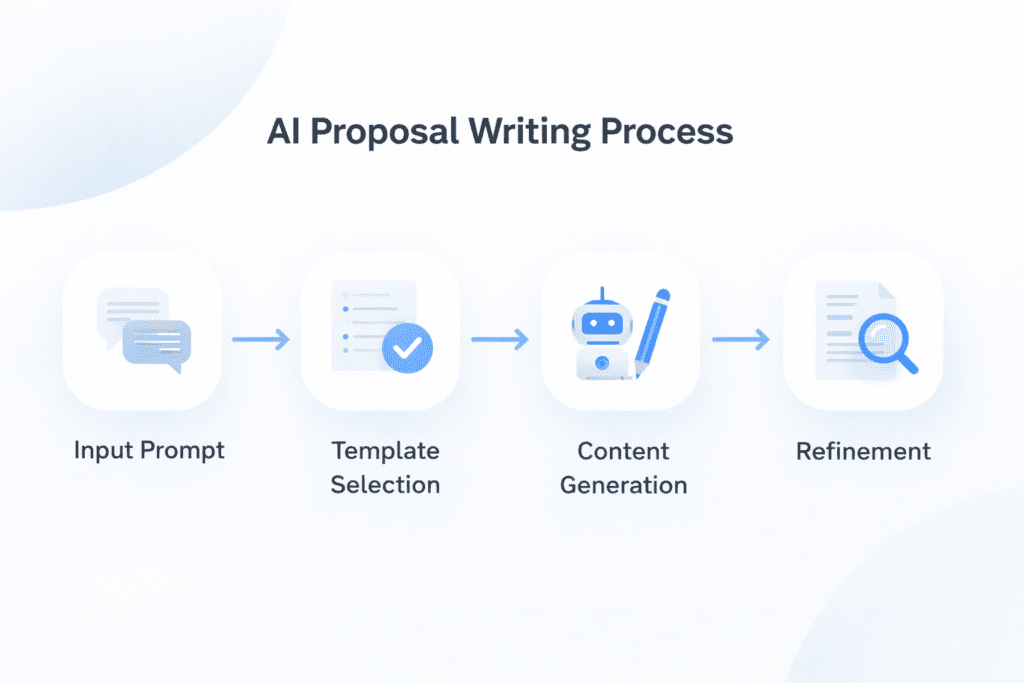
Most AI proposal writing tools follow a simple flow.
• Input prompt: You describe your proposal for a project or goal
• Template selection: The system applies a relevant template or structure
• Content generation: The AI proposal generator creates a draft
• Refinement: You edit and improve the proposal content
Now this is where people get confused. The AI proposal generator to create drafts is fast, but it doesn’t fully understand your context unless you guide it properly.
In most cases, better inputs lead to better outputs. Sounds obvious, but many users overlook this.
Why AI Tools for Proposal Writing Matter
There’s a reason these tools are becoming more common, especially for US-based freelancers and agencies.
• Faster drafting: Helps create proposals faster without starting from zero
• Consistent structure: Keeps every proposal organized and readable
• Scalability: Makes it easier to handle a higher volume of proposals
• Time savings: Helps you save time during busy work cycles
Here’s what I noticed. When someone is sending multiple proposals each week, even small time savings start to matter.
And when you’re dealing with a higher volume of proposals, that efficiency can directly impact how quickly you respond to opportunities.
Who Should Use AI Tools for Proposal Writing
Not everyone needs advanced proposal software. It depends on your workflow.
• Freelancers: Writing proposals for clients or project-based work
• Agencies: Managing multiple proposal workflows and teams
• Startups: Creating business proposal documents for growth
• Nonprofits: Handling grant proposal and grant applications
If you’re just starting out in the US, a simple writing tool might be enough. But if you’re managing proposal management across a team, you’ll likely need something more advanced.
That said, there are exceptions. Some people still prefer manual writing for full control, and in certain cases, that approach works.
How We Tested the Best AI Tools for Proposal Writing
To find the best AI tools for proposal writing, we didn’t just list features. We focused on how these tools perform in real proposal situations.
From my research, many articles skip this part. But testing matters, especially when drafting proposals that need to perform well.
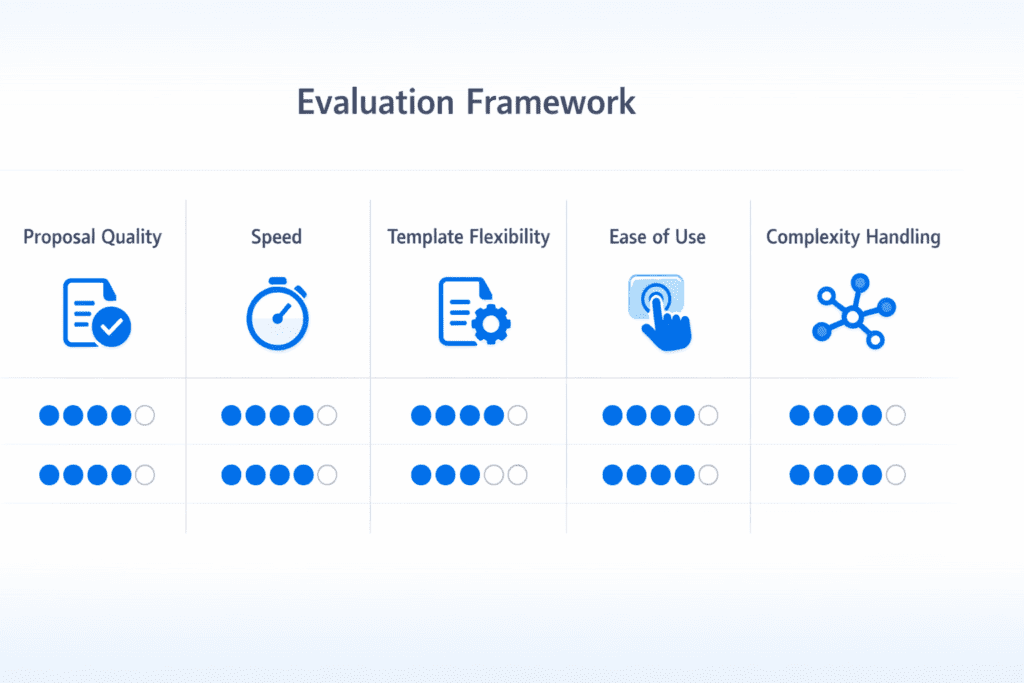
Testing Criteria We Used
We evaluated each AI tool based on practical performance.
• Proposal quality: Clarity, structure, and readability
• Speed: How fast the tool helps generate proposals
• Template flexibility: Ability to adapt templates to different needs
• Ease of use: This writing software is designed for beginners to easily create new proposals.
• Handling complexity: Ability to manage complex proposals
Here’s the thing. A tool might look powerful, but if it slows down your proposal workflow, it’s not really helping.
Real-World Proposal Scenarios We Evaluated
We tested these tools across real use cases.
• Business proposal creation: Service-based and client-focused proposals
• Grant writing workflows: Support for nonprofits and grant writers
• Sales proposals: Creating proposals to clients for conversions
• Template-based drafting: AI-generated proposals using templates
For example, a small US agency sending 8–10 proposals per week can benefit from tools that streamline the proposal process.
But let’s be real. AI-generated proposals still need editing. If you want a high-quality proposal, human input is still part of the process.
What Most Blogs Miss About AI Proposal Writing Tools
Most blogs talk about features. Templates, automation, speed… all of that sounds useful.
But here’s the thing. That’s not how proposal writing actually works in real situations.
From my research, the biggest gap isn’t the tools. It’s how people expect them to perform. A lot of users think AI will write a winning proposal on its own. In most cases, that’s not how it plays out.
There are a few important things people don’t talk about enough.
• Strategy still matters: AI can structure a proposal, but it can’t fully understand your client’s goals
• Templates are just a starting point: A template helps with layout, not personalization
• Editing is required: AI-generated proposals often need refinement before sending
• Tool choice impacts results: The right AI tool can improve proposal quality, while the wrong one slows you down
Here’s what I noticed. People who treat AI as a helper tend to get better results than those who rely on it completely.
Now this is where things get interesting. When you combine AI with human input, the proposal development process becomes faster without losing quality.
10 Best AI Tools for Proposal Writing (Detailed Breakdown)
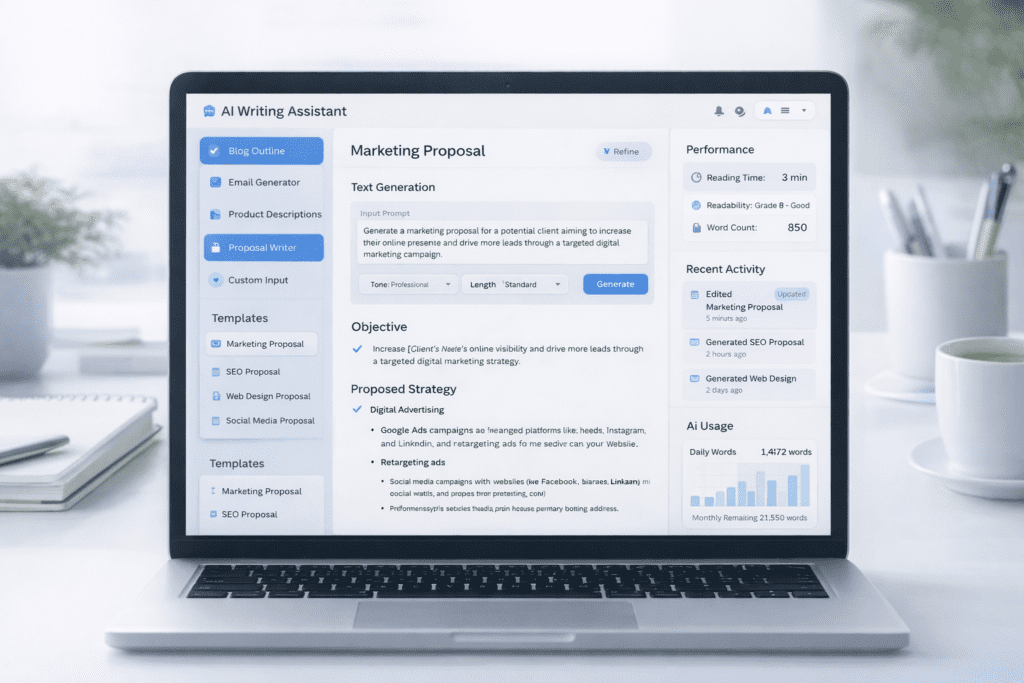
Jasper AI: Best AI Proposal Writer for High-Quality Content
Jasper AI is often considered one of the best AI tools for proposal writing, especially for long-form content and detailed proposal creation.
It’s built for users who need more than just quick drafts. Instead of basic outputs, Jasper focuses on generating structured and polished proposal content.
Key Features
• Advanced templates: Designed for long-form proposal writing
• Brand voice control: Helps keep every proposal consistent
• Long-form writing: Supports detailed proposal content, including government proposals and research proposals.
• Generative AI workflows: Built for scalable content creation
Pricing Plans
• Creator Plan – $69/month
• Pro Plan – $99/month
• Business Plan – Custom pricing
Pros
• High proposal quality: Produces more structured drafts
• Scalable usage: Works well for teams handling multiple proposals
Cons
• No free plan: Requires paid access from the start
Best For
Agencies and professionals who need a high-quality proposal at scale.
Here’s what I noticed. Jasper works well when you’re handling complex proposals or when consistency matters across multiple clients, helping you write winning content. If proposal quality is your priority, this is usually one of the stronger options.
Copy.AI: Best AI Tool for Fast Proposal Creation
Copy.AI focuses on speed. If your goal is to generate proposals quickly without spending too much time on setup, this tool can be useful.
It’s especially helpful for beginners who are just getting into AI writing and want a simple starting point.
Key Features
• AI proposal generator: Helps generate proposals quickly
• Workflow automation: Simplifies the proposal workflow
• Multiple templates: Offers different formats for proposal creation
Pricing Plans
• Free Plan – $0/month
• Pro Plan – $49/month
• Team Plan – Custom pricing
Pros
• Beginner-friendly: Easy to use interface
• Fast output: Helps create proposals faster
Cons
• Limited customization: May feel basic for advanced users
Best For
Beginners who want a simple way to start writing proposals can benefit from AI writing software.
Now this is where people get confused. Faster isn’t always better. Sometimes, quick drafts need more editing to reach a professional proposal level.
Writesonic: Best AI Writing Tool for SEO and Proposals
Writesonic is a flexible writing tool that supports both proposal writing and marketing content.
If you’re someone who handles multiple types of content, this tool can help streamline your workflow instead of switching platforms.
Key Features
• AI templates: Supports proposal template creation
• Chatbot assistant: Helps refine proposal content
• SEO support: Useful for content alongside proposals
Pricing Plans
• Free Plan – $0/month
• Individual Plan – $16/month
• Standard Plan – $79/month
Pros
• Multi-purpose usage: Works beyond proposal writing
• Flexible pricing: Suitable for different budgets
Cons
• Output variation: Some drafts may need editing
Best For
Users who want both SEO tools and proposal writing in one place.
That said, if your main focus is only writing proposals, you might not use all of its features. It’s more useful when you want one tool that handles different types of content.
Rytr: Best Budget AI Proposal Tool
Rytr is one of the most affordable options if you want to use AI tools for proposal writing without spending much.
It’s designed for simplicity. You don’t get a lot of advanced features, but for basic proposal creation, it usually gets the job done.
Key Features
• Simple interface: Easy to use even for beginners
• Pre-built templates: Helps structure a proposal quickly
• Multi-language support: Useful for different client needs
Pricing Plans
• Free Plan – $0/month
• Saver Plan – $9/month
• Unlimited Plan – $29/month
Pros
• Budget-friendly: One of the lowest-cost options
• Quick setup: Minimal learning curve
Cons
• Limited features: Not ideal for complex proposals
Best For
Budget users who need a simple way to write a proposal.
Here’s what I noticed. Rytr works best when speed and cost matter more than deep customization. If you’re handling simple proposals to clients, it can be enough.
Proposify: Best Proposal Software for Teams
Proposify is built for teams that manage a structured proposal workflow. It goes beyond writing and focuses more on proposal management.
If you’re working with multiple team members, this kind of proposal software can help keep everything organized.
Key Features
• Proposal tracking: Monitor when proposals are viewed
• Team collaboration: Work together on proposals
• Automation tools: Streamline repetitive tasks
Pricing Plans
• Basic Plan – $49/user/month
• Team Plan – $99/user/month
• Business Plan – Custom pricing
Pros
• Team-focused: Utilizing the power of AI can enhance team collaboration on project proposals. Built for collaboration
• Workflow automation: Reduces manual effort
Cons
• Higher cost: Not ideal for solo users
Best For
Agencies and teams managing multiple proposals.
Now this is where things shift a bit. Instead of just helping you write a proposal, Proposify helps track proposals and manage the entire proposal process.
For a US-based agency handling multiple clients, this kind of system can make the proposal workflow more predictable.
PandaDoc: Best AI Tool for Sales Proposals
PandaDoc combines proposal tools with document automation and e-sign features. It’s often used by sales teams that need to send proposals quickly and close deals.
It’s not the most advanced in AI writing, but it works well for handling the full proposal process.
Key Features
• Document automation: Speeds up proposal creation
• E-sign integration: Helps close deals faster
• Proposal templates: Ready-to-use formats
Pricing Plans
• Free Plan – $0/month
• Essentials Plan – $19/month
• Business Plan – $49/month
Pros
• All-in-one platform: Combines multiple tools
• Sales-friendly: Designed for proposals to clients
Cons
• Limited AI depth: Less focused on content generation
Best For
Sales teams that need to send proposals efficiently.
Let’s be real for a second. If your main goal is to close deals, features like e-sign can matter more than advanced writing.
Better Proposals: Best for Freelancers
Better Proposals focuses on simplicity and speed. It helps freelancers create proposals without dealing with complex tools.
The platform is built around ready-made templates, which makes it easy to get started.
Key Features
• Ready-made templates: Helps create proposals quickly
• Tracking tools: Monitor proposal views
• Automation: Reduces repetitive steps
Pricing Plans
• Starter Plan – $19/month
• Premium Plan – $29/month
• Enterprise Plan – Custom pricing
Pros
• Easy to use: Minimal setup required
• Fast creation: Good for quick proposals
Cons
• Limited advanced AI features: Not as powerful as some tools
Best For
Freelancers who want a straightforward way to write a proposal can use AI tools to improve their chances of winning more business.
That said, if you’re working on complex proposals, you might find it slightly limited. But for everyday client work, it usually does the job well.
GrammarlyGO: Best Writing Assistant for Proposal Quality
GrammarlyGO isn’t a full proposal software. Instead, it acts as a writing assistant that improves your proposal content.
It’s often used alongside other AI tools for proposal writing rather than as a standalone solution.
Key Features
• Grammar correction: Improves clarity
• Tone suggestions: Adjusts writing style
• AI rewriting: Use an AI to enhance your proposal content and ensure it meets best practices.
Pricing Plans
• Free Plan – $0/month
• Premium Plan – $12/month
• Business Plan – $15/user/month
Pros
• Improves clarity: Makes proposals easier to read
• Easy integration: Works with other tools
Cons
• Not full proposal software: Limited for complete workflows
Best For
Users who want to improve proposal quality.
Here’s the thing. Even the best AI-generated proposals can feel rough at times. A writing assistant like this helps polish the final output before you send proposals.
Grantable: Best AI Tool for Grant Proposal Writing
Grantable is designed specifically for grant writing and grant proposal workflows. It’s not a general-purpose tool, and that’s actually its strength.
Instead of trying to handle every type of proposal, it focuses on helping grant writers deal with structured and often complex grant applications.
Key Features
• AI grant assistant: Supports structured grant proposal writing
• Smart suggestions: Helps improve proposal content by incorporating best practices and the latest trends in writing winning proposals.
• Collaboration tools: Useful for teams working on grant applications
Pricing Plans
• Starter Plan – Custom pricing
• Team Plan – Custom pricing
Pros
• Specialized focus: Built for grant proposal needs
• Workflow support: Helps manage structured applications
Cons
• Limited general use: Not ideal for everyday business proposal work
Best For
Nonprofits and teams focused on grant writing.
From my research, tools like this make more sense when you’re dealing with detailed grant requirements. For general proposals to clients, it may feel a bit too specific.
Anyword: Best for Conversion-Focused Proposals
Anyword focuses on performance. It uses data and predictive scoring to improve how your proposal performs, especially in marketing or sales contexts, helping you win more business.
This makes it different from generic AI writing tools that only generate content without feedback.
Key Features
• Predictive scoring: Estimates how content may perform
• AI optimization: Improves proposal content
• Data insights: Helps refine messaging
Pricing Plans
• Starter Plan – $39/month
• Data-Driven Plan – $79/month
• Business Plan – Custom pricing
Pros
• Data-driven: Focuses on measurable outcomes
• Conversion-focused: Helps improve engagement
Cons
• Higher cost: More expensive than basic tools
Best For
Marketing teams that want better-performing proposals.
Here’s what I noticed. If your goal is not just to write a proposal but to improve how it converts, this kind of tool can be useful.
Best AI Tools for Proposal Writing by Use Case
Different users need different tools. Choosing the right AI tools for proposal writing depends on your workflow and goals.
• Freelancers: Rytr, Better Proposals
• Agencies: Jasper AI, Proposify
• Grant writing: Grantable
• Beginners: Copy.AI
• Sales teams: PandaDoc
Now this is where people often overthink things. You don’t need the most advanced tool. You need the right AI tool for your specific use case.
AI Proposal Writing vs Traditional Proposal Writing: Key Differences
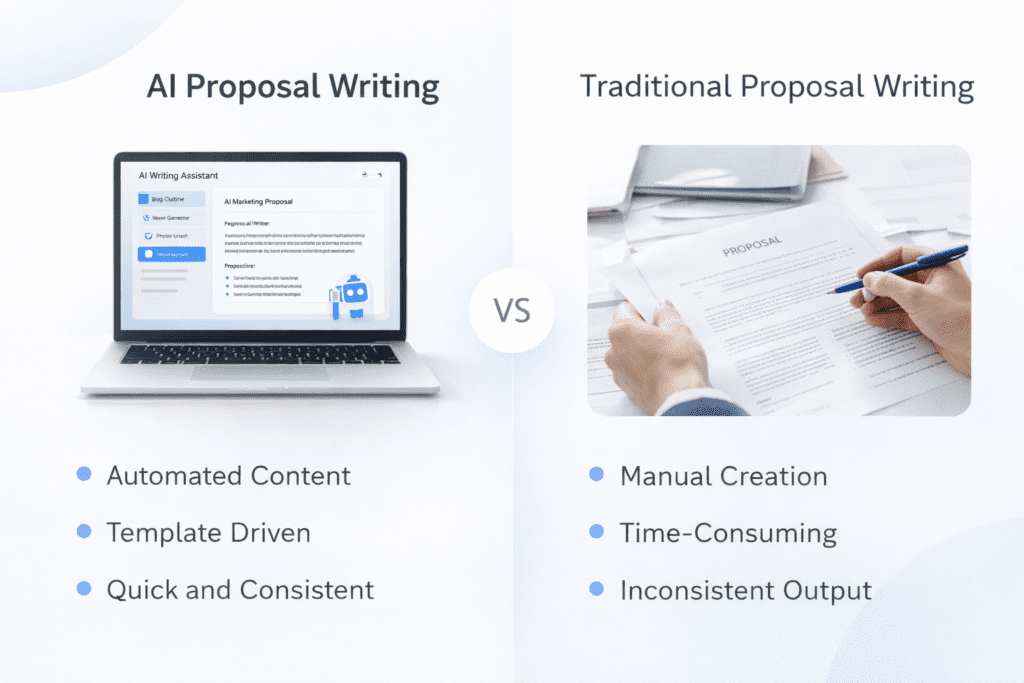
AI proposal writing and traditional proposal writing follow different approaches. Both have their place depending on the situation.
Key Differences
• AI approach: Faster proposal generation with structured output
• Traditional approach: Manual writing with full control
Speed Comparison
• AI tools: Help create proposals faster
• Manual writing: Takes more time
Quality Comparison
• AI: Improves structure and consistency
• Human input: Improves personalization
Here’s the thing. AI can handle the structure of every proposal, but personalization still comes from you.
If you rely only on AI-generated proposals, the content may feel generic. That’s why combining both approaches usually works better.
When You Should Not Use AI for Proposal Writing
AI is useful, but it’s not always the right choice.
• High-stakes proposals: Requires deep customization
• Complex proposals: Needs detailed understanding
• Legal documents: Requires accuracy and compliance
In some cases, manual writing is still the better option. Especially when the proposal needs a high level of detail or precision.
That said, even in these situations, AI can still help with drafting proposals or structuring ideas before final editing.
Future of AI Tools for Proposal Writing
AI tools for proposal writing are still evolving, and the changes are becoming more practical than experimental.
From my research, the shift is moving toward smarter systems that don’t just generate proposals, but actually support the full proposal workflow.
• Smarter automation: Proposal software is becoming more workflow-driven
• Better personalization: AI helps create more customized proposal content
• CRM integration: Tools connect with platforms like Salesforce or HubSpot
• Improved accuracy: AI capabilities are getting better with context
Here’s the thing. AI excels when it handles repetitive work, but it’s slowly getting better at adapting to different proposal styles too.
That said, there are exceptions. For complex proposals, human input will still play a major role.
Buying Guide: How to Choose the Right AI Tool for Proposal Writing
Choosing the right AI tools for proposal writing depends on how you actually plan to use them.
What to Consider Before Choosing
• Proposal type: Business proposal, sales, or grant proposal
• Features: Templates, automation, or collaboration tools
• Ease of use: Beginner-friendly vs advanced systems
If you’re just starting out in the US, it’s usually better to begin with a simple AI tool and then upgrade later if needed.
Budget and ROI Considerations
• Free vs paid: Free tools are good for testing
• Return on investment: Time saved vs cost
For example, a freelancer paying $19/month for a tool that helps send proposals faster might recover that cost with just one client.
Beginner vs Advanced Tools
• Beginners: Simple writing tool with basic templates
• Advanced users: Full proposal software with automation
Now this is where people get confused. More features don’t always mean better results. Sometimes, simpler tools are easier to use and more effective.
Common Mistakes in AI Proposal Writing
Even with the best AI tools, mistakes can happen.
• Over-reliance on AI: Using AI without editing
• Ignoring context: Not tailoring the proposal to the client
• Wrong tool selection: Choosing tools that don’t match needs
• Skipping review: Sending proposals without checking
Here’s what I noticed. Most beginners focus too much on speed and forget about proposal quality.
AI helps, but it doesn’t replace thinking.
FAQs About AI Tools for Proposal Writing
What are the best AI tools for proposal writing
Jasper AI, Copy.AI, and Proposify are among the best AI tools for writing winning proposals depending on your needs.
Can I use AI for grant proposal writing
Yes, tools like Grantable support grant writing and structured grant proposal workflows.
How do AI tools improve proposal quality
They improve structure, clarity, and help generate proposals faster.
Are AI-generated proposals reliable
In most cases, yes. But editing is still required before sending.
How to choose the right AI proposal tool
Choose based on your use case, features, budget, and best practices for writing winning proposals.
Can AI help create better proposals faster
Yes, AI tools can help create proposals faster while maintaining structure.
Do AI tools support different proposal types
Yes, they support business proposals, sales, grant writing, and project proposals.
Is using AI for proposal writing safe
Yes, as long as you review the final proposal before sending.

Final Verdict: Choosing the Best AI Tool for Proposal Writing
The best AI tools for proposal writing depend on what you actually need.
• Jasper AI: Strong choice for high-quality proposal content
• Rytr: Works well for budget users
• Proposify: Ideal for teams managing proposals, especially when utilizing the power of AI to streamline the process.
• Grantable: Designed for grant writing
Bottom line? If you want to create proposals faster without sacrificing structure, using AI tools makes sense.
But let’s keep it real. AI can help you write a proposal, but it won’t replace your thinking. The best results usually come from combining AI with your own input.
If you’re just starting out, try a simple tool first. Once your workflow grows, you can move toward more advanced options that help streamline your proposal process.