

A common mistake new bloggers make is assuming an AI blogging system can fully run a website on autopilot. They install an AI blog writer, generate articles in minutes, publish everything without editing, and expect Google rankings to appear automatically. In most cases, that approach fails pretty quickly.
An AI blogging system works better when it supports your workflow instead of replacing your thinking. Tools like ChatGPT, Jasper, Surfer SEO, Grammarly, and WordPress can help automate repetitive blogging tasks, speed up blog writing, and improve SEO organization. But human editing, content strategy, and audience understanding still matter. This guide focuses on building a practical AI blog workflow with realistic expectations, workflow systems, AI-powered automation, and real-life examples.
What Is an AI Blogging System?
Beginner Friendly Definition of an AI Blogging System
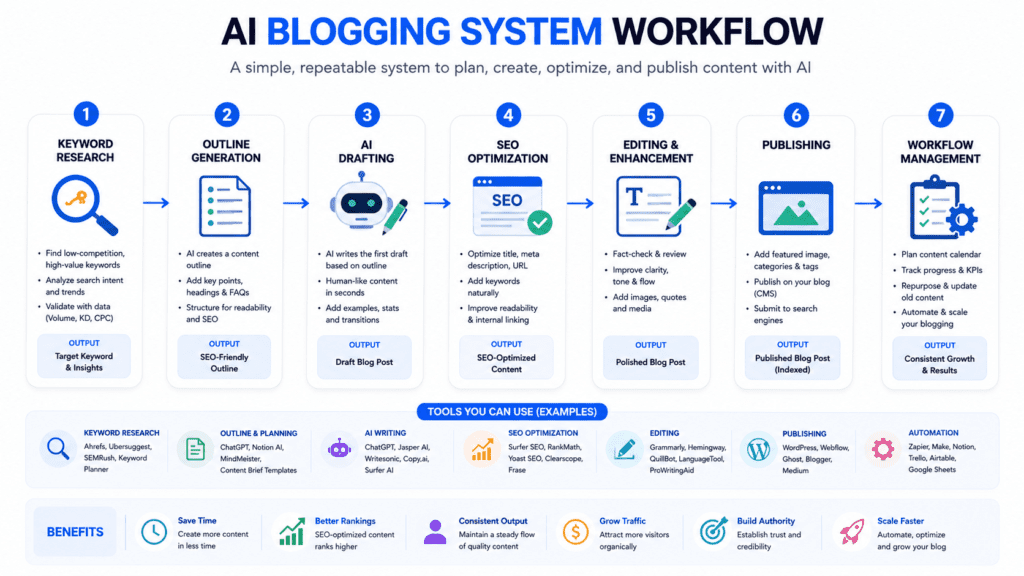
An AI blogging system is a structured workflow where multiple AI tools work together to help create, edit, optimize, and publish blog posts more efficiently.
Instead of using one random generator for fully automated article creation, the system combines different tools for specific tasks. One AI tool may help with keyword research. Another may help generate outlines. A different writing tool may assist with the first draft or SEO optimization.
That’s the biggest difference between AI-assisted blogging and autoblogging.
Autoblogging usually focuses on publishing large amounts of ai-generated content automatically with little editing. An AI blogging system focuses more on workflow quality, organization, and long term ranking potential.
Here’s the thing though. Workflow matters more than speed alone.
A solo blogger using ChatGPT for keyword planning, Jasper for long-form drafts, Grammarly for editing, and Surfer SEO for optimization often produces stronger blog content than someone relying on one-click automated article tools.
Why AI Blogging Systems Matter in the Digital Age
The digital age increased demand for faster content creation across almost every industry. Businesses, niche websites, affiliate marketers, and content creators all need blog posts consistently.
That pressure is one reason AI blogging became a game-changer for smaller creators with limited time or budget.
An organized AI blog workflow can help:
• Faster blog writing: Reducing manual drafting time
• Easier content scaling: Publishing more consistently
• Better workflow organization: Managing tasks more clearly
• Lower production costs: Reducing outsourcing expenses
• More efficient SEO workflows: Improving optimization systems
A solo blogger running a niche website might use AI tools for keyword research, outlines, blog writing ai workflows, SEO optimization, and project management without hiring a large content team.
That doesn’t mean AI replaces creativity completely. Honestly, some ai-generated blog posts still feel robotic if no human touch is added afterward.
Why More Content Creators Are Using AI Blog Systems
Publishing consistently is difficult when every article takes several hours manually. That’s one reason more blog writers and affiliate marketers now use ai tools to automate parts of the content creation process.
A structured workflow also reduces burnout. Instead of starting from scratch every time, creators can use reusable template systems for outlines, prompts, formatting, and optimization.
A niche site owner working a full-time job, for example, might use an AI blogging system to maintain a weekly publishing schedule while managing limited free time during evenings.
Now this is where people get confused. AI can create content faster, but speed alone doesn’t guarantee ranking or traffic. SEO, content quality, audience intent, and editing still make a major difference.
What Most Beginners Get Wrong About AI Blog Writing
One of the biggest problems with ai blog systems is unrealistic expectations. Some people think an ai blog post generator can fully replace research, editing, and SEO strategy.
Usually, that leads to weak results.
Common mistakes include:
• Expecting one click autoblogging success: Publishing without reviewing quality
• Using unedited AI articles: Leaving repetitive phrasing untouched
• Ignoring SEO and brand voice: Creating generic content
• Over automating workflows: Sacrificing readability for speed
Many AI blog posts fail to gain traction because they don’t match search intent or provide original value. From my research, this happens more often when creators focus only on volume.
A website publishing dozens of automated article drafts weekly may still struggle with ranking if the articles feel repetitive or shallow.
That said, AI isn’t the real problem. Poor workflow systems usually are.
How an AI Blogging System Actually Works
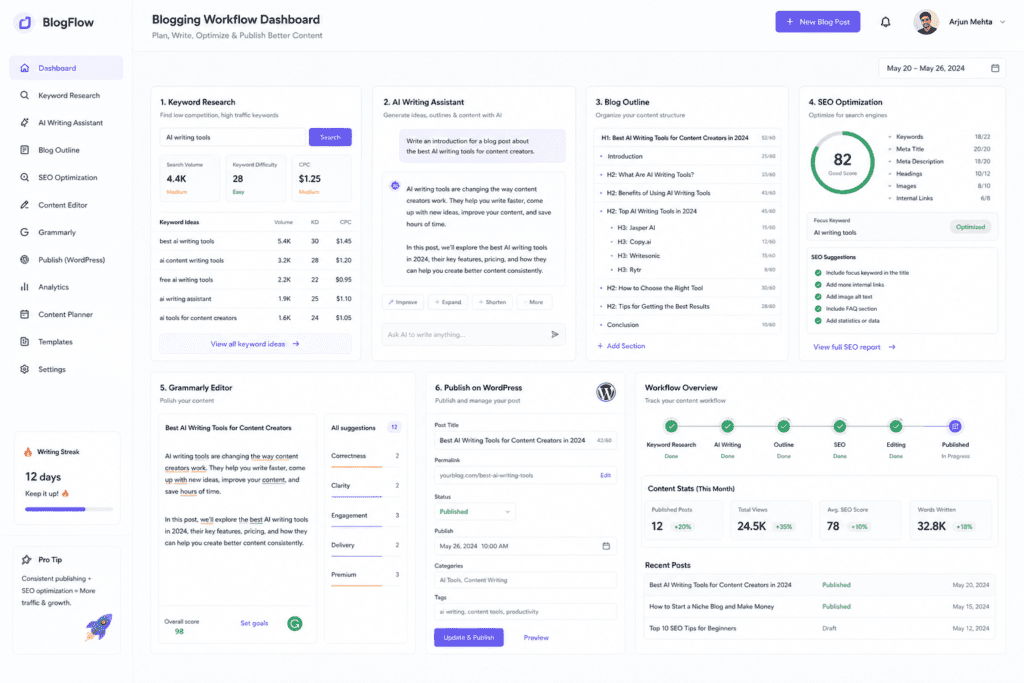
An effective AI blogging system combines multiple tools into a repeatable workflow. Each part handles a specific task inside the content creation process.
Core Parts of an AI Blogging Workflow
Most beginner systems include:
• Keyword research: Finding searchable topics
• Draft creation: Building outlines and first draft content
• SEO optimization: Improving ranking signals
• Editing workflows: Improving readability and clarity
• Publishing systems: Organizing blog schedules
Instead of relying on one generator for everything, different ai tools support different stages of blog writing.
Keyword Research
Keyword research helps bloggers identify topics people actually search for.
This includes:
• Finding ranking opportunities: Identifying lower competition topics
• Search intent analysis: Understanding reader goals
• SEO planning: Building topic clusters strategically
Some creators use ChatGPT alongside SEO platforms like Surfer SEO or Ahrefs to organize keyword ideas before writing begins.
AI Blog Post Generation
This stage focuses on generating outlines and initial article drafts faster.
An ai blog post generator can help:
• Generate articles: Creating structured draft content
• Build outlines: Organizing article sections
• Speed up workflows: Reducing manual writing time
Jasper, Copy.ai, and other blog writer software tools are commonly used for this stage.
Still, there are exceptions. A fast first draft doesn’t automatically become high-quality content without editing.
Editing and SEO Optimization
Editing is where weaker AI writing usually gets exposed.
Human review helps optimize:
• Readability: Improving flow and sentence variation
• SEO optimization: Refining headings and keyword placement
• Brand voice: Making content sound more natural
• Internal linking: Strengthening site structure
A blogger might rewrite an ai-generated introduction manually because generic openings often reduce engagement.
Honestly, this editing stage is where good AI blog systems separate themselves from low quality autoblogging setups.
Publishing and Project Management
The final stage focuses on organization and consistency.
Most systems use platforms like WordPress, Notion, Trello, or Google Docs to manage scheduling, publishing, and workflow integration.
An organized workflow helps creators publish blog posts consistently without feeling overwhelmed by scattered tasks.
Now this doesn’t need to become overly technical. Even a simple setup using WordPress, ChatGPT, Grammarly, and a project management board can work surprisingly well for smaller niche sites.
Simple AI Blogging Workflow for Beginners
| Step | Task | Recommended AI Tool |
|---|---|---|
| 1 | Keyword research | ChatGPT + SEO tools |
| 2 | Outline generation | ChatGPT |
| 3 | AI blog writing | Jasper |
| 4 | SEO optimization | Surfer SEO |
| 5 | Editing | Grammarly |
| 6 | Publishing | WordPress |
| 7 | Workflow management | Notion or Trello |
A beginner blogger using ChatGPT for outlines, Jasper for long-form drafts, and Surfer SEO for optimization can usually create blog posts much faster than relying on manual writing alone.
That’s one reason platforms like WordPress and Webflow continue integrating more AI-powered workflow features into their ecosystems.
What You Need Before Building an AI Blogging System
An AI blogging system works better when the creator understands a few basic skills first. You don’t need advanced ai knowledge or coding experience, but learning core workflow fundamentals makes the process smoother.
Basic AI Skills Every Beginner Should Learn
• Prompt writing: Creating clearer instructions for better outputs
• Editing ai-generated content: Improving readability manually
• SEO basics: Understanding ranking and search intent
• Workflow organization: Managing projects consistently
• Content formatting: Structuring articles cleanly
Most beginners underestimate how important editing becomes inside ai blog writing workflows.
A polished article usually comes from good prompts plus human review, not from fully automated publishing.
Understanding Brand Voice in AI Blog Writing
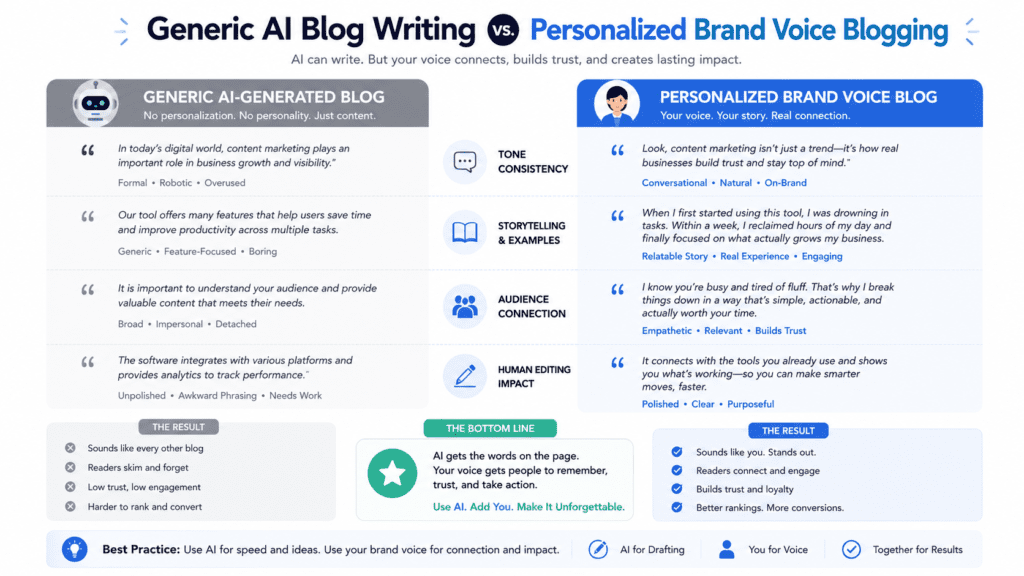
What Is Brand Voice?
Brand voice is the consistent tone and style your content uses across blog posts, newsletters, and website pages.
Some blogs sound casual. Others sound technical or highly professional. A strong brand voice helps readers recognize your content faster.
For example, HubSpot articles often sound educational and structured, while smaller niche blogs may feel more conversational.
Why AI Blog Posts Often Sound Generic
AI-generated writing sometimes feels repetitive because the system pulls from broad language patterns instead of personal expertise.
Common issues include:
• Repetitive phrasing: Similar sentence patterns repeated often
• Weak personalization: Limited audience targeting
• Generic explanations: Missing practical context
Now this is where people get frustrated with ai writing. The outputs may look clean initially, but after reading several paragraphs, everything starts sounding similar.
That’s why fully automated blog systems often struggle long term.
How to Train AI Tools to Match Your Brand Voice
A structured template system can improve consistency significantly.
Helpful methods include:
• Prompt examples: Showing preferred writing style
• Brand guidelines: Defining tone and formatting rules
• Previous articles: Using older blog posts as references
A productivity focused content creator, for example, might train ChatGPT using previous posts to create more natural ai-generated blog posts with stronger consistency.
Personally, I think this hybrid approach works better than chasing fully automated content systems. AI performs best when it supports human direction instead of replacing it completely.
Best AI Tools for Building an AI Blogging System
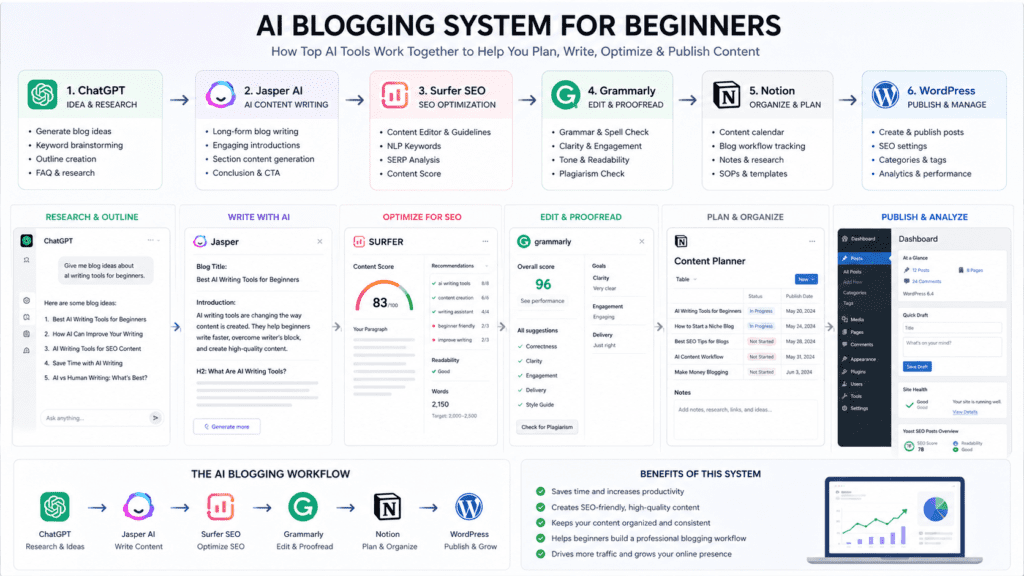
Different tools handle different parts of the workflow. Some focus on blog writing ai tasks, while others focus more on optimization or project management.
ChatGPT
ChatGPT is commonly used for:
• Blog outlines: Structuring article ideas
• Prompt workflows: Organizing instructions
• Keyword planning: Brainstorming topic ideas
• SEO assistance: Supporting content strategy workflows
The platform works well because it’s flexible and beginner friendly. A free account is usually enough for testing simple workflows before upgrading later.
Jasper AI
Jasper is designed more for long-form blog writing and marketing focused workflows. A lot of affiliate bloggers and agencies use Jasper to generate articles faster while maintaining structured formatting.
The platform includes:
• Blog templates: Faster article organization
• Workflow collaboration: Useful for teams
• Content drafting: Faster first draft generation
• Marketing support: Landing pages and email copy
Some users also connect Jasper with Surfer SEO for more seamless optimization workflows.
That said, Jasper still works best when editing remains part of the process. Even advanced ai writing systems can sound repetitive without human review.
Surfer SEO
Surfer SEO focuses heavily on seo optimization and ranking improvements.
It helps bloggers:
• Optimize headings: Improving structure for search intent
• Analyze keyword usage: Balancing optimization naturally
• Improve content scoring: Comparing against competing pages
• Support ranking workflows: Organizing SEO improvements
A niche blogger trying to rank product review content may use Surfer SEO to optimize article structure before publishing on WordPress.
From my research, this usually works better than publishing unoptimized AI articles directly.
Grammarly
Grammarly helps improve readability, grammar, and content quality.
It’s especially useful for:
• Grammar correction: Fixing writing mistakes
• Readability improvements: Making content smoother
• Sentence clarity: Reducing awkward phrasing
Even strong AI blog systems benefit from manual editing support. Grammarly doesn’t replace editing completely, but it can speed up revision workflows significantly.
Notion
Notion is commonly used for workflow organization and project management.
Bloggers often use it to:
• Track article ideas: Organizing content calendars
• Manage publishing schedules: Improving consistency
• Store prompt systems: Saving reusable workflows
• Coordinate projects: Managing larger content systems
Some creators also build entire content strategy dashboards inside Notion to manage blog writing workflows more efficiently.
How Much Does an AI Blogging System Cost?
The cost of an AI blogging system depends on how advanced the workflow becomes. Some beginners start almost entirely free, while larger content teams invest in advanced ai workflow integration tools.
Free AI Blogging Setup
A beginner setup may include:
• ChatGPT free version: Basic prompt workflows
• Free SEO tools: Topic research and optimization
• Google Docs: Draft organization
• WordPress: Publishing platform
This type of setup works well for learning fundamentals without spending much money upfront.
Budget AI Blogging Stack
A more structured workflow may include:
• Jasper: Long-form drafting support
• Grammarly: Editing assistance
• Basic SEO tools: Optimization support
A beginner affiliate blogger may spend around $20/month to $50/month for a smaller workflow stack depending on the tools selected.
Honestly, that’s still far cheaper than outsourcing every article manually.
Advanced AI Blogging Workflow Costs
Advanced workflows often include:
• SEO platforms: Larger optimization systems
• Automation tools: Workflow integration software
• Team collaboration systems: Shared project management
• Advanced ai tools: Scalable publishing support
Some larger websites also connect plugin systems, analytics dashboards, and automation workflows across platforms like WordPress, Notion, and Copy.ai to manage higher publishing volume more efficiently.
A beginner blogger, though, usually doesn’t need advanced ai systems immediately. Starting simple tends to work better than overbuilding workflows too early.
Step by Step AI Blogging System Setup for Beginners
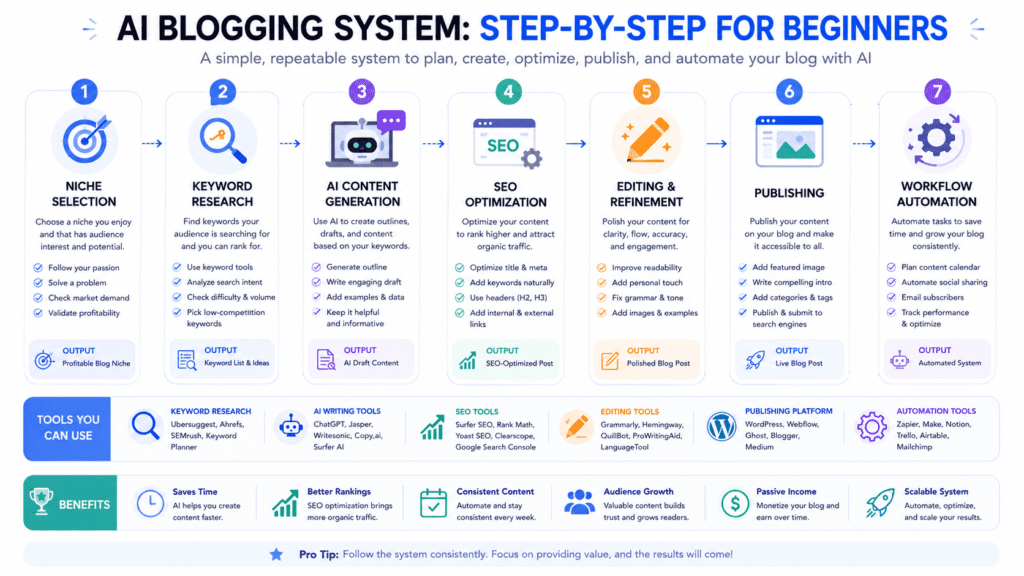
Step 1: Choose a Blog Niche
Niche selection affects almost everything inside an AI blogging system, including SEO opportunities, audience targeting, and monetization potential.
A focused niche usually performs better than publishing random topics across unrelated categories.
Why Niche Selection Matters for SEO
A clear niche helps:
• Build topical authority: Improving trust signals
• Create stronger ranking opportunities: Focusing content direction
• Improve audience targeting: Attracting consistent readers
For example, a website focused entirely on productivity tools often builds authority faster than a general blog covering unrelated subjects.
Beginner Friendly Niche Ideas
• AI tools: Growing search demand
• Productivity: Evergreen content opportunities
• Personal finance: Strong affiliate potential
• Online business: High content demand
• Education: Consistent search traffic
A beginner starting a productivity focused AI blog around tools for students may find it easier to organize keyword clusters and content strategy early on.
Step 2: Create an SEO Content Workflow
A structured workflow makes publishing more manageable and helps maintain consistency.
Without organization, most creators eventually lose track of ideas, drafts, optimization tasks, and publishing schedules.
Keyword Research Setup
A basic workflow often includes:
• Finding low competition keywords: Easier ranking targets
• Search intent analysis: Matching reader expectations
• Keyword organization: Structuring article clusters
Some creators use tools like Ahrefs, Surfer SEO, or ChatGPT to organize keyword systems before starting blog writing.
Content Calendar Creation
Publishing consistency becomes easier when workflows are planned ahead.
Helpful systems include:
• Monthly planning: Organizing future blog posts
• Workflow tracking: Monitoring publishing progress
• Project management boards: Managing article stages
A blogger using Notion for monthly content planning may avoid burnout more easily because tasks remain organized instead of scattered.
Now this is where workflow organization becomes surprisingly important. Even strong AI blog writing systems struggle if publishing schedules constantly break down.
Step 3: Build AI Blog Post Templates
Reusable template systems save time and improve consistency across multiple articles.
Most experienced content creators don’t start every article from zero.
Create Reusable Prompt Templates
Useful template systems include:
• Introduction prompts: Faster opening creation
• Outline prompts: Better article structure
• SEO prompts: Optimization support
• FAQ prompts: Answer formatting consistency
A structured prompt system can also improve brand voice consistency across different blog posts.
Why Templates Improve Workflow Efficiency
Templates help:
• Create content faster: Reducing repetitive setup
• Improve formatting consistency: Keeping articles organized
• Support workflow efficiency: Simplifying repetitive tasks
A content creator reusing structured prompts for outlines and formatting may save several hours weekly during the content creation process.
Step 4: Use AI Blog Post Generators Correctly
An ai blog post generator can support drafting and workflow speed, but it still has limitations.
That’s why human editing remains important.
What an AI Blog Post Generator Can Actually Do
Most systems can:
• Generate outlines: Organizing article sections
• Create first draft content: Accelerating writing speed
• Support ai for blog workflows: Reducing repetitive work
Some tools even produce posts in minutes, but faster outputs don’t always mean stronger content quality.
What AI Cannot Fully Automate
AI still struggles with:
• Original expertise: Unique real-world knowledge
• Audience trust: Building emotional connection
• Personal insights: Adding authentic perspective
• Strategic SEO thinking: Understanding long term positioning**
A blogger improving ai-generated introductions manually often creates more engaging articles than someone publishing raw automated article drafts directly from a generator.
Step 5: Optimize AI Blog Content for SEO
Even the best ai blog workflows still need proper SEO structure. Without optimization, strong articles may never reach the right audience.
SEO Elements Every AI Blog Needs
Important optimization areas include:
• Search intent alignment: Matching what readers expect
• Internal linking: Connecting related blog posts
• Heading structure: Improving readability and organization
• Readability improvements: Making articles easier to scan
A blogger using Surfer SEO may optimize headings, keyword placement, and formatting before publishing content on WordPress.
How SEO Helps AI Articles Rank
Good optimization improves:
• Keyword relevance: Better topical alignment
• Engagement signals: Longer reading time
• Topical authority: Stronger site organization
A blogger rewriting generic AI introductions to better match search intent may notice stronger ranking stability over time.
That said, SEO optimization alone isn’t enough. High-quality content still matters more than stuffing keywords everywhere.
Step 6: Automate Repetitive Blogging Tasks
An organized AI blogging system should automate repetitive work without sacrificing quality.
The goal is improving efficiency, not removing human involvement completely.
Tasks You Can Safely Automate
Helpful automation tasks include:
• Outline generation: Faster article structure
• Meta description creation: Supporting SEO workflows
• Content briefs: Organizing article direction
• Social captions: Supporting content promotion
Some creators also use Copy.ai or RightBlogger to automate content planning and repetitive formatting tasks.
Tasks You Should Not Fully Automate
Certain tasks still require human review.
These include:
• Final editing: Improving clarity and flow
• Fact-checking: Verifying information accuracy
• Personal insights: Adding originality
• Brand storytelling: Maintaining audience connection
A blogger automating keyword clustering while manually reviewing every article often builds stronger long term trust than a fully automated autoblogging system.
AI Blogging System vs Traditional Blog Writing
| Feature | AI Blogging System | Traditional Blog Writing |
|---|---|---|
| Speed | Faster | Slower |
| Workflow automation | Higher | Lower |
| Scaling content | Easier | Harder |
| SEO optimization | Faster with tools | Manual process |
| Content costs | Lower long term | Higher outsourcing costs |
| Human creativity | Needs editing | Naturally stronger |
Traditional blog writers still bring stronger storytelling naturally, while AI systems improve workflow speed and organization.
Honestly, the best setup usually combines both approaches instead of treating them as competitors.
Frequently Asked Questions
What is an ai blogging system and how does it help with content creation?
An ai blogging system uses artificial intelligence to draft and edit posts, making it easier to produce ai content quickly and consistently.
Can an ai blogging system act as my article writer?
Yes, it can write drafts, suggest headlines, and format text so you have ready to publish posts faster.
Is the ai content produced by these systems ready to publish?
Often the output is near ready to publish but benefits from a quick human edit for voice and accuracy.
How does integration with my current blog platform work?
Most systems offer simple integration or plugins so the blog tool connects directly and queues your next post.
Will using an ai blogging system save me time?
Definitely, these tools are time-saving by automating research, outlines, and first drafts in a step-by-step flow.
Can artificial intelligence keep my brand voice consistent?
Yes, you can train templates and tone settings so the AI mimics your style across posts and next post ideas.
Are there case studies showing real results from using an ai blogging system?
Yes, many vendors publish case studies that show improved output, traffic, and growing your business metrics.
Is autoblogging safe and does it affect SEO?
Autoblogging can be safe if content is unique and edited; good AI tools focus on quality to protect SEO health.
How do I get started step-by-step with an ai blogging system?
Start by connecting your blog tool, set tone and keywords, generate a draft, edit, then publish the next post.
Can small businesses use an ai blogging system for growing your business?
Yes, small teams use it to scale content, drive leads, and free time for strategy and customer work.
What should I look for in the best ai blog tool?
Look for quality of writing, easy integration, customization, and options to export ready to publish content.
Final Verdict: Is an AI Blogging System Worth It for Beginners?

Bottom line? Yes, if expectations stay realistic.
An AI blogging system can help beginners create blog content faster, organize workflows more efficiently, and maintain publishing consistency without feeling overwhelmed. Tools like ChatGPT, Jasper, Grammarly, Surfer SEO, and WordPress support different parts of the workflow, but human input still matters for ranking and audience trust.
The strongest systems usually balance AI for speed with human creativity, editing, and SEO strategy.
My Recommendation
• Start simple: Use ChatGPT, WordPress, and basic SEO workflows first
• Focus on quality: Avoid publishing weak ai-generated content
• Build repeatable systems: Create reusable workflow templates
• Improve gradually: Develop stronger prompt and optimization skills over time
A beginner blogger using a structured AI blogging workflow can realistically publish consistent, optimized articles without needing a large content team.
Final Thoughts on Building a Long Term AI Blogging Workflow
The best ai blog systems don’t fully replace human creativity. They support it.
If you’re just starting out, focus on learning workflow fundamentals before chasing advanced automation. A smaller system with strong editing and clear content strategy usually performs better than a massive automated blog producing low quality articles daily.