

An AI Content Pipeline is a structured system where AI tools, workflow automation, editorial processes, and publishing systems work together to streamline content production at scale. Instead of relying on disconnected tools or scattered workflows, agencies use an AI pipeline to organize research, drafting, editing, approvals, publishing, and analytics inside one operational framework.
That’s one reason more agencies are investing in AI Content Pipeline systems. Traditional content production often struggles with slow approvals, inconsistent output, workflow bottlenecks, and increasing SEO demands. A practical content pipeline helps automate repetitive tasks while improving workflow visibility, team coordination, and publishing consistency. This guide focuses on scalable frameworks, AI agents, automation systems, SEO-focused workflows, quality control strategies, and realistic agency operations.
Quick Picks (2026)
Best Overall AI Writing Platform: Jasper AI
Best for: Scalable agency workflows and brand voice consistency
Best for Workflow Automation: ClickUp
Best for: Managing editorial workflows, projects, and team collaboration
Best for SEO Optimization: Surfer SEO
Best for: Ranking-focused workflows and SEO content optimization
•Best AI Assistant for Drafting: ChatGPT
Best for: Research, outlines, drafting, and flexible AI workflows
What Is an AI Content Pipeline?
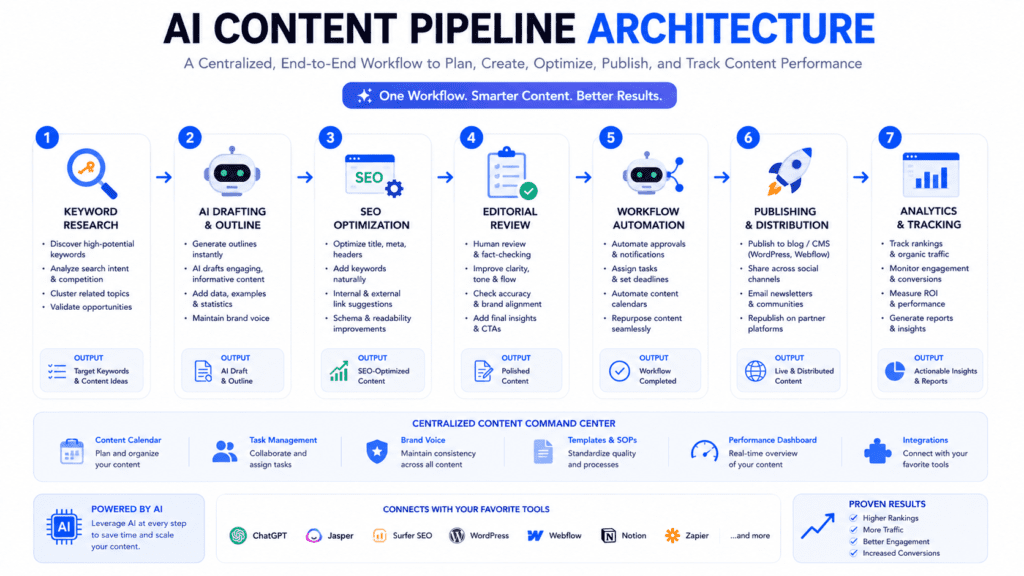
Beginner Friendly Definition of an AI Content Pipeline
An AI Content Pipeline is a structured workflow where multiple AI tools support different stages of content operations.
One platform may handle keyword research. Another tool may assist with draft generation. A separate system may manage workflow automation, approvals, analytics, or publishing.
That’s the main difference between isolated AI usage and a scalable pipeline design.
Using AI randomly across disconnected tools often creates confusion, duplicate work, and inconsistent output. A structured pipeline creates consistency across teams, workflows, and publishing systems.
Here’s the thing though. Agencies don’t really scale through tools alone. They scale through systems.
A content agency using ChatGPT for research, Jasper AI for drafting, Surfer SEO for optimization, ClickUp for approvals, and Zapier for automation can usually streamline production much better than a team relying entirely on manual handoffs.
How AI Pipelines Change Modern Content Operations
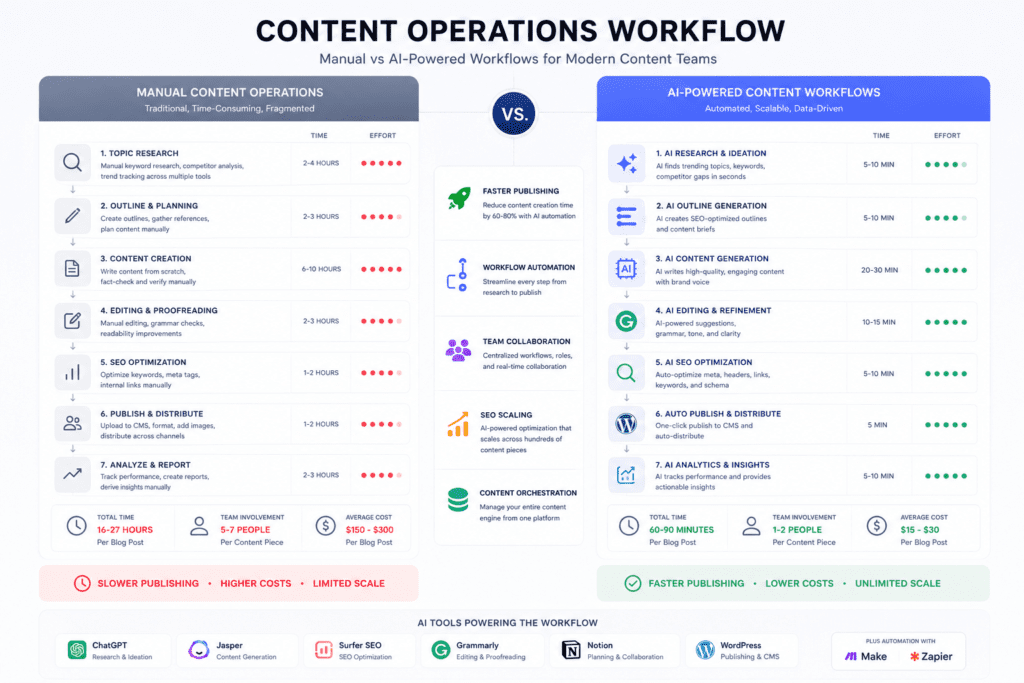
Modern agencies manage larger publishing demands than before. Clients expect faster turnaround times, stronger SEO performance, and more content across channels.
Manual workflows often struggle under that pressure.
An AI pipeline helps simplify content operations through:
• Faster production cycles: Reducing manual drafting delays
• Workflow automation: Handling repetitive tasks automatically
• Improved output consistency: Standardizing editorial systems
• Better team coordination: Organizing approvals and assignments
• Easier SEO scaling: Supporting larger publishing volume
A content team may use AI agents and workflow automation to handle keyword clustering, outlines, editing checkpoints, and publishing approvals simultaneously for multiple clients.
That doesn’t mean agencies should fully automate everything though.
Honestly, over-automation is where many content systems break down. AI-generated drafts still need refinement, editorial judgment, and strategic oversight to remain useful.
Why Agencies Are Investing in AI Content Pipelines
SEO competition keeps increasing across industries. At the same time, clients expect more content with faster delivery timelines.
That creates pressure on agencies trying to scale without dramatically increasing staffing costs.
An AI-powered workflow can help automate repetitive tasks, reduce bottlenecks, and improve operational efficiency without removing human oversight completely.
A smaller agency using AI-assisted drafting and automation systems, for example, may double monthly content production while keeping the same editorial team size.
Now this is where people get confused. The goal of an AI Content Pipeline isn’t replacing writers or editors. The real goal is building a more structured approach for scalable content production.
What Most Agencies Get Wrong About AI Content Pipelines
A lot of agencies assume adding more AI tools automatically fixes workflow problems. Usually, it doesn’t.
The bigger issue is often weak pipeline structure, poor documentation, and inconsistent editorial review.
Common mistakes include:
• Over automating low quality content: Prioritizing speed over usefulness
• Ignoring editorial review: Publishing without proper refinement
• Weak content strategy: Creating disconnected articles without direction
• Poor workflow documentation: Causing confusion across teams
• Inconsistent brand voice: Producing uneven client output
Many agencies struggle with ai-generated content because they remove too much human oversight from the process.
That said, AI itself usually isn’t the problem. Weak workflow systems are.
Why AI Content Pipelines Matter in 2026
Growing Demand for Scalable Content Creation
Agencies now manage content across blogs, email marketing, LinkedIn, social platforms, landing pages, and product marketing campaigns simultaneously.
Publishing expectations continue growing.
This creates pressure around:
• SEO content growth: Increasing search competition
• Multi channel publishing: Supporting content across channels
• Faster client expectations: Shorter turnaround timelines
A scalable AI pipeline helps content teams handle larger production demands without constantly rebuilding workflows manually.
Why Manual Content Workflows Break at Scale
Manual systems often work fine for smaller teams. Problems usually appear once agencies manage higher client volume.
Typical workflow bottlenecks include:
• Editing delays: Articles waiting too long for review
• Team communication issues: Unclear approvals and ownership
• Workflow inefficiencies: Duplicate tasks and scattered files
• Content handoffs: Slowing production between departments
A small delay during approvals may not seem serious initially. But once dozens of articles move through the same pipeline weekly, bottlenecks become harder to manage.
Honestly, this is where operational efficiency starts mattering more than raw writing speed.
How AI Helps Agencies Scale Without Losing Quality
An organized AI Content Pipeline can streamline repetitive production tasks while still keeping editorial control inside the system.
Useful workflow improvements include:
• Workflow automation: Reducing repetitive manual actions
• Faster research: Supporting quicker content planning
• AI-assisted optimization: Improving structure and readability
• Cross channel repurposing: Reusing content efficiently
An agency may repurpose one optimized SEO article into LinkedIn posts, email campaigns, and social captions through structured AI workflows instead of rebuilding every asset manually.
Now this is where agencies often find real value. The pipeline isn’t only about drafting articles faster. It’s about building repeatable systems that reduce friction across the entire workflow.
The 4 Stages of an AI Content Pipeline
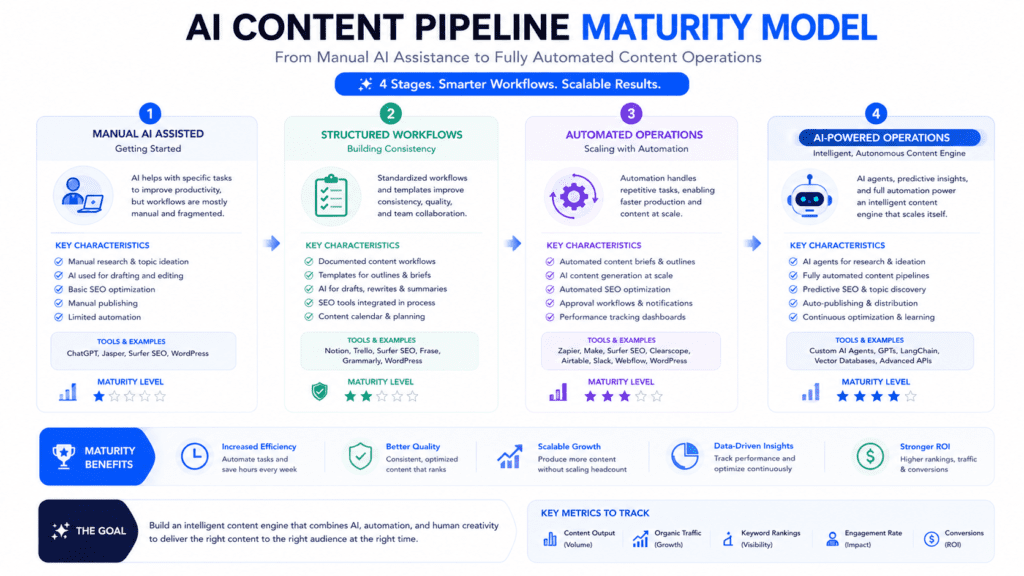
Stage 1: Manual AI Assisted Workflow
This is the starting point for most smaller agencies.
The process usually includes:
• Basic ChatGPT usage: Research and drafting support
• Simple workflow systems: Shared templates and prompts
• Manual editing: Human review before publishing
At this stage, teams still rely heavily on manual approvals and coordination.
Stage 2: Structured Workflow Automation
As content operations grow, agencies begin building more organized systems.
This stage often includes:
• SOPs: Standardized production guidelines
• Template systems: Reusable workflow structures
• Editorial frameworks: Organized review checkpoints
• Team collaboration: Shared production visibility
A structured workflow framework reduces human error and improves consistency across larger content teams.
Stage 3: Integrated AI Pipeline
At this stage, agencies move beyond isolated tools and start connecting systems together through workflow automation and integrations.
The pipeline becomes more centralized.
Common upgrades include:
• Connected tech stack: Shared tools working together
• Workflow automation: Reducing repetitive approvals
• Cross platform integration: Linking publishing systems
• Multi channel publishing: Coordinating content distribution
A small SEO agency may begin with ChatGPT for outlines, then later connect Zapier integrations to automate approvals, publishing, and reporting workflows inside ClickUp and WordPress.
That’s usually where agencies notice major improvements in workflow visibility and production speed.
Stage 4: Advanced AI Operations
Advanced AI operations focus on larger scale orchestration and content systems.
This stage may include:
• AI agents: Triggering structured workflow actions
• Data pipelines: Managing larger operational systems
• Automated SEO systems: Supporting scalable optimization
• Scalable content operations: Coordinating larger production volume
Some agencies even build custom api integrations between analytics dashboards, CMS platforms, and workflow systems to create more real-time production tracking.
Still, there are limits. Even advanced ai models require editorial refinement and approval systems before content becomes publish-ready.
Core Components of an AI Content Pipeline
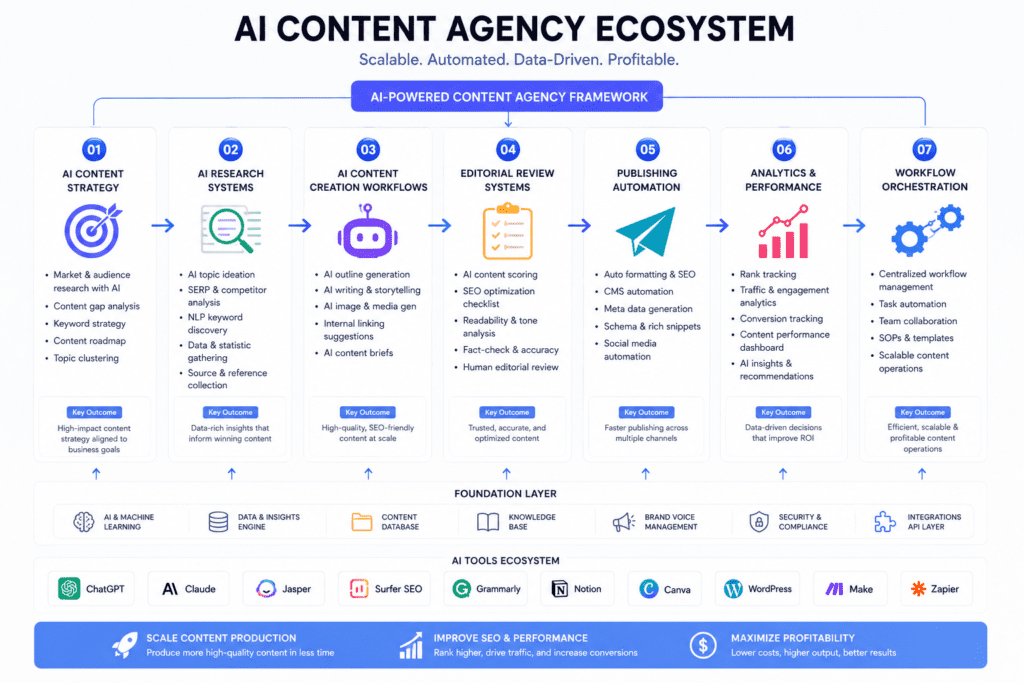
An effective AI Content Pipeline usually includes several connected layers working together instead of isolated production steps.
Content Strategy Layer
The content strategy layer guides the overall direction of the pipeline.
This often includes:
• Keyword planning: Organizing search opportunities
• SEO clustering: Structuring related topics
• Editorial planning: Coordinating publishing priorities
• Audience targeting: Matching client persona goals
Without a clear content strategy, even strong AI workflows often produce disconnected output that lacks long term direction.
AI Research and Brief Generation
This layer handles planning before drafting begins.
Typical workflow tasks include:
• Search intent analysis: Understanding audience expectations
• Competitor research: Reviewing ranking content
• Outline generation: Structuring article frameworks
• Content briefs: Organizing production requirements
Some agencies use ChatGPT and Jasper AI together to generate structured briefs before writers begin refinement work.
AI Content Creation Workflow
This stage focuses on drafting and optimization systems.
It often includes:
• Draft generation: Accelerating article production
• AI-assisted writing: Supporting content with ai systems
• Template workflows: Standardizing production structure
• Content optimization: Improving readability and SEO alignment
A structured template system also helps maintain consistency across larger content operations.
Now this is where pipeline orchestration becomes important. The goal isn’t simply creating content faster. It’s building a systematic approach where every stage connects smoothly.
Human Editorial Layer
Even advanced ai-driven systems still need human oversight.
Editors usually handle:
• Fact-checking: Validating accuracy before approval
• SEO review: Improving ranking alignment
• Brand voice consistency: Maintaining client tone
• Quality assurance: Reviewing final output
An agency editor reviewing every AI-generated article before publication often catches weak structure, awkward phrasing, or missing expertise signals that automation alone may overlook.
Honestly, this editorial layer is what separates stronger agencies from low quality content farms.
Publishing and Distribution Automation
Once content passes editorial review, the final stage focuses on publishing, distribution, and analytics tracking.
This layer often includes:
• CMS integration: Sending approved drafts into WordPress
• Scheduling workflows: Organizing publishing timelines
• Cross channel distribution: Sharing content across platforms
• Analytics tracking: Monitoring content performance
Some agencies automate approval workflows so finished articles move directly into WordPress draft mode after editorial approval inside ClickUp.
That usually reduces delays caused by scattered manual handoffs.
How an AI Content Pipeline Actually Works
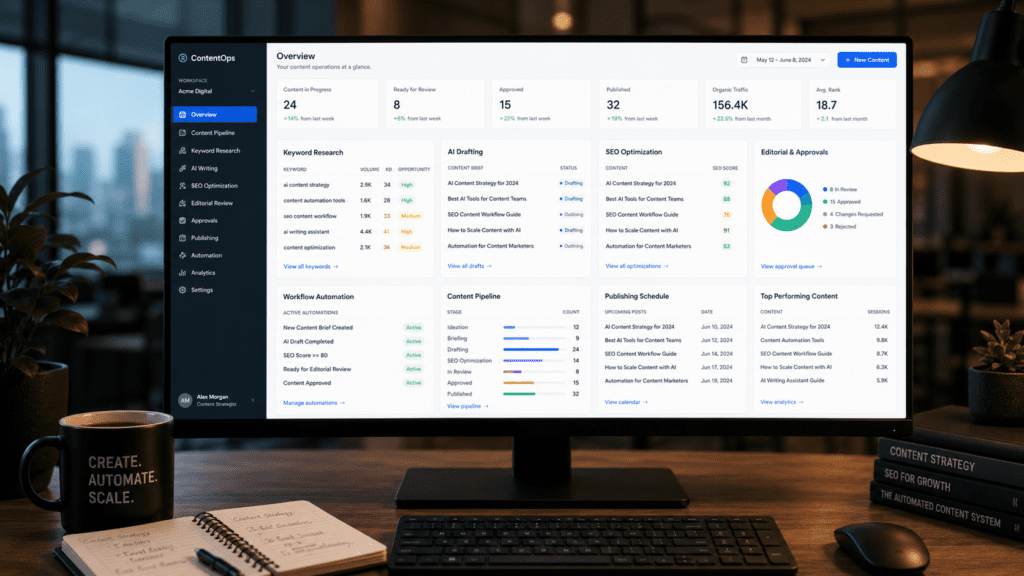
A structured AI pipeline works best when every stage connects clearly inside the workflow.
Instead of random tool usage, agencies build repeatable systems where research, drafting, editing, approvals, publishing, and analytics operate together.
Step by Step AI Pipeline Workflow
| Stage | Workflow Task | Recommended Tools |
|---|---|---|
| 1 | Keyword research | ChatGPT + SEO tools |
| 2 | Content briefs | Jasper AI |
| 3 | Draft generation | ChatGPT |
| 4 | SEO optimization | Surfer SEO |
| 5 | Editing and QA | Grammarly |
| 6 | Project management | ClickUp |
| 7 | Workflow automation | Zapier |
| 8 | Publishing | WordPress |
A content team using ClickUp and Zapier integrations may automate approvals, assignments, and publishing checkpoints while maintaining centralized workflow visibility.
That creates a much cleaner pipeline compared to disconnected spreadsheets, emails, and scattered documents.
Agency Roles Inside an AI Content Pipeline

An AI Content Pipeline still depends heavily on human collaboration. AI workflows improve speed, but people continue managing strategy, refinement, approvals, and communication.
SEO Strategists
SEO strategists usually manage:
• Keyword planning: Building search opportunities
• Search intent analysis: Matching audience expectations
• SEO frameworks: Structuring optimization systems
Their role helps optimize the pipeline around ranking goals instead of random publishing volume.
AI Workflow Managers
Workflow managers focus on operational systems.
Typical responsibilities include:
• Automation systems: Managing workflow automation
• Workflow maintenance: Improving production efficiency
• Tool integrations: Connecting platforms together
Some agencies also assign workflow managers to monitor analytics, approval timing, and pipeline bottlenecks.
Editors
Editors remain one of the most important layers inside the pipeline.
Their responsibilities often include:
• Editorial review: Improving readability and structure
• Brand voice consistency: Maintaining client standards
• Quality control: Reviewing final content output
An editor reviewing every article before final approval may reduce client revisions significantly because weak ai-generated sections get refined earlier in the workflow.
Now this is where agencies sometimes underestimate human oversight. Even advanced AI workflows still need experienced editorial judgment to maintain consistency across clients.
Writers
Writers still play an important role inside AI-assisted systems.
Instead of producing every section manually from scratch, many writers focus more on:
• Human refinement: Improving tone and clarity
• Expertise injection: Adding practical insights
• Storytelling improvements: Making content feel more natural
Honestly, strong writers usually become more valuable inside scalable AI workflows because they help transform generic drafts into higher quality client content.
Project Managers
Project managers coordinate the entire workflow from assignment to delivery.
Their role often includes:
• Workflow coordination: Managing production timelines
• Delivery tracking: Monitoring deadlines and approvals
• Team organization: Keeping content systems organized
A strong project management layer helps streamline collaboration between writers, editors, SEO strategists, and workflow managers.
Building AI Pipelines for Different Agency Models
Different agencies need different pipeline structures. A smaller freelancer workflow usually looks very different from a larger enterprise content system.
SEO Agency AI Pipeline
SEO agencies typically focus heavily on ranking workflows and scalable article production.
Common systems include:
• Keyword clustering: Organizing topical authority
• SEO article production: Scaling informational content
• Internal linking workflows: Strengthening site structure
• Ranking focused optimization: Supporting search visibility
An ecommerce SEO agency, for example, may automate product description generation while editors handle final refinement and optimization manually.
Social Media Content Pipeline
Social media agencies often prioritize speed and repurposing systems.
Their workflow may include:
• Multi channel repurposing: Reusing existing content
• Caption generation: Supporting short form publishing
• Content scheduling: Managing posting calendars
• AI-assisted creatives: Improving production speed
Some teams also connect chatbot workflows, scheduling systems, and analytics dashboards to monitor campaign performance data more efficiently.
Content Marketing Agency Workflow
Content marketing agencies usually require broader content systems beyond blog production alone.
This may include:
• Blog production: Long-form article workflows
• Email marketing: Campaign creation systems
• Lead magnets: Downloadable content assets
• Reporting systems: Monitoring client analytics
A structured content ops system helps agencies maintain consistency across multiple deliverables instead of treating every asset separately.
Ecommerce Content Pipeline
Ecommerce agencies often focus on scaling repetitive product content efficiently.
Their workflow may include:
• Product descriptions: Faster catalog production
• SEO category pages: Supporting organic visibility
• Conversion focused workflows: Improving product messaging
Some ecommerce teams also integrate CRM systems, inventory data, and AI-assisted workflows together to automate portions of product content management more efficiently.
Best AI Tools for Building an AI Content Pipeline
Different tools support different stages of the pipeline. The right tools usually depend on agency size, workflow complexity, and publishing volume.
ChatGPT
ChatGPT works well for:
• Research: Organizing topic discovery
• Workflow planning: Structuring production systems
• Brief generation: Supporting editorial preparation
• AI-assisted drafting: Accelerating first draft creation
A lot of agencies start with ChatGPT because it simplifies prompt creation and supports flexible workflow experimentation.
Jasper AI
Jasper AI is commonly used for:
• Brand voice consistency: Standardizing client tone
• Long-form drafting: Scaling article production
• Team collaboration: Supporting shared workflows
• Scalable content creation: Managing larger publishing demands
Some agencies combine Jasper AI with Surfer SEO and ClickUp to create more seamless pipeline integration across departments.
That said, the tool itself isn’t the full solution. Strong systems, editorial refinement, and workflow documentation still matter far more than simply adding more AI software.
Surfer SEO
Surfer SEO focuses heavily on SEO workflows and ranking optimization.
Agencies commonly use it for:
• Content scoring: Measuring optimization strength
• Keyword analysis: Improving topical relevance
• SEO frameworks: Supporting ranking workflows
A content team may use Surfer SEO to optimize headings, keyword placement, and structure before articles move into final approval.
ClickUp
ClickUp helps agencies organize workflow systems and editorial operations.
Useful features include:
• Workflow organization: Managing production stages
• Editorial pipeline management: Tracking assignments and approvals
• Team collaboration: Centralizing communication
Many agencies prefer ClickUp because it creates a single source of truth across larger content teams.
Zapier
Zapier connects tools together through workflow automation.
Agencies often use it for:
• Workflow orchestration: Connecting platforms automatically
• Data pipelines: Moving information across systems
• Cross platform integrations: Supporting scalable workflows
A team might use Zapier to automate notifications, approvals, publishing triggers, or analytics reporting between WordPress, ClickUp, Google Docs, and Slack.
Best AI Content Pipeline Frameworks by Agency Size
Solo Freelancer Workflow
Smaller freelancers usually benefit from lightweight systems.
This often includes:
• Simple automation: Basic repetitive task handling
• Manual oversight: Human review before publishing
• Lightweight workflows: Easier operational management
A solo strategist managing a few clients may not need advanced orchestration systems immediately.
Small Agency Workflow
As agencies grow, workflows become more standardized.
This stage often includes:
• Shared templates: Consistent production systems
• Editorial workflows: Structured approvals and refinement
• SEO focused operations: Organized optimization systems
Smaller agencies often improve operational efficiency significantly once workflow documentation becomes more structured.
Mid Size SEO Agency Pipeline
Mid size agencies usually require stronger coordination across departments.
Their systems may include:
• Automation systems: Reducing repetitive tasks
• Multi client management: Organizing larger workloads
• Cross team collaboration: Improving handoffs between departments
At this stage, workflow visibility becomes almost as important as content production itself.
Enterprise Content Operations Framework
Larger enterprise systems often rely on more advanced ai pipeline architecture.
This can include:
• AI agents: Supporting automated workflow actions
• Advanced integrations: Connecting enterprise systems
• Data pipelines: Managing larger scale operations
• Multi channel operations: Coordinating publishing across platforms
Some larger organizations also connect GTM systems, CRM workflows, analytics platforms, and API integrations into centralized content management operations.
Frequently Asked Questions
What is an ai content pipeline in simple terms?
An ai content pipeline is a structured flow that turns raw data into usable content using ai models, tools, and automation steps.
Why should teams focus on building ai pipelines?
Teams build ai pipelines to scale content ops, improve content performance, and keep a single source of truth for data and assets.
How do ai data and data ingestion fit into the pipeline?
Ai data and data ingestion bring raw data into your system so models can be trained and content can be generated reliably.
What role do ai prompts and iterative testing play?
Ai prompts guide model output, and you iterate prompts to refine results and reach consistent quality faster.
Can an ai content pipeline help with seo and content performance?
Yes, it can optimize titles, meta descriptions, and content structure to improve seo and measure content performance with real data.
How do ai agents and chatbots fit into content workflows?
Ai agents and chatbots can create drafts, answer user queries, and feed performance data back into the pipeline for refinement.
What tech stack and tools are right for a typical pipeline?
Pick tools that support model training, data pipelines, content management, and easy deployment and monitoring for your use case.
How do we ensure customization and automation and personalization at scale?
Use feature engineering, user data from crm and gtm signals, and templates to automate personalized content while keeping control.
What is the best way to iterate and refine output after deployment?
Monitor performance data, collect user feedback, and iterate model training and prompts to continuously refine content output.
How do we keep a single source of truth for content ops?
Centralize assets, metadata, and performance data in a content management system that connects to your data pipelines and crm.
What metrics should we track for actionable insights?
Track engagement, conversion, downstream revenue, and model metrics to get actionable insights and improve the pipeline.
When is it right to move from prototype to full deployment and monitoring?
Move to full deployment once you have stable model training results, repeatable ai prompts, and monitoring for errors and performance.
Final Verdict: Is an AI Content Pipeline Worth It for Agencies?
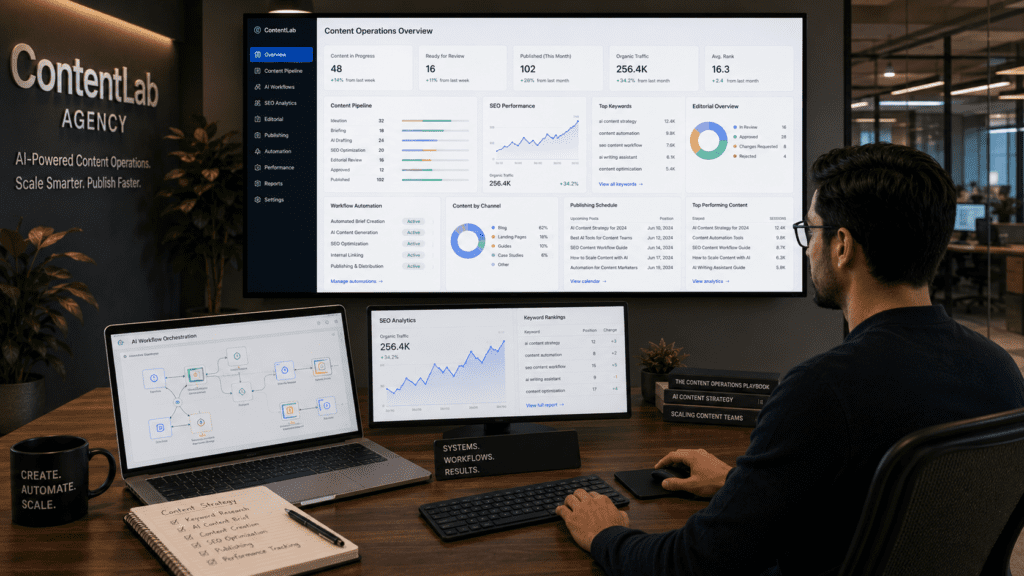
Bottom line? For most agencies, yes.
An AI Content Pipeline can help streamline production, improve workflow visibility, reduce bottlenecks, and support scalable publishing systems without dramatically increasing staffing requirements.
That said, agencies still need editorial refinement, approval systems, and strategic oversight. AI works best as a support layer inside a structured workflow, not as a full replacement for human judgment.
My Recommendation
• Start with one workflow first: Avoid overbuilding systems too early
• Prioritize editorial quality: Maintain strong review layers
• Use AI to assist teams: Improve speed without replacing expertise
• Build scalable systems gradually: Expand automation carefully
A small agency gradually building structured AI workflows often scales more sustainably than teams trying to automate every process immediately.
Final Thoughts on Building Scalable AI Workflow Systems
The strongest agencies usually combine AI-powered workflow automation with strong editorial systems, realistic approvals, and clear documentation.
If you’re building an AI Content Pipeline, focus on repeatable systems first. Once the workflow becomes stable, scaling automation and integrations becomes much easier without sacrificing quality or client trust.