

How do some affiliate marketers publish product reviews, comparison articles, funnel pages, email sequences, and SEO blog posts consistently without burning out? In many cases, the answer is workflow systems powered by AI-assisted tools and automation.
An AI Content Workflow for Affiliate Marketing helps organize research, content creation, SEO optimization, publishing, and funnel management into a repeatable process. Instead of handling every repetitive task manually, affiliate marketers now use AI for affiliate marketing workflows to streamline outlines, keyword research, affiliate content production, and workflow organization. That said, affiliate marketing still depends heavily on strategy, trust, and human editing. This guide focuses on realistic scaling systems, SEO optimization workflows, automation strategies, funnel structures, AI tools for affiliate marketing, and beginner-friendly workflow examples.
Quick Picks (2026)
Quick Recommendation: Affiliate Marketing Snapshot (2026)
Best Overall AI Writing Tool: Jasper AI
Best for: Scalable affiliate content production and brand voice consistency
Best for SEO Optimization: Surfer SEO
Best for: Ranking-focused affiliate workflows and content optimization
Best AI Assistant for Flexible Workflows: ChatGPT
Best for: Research, outlines, brainstorming, and funnel planning
Best for Automation: Zapier
Best for: Automating repetitive affiliate marketing tasks across multiple tools
What Is an AI Content Workflow for Affiliate Marketing?
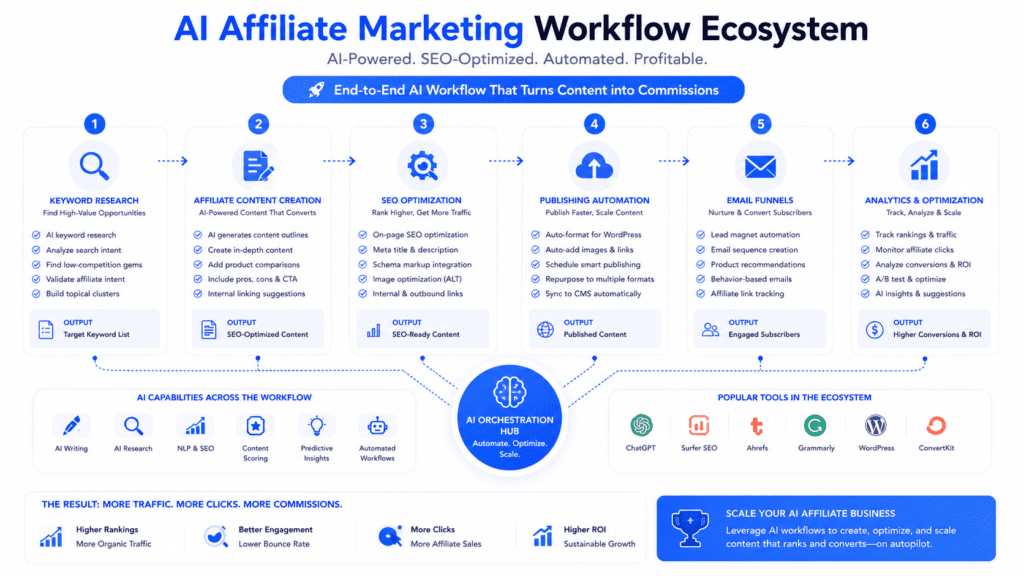
Beginner-Friendly Definition of an Affiliate Marketing Workflow
An AI Content Workflow for Affiliate Marketing is a structured system where AI tools, SEO processes, automation systems, and publishing workflows work together to support affiliate content production more efficiently.
Instead of using disconnected tools randomly, affiliate marketers build repeatable systems for keyword research, drafting, editing, SEO optimization, internal linking, publishing, and funnel management.
That’s the biggest difference between isolated AI usage and scalable affiliate workflow systems.
A marketer using ChatGPT for keyword clustering, Jasper for drafting, Surfer SEO for optimization, and Zapier to automate publishing workflows often manages content production more efficiently than someone handling every step manually.
Now this is where people get confused. AI-powered systems don’t replace affiliate strategy completely. They reduce manual work and repetitive tasks while helping content creators stay organized.
How AI Is Changing Affiliate Marketing
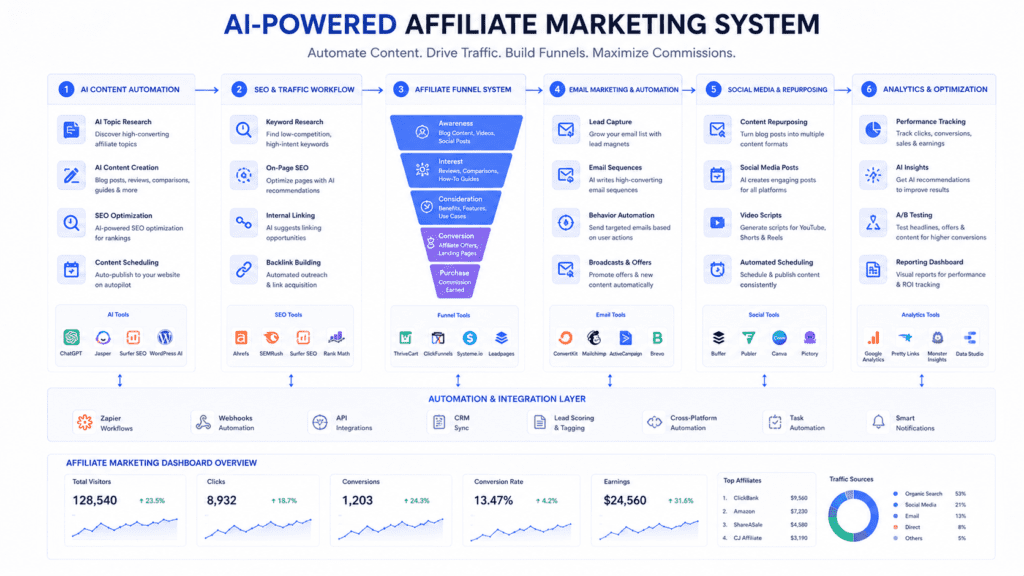
Faster Affiliate Content Creation
AI tools for affiliate marketing help speed up content creation significantly.
This often includes:
• Keyword research support: Faster topic discovery
• Outline generation: Organized article structure
• Draft creation: Faster affiliate content production
• SEO optimization: Supporting ranking workflows
An affiliate blogger may use AI assistants to handle keyword research, comparison article outlines, and first drafts faster while manually reviewing final content before publishing.
Easier Workflow Scaling
Affiliate marketing workflows become difficult to manage once publishing volume increases.
AI can help:
• Automate repetitive tasks: Reducing workflow friction
• Improve workflow organization: Managing editorial systems
• Support scaling: Handling larger publishing schedules
A niche site owner using workflow automation and structured templates may publish more consistently without dramatically increasing workload hours.
SEO-Focused Affiliate Optimization
SEO remains one of the biggest traffic sources in affiliate marketing.
AI-assisted optimization workflows may help with:
• Search intent alignment: Improving content relevance
• Internal linking suggestions: Strengthening site structuresite relying entirely on AI-generated reviews without refinin
• Content formatting: Supporting readability and conversion
Honestly, SEO optimization usually works best when affiliate marketers combine automation with manual review instead of relying entirely on AI-generated workflows.
Multi-Channel Affiliate Content Production
Affiliate marketers rarely rely on one platform anymore. A single article may support SEO traffic, Pinterest pins, TikTok clips, email funnels, and social media marketing campaigns at the same time.
AI workflows help simplify that process.
Common systems include:
• Blog repurposing: Turning articles into social posts
• Video script creation: Supporting YouTube or TikTok content
• Email sequence drafting: Supporting affiliate funnels
• Landing page support: Improving conversion focused pages
A marketer may create content for search traffic first, then repurpose the same article into visual content, short-form clips, and funnel emails using AI-powered workflows.
That’s usually more efficient than building every asset separately from scratch.
Why Affiliate Marketers Are Using AI More in 2026
Affiliate marketing competition continues increasing across almost every niche. More websites publish product reviews, comparison articles, and tutorial content daily.
That creates pressure around:
• Faster publishing expectations: More content production demand
• SEO competition: Harder ranking environments
• Workflow complexity: Managing multiple systems
• Scaling challenges: Handling larger content pipelines
AI can help affiliate marketers reduce response time during research, drafting, optimization, and workflow management.
Still, there are limits.
Reality check: affiliate marketing doesn’t become automatic just because automation systems exist. Human editing, product understanding, SEO decisions, and audience trust still matter heavily.
A small affiliate site relying entirely on AI-generated reviews without refining the message or adding expertise often struggles with conversion rates and long-term rankings.
Why AI Content Workflows Matter for Affiliate Marketing
Scaling Affiliate Content Faster
An organized workflow makes scaling easier because repetitive production systems become more structured.
This often helps with:
• More blog posts: Supporting larger publishing schedules
• Faster content production: Reducing manual workload
• Better workflow organization: Improving editorial consistency
A marketer publishing product comparisons weekly may build momentum faster than someone posting inconsistently without a structured affiliate marketing workflow.
Reducing Repetitive Tasks
Affiliate workflows often include repetitive operational work that slows production unnecessarily.
Automation systems may help:
• Research automation: Faster keyword discovery
• Outline generation: Supporting structured drafts
• Internal linking suggestions: Improving SEO workflows
• Content optimization: Supporting readability improvements
Now this is where automation usually provides the biggest value. The goal isn’t replacing strategy completely. The goal is reducing repetitive tasks that consume time without improving content quality significantly.
Improving SEO and Funnel Efficiency
SEO and funnel systems work together inside affiliate marketing.
A stronger AI Content Workflow for Affiliate Marketing may improve:
• Search intent optimization: Better ranking alignment
• Funnel consistency: More organized conversion systems
• Publishing consistency: Supporting traffic growth
A niche site owner using AI workflows to publish optimized comparison articles consistently may reduce production time while improving funnel organization and affiliate link placement.
Honestly, consistency often performs better than chasing aggressive publishing volume without structure.
The 4 Stages of an AI Affiliate Marketing Workflow
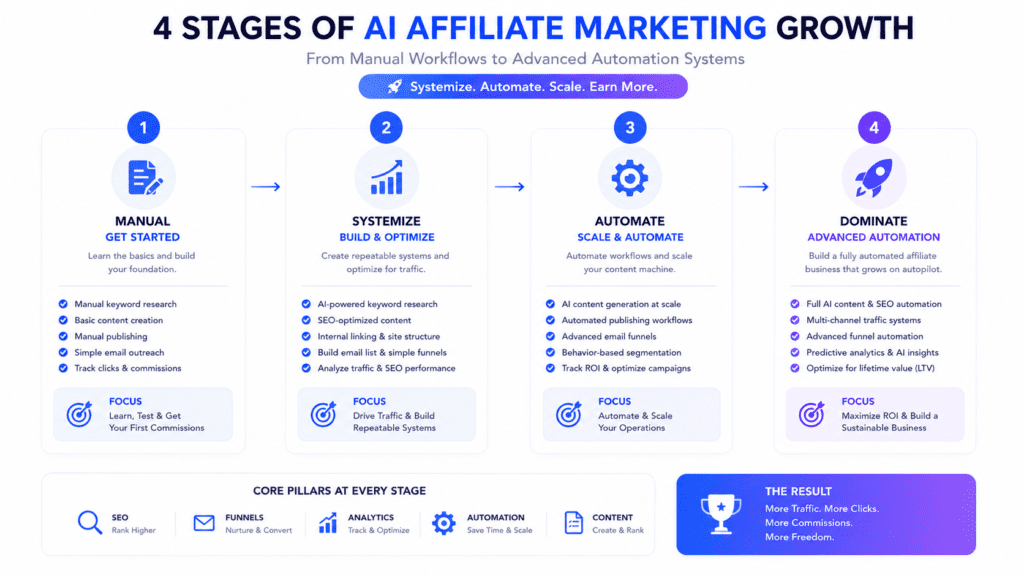
Stage 1: Manual AI-Assisted Workflow
This is where most affiliate marketers begin.
The workflow usually includes:
• ChatGPT prompts: Supporting outlines and research
• Manual editing: Refining affiliate content manually
• Basic SEO workflows: Supporting ranking opportunities
At this stage, marketers still manage most publishing and optimization tasks manually while experimenting with AI use and workflow systems.
Stage 2: Structured Content Workflow
Once affiliate marketers publish more consistently, workflow organization becomes more important.
This stage usually introduces:
• Templates: Repeatable article structures
• SOPs: Standardized publishing systems
• Editorial workflows: Organized review processes
• Workflow organization: Better project visibility
A marketer may create template systems for product reviews, comparison articles, and funnel pages instead of rebuilding formatting every time.
That’s usually where affiliate content production starts feeling more manageable.
Stage 3: Automated Affiliate Content Pipeline
This stage focuses more heavily on automation and scalable systems.
The workflow often includes:
• Automation systems: Reducing manual publishing tasks
• Internal linking workflows: Supporting SEO structure
• Cross-platform publishing: Repurposing affiliate content
A niche blogger may connect WordPress, Notion, Zapier, and email marketing tools together to automate affiliate marketing workflows across multiple channels.
Now this is where people sometimes overdo automation. Publishing large amounts of low-quality AI-generated content rarely works long term, even if the workflow feels efficient initially.
Stage 4: Advanced Affiliate Marketing Automation
Advanced affiliate workflows usually involve multiple integrated systems working together.
This may include:
• AI agents: Supporting workflow actions
• Funnel automation: Managing email sequences
• Multi-channel workflows: Coordinating traffic sources
• Scalable content operations: Handling larger publishing systems
Some affiliate marketers also use ai analytics dashboards to audit funnel performance, click-through behavior, and affiliate campaigns more efficiently.
Still, human strategy remains important. AI can analyze vast amounts of data quickly, but final positioning and conversion decisions still need oversight.
What a Real AI Content Workflow for Affiliate Marketing Looks Like
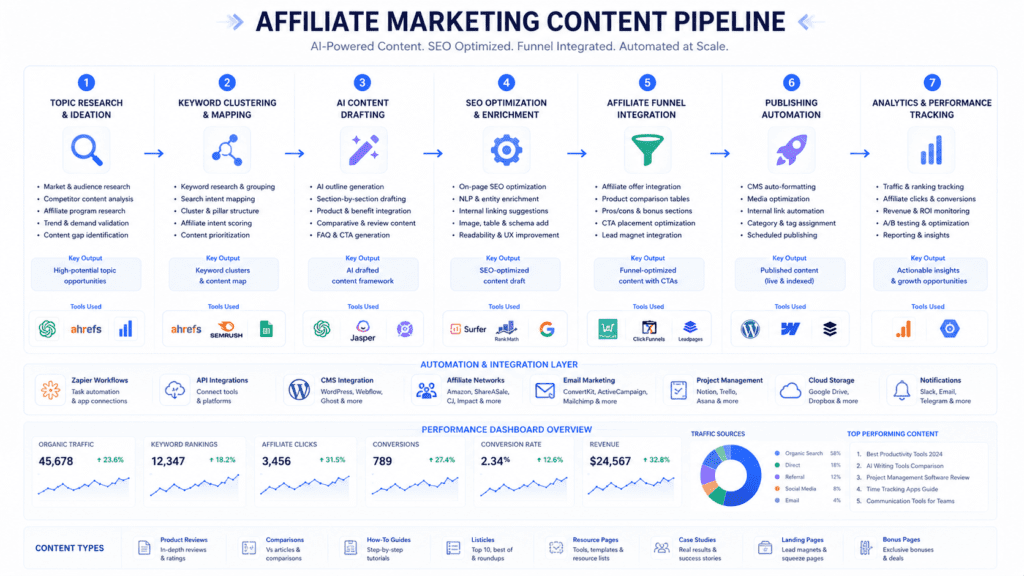
An organized affiliate workflow connects research, content production, SEO optimization, publishing, and funnel systems together instead of treating them separately.
Research Workflow
Research usually happens before drafting begins.
This stage often includes:
• Keyword clustering: Grouping related search topics
• Competitor analysis: Reviewing ranking pages
• Search intent research: Understanding audience goals
Some marketers use tools like ChatGPT and Ahrefs together to identify content gaps and low competition keyword opportunities before publishing new affiliate content.
Content Production Workflow
Content production focuses on drafting and editing systems.
Common steps include:
• Outline generation: Structuring affiliate articles
• AI-assisted drafting: Creating first drafts faster
• Editing workflows: Refining readability and tone
• SEO optimization: Improving ranking structure
A marketer using Jasper for long-form affiliate content may still manually rewrite introductions, CTA sections, and product positioning for stronger conversion performance.
Honestly, hybrid workflows combining human editing with AI-assisted drafting usually work best for affiliate marketing content.
SEO Optimization Workflow
SEO workflows focus on improving visibility and search performance.
This often includes:
• Internal linking: Supporting site structure
• Readability improvements: Better user experience
• Search intent alignment: Matching audience expectations
• Affiliate content optimization: Improving click-through opportunities
A marketer using Surfer SEO may optimize headings, keyword placement, and formatting before publishing product reviews or comparison pages on WordPress.
Funnel Workflow
Funnels help move visitors from informational content toward affiliate conversion opportunities more strategically.
An affiliate funnel workflow often includes:
• CTA placement: Positioning affiliate offers naturally
• Email capture: Building subscriber lists
• Affiliate offer positioning: Improving product relevance
• Conversion optimization: Supporting better user flow
A marketer promoting SaaS affiliate programs may guide readers from informational SEO posts into a landing page and automated email funnel before presenting affiliate offers.
Now this is where funnel systems usually outperform random affiliate link placement. Structured funnels create clearer pathways for users instead of dropping links everywhere without context.
Analytics and Optimization Workflow
Analytics workflows help affiliate marketers see which pages, funnels, and affiliate campaigns perform best.
This stage often includes:
• Ranking tracking: Monitoring SEO visibility
• Affiliate click tracking: Measuring link engagement
• Funnel analytics: Reviewing conversion performance
• Workflow adjustments: Improving weak systems
A blogger using HubSpot analytics and affiliate tracking tools may audit which comparison articles generate the highest payout and optimize future content around those patterns.
Honestly, affiliate marketing workflows improve much faster once performance data becomes part of the decision-making process.
Core Components of an AI Content Workflow for Affiliate Marketing
A scalable AI Content Workflow for Affiliate Marketing usually includes several connected layers instead of isolated content tasks.
Keyword Research and SEO Planning
SEO planning shapes almost every part of affiliate marketing.
This stage often includes:
• Search intent analysis: Matching user goals
• Low-competition keyword targeting: Finding ranking opportunities
• Topic clustering: Building content structure
A marketer may use AI tools for affiliate marketing alongside SEO platforms to organize keyword clusters around buyer intent and informational search queries.
Affiliate Content Creation Workflow
Affiliate content systems usually focus on search visibility and conversion intent simultaneously.
This may include:
• Product reviews: Evaluating affiliate offers
• Comparison articles: Helping buying decisions
• Tutorial content: Supporting product education
• Funnel-focused blog posts: Moving readers toward conversion
A lot of affiliate marketers notice that comparison content and tutorials often perform better than purely promotional content because they solve real user problems first.
SEO Optimization Layer
Optimization workflows help affiliate content perform better in search engines and improve readability for users.
This stage often focuses on:
• Internal linking: Strengthening topic relationships
• Readability improvements: Better formatting and structure
• Conversion-focused formatting: Supporting click-through behavior
A marketer may use Surfer SEO to optimize affiliate reviews while manually improving formatting, CTA placement, and message clarity afterward.
Workflow Automation Systems
Automation systems help reduce manual work across larger affiliate operations.
Common automation workflows include:
• Publishing workflows: Scheduling content automatically
• Content calendars: Organizing production systems
• AI assistants: Supporting repetitive operational tasks
• Affiliate marketing automation: Coordinating workflows across platforms like WordPress, Zapier, and HubSpot
That said, multiple tools only work well when the workflow itself stays organized. Disconnected tools usually create more confusion than efficiency.
Funnel and Conversion Optimization
Funnels and affiliate content need to work together instead of operating separately.
A stronger workflow may improve:
• CTA placement: Better affiliate positioning
• Email funnel integration: Supporting follow-up systems
• Affiliate link management: Organizing offers more clearly
• User journey optimization: Guiding readers naturally
A marketer automating article publishing and email funnel distribution with Zapier integrations may reduce manual workflow management significantly while maintaining publishing consistency.
How an AI Affiliate Marketing Workflow Actually Works
A structured AI Content Workflow for Affiliate Marketing connects multiple systems together into one repeatable process.
| Stage | Workflow Task | Recommended Tools |
|---|---|---|
| 1 | Keyword research | ChatGPT + SEO tools |
| 2 | Outline generation | Jasper AI |
| 3 | Affiliate content drafting | ChatGPT |
| 4 | SEO optimization | Surfer SEO |
| 5 | Workflow organization | Notion |
| 6 | Automation workflows | Zapier |
| 7 | Funnel integration | Email marketing tools |
| 8 | Publishing and tracking | WordPress |
A niche blogger using Zapier integrations may automate article publishing, affiliate email sequences, and reporting systems while still manually reviewing SEO and conversion decisions.
That hybrid setup usually performs better than relying entirely on automation alone.
Best AI Tools for Affiliate Marketing Workflows
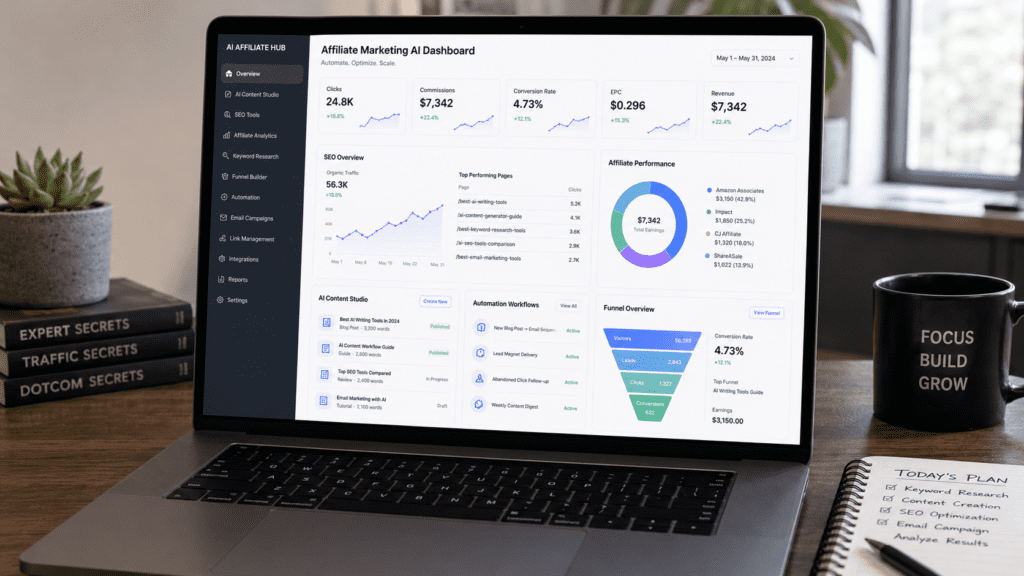
Different tools solve different workflow problems. Most affiliate marketers eventually combine several systems together depending on their business model.
ChatGPT
ChatGPT works well for:
• Research: Supporting keyword discovery
• Affiliate content outlines: Organizing article structure
• AI assistants: Supporting workflow systems
• Funnel planning: Structuring affiliate journeys
A lot of affiliate marketers use ChatGPT during the research stage because it simplifies brainstorming and content briefs significantly.
Jasper AI
Jasper focuses more heavily on scalable affiliate content production.
It’s commonly used for:
• Long-form affiliate content: Product reviews and tutorials
• Product review workflows: Structured comparison content
• SEO blog production: Supporting affiliate publishing systems
Some marketers combine Jasper with Surfer SEO to create more optimized affiliate marketing campaigns across larger content pipelines.
Surfer SEO
Surfer SEO supports ranking-focused optimization workflows.
This often includes:
• SEO optimization: Improving search visibility
• Search intent workflows: Aligning content structure
• Affiliate content formatting: Supporting readability and conversion
A marketer may optimize affiliate comparison pages with Surfer SEO before publishing them inside WordPress workflows.
Honestly, search intent usually matters more than simply adding more keywords everywhere.
Zapier
Zapier helps automate affiliate marketing workflows across multiple systems.
Common use cases include:
• Workflow integration: Connecting platforms together
• Affiliate marketing automation: Reducing repetitive operational work
• Cross-platform publishing: Coordinating publishing systems
Some affiliate managers also use Zapier to automate repetitive tasks between Google Sheets, WordPress, HubSpot, and email marketing platforms.
Notion
Notion helps organize affiliate workflow systems more clearly.
It’s often used for:
• Workflow organization: Managing production systems
• Content calendars: Planning affiliate publishing
• Affiliate program management: Tracking partnerships and payout systems
A marketer managing multiple affiliate programs may use Notion dashboards to organize content schedules, funnel planning, affiliate links, and analytics tracking in one place.
Best AI Workflow Setups Based on Affiliate Marketing Goals
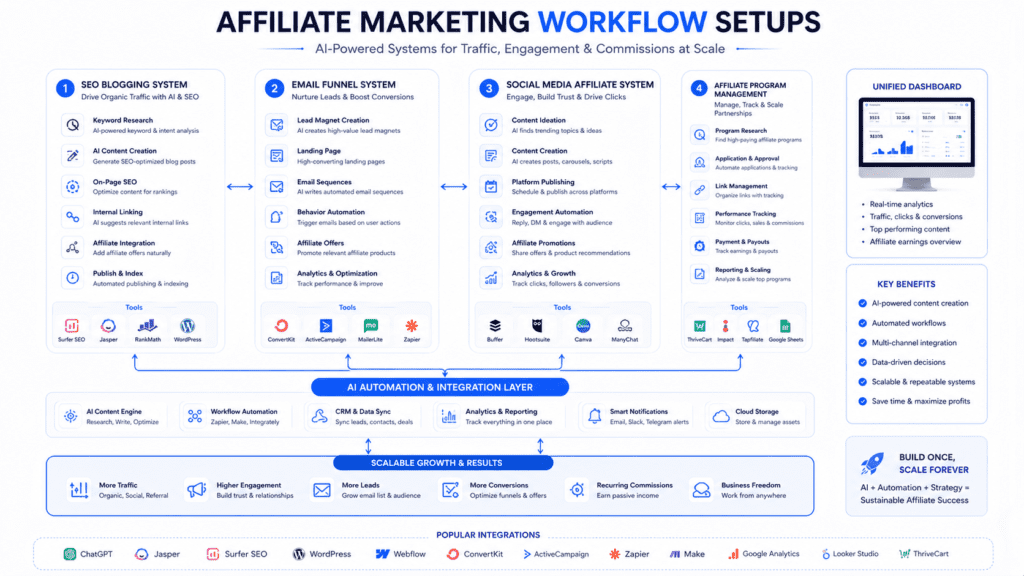
Different affiliate marketing goals usually require different workflow systems.
SEO Affiliate Blogging Workflow
SEO affiliate blogging workflows often focus heavily on long-form content and search visibility.
This usually includes:
• Keyword clustering: Organizing related search topics
• SEO article production: Publishing optimized affiliate content
• Internal linking workflows: Strengthening topic structure
A blogger publishing product comparison articles weekly may build stronger organic traffic over time than someone relying only on random social traffic spikes.
Email Funnel Affiliate Workflow
Email funnels help affiliate marketers build repeatable conversion systems.
This workflow may include:
• Lead magnets: Collecting subscriber emails
• Automated email sequences: Nurturing subscribers gradually
• Funnel optimization: Improving conversion pathways
A marketer may test new offers through segmented email funnels instead of relying entirely on direct affiliate links inside blog posts.
Social Media Affiliate Workflow
Social workflows help affiliate marketers repurpose content across multiple channels.
This often includes:
• Short-form content: Repurposing affiliate articles
• Caption generation: Supporting TikTok and social posting
• Cross-platform publishing: Expanding traffic sources
Some marketers use AI-powered systems to turn affiliate blog posts into TikTok scripts, Pinterest descriptions, and Instagram captions more efficiently.
Affiliate Program Management Workflow
Larger affiliate operations often require more structured affiliate program management systems.
This may include:
• Managing affiliate programs: Tracking different offers
• Campaign reporting: Monitoring payout performance
• Workflow reporting systems: Organizing performance tracking
A creator automating affiliate email follow-ups while manually reviewing conversion performance often maintains better optimization control than someone fully automating the entire funnel.
How to Make AI Affiliate Content Sound More Human
One of the biggest affiliate marketing problems with AI-generated content is repetitive tone.
Readers usually notice when every article sounds overly polished or generic.
Helpful improvements include:
• Add real product insights: Improve trust and specificity
• Rewrite AI introductions: Make openings feel more natural
• Improve readability: Use cleaner formatting and sentence variation
• Match search intent carefully: Align content with user goals
A marketer rewriting AI-generated introductions with personal observations and clearer message flow may improve click-through and conversion performance significantly.
Honestly, combining human editing with AI-assisted drafting tends to work best for affiliate marketing content.
How to Maintain Quality While Scaling Affiliate Content
Scaling affiliate content doesn’t mean publishing endless low-quality articles.
Quality control still matters heavily.
Important best practices include:
• Human editing still matters: Refine every draft manually
• Focus on search intent: Match user expectations clearly
• Add product insights: Improve trust and conversion potential
• Avoid generic AI affiliate content: Strengthen originality
Reality check: some affiliate websites struggle because every review sounds identical and lacks real expertise or useful funnel structure.
Frequently Asked Questions
What is an AI content workflow for affiliate marketing?
An AI content workflow uses artificial intelligence to plan, create, and optimize affiliate content so you save time and improve conversions.
How can AI help me choose the best affiliate programs?
AI can analyze commission rates, niche fit, and past performance to help you choose the best programs that match your audience.
What are simple ways to use AI in content creation like blog posts and emails?
Use AI to generate drafts, brainstorm subject lines, and polish copy for blogs and emails to speed up content creation like a pro.
Are there free AI tools I can try for affiliate marketing?
Yes, there are free AI tools for basic writing, keyword ideas, and simple image or video prompts to get started without cost.
How do AI assistants help with managing affiliate programs?
AI assistants can track links, report commissions, and remind you of deadlines so you stay ahead without manual tracking.
Can AI improve my digital marketing and video content?
AI can edit video clips, suggest hooks, and optimize descriptions to boost views and fit digital marketing goals.
What tools for your affiliate marketing should I test first?
See which ones offer link tracking, content suggestions, and analytics; those give the fastest wins for affiliate growth.
How does AI support research and content optimization?
AI scans top pages, finds content gaps, and gives SEO tips so your posts rank better and attract more clicks.
Will AI make my content sound robotic?
No, good tools let you add personal voice and tweak tone so AI helps maintain a human, relatable style.
How can I use AI to increase my commission rates?
AI can suggest higher-converting offers, optimize landing pages, and test subject lines to lift conversion and commission.
What are the best ways to use AI for email subject lines?
Generate multiple subject line options, A/B test them, and choose the best one based on open-rate predictions.
How do I pick the right mix of multiple tools for affiliate marketing?
Choose tools that cover research, content creation, tracking, and analytics so they work together and reduce duplicate work.

Final Verdict: Is an AI Content Workflow Worth It for Affiliate Marketing?
Bottom line? For most affiliate marketers, yes.
An AI Content Workflow for Affiliate Marketing can help reduce repetitive tasks, improve workflow organization, support SEO optimization, and streamline affiliate content production more efficiently.
That said, affiliate marketing still depends on trust, strategy, product positioning, and human-written refinement. AI can improve speed and scaling, but it doesn’t replace strong funnel systems or audience understanding.
My Recommendation
• Start with one workflow: Avoid using too many systems immediately
• Focus on SEO and trust: Build stronger affiliate positioning
• Use AI to improve efficiency: Not replace human expertise completely
• Scale gradually: Build automation systems step-by-step
A beginner affiliate marketer gradually building structured workflows with ChatGPT, Jasper, Surfer SEO, and WordPress may create a more sustainable affiliate business than someone aggressively automating everything at once.
Final Thoughts on Building a Sustainable Affiliate Workflow System
The strongest affiliate marketing systems usually combine automation with strategic human oversight.
If you’re building an AI Content Workflow for Affiliate Marketing, focus on repeatable workflows, search intent, funnel structure, and audience trust first. Once those systems become stable, scaling content production becomes much easier without sacrificing quality or conversion performance.