

A solo marketer manages SEO blog posts, client reporting, email campaigns, and workflow systems from a small home office using ChatGPT, Surfer SEO, Zapier, and ClickUp. Five years ago, building that type of operation often required a much larger team. Now, scalable AI workflows allow smaller businesses to handle content production more efficiently while keeping operational costs lower.
That’s one reason more people want to Start an AI Content Agency. Businesses increasingly outsource AI-assisted content production, SEO operations, automation systems, and multi-channel workflows to specialized agencies instead of building everything internally. This guide focuses on practical agency systems, workflow organization, pricing models, client acquisition, automation setups, scaling strategies, and realistic business operations for beginners building an AI Content Agency.
Quick Picks (2026)
Quick Picks: Best AI Tools for Agency Workflows in 2026
Best Overall AI Writing Platform: Jasper AI
Best for: Scalable agency workflows and brand voice consistency
Best for SEO Optimization: Surfer SEO
Best for: Ranking-focused AI content workflows and SEO strategy
Best AI Assistant for Flexible Workflows: ChatGPT
Best for: Research, outlines, workflow systems, and flexible agency tasks
Best for Workflow Automation: Zapier
Best for: Automating repetitive agency operations and connecting tools
Why AI Content Agency Businesses Matter in 2026
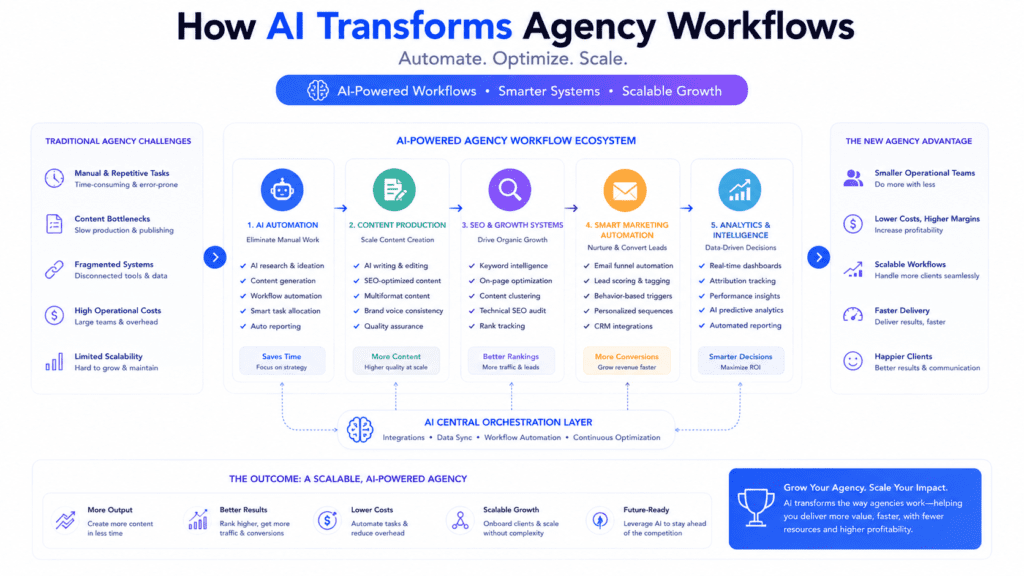
How AI Is Changing the Agency Industry
AI-assisted workflows are changing how agencies handle content production and marketing operations.
This often includes:
• Faster content production: Reducing manual drafting time
• Smaller operational teams: Managing larger workloads efficiently
• Workflow automation: Simplifying repetitive operations
• Growing SEO demand: Supporting scalable content marketing
• More scalable systems: Improving operational efficiency
A smaller AI Content Agency may now manage multiple clients using AI-assisted workflows instead of hiring a massive internal writing team.
Now this is where people get confused. AI agencies don’t really scale because AI replaces people entirely. They scale because organized systems help smaller teams operate more efficiently.
Why Businesses Are Hiring AI Agencies
Companies increasingly outsource AI content and automation workflows because digital publishing requirements continue growing.
Businesses often want:
• Faster publishing: More consistent content output
• Lower production costs: Improving operational efficiency
• SEO-focused scaling: Supporting organic growth
• Multi-channel workflows: Managing content across platforms
Some SaaS companies, for example, outsource blog production, SEO optimization, email marketing, and workflow automation together instead of hiring separate departments internally.
Why This Business Opportunity Continues to Grow
Several trends continue supporting AI agency growth.
These include:
• Rising demand for AI content: Expanding publishing needs
• Growth of digital marketing: More online competition
• Increased automation adoption: Simplifying operations
• Expanding AI development tools: Supporting scalable workflows
Reality check though. Most businesses still expect strong human editing, communication, SEO expertise, and strategic thinking even when agencies use AI tools internally.
Honestly, that’s probably why premium AI Content Agency businesses still stand out despite the growing number of low-quality AI spam services online.
What Is an AI Content Agency?
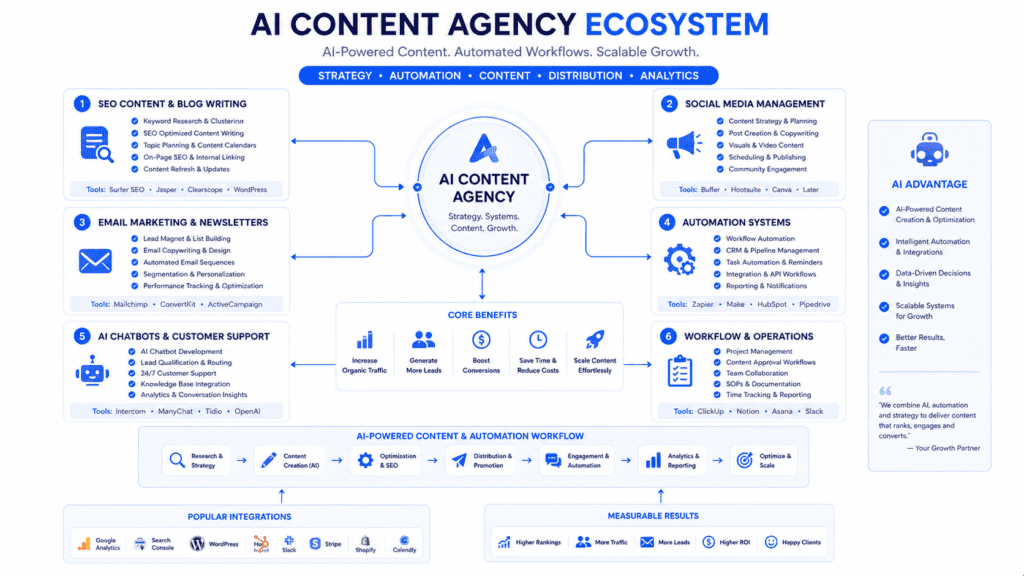
Beginner-Friendly Definition of an AI Content Agency
An AI Content Agency is a business that combines human expertise with AI-assisted workflows to deliver scalable content production, SEO systems, automation services, and digital marketing operations.
Instead of relying completely on manual production, agencies use AI tools to support drafting, keyword research, workflow management, analytics, optimization, and repetitive marketing tasks more efficiently.
That’s the main difference between professional AI agencies and low-quality automated spam operations.
A professional AI Content Agency still depends heavily on human oversight, editorial review, workflow systems, client communication, and SEO strategy.
Types of Services an AI Content Agency Can Offer
An AI Content Agency can offer several different services depending on the niche, workflow structure, and team size.
Some agencies focus only on SEO content. Others expand into automation, chatbot systems, analytics workflows, and broader marketing operations.
SEO Blog Writing Services
SEO blog writing remains one of the most common agency services because businesses constantly need educational content for search visibility.
This often includes:
• Keyword-focused articles: Supporting SEO growth
• Long-form content: Building topical authority
• Optimization workflows: Improving rankings and readability
A SaaS company may outsource weekly blog production to an AI Content Agency instead of managing a full in-house content team.
Content Strategy and SEO Planning
Some agencies move beyond writing and focus more heavily on strategy systems.
This may include:
• Topic clustering: Organizing SEO content structure
• Search intent analysis: Matching audience goals
• Editorial planning: Managing publishing priorities
A stronger strategy layer usually improves long-term ROI more than publishing random articles without direction.
Social Media Content Services
Businesses also need consistent social media management across multiple channels.
Agencies may provide:
• Short-form content: Supporting social publishing
• Content repurposing: Turning blogs into social posts
• Caption workflows: Improving consistency
Some AI marketing agencies also personalize content differently for LinkedIn, Instagram, and TikTok instead of reusing identical messaging everywhere.
Email Marketing and Funnel Content
Email marketing remains important for lead nurturing and retention workflows.
Agency services often include:
• Newsletter content: Audience engagement systems
• Email sequences: Funnel automation workflows
• Campaign messaging: Supporting marketing campaigns
A smaller startup may outsource email marketing workflows because internal teams often lack time and resources to maintain consistent publishing.
Automation Services and Workflow Systems
Automation services are becoming a larger part of many agency operations.
This may include:
• Workflow automation: Reducing repetitive operational tasks
• Content pipelines: Streamlining publishing systems
• Marketing automation: Improving workflow efficiency
Some agencies start an AI automation agency division later after building stronger expertise in ai technologies and workflow systems.
Now this is where agencies usually gain a competitive advantage. Businesses often value operational efficiency just as much as content production itself.
Chatbots and AI Assistants
Some AI agencies also build chatbot systems and AI assistant workflows for clients.
These systems may support:
• Customer support automation: Faster response systems
• Lead qualification workflows: Supporting lead generation
• AI assistant integration: Improving internal operations
A local business may use an ai chatbot on its website to answer basic customer questions before routing leads to human support staff.
AI Development Support Services
Larger agencies sometimes expand into AI development support services.
This may include:
• Custom AI workflows: Tailored operational systems
• AI integrations: Connecting tools and platforms
• AI solutions: Supporting business automation goals
Some agencies working with ecommerce companies also help businesses optimize product workflows using predictive analytics and AI-powered reporting systems.
Honestly, most beginners don’t need advanced AI development services immediately. Starting with SEO blog production and workflow systems usually creates a more manageable foundation first.
What a Real AI Content Agency Actually Looks Like
A lot of people imagine large offices and massive teams when they think about agencies. Modern AI Content Agency models often look much smaller operationally.
Solo AI Agency Model
Some agencies begin as one-person operations using AI-assisted workflows.
This usually includes:
• AI-assisted drafting: Faster production workflows
• Simple automation systems: Streamlining repetitive work
• Lean operations: Managing smaller overhead costs
A solo operator may use ChatGPT, Jasper AI, Surfer SEO, and ClickUp together to manage multiple smaller SEO clients efficiently.
Small Team AI Content Agency Structure
As agencies grow, workflows usually become more specialized.
A smaller team structure may include:
• Writers: Handling SEO content production
• Editors: Managing quality control
• Workflow managers: Organizing operations
• SEO strategists: Supporting ranking systems
A structured team setup often improves delivery consistency more than simply adding more writers without clear systems.
SEO-Focused Agency Workflow
SEO-focused agencies usually build operations around scalable organic traffic systems.
This workflow often includes:
• Keyword research: Finding ranking opportunities
• Search intent planning: Matching audience expectations
• SEO content production: Publishing optimized articles
• Optimization systems: Improving rankings and readability
Some agencies combine Surfer SEO, Ahrefs, and Jasper AI to streamline optimizing content across larger publishing schedules.
That said, SEO workflows still require strong editorial review. AI-generated SEO content without refinement often struggles long term.
Automation-Based Agency Workflow
Automation-focused agencies rely more heavily on workflow systems and integrations.
This often includes:
• Workflow automation: Reducing repetitive operational work
• Reporting systems: Streamlining analytics delivery
• AI assistants: Supporting operational efficiency
• Content pipelines: Organizing publishing systems
A growing agency may automate content scheduling, reporting workflows, and client notifications using Zapier and ClickUp integrations.
Now this is where workflow organization becomes extremely important. Disconnected tools usually create bottlenecks instead of efficiency.
Hybrid Human Plus AI Agency Structure
Most successful AI agencies eventually operate through hybrid systems where AI supports speed while humans manage quality and strategic oversight.
This structure often focuses on:
• AI for speed: Accelerating repetitive production tasks
• Humans for quality: Improving clarity and originality
• Editorial oversight: Maintaining client standards
A small AI Content Agency may use ChatGPT for drafting, Surfer SEO for optimization, and human editors for final quality control before publication.
Honestly, hybrid agency systems usually outperform fully automated content operations because clients still value communication, strategic thinking, and human creativity.
Why Clients Hire an AI Content Agency Instead of Freelancers
Businesses sometimes prefer agencies because operational systems feel more scalable and reliable.
Faster Workflow Capacity
Agencies usually manage higher publishing volume more efficiently than solo freelancers.
This may include:
• Larger production systems: Supporting multiple projects
• Workflow coordination: Managing deadlines consistently
• Scalable operations: Handling broader campaigns
A SaaS company publishing weekly SEO content across blogs, newsletters, and landing pages may prefer agency support because operations stay more centralized.
Better Content Consistency
Consistency becomes important once businesses scale publishing operations.
Agencies often improve:
• Editorial consistency: Maintaining quality standards
• Brand voice management: Keeping messaging aligned
• Workflow structure: Reducing operational confusion
A stronger editorial system usually creates better long-term client retention than inconsistent delivery workflows.
Scalable Production Systems
An AI Content Agency often builds repeatable systems designed for growth.
These systems may support:
• Multi-client workflows: Managing larger workloads
• Team collaboration: Improving operational visibility
• Automation layers: Streamlining repetitive tasks
Some agencies leverage ai and machine learning systems alongside workflow automation to scale content operations more efficiently without dramatically increasing staffing costs.
Multi-Channel Content Support
Businesses increasingly publish content across several platforms simultaneously.
Agency workflows may support:
• SEO blogs: Long-form content marketing
• Email marketing: Audience nurturing systems
• Social media management: Multi-channel visibility
• Landing pages: Conversion-focused content
A business may hire one AI Content Agency instead of coordinating separate freelancers for blog writing, social content, and email workflows independently.
Long-Term SEO Operations
Businesses also hire agencies because SEO requires ongoing consistency instead of one-time publishing.
An AI Content Agency may help with:
• Content updates: Refreshing older articles
• SEO monitoring: Tracking rankings and traffic
• Internal linking: Strengthening content structure
• Content scaling: Supporting long-term organic growth
A SaaS business may choose an AI Content Agency because it needs weekly SEO publishing across multiple channels for months instead of occasional freelance projects.
What Clients Really Pay an AI Content Agency For
A lot of clients don’t actually care which AI tools agencies use internally.
Usually, they care more about outcomes, workflow efficiency, communication quality, and consistent delivery systems.
Faster Content Production
Businesses often want scalable publishing systems that reduce operational delays.
This usually includes:
• Consistent publishing: Maintaining content schedules
• Faster delivery timelines: Improving operational speed
• Workflow efficiency: Reducing production bottlenecks
A client may prioritize weekly article delivery and faster marketing operations more than knowing whether ChatGPT helped draft the first version.
SEO Growth and Organic Traffic
SEO growth remains one of the biggest reasons companies hire ai agencies.
Clients often want:
• Search visibility improvements: Supporting organic traffic
• Better topical authority: Expanding ranking opportunities
• SEO-focused workflows: Improving long-term performance
An agency helping businesses optimize search intent, internal linking, and publishing consistency often creates stronger long-term ROI than simply publishing large amounts of generic ai content.
Workflow Efficiency
Workflow efficiency matters heavily for scaling businesses.
Agencies may improve:
• Operational organization: Streamlining processes
• Team coordination: Managing projects more clearly
• Automation systems: Reducing repetitive work
A startup managing rapid growth may outsource marketing tasks and publishing systems to an AI Content Agency because internal operations become difficult to coordinate efficiently.
Multi-Channel Content Systems
Modern businesses often need content across several channels simultaneously.
This may include:
• SEO articles: Supporting organic search
• Email marketing: Building audience relationships
• Social content: Expanding visibility
• Landing pages: Supporting conversions
Some agencies also use ai technologies to personalize content differently for each platform instead of publishing identical messaging everywhere.
Now this is where scalable workflow systems create real value. Businesses usually prefer coordinated operations instead of disconnected marketing efforts spread across different freelancers.
Consistent Publishing Operations
Consistency often matters more than occasional bursts of content production.
Businesses value:
• Reliable delivery systems: Predictable workflows
• Editorial oversight: Maintaining quality control
• Structured publishing schedules: Supporting long-term growth
A SaaS client may hire an AI Content Agency mainly because consistent weekly publishing improves content marketing performance over time.
Honestly, reliable systems usually separate stronger agencies from unstable operations struggling with missed deadlines and inconsistent communication.
The 4 Stages of Building an AI Content Agency
Most agencies don’t scale overnight. Growth usually happens in stages as workflow systems improve.
Stage 1: Learning AI and Content Workflows
The first stage focuses on developing operational foundations.
Important areas include:
• AI writing basics: Understanding AI-assisted workflows
• SEO fundamentals: Learning ranking systems
• Workflow organization: Managing production systems
• Prompt engineering: Improving AI outputs
A beginner learning how to use ai tools effectively for SEO and workflow systems often develops stronger operational efficiency later when scaling client work.
Stage 2: Landing the First Clients
Once the basic workflow skills improve, the next stage focuses on client acquisition systems.
This often includes:
• Portfolio building: Creating sample work
• Outreach systems: Contacting potential clients
• Freelance platforms: Using Fiverr, Upwork, and Freelancer
• Networking: Building professional relationships
A beginner agency may create sample SEO blog content for imaginary SaaS brands before landing real client projects.
Now this is where people sometimes overcomplicate things. Early clients usually care more about clarity, communication, and workflow organization than having a huge portfolio immediately.
Stage 3: Building Repeatable Agency Systems
As client volume grows, workflow systems become more important than raw writing speed.
This stage often includes:
• SOPs: Standardizing internal operations
• Workflow templates: Improving consistency
• Automation systems: Reducing repetitive tasks
• Team collaboration: Coordinating operations more efficiently
A growing AI Content Agency may automate reporting systems, editorial scheduling, and client notifications through Zapier and ClickUp integrations.
Honestly, agencies usually scale faster after building structured internal systems instead of constantly improvising workflows manually.
Stage 4: Scaling Into a Real AI Content Agency
Scaling focuses on operational efficiency and repeatable service delivery.
This often includes:
• Team expansion: Hiring editors and specialists
• Advanced automation: Improving workflow efficiency
• Multi-channel operations: Managing broader content systems
• AI development workflows: Supporting larger agency infrastructure
A solo freelancer may start with SEO blog writing and later build an AI Content Agency with editors, workflow managers, and automation systems supporting multiple clients simultaneously.
Best AI Agency Business Models in 2026
Different agency models focus on different services and operational strengths.
AI SEO Content Agency
An SEO-focused AI Content Agency primarily handles search-driven publishing systems.
This often includes:
• SEO blog production: Supporting organic traffic
• Content optimization: Improving rankings
• Search intent workflows: Matching audience needs
Some agencies specialize almost entirely in long-form SEO operations for SaaS and software companies.
AI Social Media Agency
Social media focused agencies support short-form publishing systems.
This may include:
• Social media management: Managing multiple platforms
• Caption workflows: Supporting consistent posting
• Content repurposing: Turning blogs into social assets
A smaller creative agency may leverage ai workflows to streamline caption production and content scheduling across LinkedIn, Instagram, and TikTok.
AI Automation Agency
Automation agencies focus more heavily on operational systems than content alone.
Services often include:
• Workflow automation: Reducing repetitive operational tasks
• Marketing automation: Streamlining internal systems
• AI assistants: Supporting business workflows
Some founders eventually start an ai automation agency after gaining stronger expertise in ai technologies and workflow integrations.
AI Chatbot Agency
Chatbot agencies focus on customer interaction systems and automation support.
This may include:
• AI chatbot integration: Supporting customer communication
• Lead qualification systems: Improving operational workflows
• Support automation: Handling repetitive inquiries
A local ecommerce business may implement ai chatbot systems to improve customer response speed and automate simple support requests.
AI Lead Generation Agency
Lead generation agencies focus on helping businesses generate and organize new prospects.
This may include:
• Lead generation workflows: Capturing and organizing prospects
• Data-driven systems: Improving targeting workflows
• Predictive analytics: Supporting conversion optimization
A B2B company may outsource prospect research and outreach workflows to AI agencies instead of building large internal sales support teams.
Best AI Tools for Starting an AI Content Agency
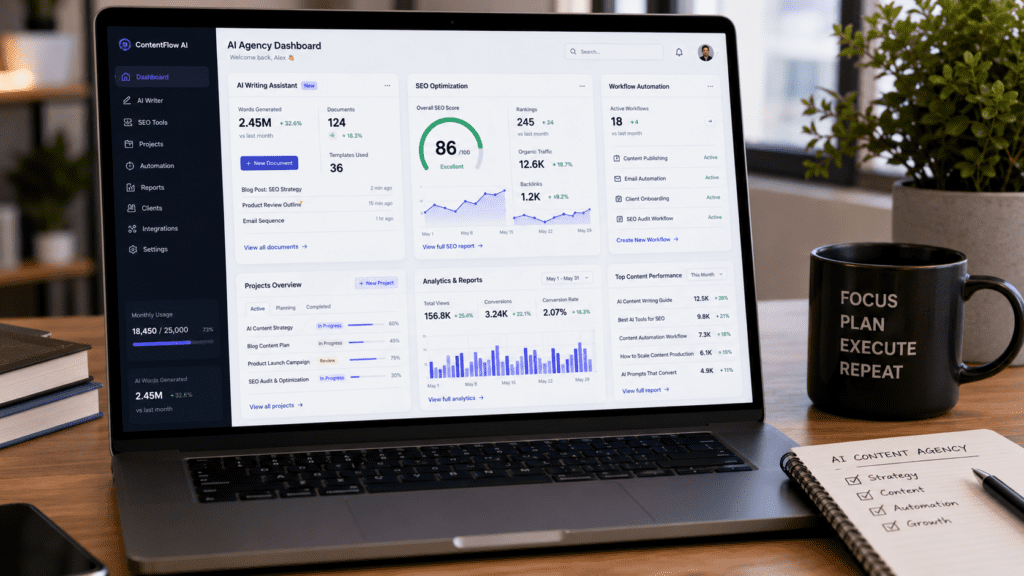
Different AI tools support different parts of agency operations. Most successful agencies combine several platforms together instead of relying on one system only.
ChatGPT
ChatGPT works well for:
• Research: Supporting topic discovery and planning
• Content outlines: Organizing SEO article structures
• Workflow planning: Building operational systems
• AI assistants: Supporting repetitive agency workflows
A smaller AI Content Agency may use ChatGPT daily for brainstorming, keyword clustering, and drafting support before editorial review begins.
Jasper AI
Jasper AI focuses more heavily on scalable content production workflows.
It’s commonly used for:
• Long-form ai content: Supporting larger publishing systems
• Brand voice consistency: Maintaining client tone
• Agency workflows: Managing scalable operations
• Content scaling: Improving publishing efficiency
Some ai marketing agencies combine Jasper AI with Surfer SEO and ClickUp to streamline SEO publishing systems more efficiently.
Surfer SEO
Surfer SEO helps agencies optimize SEO performance and search intent alignment.
This usually includes:
• SEO optimization: Improving ranking opportunities
• Search intent workflows: Matching user expectations
• Optimization systems: Supporting content structure
A growing agency may use Surfer SEO to optimize articles before editorial approval and client delivery.
Zapier
Zapier supports workflow automation across different platforms.
This often includes:
• Workflow automation: Reducing repetitive operational tasks
• Tool integrations: Connecting agency systems
• Content pipelines: Improving operational efficiency
Some agencies automate reporting, scheduling, notifications, and publishing workflows through Zapier integrations.
ClickUp
ClickUp helps agencies organize workflow systems and internal operations.
It’s commonly used for:
• Team collaboration: Managing production visibility
• Editorial systems: Tracking publishing stages
• Workflow management: Organizing client operations
Honestly, operational clarity usually matters more than stacking endless ai tools together without structure.
Best AI Workflow Stacks for Content Agencies
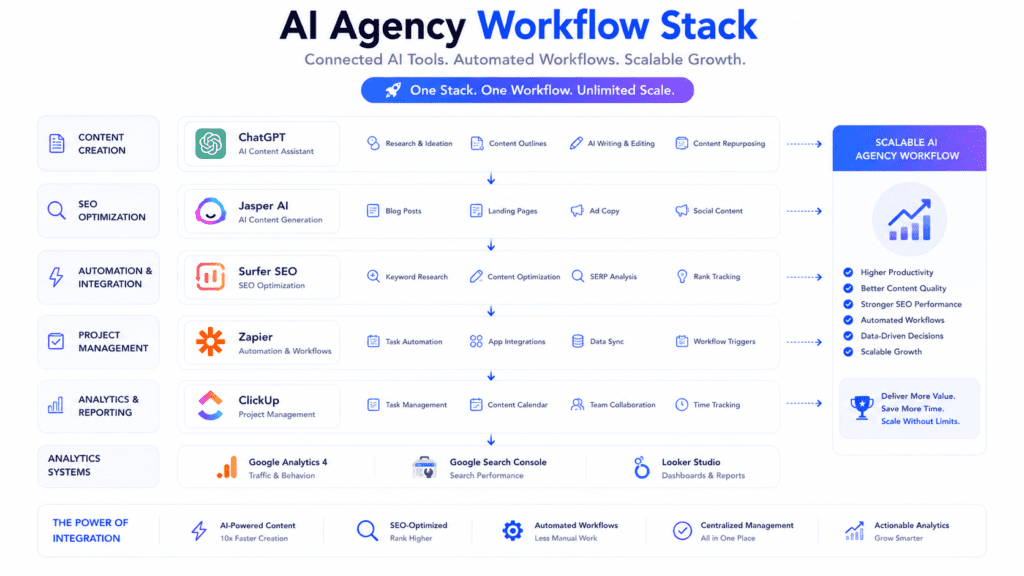
Different workflow stacks work better for different agency sizes and service models.
Beginner Agency Stack
A smaller beginner stack may include:
• ChatGPT: Research and drafting support
• Google Docs: Editorial collaboration
• Trello: Basic workflow organization
This type of setup works well for solo founders and smaller startup operations.
SEO Agency Stack
An SEO-focused AI Content Agency often uses:
• Jasper AI: Long-form content production
• Surfer SEO: Ranking-focused optimization
• ClickUp: Workflow coordination
A smaller SEO agency may optimize publishing systems significantly using this stack before expanding into more advanced automation.
Automation Agency Stack
Automation-focused agencies usually build around operational systems.
This may include:
• Zapier: Workflow integrations
• AI assistants: Supporting repetitive operations
• Workflow systems: Managing content pipelines
Now this is where agencies often save serious time and resources. A well-structured automation stack can reduce operational bottlenecks without sacrificing editorial oversight.
How to Build an AI Content Workflow for Agencies
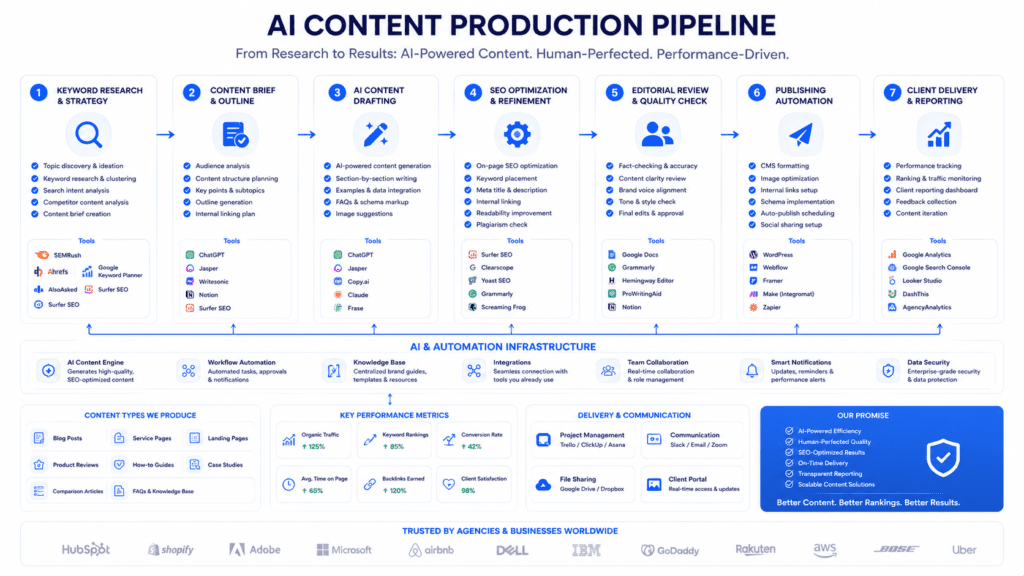
A scalable AI Content Agency depends heavily on workflow organization instead of random publishing systems.
Keyword Research Workflow
Keyword research often shapes the entire SEO strategy.
This usually includes:
• Search intent analysis: Matching audience goals
• Topic clustering: Organizing content structure
• SEO planning: Supporting ranking opportunities
Some agencies use ai algorithms can analyze search trends and ranking patterns faster than manual research workflows alone.
Content Creation Workflow
The production workflow focuses on drafting and editorial systems.
This may include:
• AI-assisted drafting: Accelerating production speed
• Editing systems: Improving readability and structure
• Content optimization: Supporting SEO workflows
A stronger workflow usually combines human editing with AI-assisted drafting instead of relying entirely on automated publishing.
Editorial and Quality Control Workflow
Editorial systems help agencies maintain consistency across clients.
This often includes:
• Fact-checking: Improving content accuracy
• Human review: Maintaining quality control
• Brand voice consistency: Supporting client positioning
Many agencies struggle because every article sounds repetitive. Strong editorial oversight usually fixes that problem.
Publishing and Automation Workflow
Publishing systems help streamline delivery operations.
This may include:
• Scheduling systems: Managing publishing timelines
• Workflow automation: Coordinating operational tasks
• Multi-channel publishing: Expanding content distribution
An AI Content Agency may automate scheduling workflows while editors manually approve every article before publication.
What a Real AI Agency Workflow Looks Like
Client Onboarding Workflow
The onboarding process often includes:
• Discovery calls: Understanding client goals
• Content planning: Organizing publishing systems
• Strategy setup: Aligning workflow expectations
Content Production Workflow
Production workflows usually involve:
• Research: Supporting SEO direction
• AI-assisted drafting: Accelerating article creation
• SEO optimization: Improving rankings
• Editorial review: Maintaining quality standards
A small agency may use ChatGPT for outlines, Jasper for drafting, Surfer SEO for optimization, and ClickUp to manage delivery systems.
Client Delivery Workflow
Client delivery systems often include:
• Approval systems: Managing revisions
• Reporting workflows: Tracking SEO progress
• Revision handling: Supporting client communication
Automation and Optimization Workflow
Optimization systems focus on operational efficiency.
This often includes:
• Workflow automation: Reducing repetitive tasks
• Internal process optimization: Improving operations
• Scaling systems: Supporting larger publishing volume
How to Build an AI Content Agency Portfolio Without Existing Clients
A beginner AI Content Agency can still build authority without real client work initially.
Helpful methods include:
• Create sample SEO articles: Demonstrating workflow quality
• Build demo workflows: Showing operational systems
• Publish educational content: Building visibility
• Create case study simulations: Showcasing strategy thinking**
A beginner founder may publish SEO-focused AI content for imaginary SaaS companies before landing the first real client.
How to Get Your First AI Content Agency Clients

Freelance Platforms
Many beginners start on:
• Upwork: Freelance client acquisition
• Fiverr: Smaller service packages
• Freelancer: Project-based opportunities
LinkedIn Outreach
LinkedIn often works well for relationship building.
This may include:
• Educational content: Building authority
• Personalized networking: Creating trust gradually
• Relationship building: Supporting long-term growth
Cold Email Prospecting
Some agencies use outreach workflows targeting:
• SaaS businesses: SEO-focused growth companies
• Local companies: Smaller operational teams
• Ecommerce brands: Content-heavy businesses
Content Marketing for Client Acquisition
Content marketing can also attract leads organically.
This often includes:
• SEO blog posts: Building organic visibility
• Social proof: Showcasing expertise in ai
• Educational AI content: Supporting authority building**
A beginner AI Content Agency may land the first retainer client after consistently publishing SEO and workflow education content online.
Frequently Asked Questions
What is an AI content agency and why should I start an ai agency?
An AI content agency uses artificial intelligence to create and optimize content at scale, letting you offer faster, cheaper marketing services that clients want.
How do I start your own ai agency with no prior tech background?
Begin by learning basic ai tools, pick a niche, and partner with developers or ai agents to deliver customized ai solutions for clients.
Which ai services should I offer first to attract clients?
Start with content automation, personalized marketing, and natural language processing tasks that show clear metrics and quick wins.
How can I automate content creation without losing quality?
Use tailored ai models, set clear prompts, and add human editing to keep tone and accuracy while scaling output.
What marketing strategy works best for launching your ai agency?
Combine case studies, testimonials, and demo campaigns that highlight how leveraging ai algorithms improved specific marketing tasks.
How do I price ai services and measure success with a simple metric?
Price by project or subscription and track a few key metrics like engagement, conversion rate, and content output per hour.
Can integrating ai replace my creative team or just optimize workflows?
AI is best for automating repetitive tasks and optimizing workflows, while humans handle creative strategy and client relationships.
What tools should I use to design workflows and launch your ai offerings?
Pick tools for natural language processing, workflow automation, and analytics that let you create repeatable, efficient processes.
How do I show the potential of ai to skeptical clients?
Share short demos, before-and-after metrics, and client testimonials that prove ai advancements deliver real marketing results.
How can I use personalized marketing and tailored ai to exceed client expectations?
Create segmented campaigns, use ai to predict behavior, and deliver customized ai solutions that boost relevance and ROI.
What legal or ethical issues should I consider when building a successful ai agency?
Be transparent about ai use, respect data privacy, and verify outputs to avoid misinformation and protect client brands.

Final Verdict: Is It Worth It to Start an AI Content Agency?
Bottom line? For many freelancers and marketers, yes.
An AI Content Agency can help businesses scale SEO content, automate repetitive workflows, improve operational efficiency, and manage multi-channel marketing systems more effectively.
That said, AI alone isn’t enough. Strong workflow organization, SEO expertise, communication quality, and human editorial systems still separate premium agencies from low-quality automation-heavy operations.
My Recommendation
• Start with one niche first: Build operational clarity gradually
• Use AI tools to improve efficiency: Not replace human quality completely
• Focus on SEO and workflow systems: Build long-term operational strength
• Prioritize client trust: Communication and reliability still matter heavily
A beginner freelancer may gradually build an AI Content Agency by focusing on SEO blog production, repeatable systems, and stronger editorial workflows before expanding into advanced automation services.
Final Thoughts on Building a Sustainable AI Content Agency
The strongest AI agencies usually combine workflow automation with human creativity, editorial oversight, and strategic marketing operations.
If you want to Start an AI Content Agency, focus on operational systems first. Once the workflow becomes stable, scaling clients, publishing systems, and automation setups becomes much easier without sacrificing quality or client trust.