

Trying out new AI writing tools can feel like a gamble. You hear about their amazing features, but committing to a monthly subscription without truly testing if it fits your workflow is a common headache for many content creators, marketers, and small business owners. What if it doesn’t deliver on its promises for *your* specific needs? This hesitation often stops people from exploring powerful platforms that could genuinely boost their content game.
That’s where a solid free trial comes in, and understanding the Writesonic Free Trial Explained is crucial for making an informed decision. This isn’t just about getting a few free words; it’s about giving you the chance to put Writesonic through its paces, see its capabilities firsthand, and determine if it’s the right AI assistant for your content strategy. We’ll walk you through exactly how to claim your free access and maximize your testing period, ensuring you get real value before considering any commitment.
How to Claim the Writesonic Free Trial in 2026
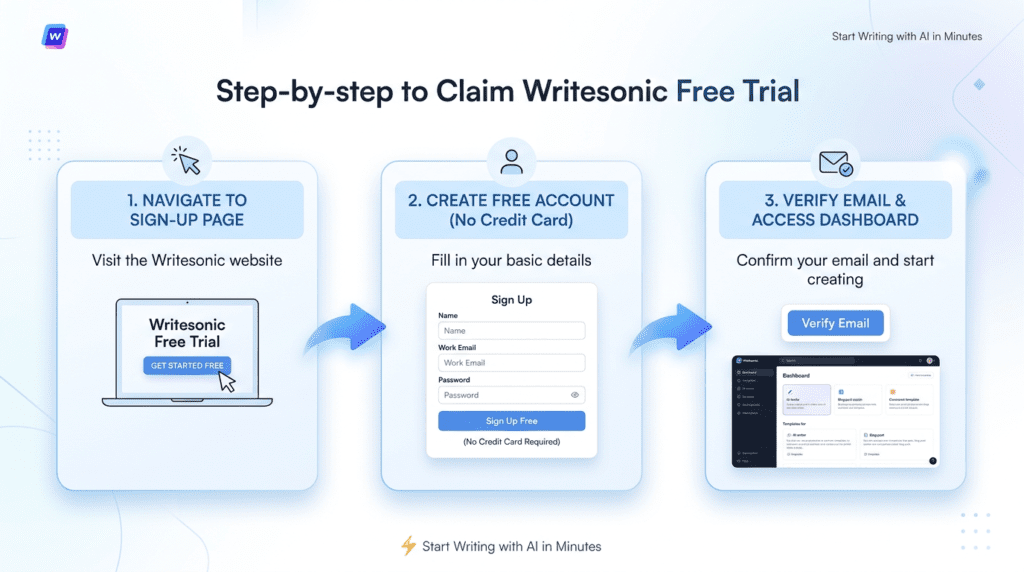
Ready to dive in and see what Writesonic can do for your content? The good news is that getting started with the Writesonic free trial is straightforward and doesn’t require a credit card upfront. This means you can explore its core features without any financial commitment. Here’s a step-by-step guide to claiming your free words and setting up your account in 2026.
Step 1: Navigate to the Writesonic Sign-Up Page
Your first move is to head directly to the official Writesonic website. Look for a prominent ‘Sign Up Free’ or ‘Get Started’ button, usually located in the top right corner or center of the homepage. Clicking this will take you to the account creation form.
Step 2: Create Your Free Account (No Credit Card Required)
Once on the sign-up page, you’ll have a few options. You can typically create your free account using your Google account for a super-fast setup, or you can register with an email address and create a password. This is a crucial point: Writesonic does *not* ask for your credit card details to start your free trial. This ‘no credit card required’ policy is a big plus, letting you test the platform truly risk-free without worrying about accidental charges or remembering to cancel.
Step 3: Verify Your Email and Access the Dashboard
After submitting your details, Writesonic will send a verification email to the address you provided. Head over to your inbox, find that email (check spam if you don’t see it right away!), and click the verification link. This step confirms your identity and activates your free Writesonic account. Once verified, you’ll be automatically logged in and directed to your Writesonic dashboard, ready to start generating content.
Step 4: Understanding Your Initial Word Credit Balance
Once you’re inside your Writesonic dashboard, your immediate focus should be on understanding your initial word credit balance. This is the currency of your free trial. Writesonic doesn’t offer an unlimited free period; instead, it provides a set amount of ‘free words’ or ‘credits’ that you can use to generate content. In 2026, new free accounts typically start with a generous allocation, often around 10,000 words, though this can vary slightly based on promotions or regional offers.
These credits aren’t just a flat number; their usage depends on the ‘quality level’ you choose for your AI-generated content. Writesonic usually offers options like ‘Economy,’ ‘Average,’ ‘Good,’ ‘Premium,’ and ‘Ultra’ quality. Higher quality settings consume more credits per word generated. For example, generating 100 words at ‘Ultra’ quality might use significantly more credits than 100 words at ‘Economy’ quality. This is a critical trade-off to grasp early on: you can generate more content at lower quality, or less content at higher, more refined quality.
The beauty of this credit system is that it lets you experiment with different tools and quality settings. You can test out the AI article writer, try generating social media posts, or even play with Photosonic for AI
What’s Actually Included in the Writesonic Free Trial?
Understanding exactly what you get with the Writesonic free trial is crucial for making the most of your testing period. It’s not just about signing up; it’s about knowing which tools are at your fingertips and how to best utilize your initial allocation. This section clarifies the value proposition of the free offering, managing user expectations about what they can and cannot do.
Your Starting Word Count: How Far Does It Go?
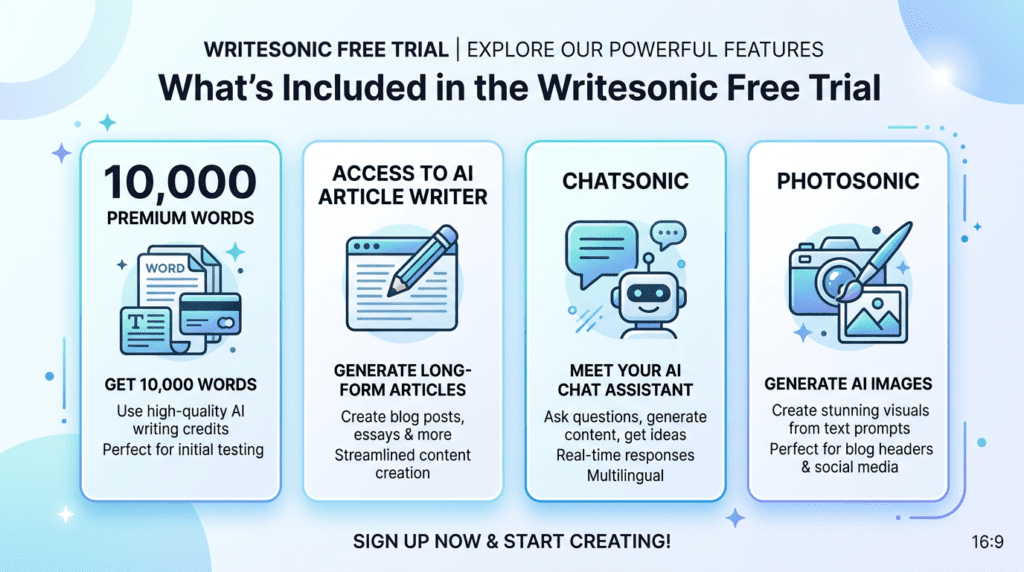
When you first sign up for the Writesonic Free Trial Explained, you’ll typically receive a generous starting credit of 10,000 premium words. This isn’t just a random number; it’s designed to give you a substantial taste of the platform’s capabilities. For a beginner, 10,000 words can go quite far, allowing you to generate several short blog posts, numerous social media captions, product descriptions, or even a few sections of a longer article. However, it’s important to understand that “premium words” are a specific currency within Writesonic. The actual number of words you can generate depends heavily on the quality setting you choose, which directly impacts how many credits each generation consumes. This initial word count is your primary resource for exploring the platform.
Access to Key Features: What You Can Test
The Writesonic Free Trial Explained provides access to a wide array of its core features, allowing you to test the waters without commitment. This is where the real value of the free account shines, as you can experiment with the tools that matter most to your content creation workflow.
- AI Article Writer: This is often the main draw for many users. The free trial lets you experiment with generating outlines, introductions, and even full articles. You can test its ability to produce coherent, engaging content on various topics, which is vital for bloggers and content marketers. For example, you could generate a 500-word blog post on “SEO tips for small businesses” to see how well it captures your desired tone and information.
- Chatsonic: Think of Chatsonic as Writesonic’s answer to ChatGPT, but with real-time data access and image generation capabilities. The free trial allows you to ask questions, brainstorm ideas, summarize content, and even generate basic images through conversational prompts. This is incredibly useful for quick research, content ideation, or getting instant answers.
- Photosonic: Writesonic’s AI image generator is also available. You can create unique images from text prompts, which is a huge benefit for social media managers, bloggers, and anyone needing visuals without stock photo limitations. The free trial typically includes a specific allocation of image credits (e.g., 100 images), separate from your word count, allowing you to test its creative potential.
- Other Core Tools: Beyond these flagship features, you’ll find access to many of Writesonic’s 100+ AI templates. This includes tools for ad copy, landing page copy, product descriptions, social media posts, email subject lines, and more. This broad access means you can test the platform’s versatility across different marketing and content needs.
Quality Settings: Using Premium vs. Economy Words
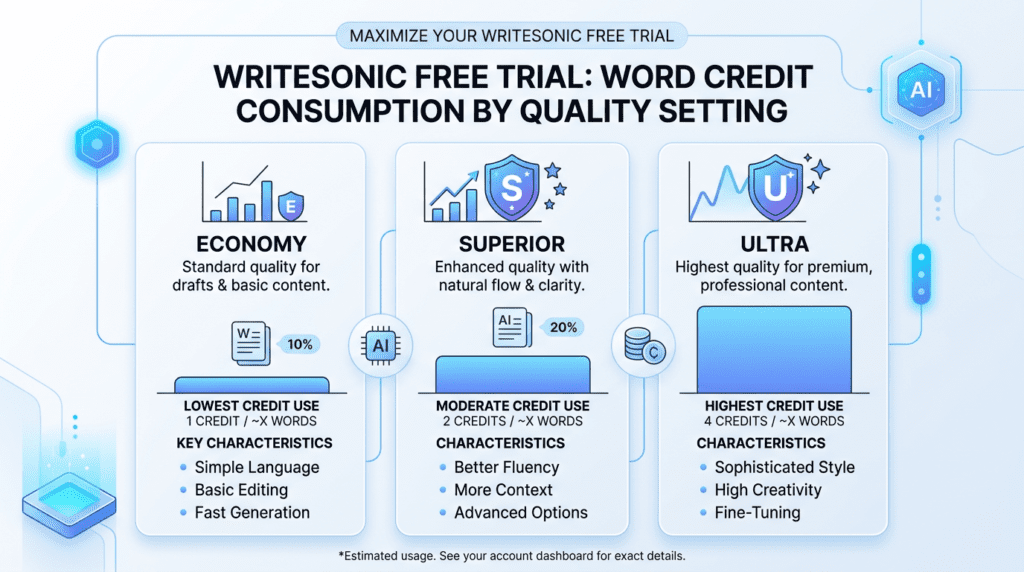
One of the most important aspects to grasp during your Writesonic Free Trial Explained is the concept of quality settings and how they impact your word credit consumption. Writesonic offers different quality levels for its AI-generated content: Economy, Average, Superior, and Ultra.
- Economy: This setting uses the fewest credits per word generated. While it’s the most cost-effective, the output quality might be less refined or require more editing. It’s best for generating large volumes of draft content or ideas where perfection isn’t the immediate goal.
- Average: A good balance between credit usage and quality. This is often suitable for initial drafts that you plan to heavily edit.
- Superior: This is the default “premium” setting and offers higher quality, more coherent, and often more engaging content. It consumes more credits than Economy or Average but typically requires less post-editing. Most of your 10,000 free words are considered “premium” words, meaning they align with this or the Ultra quality.
- Ultra: This is the highest quality setting, designed for the most polished and sophisticated output. It consumes the most credits but aims for near-human quality.
During your free trial, you’ll primarily be working with the “premium” word allocation, which often defaults to Superior or allows you to choose. Understanding this distinction is key to managing your free words effectively. If you generate content using the “Ultra” quality, your 10,000 words will be depleted much faster than if you stick to “Economy” or “Superior.” For beginners, testing with “Superior” quality is recommended to get a true feel for Writesonic’s capabilities.
Language and Tone of Voice Options Available
Even within the Writesonic Free Trial Explained, you’ll have access to a robust selection of language and tone of voice options. This means you can generate content in multiple languages (e.g., Spanish, French, German) and experiment with different tones (e.g., professional, witty, enthusiastic, persuasive). This is a significant advantage for global businesses or those targeting diverse audiences, allowing you to assess the AI’s adaptability to your specific brand voice requirements. Testing these options early can help you determine if Writesonic can truly cater to your content strategy.
Key Limitations of the Free Trial You Need to Know
While the Writesonic Free Trial Explained offers a fantastic opportunity to explore the platform, it’s essential to be aware of its limitations. Understanding these constraints upfront will help you set realistic expectations, avoid frustration, and plan your testing strategy more effectively. Transparency about these limitations is crucial for making an informed decision about a potential upgrade.
The Word Count Cap: The Biggest Constraint
The 10,000 premium words provided in the Writesonic Free Trial Explained are a valuable resource, but they are also your biggest constraint. While this might seem like a lot, especially for short-form content, it can quickly diminish if you’re attempting to generate multiple long-form articles or experimenting extensively with different quality settings. For instance, generating a single 1,500-word article at “Superior” quality could consume a significant portion of your free words. This cap means you can’t rely on the free trial for ongoing content production. Instead, view it as a testing budget. Prioritize generating content for your most critical use cases to see if Writesonic meets your core needs before your free words run out. This limitation often becomes a hidden frustration for users who underestimate how quickly words are consumed, especially when exploring different templates or regenerating content.
Feature Restrictions: What’s Locked Behind a Paid Plan?
While the free trial gives you access to many core tools, several advanced features are typically reserved for paid subscribers. These restrictions are common across SaaS platforms and are designed to encourage users to upgrade for more specialized needs.
- Brand Voice: One of the most significant limitations for businesses is the absence of a dedicated “Brand Voice” feature. Paid plans often allow you to train the AI on your specific brand guidelines, ensuring consistent tone, style, and terminology across all generated content. Without this, you’ll need to manually edit and refine the output to match your brand, which can be time-consuming.
- Bulk Processing: If you need to generate hundreds of product descriptions or social media posts simultaneously, the free trial won’t support this. Bulk generation features, which save immense time for e-commerce stores or agencies, are typically premium offerings.
- Advanced Integrations & API Access: While the Chrome extension might be available, deeper integrations with other marketing tools (like WordPress, Zapier, or specific CRM systems) or direct API access for custom applications are usually locked behind higher-tier subscriptions. This impacts workflows for users looking to automate content publishing or integrate AI writing into existing software.
- Team Collaboration: For agencies or larger content teams, features like shared workspaces, user management, and collaboration tools are essential. These are not available in the free trial, making it unsuitable for multi-user testing environments.
- Plagiarism Checker & SEO Optimizer: While Writesonic offers these tools, their full functionality or higher usage limits are often tied to paid plans. You might get a limited number of checks or basic SEO suggestions in the free trial, but not the comprehensive analysis needed for professional content.
These restrictions mean that while you can test the *quality* of the AI’s output, you can’t fully evaluate its *workflow efficiency* or *scalability* for larger operations without a paid plan.
Usage Limits on Specific Tools (e.g., Photosonic Images)
Beyond the overall word count, specific tools within Writesonic often have their own, separate usage limits even within the free trial. For instance, while you get access to Photosonic, the number of AI images you can generate might be capped at, for example, 100 images. Similarly, other specialized tools might have daily or monthly limits that are lower than what’s available in paid plans. This means you need to be strategic about how you use each tool, prioritizing the most important tests. For a blogger, generating a few key images for a post might be sufficient, but a graphic designer would quickly hit this ceiling.
Does the Free Trial Expire?
A common question about the Writesonic Free Trial Explained is whether it has a time limit. Unlike some software trials that expire after 7 or 14 days, Writesonic’s free trial is typically credit-based, not time-based. This means your free account remains active until you exhaust your initial 10,000 premium words (and any separate image credits). There’s no ticking clock forcing you to rush your evaluation. This is a significant advantage, as it allows you to test the platform at your own pace, returning to it as needed until your credits are used up. Once your free words are gone, you’ll need to upgrade to a paid plan to continue generating content.
A Strategic 7-Day Plan to Maximize Your Writesonic Trial
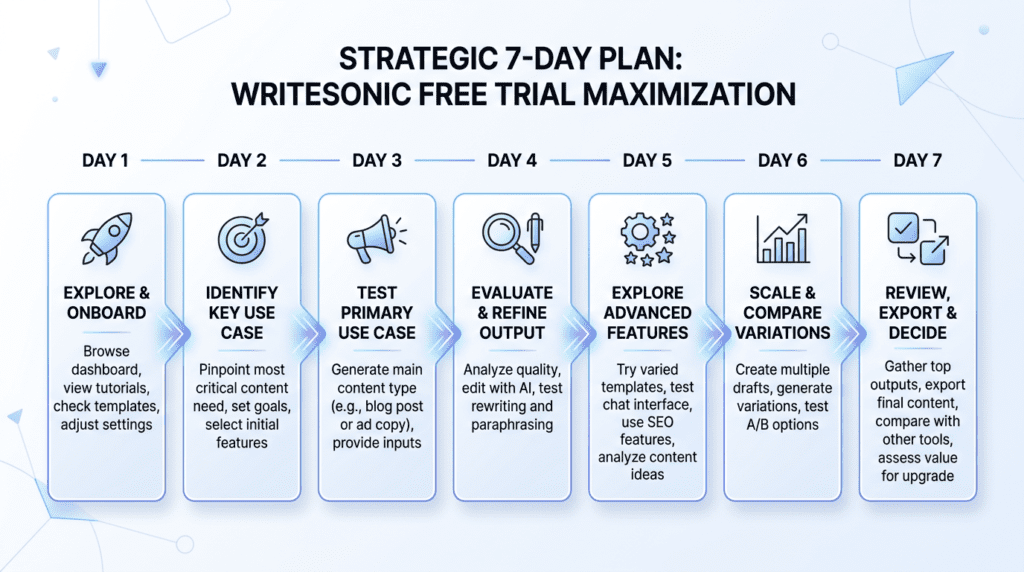
Getting a Writesonic free trial explained is one thing, but actually making the most of it is another. You’ve got a limited number of free words, and you want to ensure you put Writesonic through its paces for *your* specific needs. This isn’t just about clicking buttons; it’s about strategically evaluating if this AI writing assistant fits into your workflow and helps you achieve your content goals. Think of your free words as a budget – spend them wisely!
Day 1-2: Exploring the Interface and Core Tools
When you first sign up for your free account, it’s easy to feel a bit overwhelmed by all the options. Don’t jump straight into generating a 2,000-word article. Instead, take these first couple of days to get comfortable.
Start by navigating the user interface. Where are the templates? How do you access Chatsonic? What about Photosonic? Many beginners struggle with simply finding their way around, and that initial confusion can eat into your valuable trial time.
A great starting point is the AI Article Writer 5.0. Try generating a short blog post, maybe 500-700 words, on a topic you know well. This will give you a feel for the multi-step process, how it handles outlines, and the quality of the initial draft. Don’t expect perfection, but look for coherence and relevance.
Next, switch over to Chatsonic. This is Writesonic’s AI chatbot, similar to ChatGPT. Test it with both factual and creative prompts. Ask it to summarize a complex topic, brainstorm blog post ideas, or even write a short poem. This helps you understand its conversational capabilities and how it can assist with research or idea generation, which can be a huge time-saver in your content creation process.
Day 3-4: Testing for Your Primary Use Case
Now that you’re familiar with the basics, it’s time to get specific. This is where the Writesonic free trial explained really starts to deliver practical value. Don’t just generate random content; focus on the types of content you create most often.
- Example for Bloggers: If you’re a blogger, try outlining and drafting a full article (within your word limit, of course). Use the AI Article Writer 5.0 to generate sections, then use the Sonic Editor to refine them. Pay attention to how much editing is required to make the content sound like *you*. Does it capture your brand voice, or does it feel generic? This is where you’ll discover if Writesonic can genuinely speed up your article writing process or if it’s just a fancy rephrasing tool.
- Example for Marketers: For marketers, focus on ad copy and social media posts. Use the “Facebook Ad Headlines” or “LinkedIn Post” templates. Generate several variations and compare them. Do they sound compelling? Are they concise? Test the landing page copy generator if that’s a key part of your work. You’ll quickly see if the AI understands marketing psychology or if it just spits out buzzwords. This helps you determine if Writesonic can be a reliable assistant for your daily marketing tasks.
Day 5-6: Pushing the Limits and Testing Quality
With a few days under your belt, it’s time to really challenge the Writesonic free trial. This is where you move beyond basic functionality and start to understand its nuances and limitations.
One of the most important tests is comparing the output quality. If your free account offers different quality levels (e.g., Premium vs. Economy words), experiment with both. Generate the same type of content (e.g., a product description) using each setting. You’ll likely notice a significant difference in fluency, originality, and overall sophistication. Many users overestimate the “economy” quality, expecting it to be nearly as good as premium, which isn’t always the case. Understanding this trade-off is crucial for estimating your future credit usage and overall cost.
Also, experiment with different tones of voice and custom commands. Can you get the AI to write in a humorous tone? A formal tone? What happens when you give it very specific instructions? This helps you understand how much control you have over the output and how much “hand-holding” the AI needs. You might find that while it’s great for generating ideas, getting it to perfectly match a complex brand voice requires a lot of iterative prompting.
Day 7: Evaluating Output and Making a Decision
By your final day, you should have a solid collection of generated content. Now it’s time for a critical assessment.
- Assess the quality of the generated content: Go back through everything you’ve created. How much editing did each piece require? Was it easy to make it sound like your own? Did it meet your expectations for accuracy and creativity? Be honest about the time saved versus the time spent editing.
- Estimate your monthly word usage to choose a plan: This is a critical step for anyone considering an upgrade. Based on your usage during the trial, how many words do you think you’d need in a typical month? If you’re a blogger publishing two 1,500-word articles, plus social media posts, that adds up quickly. This estimate will directly inform which Writesonic pricing plan makes the most sense for you, or if a paid subscription is even necessary. Don’t forget to factor in re-generations and edits, as those consume words too.
What Happens When Your Free Words Run Out?
The Writesonic free trial explained that you get a certain number of words to start. But what happens when that initial well runs dry? It’s a common question, and understanding your options is key to planning your next steps.
The Upgrade Path: An Overview of Writesonic’s Paid Plans
Once your initial free words are used up, Writesonic will prompt you to upgrade to a paid subscription. This is the primary way to continue using the platform’s full capabilities without interruption. Their paid plans typically offer significantly higher word counts, access to premium features that might have been restricted during the trial (like Brand Voice or higher quality settings), and often include more advanced tools like bulk processing or dedicated customer support. The upgrade path is designed to provide seamless continuity, allowing you to pick up right where you left off, but with expanded resources.
Can You Get More Free Words? (Referral Programs, etc.)
While the initial free word count is a one-time grant, some platforms offer ways to earn additional credits. Writesonic occasionally runs promotions or referral programs where you can get extra free words by inviting friends or completing specific tasks. It’s worth checking their website or your account dashboard for any current offers. However, these are usually not a sustainable long-term solution for consistent, high-volume content creation. They’re more like bonus top-ups rather than a replacement for a paid plan.
Continuing on the Free Plan with Daily Word Refreshes
Good news for those who aren’t ready to commit to a paid plan immediately: Writesonic typically offers a perpetual free tier, even after your initial free trial words are exhausted. This free plan usually comes with a very limited number of daily or monthly word credits. For example, you might get 10,000 words per month on the free plan, but these are often “economy” quality words. This allows you to continue using basic features and generate short pieces of content, but it’s not suitable for serious content creators or businesses. It’s a great option for occasional use, testing new templates, or simply keeping your account active without a subscription. Just be aware of the word limit and potential quality restrictions.
Honest Take: Is the Writesonic Free Trial Worth Your Time?

After going through the Writesonic free trial explained, you might still be wondering if it’s truly worth the effort. In short, yes, but with some important caveats. It’s not a magic bullet, but it can be an incredibly valuable diagnostic tool for your content strategy.
Who Benefits Most from the Free Trial?
The Writesonic free trial is an absolute must for bloggers, content marketers, and small business owners who are new to AI writing tools. If you’re looking to understand what AI can *actually* do for your content, this trial is your low-risk entry point. It’s perfect for testing specific content types like blog post outlines, social media updates, product descriptions, or ad copy. You’ll quickly see if AI can help you overcome writer’s block, generate ideas faster, or simply speed up the drafting process. It’s also great for those who want to compare Writesonic’s output quality against other AI tools they might be considering. For these users, the free words provide enough runway to make an informed decision without any financial commitment.
Who Might Find the Free Trial Too Limiting?
On the flip side, agencies, large content teams, or power users with extremely high-volume content needs might find the free trial too restrictive. The word count cap, even with the initial generous allowance, can be quickly exhausted when you’re trying to generate dozens of articles or thousands of pieces of ad copy. These users often need advanced features like Brand Voice, bulk generation, or extensive API access, which are typically locked behind premium paid plans. For them, the free trial might only offer a superficial glimpse, leading to frustration rather than a full evaluation. They might need to consider a short-term paid plan or a more robust trial if available, to truly test the tool at scale.
The Hidden Value: Using It as a Litmus Test for AI Workflows
Beyond just evaluating Writesonic itself, the free trial offers a deeper, often overlooked benefit: it serves as a litmus test for integrating *any* AI into your content workflow. Many users approach AI tools with misconceptions, expecting them to fully replace human writers or produce perfect, ready-to-publish content. The Writesonic free trial explained that this isn’t the case.
By actively using the trial, you’ll uncover the practical implications of AI writing:
- Beginner challenges: You’ll learn how to prompt effectively, which is a skill in itself.
- Workflow implications: You’ll see how AI fits into your existing content creation process – does it streamline outlining, drafting, or editing?
- Performance trade-offs: You’ll understand the difference between “economy” and “premium” quality and what that means for your brand.
- Scaling concerns: You’ll get a real sense of how quickly words are consumed and what your actual monthly needs might be.
This experience helps you understand not just Writesonic, but the broader landscape of AI writing. It helps you avoid the opportunity cost of investing in the wrong tool or having unrealistic expectations. Even if you decide Writesonic isn’t for you, the trial will have taught you valuable lessons about how AI can (or cannot) enhance your content strategy.
Final Recommendation: Should You Start the Writesonic Trial?
Absolutely. Based on the strategic evaluation framework we’ve outlined, the Writesonic free trial is a highly recommended, no-risk opportunity for anyone considering an AI writing assistant. It provides ample opportunity to test its capabilities against your specific content needs, from generating blog posts and ad copy to exploring creative prompts with Chatsonic. The trial allows you to thoroughly assess the quality of output, experiment with different tools, and determine how seamlessly Writesonic integrates into your workflow, all without any financial commitment. It serves as an invaluable litmus test, enabling you to make an informed decision about whether Writesonic is the right long-term solution for your content generation requirements.
Frequently Asked Questions (FAQ)
Do I need a credit card for the Writesonic free trial?
No, you do not need a credit card to sign up for the Writesonic free trial, making it a truly risk-free way to explore the platform.
How many words do you get with the Writesonic free trial?
The Writesonic free trial typically offers a generous allocation of free words, which can vary but is usually sufficient for extensive testing across various tools.
Does the content I create during the trial belong to me?
Yes, any content you generate using Writesonic during your free trial is yours to keep and use as you see fit.
Can I use the Writesonic API on the free trial?
No, access to the Writesonic API is generally reserved for paid plans and is not included with the free trial.
How does Writesonic’s free trial compare to Jasper’s or Copy.ai’s?
Writesonic’s free trial stands out by offering a substantial word count without requiring a credit card upfront, allowing for a more comprehensive and commitment-free evaluation compared to some competitors that may have stricter trial limitations or require payment details.
What is the best way to use the free trial to decide on a paid plan?
The most effective approach is to follow a structured plan, such as the 7-day strategy discussed earlier, focusing on your primary use cases and thoroughly testing the quality and quantity of output to estimate your monthly word needs.