

One of the biggest mistakes people make with product descriptions is treating them like simple text.
They list features, add a few lines, and expect customers to make a purchase. But most product descriptions fail not because the product is bad, but because the messaging doesn’t connect.
That’s exactly where AI Tools for Product Descriptions come in. Instead of struggling to write product descriptions manually, these tools help generate structured, persuasive, and optimized copy without wasting time and effort.
Quick Picks: Best AI Tools for Product Descriptions Based on Use Case
If you don’t want to test every product description generator out there, this quick list gives a clear starting point.
Different tools work better depending on your workflow, whether you run a small ecommerce store or manage large scale listings.
Top picks:
Best Overall: Jasper
Best for: High-converting product descriptions with strong structure and tone
Best for Ecommerce: Copy.ai
Best for: Bulk product descriptions and ecommerce workflows
Best Budget Option: Rytr
Best for: Simple and affordable product description writing
Let’s be honest for a second.
No single AI tool handles everything perfectly. Some tools focus on speed, while others focus more on conversion or SEO.
Why High Quality Product Descriptions Matter More Than You Think
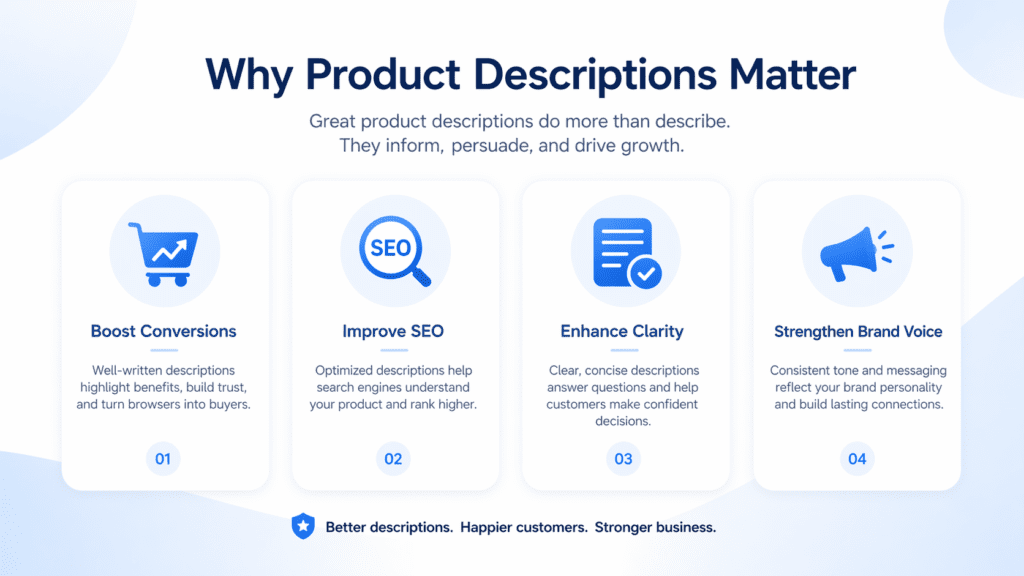
A product description is not just information.
It plays a direct role in conversion, customer trust, and how your product performs on a product page.
Why product descriptions matter:
• Conversion: Persuasive product descriptions help customers make a purchase
• Clarity: Clear product details reduce confusion
• SEO: Optimized product descriptions improve search engine visibility
• Brand voice: Consistent messaging builds brand identity
For example, a Shopify store owner managing hundreds of product names often struggles to maintain consistency. Writing product descriptions manually for each listing becomes time-consuming.
With an AI product description generator, they can generate product descriptions in bulk and then refine them based on their brand voice.
What You’ll Learn From This Guide
This guide focuses on helping you choose the right AI Tools for Product Descriptions based on real use cases.
Instead of just listing tools, we’ll look at how they help write product descriptions that actually drive conversions.
What this guide covers:
• Tool comparison: Understand different product description generator options
• Real workflows: How ecommerce businesses generate product descriptions
• Optimization: How to improve product descriptions for SEO and conversion
• Tool selection: Choose based on your product type and workflow
That said, not every tool will fit your needs.
Some are better for bulk product descriptions, while others focus on writing compelling product description copy that connects with your target audience.
Comparison Table of AI Tools for Product Descriptions With Paid Plans
Before choosing an AI Tools for Product Descriptions setup, it helps to compare how each product description generator performs in real scenarios.
Because honestly, most ecommerce businesses don’t just look at features. They care about pricing, flexibility, and how easily they can generate product descriptions at scale.
| Tool | Free Plan | Paid Pricing | Best For | Key Feature |
|---|---|---|---|---|
| Jasper AI | No | $69/month | Conversion copy | AI writing assistant |
| Copy.AI | Yes | $49/month | Ecommerce listings | Product description generator |
| Rytr | Yes | $9/month | Beginners | Copy generator |
| ChatGPT | Yes | $20/month | Flexible writing | AI writing |
| Scalenut | No | $39/month | SEO optimization | SEO tools |
| Writesonic | Yes | $16/month | Fast generation | AI content |
| Anyword | No | $39/month | Ads and conversion | Predictive copy |
From my research, pricing usually reflects what the tool is optimized for.
For example, Jasper focuses on conversion-driven product descriptions, while Scalenut leans more toward SEO-friendly content. Tools like Rytr are simpler, which is why they are more affordable.
What Are AI Tools for Product Descriptions and How They Work
AI Tools for Product Descriptions are software tools powered by artificial intelligence that help you write product descriptions faster and more efficiently.
Let’s keep it simple.
Instead of writing everything manually, you input product details, and the AI product description generator creates a draft based on patterns, keywords, and structure.
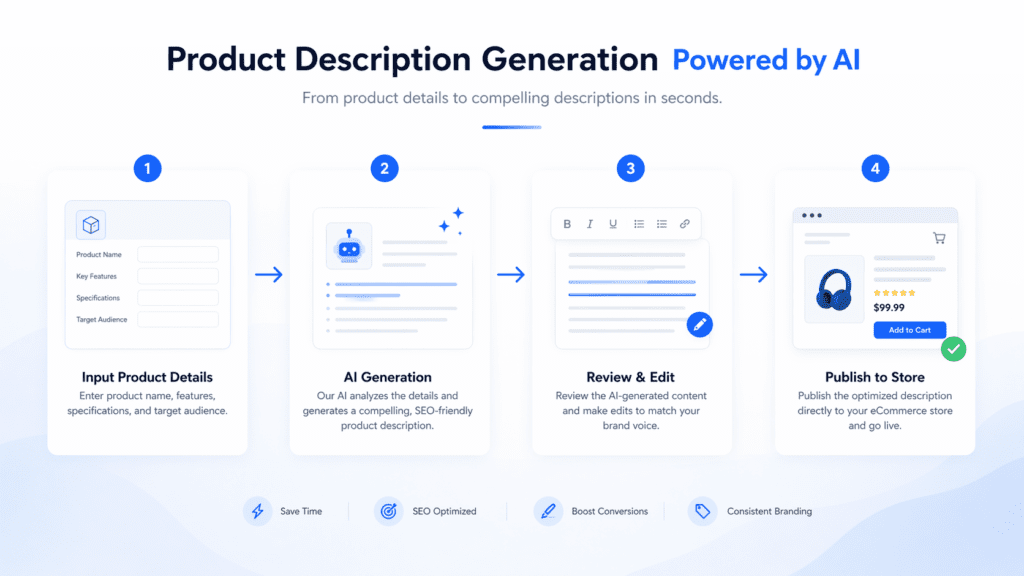
How these tools work:
• Input: Add product names, features, and key details
• Generation: The generator creates product descriptions
• Editing: You refine the tone and brand voice
• Publishing: Upload to your product page
This process helps streamline content creation, especially for ecommerce businesses managing large inventories.
Why E Commerce Businesses Use AI Tools to Generate Product Descriptions
Creating product descriptions manually can become time-consuming, especially when you have dozens or hundreds of products.
That’s why many ecommerce stores use AI Tools for Product Descriptions to simplify their workflow.
Why businesses use AI:
• Speed: Generate product descriptions quickly
• Scalability: Handle large product listing volumes
• Consistency: Maintain brand voice across listings
• Efficiency: Reduce time and effort
For example, a Shopify store managing 200 products may need to write product descriptions for each listing.
Doing this manually could take several days. With an AI-powered product description generator, they can generate content in minutes and then refine it before publishing.
How AI Changes the Product Description Workflow
The biggest shift is not just speed.
It’s how the entire workflow becomes more structured.
Traditional workflow:
• Manual writing: Create each product description individually
• Editing: Review and rewrite
• Publishing: Upload one by one
AI workflow:
• Bulk generation: Generate multiple product descriptions
• Editing: Optimize for brand identity
• Publishing: Upload efficiently
Now think about this.
Instead of spending hours writing product descriptions, you focus more on improving quality and conversion.
7 Best AI Tools for Product Descriptions
Now let’s look at the tools that actually help write product descriptions efficiently.
Not every product description generator performs the same. Some focus on conversion, some on speed, and others on SEO optimization.
Jasper AI
Jasper is one of the most well-known AI writing tools for creating high-quality product descriptions.
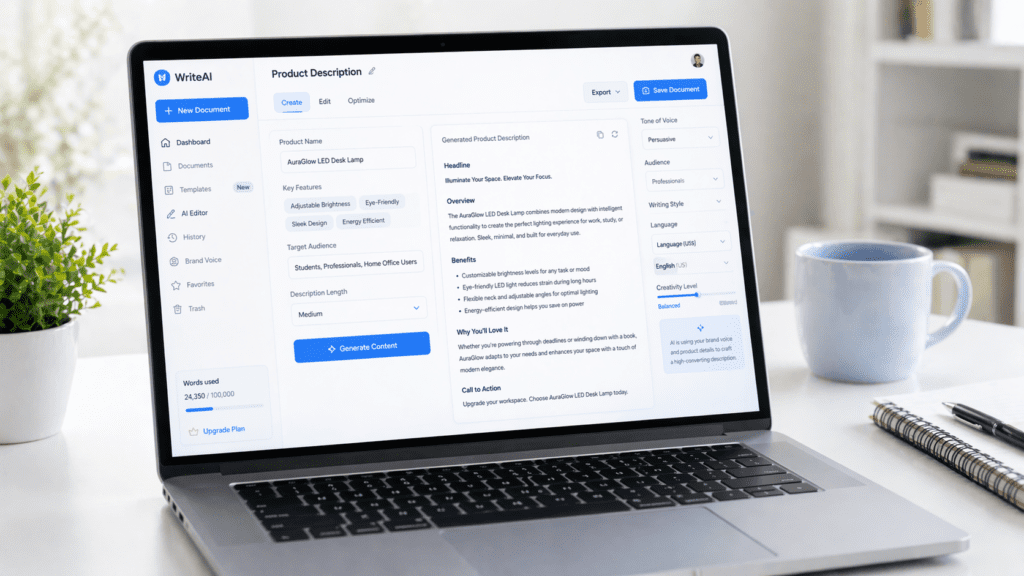
It focuses on conversion-driven copy, which makes it useful for ecommerce brands that want persuasive messaging.
Key features:
• Conversion focus: Helps write product descriptions that drive conversions
• Templates: Structured formats for different product types
• Brand voice: Keeps messaging consistent across listings
Pricing:
• Paid plan: $69/month
Pros and cons:
• Pros: Strong for persuasive product descriptions
• Cons: Higher pricing
From my research, Jasper is often used by marketers who want more control over tone and messaging.
Copy. AI
Copy. AI is a popular product description generator designed for ecommerce businesses.
It’s often used for generating product descriptions in bulk.
Key features:
• Templates: Ready-to-use formats for product descriptions
• Automation: Helps generate multiple listings quickly
• Copy generator: Produces variations of product descriptions
Pricing:
• Free plan: Available
• Paid plan: $49/month
Pros and cons:
• Pros: Easy to generate product descriptions at scale
• Cons: Limited deep customization
This tool works well for ecommerce stores that need consistent product descriptions across many listings.
Rytr
Rytr is a budget-friendly AI product description generator that focuses on simplicity.
It’s useful for small business owners who want to write product descriptions without spending much.
Key features:
• AI copy generator: Helps generate product descriptions quickly
• Simple workflow: Easy to use
• Tone selection: Adjust writing style
Pricing:
• Free plan: Available
• Paid plan: $9/month
Pros and cons:
• Pros: Affordable and beginner-friendly
• Cons: Output can feel basic
Here’s something worth noting.
Budget tools are great for speed, but they may need more editing to create compelling product description copy.
ChatGPT
ChatGPT is one of the most flexible tools for writing product descriptions.
It doesn’t rely on fixed templates. Instead, it works based on a prompt, which means you can tailor the output based on your product details and brand voice.
Key features:
• AI writing: Helps generate product descriptions for different industries
• Prompt-based: You can control tone and structure
• Multi-use: Works for product descriptions, emails, and more
Pricing:
• Free plan: Available
• Paid plan: $20/month
Pros and cons:
• Pros: Highly adaptable for different product descriptions
• Cons: Output depends on how well you write the prompt
One thing that stands out is flexibility. If you want to write product descriptions for different product types, this tool adjusts better than most.
Scalenut
Scalenut is built for SEO-focused product descriptions.
If your goal is to improve visibility on a search engine, this tool focuses more on keyword usage and optimization.
Key features:
• SEO tools: Helps optimize product descriptions for rankings
• AI content: Generates structured content
• Keyword support: Improves visibility
Pricing:
• Paid plan: $39/month
Pros and cons:
• Pros: Strong for SEO-friendly product descriptions
• Cons: Requires some learning
This tool works well for ecommerce businesses that want to balance SEO and conversion.
Writesonic
Writesonic is known for speed.
It helps generate product descriptions quickly, especially when you need to handle multiple product listings.
Key features:
• Templates: Supports product description formats
• AI writing: Helps generate content fast
• Bulk generation: Useful for large inventories
Pricing:
• Free plan: Available
• Paid plan: $16/month
Pros and cons:
• Pros: Fast product description generator
• Cons: Needs editing for better quality
For stores managing hundreds of products, speed becomes a priority, and this tool handles that well.
Anyword
Anyword focuses on performance-driven copy.
Instead of just generating product descriptions, it tries to predict which version may perform better.
Key features:
• Performance scoring: Estimates conversion potential
• AI writing tools: Helps generate persuasive product descriptions
• Optimization: Improves messaging
Pricing:
• Paid plan: $39/month
Pros and cons:
• Pros: Strong for conversion-focused product descriptions
• Cons: Not ideal for general use
This is more suited for marketers who want to optimize product descriptions for better conversion results.
Which AI Tool Writes the Highest Converting Product Descriptions
To understand how different AI Tools for Product Descriptions perform, a simple comparison was done.
The same prompt was used across tools.
“Write a product description for a wireless Bluetooth headphone”
The outputs looked similar at first, but once you read closely, the differences become clear.
What stood out:
• CTA strength: Jasper created more persuasive calls to action
• Structure: Copy. AI delivered clean and readable product descriptions
• Speed: Rytr generated content quickly but with simpler language
• SEO focus: Scalenut included better keyword placement
This usually works well, but not always.
Sometimes the quality depends more on how clearly you provide product details in the prompt.
High Converting Product Description Formula Used by Top Stores
Most high-performing ecommerce stores don’t write product descriptions randomly.
They follow a structure that makes the content more persuasive.
Basic formula:
• Hook: Grab attention with a strong opening
• Problem: Highlight what the product solves
• Solution: Present the product clearly
• Benefits: Explain why it matters
• CTA: Guide users to make a purchase
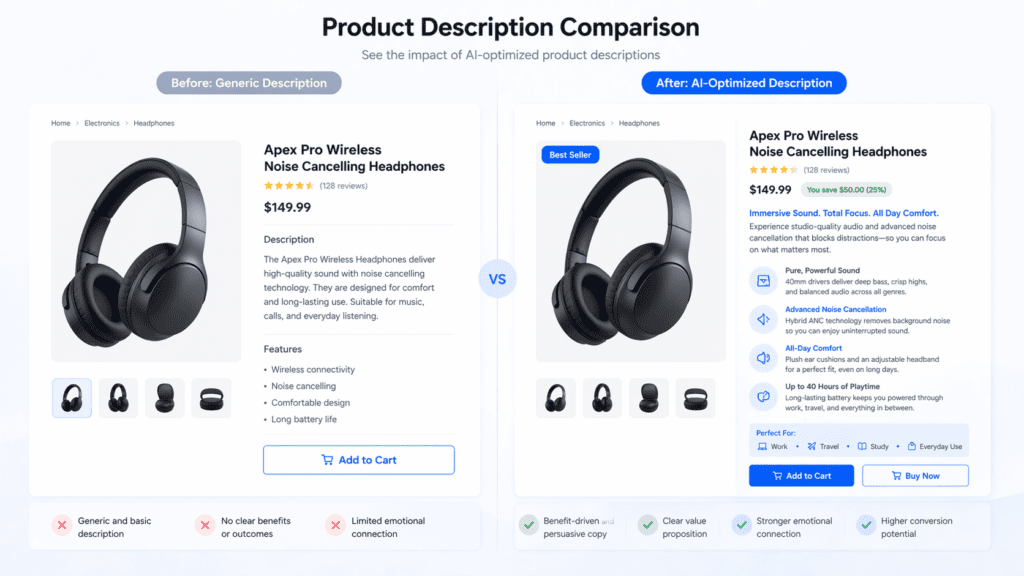
For example, compare these two versions.
A simple version might say the headphones have good sound.
A stronger version focuses on how the product improves the listening experience and solves real problems.
That difference is what makes a compelling product description.
Best AI Tools for Product Descriptions by Use Case
Different tools work better depending on your needs.
Choosing the right product description generator depends on your workflow and product type.
Best tools by use case:
• Ecommerce stores: Copy. AI works well for bulk product descriptions
• SEO focus: Scalenut helps optimize product descriptions
• Conversion focus: Jasper is strong for persuasive copy
• Beginners: Rytr is simple to use
This usually works for most cases, but there are exceptions depending on how complex your product descriptions are.
Before vs After Using AI for Product Descriptions
The impact becomes clearer when you compare workflows.
Without AI, writing product descriptions takes time and consistent effort.
With AI Tools for Product Descriptions, the process becomes faster and more structured.
Before using AI:
• Manual writing: Creating each product description individually
• Time required: Several hours for multiple listings
• Output: Limited number of product descriptions
After using AI:
• Automation: Generate product descriptions quickly
• Efficiency: Handle large product listing volumes
• Consistency: Maintain uniform tone
For example, writing 50 product descriptions manually may take a full day, while generating them with an AI product description generator can take less than an hour.
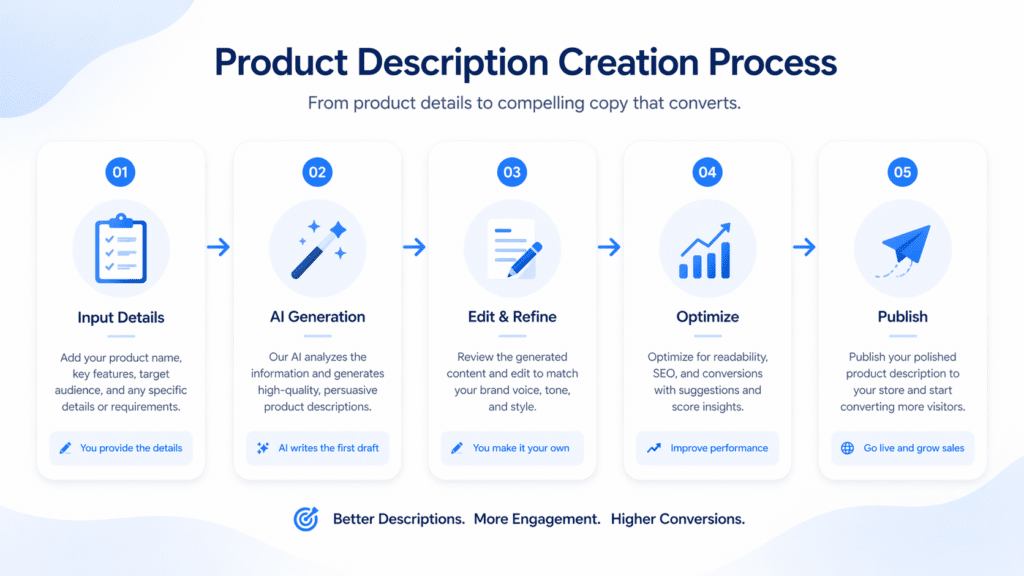
How to Generate Product Descriptions Using AI Step by Step
Using AI without a process can lead to generic product descriptions.
A structured workflow improves results.
Step by step process:
• Input details: Add product features and key information
• Generate content: Use a product description generator
• Edit: Refine tone and messaging
• Optimize: Add keywords and improve clarity
• Publish: Upload to your product page
One thing that makes a difference is how detailed your input is. Better inputs usually lead to better product descriptions.
Best AI Tool Stack for Product Descriptions
Relying on a single product description generator can feel limiting.
A better approach is combining tools based on their strengths.
Common tool stacks:
• Content stack: ChatGPT for ideas, Jasper for persuasive product descriptions
• SEO stack: Scalenut for keyword optimization and structure
• Speed stack: Writesonic plus Copy. AI for bulk product descriptions
This setup helps balance speed, quality, and optimization across product descriptions.
AI vs Human Copywriter for Product Descriptions
There’s always a question about whether AI or a copywriter performs better.
The answer is not one or the other.
Comparison:
• AI writing: Helps generate product descriptions quickly
• Human editing: Adds emotional and persuasive depth
• Best approach: Combine both for better results
In most cases, AI generates the first draft, and a copywriter refines it into a compelling product description.
Speed vs Conversion Performance in AI Product Descriptions
Speed and conversion are not the same.
Some tools focus on generating product descriptions quickly, while others focus on improving conversion.
Comparison:
• Fast tools: Writesonic generates product descriptions quickly
• Conversion tools: Jasper focuses on persuasive messaging
• Balanced tools: Copy. AI provides a mix of both
Faster output often requires more editing, while conversion-focused tools take slightly longer but produce stronger product descriptions.
SEO vs Conversion in Product Descriptions What Matters More
Product descriptions need both SEO and conversion.
But the balance matters.
Key points:
• SEO focus: Helps product descriptions rank on search engines
• Conversion focus: Helps users make a purchase
• Balanced strategy: Combine keyword usage with persuasive writing
For example, Scalenut focuses more on SEO-friendly product descriptions, while Jasper focuses on conversion-driven copy.
Best AI Tool for Different Product Types
Different products require different approaches.
Choosing the right product description generator depends on what you are selling.
Product type recommendations:
• Physical products: Copy. AI works well for ecommerce listings
• Digital products: ChatGPT helps create flexible descriptions
• Luxury products: Jasper helps write persuasive product descriptions
• Low-ticket products: Writesonic supports bulk generation
Using the right tool for the right product type improves results.
Benefits of AI Tools for Product Descriptions
AI Tools for Product Descriptions provide several advantages for ecommerce businesses.
But these benefits depend on how they are used.
Key benefits:
• Save time: Generate product descriptions quickly
• Scale content: Handle large product listings
• Consistency: Maintain brand voice across listings
• Boost conversions: Improve persuasive messaging
How to Choose the Right AI Tool for Product Descriptions
Choosing the right AI Tools for Product Descriptions depends on your workflow.
Not every product description generator fits every use case.
What to consider:
• Product type: Physical, digital, or niche products
• Features: Writing, SEO, or optimization tools
• Ease of use: Beginner-friendly or advanced
Performance factors:
• Conversion quality: How well product descriptions perform
• SEO optimization: Keyword usage and visibility
• Workflow efficiency: How easily you can scale
The best tool is the one that fits your process, not just the one with the most features.
Accuracy Plagiarism and Limitations of AI Content
AI generated product descriptions are useful, but they have limitations.
Understanding these helps avoid mistakes.
Common limitations:
• Generic content: Product descriptions may sound similar
• Plagiarism risk: Some outputs may resemble existing content
• Editing required: Human review is necessary
For example, some ecommerce stores notice repeated patterns across product descriptions when using AI without editing.
Who Should Not Use AI Product Description Tools
AI Tools for Product Descriptions are not suitable for everyone.
Some situations require manual writing.
Not suitable for:
• Highly custom brands: Need unique storytelling
• Users avoiding editing: Expect perfect output
• Complex products: Require deep technical detail
Common Mistakes When Using AI for Product Descriptions
Even the best product description generator can produce poor results if used incorrectly.
Common mistakes:
• Generic product descriptions: No personalization
• Missing CTA: No clear action for users
• Ignoring SEO: No keyword optimization
• Over-reliance on AI: No editing
Most issues come from how the tool is used, not the tool itself.
What Most AI Product Description Tool Lists Miss
Most lists focus on features.
But they miss important factors.
What they overlook:
• Benefits matter more than features
• CTA plays a key role in conversion
• AI does not guarantee results
• Real ecommerce workflows matter
Understanding how to use AI properly matters more than choosing the tool.
Frequently Asked Questions About AI Tools for Product Descriptions
What are AI tools for product descriptions and how do they help?
AI tools for product descriptions are generative content generators powered by AI that craft engaging product descriptions quickly, helping e-commerce businesses create SEO-optimized content that can boost sales.
Can a free AI product description generator really create well-crafted, ready to publish copy?
Yes, many free AI product description generators can produce concise, ready to publish copy in seconds, especially when you give a clear outline or prompt.
How do these writing tools help e-commerce businesses increase conversions?
They create engaging product descriptions that highlight unique selling points and guide potential customers, which can captivate shoppers and increase conversions.
Will AI-generated descriptions sound authentic to my unique brand?
When you add brand voice and keywords, AI-powered tools can craft descriptions that resonate and create an emotional connection while staying unique to your brand.
Are AI tools for product descriptions SEO-friendly?
Most tools can produce seo-optimized content with key words included, helping your product pages rank better and attract more organic traffic.
How quickly can I create your product listings using an AI product description generator?
You can have copy in seconds or minutes, streamlining the creation workflow so small business owners save time and publish more listings faster.
Can generative AI help with crafting engaging call to action lines?
Yes, AI copy generators can suggest concise, compelling calls to action that guide potential customers and boost click-throughs or purchases.
Is it hard to use AI tools if I’m not a marketer?
Not at all, many AI-powered tools are built for business owners and are easy to use with simple prompts and templates for ready-to-publish results.
How do I keep descriptions unique and avoid duplicate content issues?
Provide product details and brand tone, tweak the output, and use keywords strategically so the content stays unique and helps your SEO strategy.
Can AI help me craft emotional product stories to captivate buyers?
Absolutely, generative models can create short, well-crafted narratives that create an emotional connection and showcase your product’s benefits.
Should I use AI for Shopify listings and other platforms?
Yes, AI-powered product tools and copy generators integrate well with Shopify and other platforms, making it effortless to publish optimized listings.
What’s the best way to start using an AI product description generator?
Begin with a clear prompt or outline, include key words and unique selling points, then refine the output to match your voice for the best results.

Final Verdict Best AI Tools for Product Descriptions
So what does this mean for you?
Choosing the right AI Tools for Product Descriptions depends on your goals, product type, and workflow.
If you want conversion-focused product descriptions, Jasper is a strong option. If you want to generate product descriptions at scale, Copy. AI works well. If you need SEO optimization, Scalenut is a practical choice.
Bottom line?
There is no single product description generator that fits every use case.
The best approach is to combine tools, refine your workflow, and focus on creating product descriptions that connect with your audience and drive conversions.