

In today’s fast-paced digital landscape, AI writing tools have become indispensable for businesses looking to scale their content creation efforts. Writesonic, with its diverse set of features, has certainly carved out a significant niche, helping countless marketers, bloggers, and entrepreneurs generate everything from ad copy to blog posts. However, as businesses grow and their content strategies evolve, many find themselves needing more specialized capabilities, different pricing structures, or a user experience that better aligns with their specific workflows.
It’s a common scenario: a tool that was perfect for initial content bursts might not be the ideal long-term solution for maintaining a consistent brand voice, optimizing for complex SEO, or managing large-scale team projects. This is precisely why exploring Writesonic Alternatives isn’t about finding a “better” tool in a general sense, but rather finding the *right* tool for your unique and evolving business needs.
This comprehensive guide is designed to cut through the noise, offering a clear breakdown of the top 7 Writesonic alternatives available today. We’ll dive into who each tool is best suited for, highlight their core strengths, and provide a quick comparison to help you pinpoint the perfect fit for your content creation journey.
Quick Verdict: The Best Writesonic Alternatives
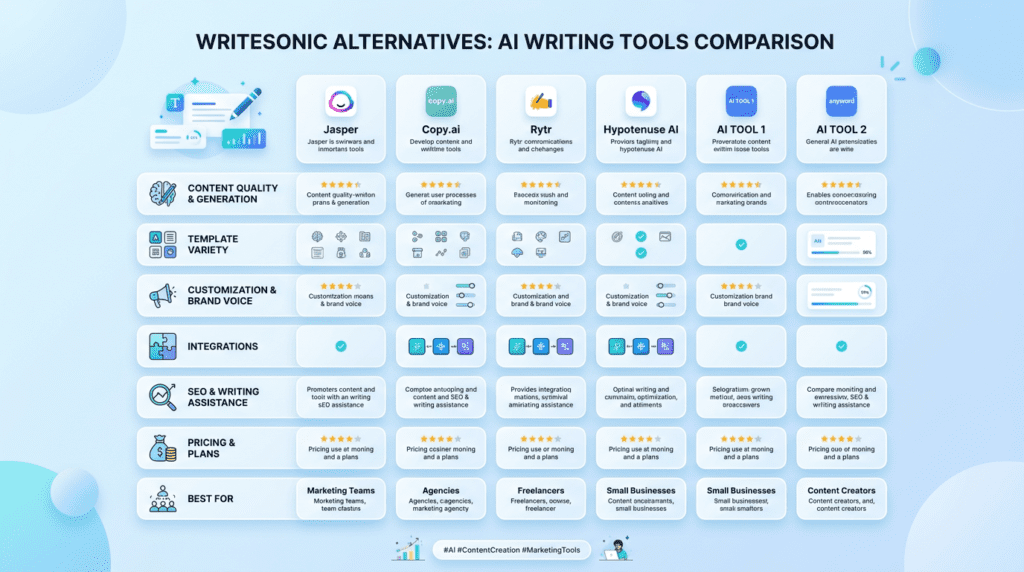
When you’re sifting through AI writing tools, getting a fast overview can save you a ton of time. This quick verdict table lays out the essential differences between Writesonic and its top competitors, focusing on what truly matters for your decision-making process.
Complete Verdict Table
| Writesonic Alternative | Best For | Key Strength | Pricing Model |
|---|---|---|---|
| Jasper | Marketing Teams & Content Quality | Brand Voice & Workflows | Seat-based Subscription |
| Copy.ai | Sales & Marketing Professionals | Sales Copy & Automation | Per-user Subscription |
| Rytr | Bloggers & Casual Users | Simplicity & Affordability | Freemium & Tiered |
| Frase.io | SEO Content Creators | SEO Optimization & Briefs | Tiered Subscription |
| Anyword | Performance Marketers | Predictive Performance Scoring | Tiered Subscription |
| Scalenut | Agencies & SEO Teams | End-to-end Content Workflow | Tiered Subscription |
| ClosersCopy | Copywriters & Direct Response | Advanced Copywriting Frameworks | Lifetime Deal (often) / Subscription |
Best For
Best Overall Alternative: Jasper
If you’re running a marketing team or an agency where consistent brand voice and high-quality, long-form content are non-negotiable, Jasper stands out. It offers robust features for managing brand guidelines and integrating AI content generation seamlessly into complex workflows, making it a powerful all-rounder.
Best for SEO Content: Frase.io
For anyone whose primary goal is to rank higher on search engines, Frase.io is a game-changer. It’s not just an AI writer; it’s an integrated research and optimization platform that helps you build comprehensive content briefs and optimize your articles for SEO right from the start.
Best Budget-Friendly Option: Rytr
New bloggers, small business owners, or individuals with lighter content needs will find Rytr incredibly appealing. Its generous free plan allows you to test the waters without commitment, and its premium tiers offer excellent value, making quality AI writing accessible even on a tight budget.
Not Ideal For
These Writesonic Alternatives might not be the perfect fit if you’re:
Looking for a tool that offers a completely hands-off, one-click solution for generating full articles without any need for human oversight or advanced customization.
Expecting a truly free, unlimited AI writing solution that can handle professional-level content volume without any cost. Most powerful AI tools require a financial investment for serious use.
Bottom Line
While Writesonic offers a solid foundation for many content needs, the “best” tool truly depends on your specific priorities. For top-tier content quality and robust team workflows, Jasper often takes the lead. If SEO performance is your main driver, Frase.io provides an unmatched integrated experience. And for those just starting out or needing an affordable option, Rytr offers an unbeatable entry point. Your ultimate choice will hinge on your primary use case, team size, and, of course, your budget.
Why You Might Need a Writesonic Alternative
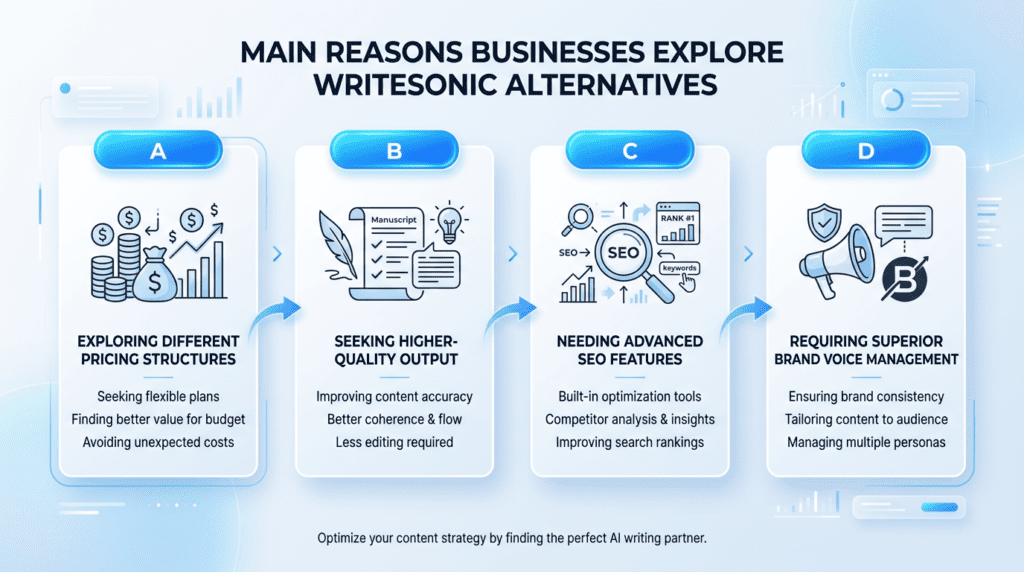
Even with a powerful AI writing tool like Writesonic, businesses often find themselves exploring Writesonic alternatives. This isn’t always because Writesonic is lacking, but rather because specific needs evolve or new priorities emerge. Understanding these common drivers can help you pinpoint the right alternative for your unique workflow.
Exploring Different Pricing Structures: Writesonic’s credit and quality-based system works well for many, but it can sometimes feel unpredictable, especially for teams with fluctuating content demands. Many users look for Writesonic alternatives that offer simpler, more predictable subscription models, like per-user pricing or unlimited word counts. This helps with budget forecasting and avoids the frustration of running out of credits mid-project. For instance, a small agency might prefer a flat monthly fee for unlimited generation rather than constantly monitoring word usage.
Seeking Higher-Quality or More Specialized Output: While Writesonic is versatile, some users find themselves needing a tool that truly excels in a niche. For example, a direct-response marketer might seek an AI that’s specifically trained on high-converting sales copy, or an SEO specialist might need an AI that deeply understands long-form, keyword-rich content. These specialized Writesonic alternatives often provide a more refined output for their specific domain, reducing the need for heavy editing.
Needing Advanced SEO & Content Research Features: Creating content that ranks isn’t just about writing; it’s about research, outlining, and optimization. Many content teams look for Writesonic alternatives that integrate SERP analysis, competitive intelligence, and content briefing directly into the writing workflow. This means less jumping between tools and a more cohesive process for producing SEO-optimized articles. Think of it as moving from a general-purpose writing assistant to a dedicated SEO content platform.
Requiring Superior Brand Voice & Tone Management: Maintaining a consistent brand voice across all content is crucial for larger organizations and agencies. While Writesonic offers tone settings, some Writesonic alternatives provide more granular control, allowing the AI to “learn” from existing brand assets and adapt its output to a specific, unique identity. This is particularly valuable for companies that invest heavily in their brand messaging and want their AI-generated content to sound indistinguishable from human-written copy.
Looking for a Simpler, More Focused User Interface: Sometimes, less is more. Writesonic packs a lot of features, which can be fantastic, but for users who only need a few core functions, it might feel a bit overwhelming. Some individuals or small teams prefer Writesonic alternatives with a minimalist design and a more focused set of tools, making the writing process faster and less distracting. This can be a huge benefit for bloggers or freelancers who prioritize speed and ease of use for everyday tasks.
The 7 Best Writesonic Alternatives of 2026
1. Jasper: The Premium Choice for Quality & Brand Voice
Who is Jasper Best For? Jasper is the go-to for marketing teams, agencies, and serious content creators who prioritize output quality and brand consistency above all else. If your business relies on high-volume, high-stakes content that needs to sound professional and on-brand every time, Jasper is likely on your radar. It’s built for those who see AI as a strategic partner in content production, not just a quick content generator.
How Jasper’s “Brand Voice” Feature Compares to Writesonic: This is where Jasper truly shines as a premium Writesonic alternative. While Writesonic offers various tone settings (e.g., “professional,” “witty”), Jasper’s “Brand Voice” feature goes much deeper. You can upload existing content, style guides, and brand guidelines, and Jasper will analyze them to learn your unique voice. This means the AI doesn’t just *sound* a certain way; it *writes* like your brand. For a marketing agency managing multiple clients, or a large enterprise with strict brand guidelines, this capability is invaluable. It drastically reduces the editing time needed to align AI-generated content with your established identity, a common hidden frustration with many AI tools.
Workflow & Automation Capabilities: Jasper’s “Campaigns” and “Recipes” are designed to streamline content production for marketing teams, making it a powerful Writesonic alternative for complex workflows. Recipes are pre-built workflows that guide you through generating specific content types, like a blog post or a sales email sequence, step-by-step. Campaigns allow you to generate multiple pieces of content (e.g., social media posts, ad copy, email subject lines) around a central theme or product launch, ensuring consistency across all assets. This level of structured automation is a significant advantage for teams looking to scale their content efforts efficiently.
Pricing & Value Proposition: Jasper’s premium price point reflects its advanced capabilities. Plans typically start around $49/month for the Creator plan (billed annually) or $59/month (billed monthly), offering unlimited words and access to core features. For teams, the Teams plan starts around $125/month (billed annually) or $149/month (billed monthly) for 3 seats, with additional seats costing more. While this is a higher investment than many Writesonic alternatives, its value lies in the time saved on editing, the consistency of brand voice, and the ability to scale high-quality content production. For a business where content quality directly impacts revenue, the ROI can be substantial.
Where Writesonic is Still a Better Option: For users who need a more straightforward, all-in-one tool with features beyond just text generation, Writesonic can still be a better choice. Writesonic’s integrated Photosonic (AI image generation) and Audiosonic (AI voice generation) offer a broader multimedia content creation suite under one roof. If your workflow frequently requires generating images or audio alongside text, and you don’t need Jasper’s deep brand voice customization, Writesonic’s comprehensive approach might be more appealing.
2. Copy.ai: The Go-To for Sales & Marketing Automation
Who is Copy.ai Best For? Copy.ai is ideal for sales teams, marketing professionals, and businesses focused on generating high volumes of sales copy, emails, and social media content. If your primary goal is to quickly produce persuasive copy for ads, landing pages, or outreach, and you need to do it at scale, Copy.ai positions itself as a strong Writesonic alternative. It’s less about long-form articles and more about short, impactful conversions.
Comparing Sales Copy Frameworks (Copy.ai vs. Writesonic): Both tools offer templates for various sales copy types, but Copy.ai often provides a slight edge in the sheer volume and specialization of its sales-focused frameworks. It’s built from the ground up with marketing and sales in mind, offering a wider array of templates for things like AIDA, PAS, pain-agitate-solution, and specific ad copy variations. For a performance marketer, Copy.ai’s output for landing page headlines, ad descriptions, and cold email sequences can feel more refined and conversion-oriented right out of the gate, often requiring less tweaking than a general-purpose AI. This is a key differentiator when evaluating Writesonic alternatives for direct-response needs.
Workflow Automation for Go-to-Market Teams: Copy.ai excels in supporting automated content creation for sales funnels, making it a powerful Writesonic alternative for go-to-market teams. Its API and integrations allow businesses to connect Copy.ai directly into their existing marketing automation platforms or CRM systems. Imagine automatically generating personalized email sequences for new leads or crafting social media posts based on product updates without manual intervention. This level of workflow integration is a significant advantage for scaling outreach and engagement efforts, reducing the manual effort involved in content creation for every stage of the customer journey.
Pricing for Teams: Copy.ai’s pricing model is typically per-seat, which contrasts with Writesonic’s credit-based system. The Pro plan starts around $36/month (billed annually) or $49/month (billed monthly) for one user, offering unlimited words. For teams, the pricing scales up based on the number of users, with custom plans available for larger organizations. This per-seat model can be more predictable for teams, as you know exactly what you’re paying per team member regardless of their output volume. For a sales manager, this clarity in cost is often preferred over managing shared credit pools.
Where Writesonic Wins: While Copy.ai is a powerhouse for short-form sales copy, Writesonic still holds an advantage for long-form blog post generation and integrated SEO features. If your content strategy heavily relies on producing detailed articles, guides, or blog posts optimized for search engines, Writesonic’s Article Writer and SEO features might offer a more comprehensive solution. Copy.ai can generate sections of long-form content, but it’s not designed as an end-to-end long-form content creation tool in the same way Writesonic is.
3. Rytr: The Best Budget-Friendly & Simple Alternative
Who is Rytr Best For? Rytr is the ideal Writesonic alternative for bloggers, students, freelancers, and anyone needing a simple, fast, and affordable AI writer for short-form content. If you’re just starting with AI tools, or if your content needs are primarily for social media posts, email snippets, or quick blog outlines, Rytr offers an accessible entry point without a steep learning curve.
The Simplicity Advantage: Rytr’s User Interface vs. Writesonic’s: Rytr’s minimalist design is a breath of fresh air compared to some more feature-rich Writesonic alternatives. Its user interface is incredibly clean and intuitive, making it easy for beginners to jump in and start generating content immediately. You select a use case, input some context, and hit “Ryte for me.” This straightforward approach avoids the “feature bloat” that can sometimes overwhelm new users in more complex platforms like Writesonic, which has a wider array of tools and settings. For someone who just wants to get content done quickly without navigating many menus, Rytr’s simplicity is a major benefit.
Generous Free Plan & Pricing Breakdown: Rytr stands out with its generous free plan, offering 10,000 characters per month. This is a fantastic way for beginners to test the waters and see if AI writing fits their workflow without any financial commitment. For those needing more, the Saver plan starts around $9/month (billed annually) or $12/month (billed monthly), providing 100,000 characters. The Unlimited plan, which offers unlimited character generation, is priced at approximately $29/month (billed annually) or $39/month (billed monthly). This makes Rytr one of the most budget-friendly Writesonic alternatives, offering exceptional value for casual users and small businesses.
Key Limitations to Consider: While Rytr excels in simplicity and affordability, it does have key limitations compared to more advanced Writesonic alternatives. Its output quality for complex or highly nuanced topics might require more editing. It also lacks the advanced SEO features, deep brand voice customization, or extensive workflow automation found in tools like Frase.io or Jasper. Users looking for comprehensive long-form article generation or intricate content optimization might find Rytr’s capabilities too basic for their needs. It’s a great starting point, but it might not scale with highly specialized content demands.
When to Choose Rytr Over Writesonic: You should choose Rytr over Writesonic if your primary needs are speed, simplicity, and affordability for tasks like emails, social posts, short blog sections, or basic ad copy. If you’re a student needing help with essays, a small blogger on a tight budget, or a freelancer looking for quick content ideas, Rytr offers an unbeatable combination of ease of use and cost-effectiveness. It’s perfect for those who want to dip their toes into AI writing without a significant investment or a steep learning curve.
4. Frase.io: The Ultimate Tool for SEO Content Workflows
Who is Frase.io Best For? Frase.io is the ultimate Writesonic alternative for SEO specialists, content marketers, and agencies focused on creating top-ranking long-form content. If your goal is to dominate search engine results pages (SERPs) with comprehensive, optimized articles, Frase.io provides a workflow specifically designed for that purpose. It’s less about quick content generation and more about strategic content planning and execution.
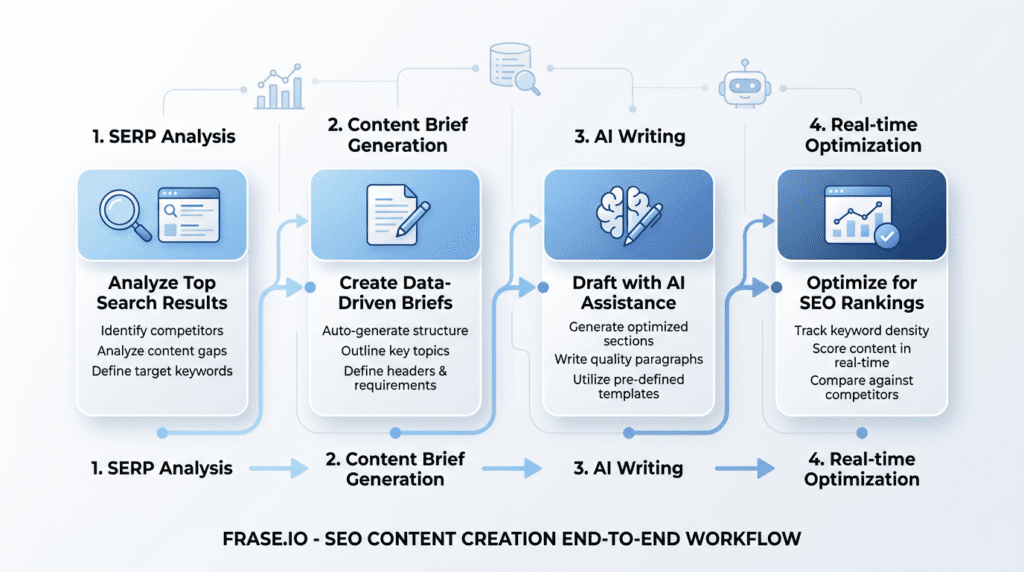
From SERP Analysis to Final Draft in One Platform: This is Frase.io’s core strength and a major differentiator from many Writesonic alternatives. Frase.io integrates research, outlining, and optimization tools into a single, seamless workflow. You start by inputting a target keyword, and Frase.io analyzes the top-ranking SERP results, identifying key topics, questions, and headings. It then helps you build a comprehensive content brief, and you can write your article directly within its editor, receiving real-time feedback on how well you’re covering the topic compared to competitors. This end-to-end process ensures your content is not just well-written, but also strategically optimized for search performance.
Content Brief Generation: Frase vs. Writesonic: When comparing content brief generation, Frase.io offers a significantly deeper and more actionable approach than Writesonic. While Writesonic can help generate outlines, Frase.io’s briefs are data-driven, pulling insights directly from top-ranking articles. They include competitor headings, common questions, statistics, and related topics, giving content writers a clear roadmap for what needs to be covered to outrank competitors. This level of detail is crucial for agencies or teams managing multiple writers, ensuring consistency and quality in SEO output.
Content Scoring and On-Page Optimization: Frase.io’s real-time content scoring is a game-changer for on-page optimization. As you write, the platform provides a score indicating how comprehensively you’ve covered the topic relative to your competitors. It highlights missing keywords, suggests related concepts, and helps you structure your content for maximum relevance. This isn’t just about keyword density; it’s about semantic SEO and ensuring you address the full scope of user intent. This feature helps content creators confidently produce articles that are not only engaging but also highly likely to rank well.
Where Writesonic Has an Edge: For users who need a general-purpose writer for a wider variety of non-SEO content types, Writesonic often has an edge. While Frase.io has AI writing capabilities, its primary focus is SEO content workflows. If you frequently need to generate ad copy, social media posts, product descriptions, or creative stories that don’t require deep SERP analysis, Writesonic’s broader template library and general-purpose AI writing tools might be more efficient. Frase.io is a specialist; Writesonic is a generalist.
5. Anyword: The Data-Driven Choice for Performance Marketers
Who is Anyword Best For? Anyword is the ideal Writesonic alternative for performance marketers, advertisers, and CRO (Conversion Rate Optimization) specialists who need to predict which copy will perform best. If your marketing efforts are heavily reliant on A/B testing and optimizing for conversions, Anyword’s unique predictive capabilities can give you a significant edge. It’s designed for those who want to take the guesswork out of copywriting.
Anyword’s Predictive Performance Score Explained: This is Anyword’s flagship feature and a major differentiator among Writesonic alternatives. As the AI generates headlines, ad copy, or calls-to-action, it provides a “Predictive Performance Score.” This score, based on a vast dataset of successful marketing copy, estimates the potential engagement and conversion rate of each generated variant. For a performance marketer, this means you’re not just getting copy; you’re getting copy with a data-backed likelihood of success, helping you choose the most effective options before you even launch a campaign. This feature directly addresses the hidden frustration of launching campaigns with untested copy.
Customer Persona Targeting: Anyword goes beyond generic copy generation by allowing for detailed customer persona targeting, a feature not as prominent in Writesonic. You can define specific audience segments (e.g., “small business owners,” “tech enthusiasts,” “young parents”), and Anyword will generate copy variants tailored to resonate with each persona. This ensures your messaging is highly relevant to different segments of your audience, increasing the chances of conversion. For an e-commerce business running highly segmented ad campaigns, this capability is invaluable for maximizing ad spend efficiency.
Pricing Based on Performance Goals: Anyword’s value proposition is deeply tied to its ability to improve conversion rates, and its pricing reflects this. The Starter plan begins around $39/month (billed annually) or $49/month (billed monthly) for 20,000 words and access to the predictive score. For teams, the Data-Driven plan starts around $399/month (billed annually) or $499/month (billed monthly), offering unlimited words, custom keywords, and more advanced features. While this is a higher investment than many Writesonic alternatives, the potential ROI from improved conversion rates on ads and landing pages can quickly justify the cost for businesses with significant ad spend or high-value conversions.
When is Writesonic a More Practical Choice? Writesonic is a more practical choice for general content creation where predictive scoring is not a primary requirement. If you’re a blogger focusing on informational articles, a content creator producing social media posts for engagement rather than direct conversion, or a small business needing a wide variety of content types without a heavy emphasis on A/B testing, Writesonic’s broader feature set and more accessible pricing for general use might be more suitable. Anyword is a specialist for conversion-focused copy; Writesonic is a generalist for diverse content needs.
6. Scalenut: The All-in-One Content Marketing & SEO Platform
Who is Scalenut Best For? Scalenut is an excellent Writesonic alternative for SEO agencies and content teams looking for a single platform to manage the entire content lifecycle, from planning to writing and optimization. If you’re aiming to build topical authority, scale your content production, and ensure every piece is optimized for search engines, Scalenut offers a comprehensive solution that goes beyond just AI writing.
Cruise Mode vs. Writesonic’s Article Writer: Scalenut’s “Cruise Mode” is a standout feature, offering a guided, step-by-step article creation process that provides a different experience than Writesonic’s Article Writer. While Writesonic’s Article Writer can generate full articles quickly, Cruise Mode walks you through the entire process: from generating a title and outline based on SERP analysis, to writing each section, and finally optimizing the content. This structured approach ensures that every article is comprehensive and well-optimized, making it particularly useful for content teams who need a consistent, high-quality output. It’s like having an SEO expert guiding your AI writer.
Keyword Planning and Topic Clustering Features: Scalenut helps build topical authority beyond just writing a single article, making it a powerful Writesonic alternative for strategic SEO. Its integrated keyword planning and topic clustering features allow you to identify related keywords and build content clusters around core topics. This means you can plan an entire content strategy, not just individual articles, ensuring your website covers subjects comprehensively and signals expertise to search engines. For an SEO agency, this capability is crucial for developing long-term content strategies for clients.
Comparing the Full Content Suite (Scalenut vs. Writesonic): Scalenut offers a more complete content marketing suite compared to Writesonic, which is primarily an AI writing tool with some SEO features. Scalenut includes not only AI writing but also robust SEO research, content brief generation, real-time optimization, and even content planning tools. This makes it an end-to-end platform for managing your entire content strategy. Writesonic, while versatile, doesn’t offer the same depth in strategic planning and comprehensive SEO workflow management. For a business that needs to manage content from ideation to publication and optimization all in one place, Scalenut provides a more integrated solution.
Where Writesonic’s Simplicity is Better: For users who don’t need the complexity of a full content marketing suite and prefer a focused writing tool, Writesonic’s simplicity is often better. If your primary need is quick content generation for various formats without extensive SEO research or strategic planning, Writesonic’s straightforward interface and broad template library might be more efficient. Scalenut has a steeper learning curve due to its extensive features, which might be overkill for a solo blogger or a small business with simpler content needs.
7. ClosersCopy: The Power Tool for Advanced Copywriters
Who is ClosersCopy Best For? ClosersCopy is the ideal Writesonic alternative for direct-response copywriters, email marketers, and entrepreneurs who want deep control over copywriting frameworks. If you’re an experienced copywriter who understands the nuances of persuasion and wants an AI that can be heavily customized to your specific methods, ClosersCopy offers a level of flexibility that many other tools don’t.
Deep Dive into Custom Frameworks & “Megatrons”: This is where ClosersCopy truly differentiates itself from Writesonic’s templates. While Writesonic offers a good selection of pre-built templates, ClosersCopy allows for a much deeper level of customization through its “Frameworks” and “Megatrons.” Users can create their own custom AI frameworks, essentially teaching the AI their preferred copywriting styles, structures, and prompts. Megatrons are even more advanced, allowing for complex, multi-step content generation workflows. This means a seasoned copywriter can replicate their unique process within the AI, generating highly personalized and effective copy that aligns perfectly with their expertise.
The Lifetime Deal (LTD) Factor: ClosersCopy is well-known in the AI community for its frequent Lifetime Deal (LTD) offers. Unlike Writesonic’s recurring subscription model, an LTD means you pay a one-time fee for lifetime access to the software. This can represent significant long-term value, especially for freelancers or small businesses who want to avoid ongoing monthly expenses. While LTDs aren’t always available, they are a strong consideration for those looking for a cost-effective, long-term Writesonic alternative. Always check their current offerings, as these deals can change.
The Learning Curve Consideration: Acknowledging that its power comes with a steeper learning curve compared to more intuitive tools is crucial. ClosersCopy isn’t a “set it and forget it” AI. To truly harness its capabilities, especially with custom frameworks and Megatrons, users need to invest time in learning the platform and understanding copywriting principles. This might be a hidden frustration for beginners who expect instant, perfect results without much input. It’s a tool for those who want to be deeply involved in guiding the AI, not just prompting it.
Why a Beginner Might Prefer Writesonic: For ease of use and getting quality content quickly without a deep dive into copywriting theory, a beginner might prefer Writesonic. Writesonic’s user-friendly interface, clear templates, and more automated article generation make it much more accessible for those new to AI writing. If you’re not a professional copywriter and just need to generate decent content efficiently, Writesonic provides a much smoother onboarding experience and faster results without the need to master complex frameworks.
Honest Take: The Hidden Trade-Offs When Switching from Writesonic
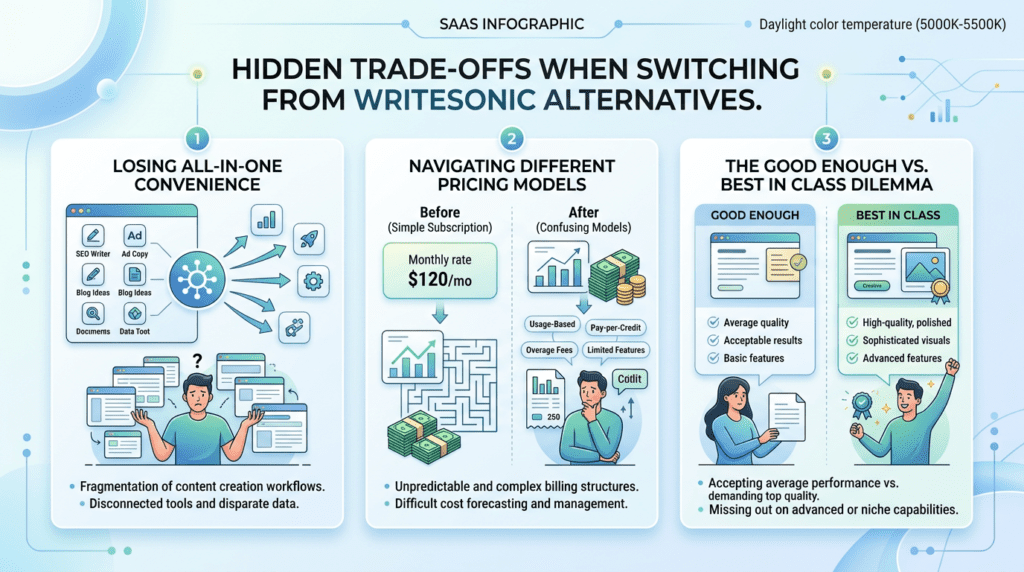
Switching from a familiar tool like Writesonic to one of its alternatives often comes with a set of hidden trade-offs that marketing pages rarely highlight. While the promise of specialized features or better pricing is appealing, it’s crucial to understand what you might be giving up or gaining in complexity.
Losing the “All-in-One” Convenience
Writesonic has carved out a niche by offering a fairly comprehensive suite of AI tools under one roof. Think about its Article Writer, Photosonic for AI image generation, and Audiosonic for text-to-speech. When you move to a specialized alternative, you’re likely giving up this “all-in-one” convenience. For instance, if you switch to Frase.io for its superior SEO capabilities, you’ll still need a separate tool for AI image generation or audio content.
This means you might end up managing multiple subscriptions, learning different user interfaces, and constantly switching between platforms to complete a single content project. For a small business owner or a solo content creator, this can quickly become a hidden frustration, adding to your workload and potentially increasing your overall software spend. While each individual tool might be “best in class” for its specific function, the cumulative effort of integrating them into your workflow can be a significant drawback that marketing materials often gloss over.
Navigating Different Pricing Models
Writesonic’s pricing, often based on word counts and quality tiers, can be straightforward for many. However, its alternatives introduce a variety of other models that can be confusing. You might encounter seat-based pricing (like with Jasper or Copy.ai), where adding team members significantly increases your cost. Other tools, such as Frase.io, might gate essential features behind higher-priced tiers, meaning the “basic” plan might not actually meet your needs for advanced SEO.
This shift requires careful budgeting and an understanding of your team’s actual usage patterns. What seems like a cheaper alternative initially might quickly become more expensive if you need multiple users or access to specific features. It’s easy to get caught off guard by these nuances, especially if you’re used to a simpler credit-based system. Always look beyond the advertised “starting at” price and consider what your specific workflow demands.
The “Good Enough” vs. “Best in Class” Dilemma
Writesonic is often described as a generalist – it’s good at many things, from short-form copy to blog posts, and even offers some unique features like Photosonic. When you opt for a Writesonic alternative, you’re typically choosing a specialist. Frase.io, for example, is elite for SEO content, but it’s not designed for generating ad copy or social media posts with the same versatility as Writesonic.
This creates a dilemma: do you want a tool that does many things “good enough,” or one that does one thing “best in class” but falls short elsewhere? For users with diverse content needs, committing to a specialist might mean sacrificing efficiency in areas where Writesonic previously performed adequately. You might gain unparalleled depth in one niche, but lose the breadth of functionality you’ve come to expect, potentially forcing you to either compromise on quality for other content types or invest in yet another tool.
The User Experience Factor
Writesonic has had time to mature, resulting in a generally polished and intuitive user interface. While many Writesonic alternatives also offer clean designs, some, especially newer or more feature-rich platforms, can present a steeper learning curve. The initial excitement of new features can quickly turn into frustration if the navigation is clunky, the editor is less responsive, or the workflow feels counter-intuitive.
Beginners, in particular, might struggle with tools that prioritize power and customization over simplicity. What looks like a robust feature set on a demo might translate into a complex series of steps in daily use. This can impact productivity and adoption rates within a team. Always consider the time and effort required to onboard yourself or your team to a new platform, as a less intuitive UX can negate the benefits of even the most powerful features.
How to Choose the Right Writesonic Alternative for You
Selecting the best Writesonic alternative isn’t about finding a one-size-fits-all solution; it’s about matching a tool’s strengths to your specific needs and workflow. Consider these scenarios to help guide your decision:
Scenario 1: You’re an SEO Agency or Content Marketer
If your primary goal is to create content that ranks high on search engines, driving organic traffic and authority, then your focus should be on tools with robust SEO integration. Frase.io or Scalenut are your best bets here. Frase.io excels at taking you from SERP analysis to a fully optimized content brief and then helping you write and score your content against top competitors. Scalenut offers a similar end-to-end content workflow, including keyword planning and topic clustering, making it ideal for agencies managing comprehensive content strategies. These tools aren’t just AI writers; they’re SEO content platforms designed to help you dominate search results.
Scenario 2: You’re a Marketing Team Focused on Brand
For marketing teams where consistent brand voice, high-quality output, and collaborative workflows are paramount, Jasper is the clear winner among Writesonic alternatives. Its “Brand Voice” feature allows the AI to learn and adapt to your specific tone and style, ensuring all generated content aligns with your brand identity. Jasper’s robust workflow automation and campaign features are built to streamline content production for marketing initiatives, from social media campaigns to email sequences. While it comes at a premium price, the investment often pays off in reduced editing time and a stronger, more cohesive brand presence across all your content.
Scenario 3: You’re a Solo Blogger or Freelancer on a Budget
If you’re a solo content creator, blogger, or freelancer who needs a reliable AI writing assistant without breaking the bank, then Rytr is an excellent starting point. It offers a generous free plan that lets you generate a decent amount of content each month, and its paid plans are exceptionally affordable, typically starting around $9/month. Rytr’s user interface is straightforward and minimalist, making it incredibly easy to jump in and start generating short-form content like blog outlines, social media posts, and email copy quickly. While it might lack the advanced SEO features or deep customization of more expensive tools, its simplicity and cost-effectiveness make it an unbeatable value for casual users or those just getting started with AI writing.
Scenario 4: You’re a Sales Team Needing Outreach Copy
For sales teams, business development representatives, or marketing professionals focused on generating high volumes of effective sales copy, ad copy, and outreach emails, Copy.ai is specifically built for your workflow. Its strength lies in its ability to quickly produce compelling marketing and sales collateral, with a strong emphasis on conversion-focused frameworks. Copy.ai’s API and integration capabilities can support automated content creation for sales funnels, helping you scale your outreach efforts without sacrificing quality. If your primary need is to generate persuasive copy for landing pages, social media ads, or cold email campaigns, Copy.ai’s specialized focus will likely yield better results than a general-purpose AI writer.
Final Recommendation
Having explored the nuances and strengths of various Writesonic alternatives, the path forward becomes clearer when aligned with your specific operational needs. While Writesonic offers a broad suite, the alternatives often excel by focusing on particular use cases, providing a more refined experience for those specific demands.
For Most Users Seeking a Direct Upgrade: Jasper offers the best balance of higher-quality output, superior brand control, and powerful marketing features, making it the strongest overall alternative to Writesonic.
For a Purely SEO-Focused Workflow: Frase.io is the undeniable champion. It replaces the need for multiple SEO tools and integrates writing directly into the optimization process.
For the Best Value and Simplicity: Rytr provides an incredible amount of utility for its price (or for free), making it the perfect choice for individuals and those with simpler content needs.
Ultimately, the “best” alternative is the one that solves your specific bottleneck. Use this guide to match your primary need—be it SEO, sales copy, brand voice, or budget—to the tool built to serve it.
Frequently Asked Questions (FAQs)
Is there a free alternative to Writesonic?
Yes, Rytr offers the most generous and functional free plan, making it the best free alternative for most users. Copy.ai also has a limited free tier.
Which Writesonic alternative is best for long-form blog posts?
For SEO-driven blog posts, Frase.io and Scalenut are top choices. For high-quality, narrative-style blog posts, Jasper excels.
How does the pricing of these alternatives compare to Writesonic?
Rytr is generally cheaper. Jasper is more expensive but offers team-based pricing. Frase and Scalenut are competitively priced but offer more SEO features for the money.
Can any of these alternatives fully replace Writesonic’s Photosonic and Audiosonic?
No. These alternatives are primarily text-focused. You would need to use separate, dedicated AI image and audio generators to replicate that functionality.
What is the learning curve like for tools like Jasper or Frase.io?
Jasper is very intuitive for basic use, but mastering its advanced workflows and Brand Voice takes time. Frase.io has a moderate learning curve due to its comprehensive SEO toolset. Both are slightly more complex than Writesonic’s core writer.