

It’s early morning. You’ve got coffee in one hand, a deadline in the other, and a blank screen staring back at you. You know you need to publish something today, and that’s usually when an ai content writing tool starts to feel less like an option and more like a necessity.
Here’s what I noticed after looking at how people in the US actually use these tools. Most aren’t trying to replace writing completely. They just want to create content faster without sacrificing quality. That’s where choosing the right ai writing tool really matters.
Quick Picks: Best AI Content Writing Tools for 2026
If you just want the short answer, here are the tools that stand out right now.
Quick Recommendation: AI Content Writing Tools Snapshot (2026)
Best Overall: Jasper
Best for: Content marketers and bloggers creating high-quality long-form content
Best Budget Option: Rytr
Best for: Beginners and small creators needing simple content generation at low cost
Best for SEO Content: Surfer AI
Best for: Bloggers and businesses focused on ranking content in search engines
Best Free Option: Copy.ai
Best for: Users who want to test AI content writing without upfront cost
Now this is where people get confused.
The best ai writing tool isn’t always the most advanced one. Sometimes a simpler tool can help you generate content more efficiently, especially if you’re just getting started.
Comparison Table of the Best AI Content Writing Tool Options
| Tool | Free Plan | Paid Plan | Best For | Key Feature |
|---|---|---|---|---|
| Jasper AI | No | $69/month | Long-form content | Brand voice + AI writing assistant |
| Copy.ai | Yes | $49/month | Best free AI writing tool | AI text generator + workflows |
| Rytr | Yes | $9/month | Budget AI writing tool | Simple writing assistant |
| Writesonic | Yes | $16/month | Blog + marketing content | AI text generator + chatbot |
| Surfer AI | No | $89/month | SEO content | SEO tools + optimization |
| Anyword | No | $39/month | Conversion content | Performance scoring |
| GrammarlyGO | Yes | $12/month | Improve your writing | AI suggestions |
| Frase | No | $14/month | Research + writing | Content briefs + SEO |
| Sudowrite | No | $10/month | Creative writing | Story-focused tools |
| ChatGPT | Yes | $20/month | General writing | Flexible AI model |
From my research, pricing usually reflects what the tool is built for, not just how good it is.
For example, tools like Surfer AI charge more because they include SEO features. On the other hand, Rytr keeps things simple and affordable, which works well if you just need to generate content quickly.
What Is an AI Content Writing Tool and How Does It Work
An ai content writing tool is software designed to help you generate content using an ai model. Instead of writing everything manually, you give instructions, and the tool produces content based on patterns it has learned.
Let’s keep it simple.
These tools are commonly used to:
• Generate blog posts, emails, and social media content
• Act as a writing assistant during content creation
• Help content creators create content at scale
Most ai-powered writing tools rely on advanced language models. That’s how they can produce content that feels natural, even if it’s generated in seconds.
That said, they’re still not perfect.
In most cases, you’ll need to edit the output. You might adjust tone, fix structure, or add your own insights. It’s less about replacing a content writer and more about speeding up the overall writing process.
How AI Writing Tools Actually Generate Content
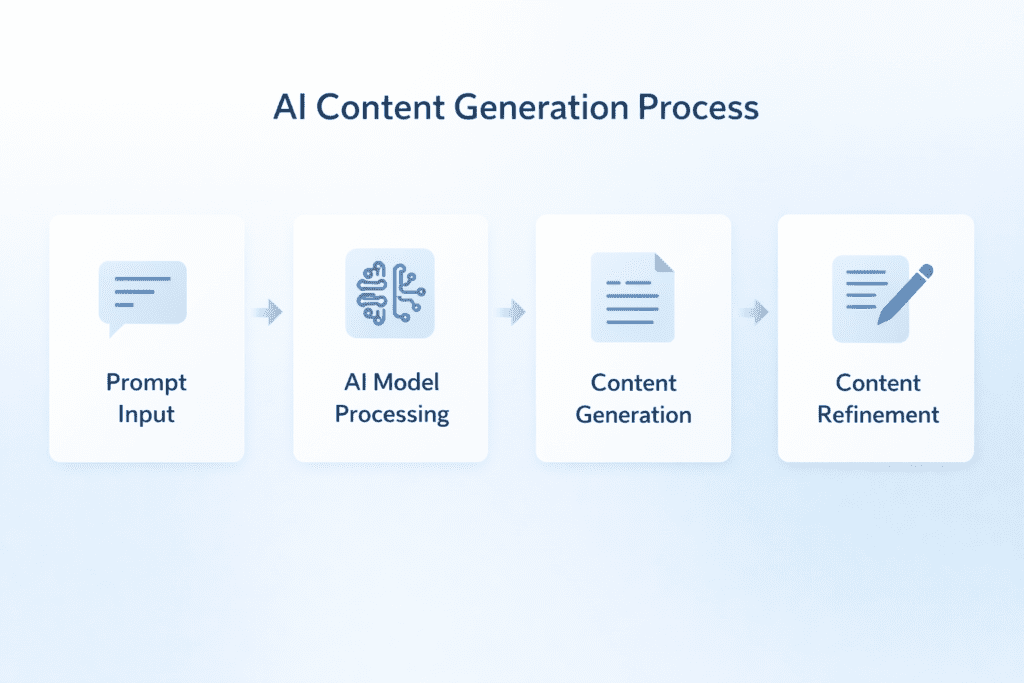
Most people use an ai content writing tool without really thinking about what’s happening behind the scenes.
Here’s the simple version.
These tools rely on an ai model trained on large datasets. When you enter a prompt, the system predicts what comes next based on patterns. That’s how it can generate content that feels natural.
But here’s where it gets interesting.
Not every ai writing tool works the same way. Some focus on long-form content, while others are better for short-form or social media content. Tools like Jasper are built for structured content creation, while others act more like flexible ai text generator systems.
That said, this usually works well, but not always.
Sometimes the output feels generic. Sometimes it lacks depth. That’s why human editing still plays a big role in the writing process.
Why AI Content Writing Matters for Content Creators
If you’re creating content regularly, you’ve probably noticed how time-consuming it can be.
This is where an ai writing tool can help.
Instead of starting from scratch, you can use ai to generate content quickly and then refine it. For many US-based websites, this makes publishing more consistent and manageable.
Here’s what I noticed.
Most people don’t use AI to replace writing. They use it to support their content creation process and handle repetitive writing tasks.
Key benefits:
• Faster creation: Helps produce drafts without starting from zero
• Better workflow: Speeds up the overall content creation process
• Idea generation: Useful for generating content ideas and outlines
But let’s be real for a second.
AI doesn’t guarantee high-quality content. It helps you create content faster, but the final output still depends on how you guide it.
How We Tested and Ranked Each AI Content Writing Tool
Now this is where people get skeptical.
There are a lot of “top tools” lists out there, but most don’t explain how testing actually works. So let’s keep it simple.
From my research, the goal wasn’t to find the most popular ai writing tool. It was to identify which tools actually help you generate content in real scenarios.
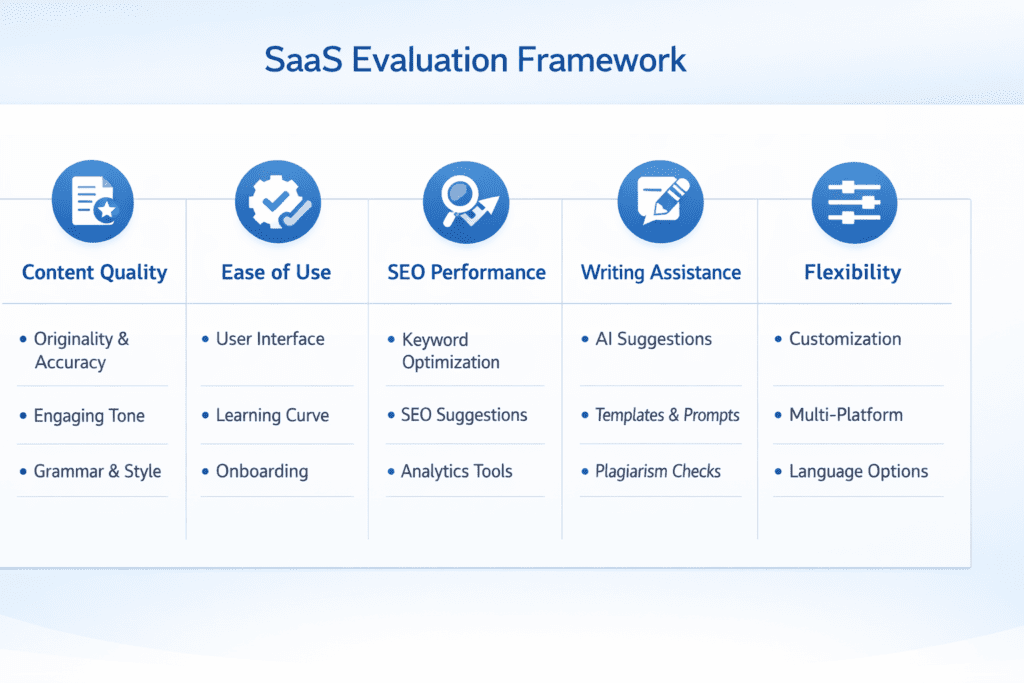
Evaluation Criteria We Used
Each ai content writing tool was evaluated using consistent criteria.
Evaluation factors:
• Content quality: How natural and readable the output feels
• Ease of use: How quickly you can start writing
• SEO performance: Whether it supports optimization
• Writing assistance: How well it improves your writing
• Flexibility: Ability to handle different types of content
Some tools perform well in one area but fall short in others.
For example, a tool might be great at ai-generated content but not strong in SEO or structure.
Real Use Cases We Tested
Instead of relying only on features, we focused on real usage.
Use cases tested:
• Blog creation: Writing articles for niche websites
• Content marketing: Generating marketing-focused content
• Creative writing: Testing storytelling capabilities
• Editing support: Using it as a writing assistant
For example, imagine running a small US-based site and trying to publish multiple posts weekly. AI can help generate drafts faster, but you still need to refine them before publishing.
That’s how most people actually use ai tools for content writing.
What Most Blogs Get Wrong About AI Writing Tools
Here’s the thing.
A lot of blogs either overhype AI or dismiss it completely. The reality is somewhere in between.
Common misconceptions:
• Full replacement: AI cannot fully replace a content writer
• Perfect output: AI writing tools still need human editing
• Tool dependency: Strategy matters more than the tool itself
• One-size-fits-all: Choosing the right ai tool impacts results
Personally, I feel expectations are often unrealistic.
People expect finished content from AI, but in most cases, it works better as a starting point that you refine and improve.
Types of AI Writing Tools You Should Know Before Choosing
Before picking an ai content writing tool, it helps to understand that not all tools are built for the same purpose.
Here’s where many people in the US get confused.
They try one tool, expect it to do everything, and then assume AI doesn’t work. In reality, different tools are designed for different types of content.
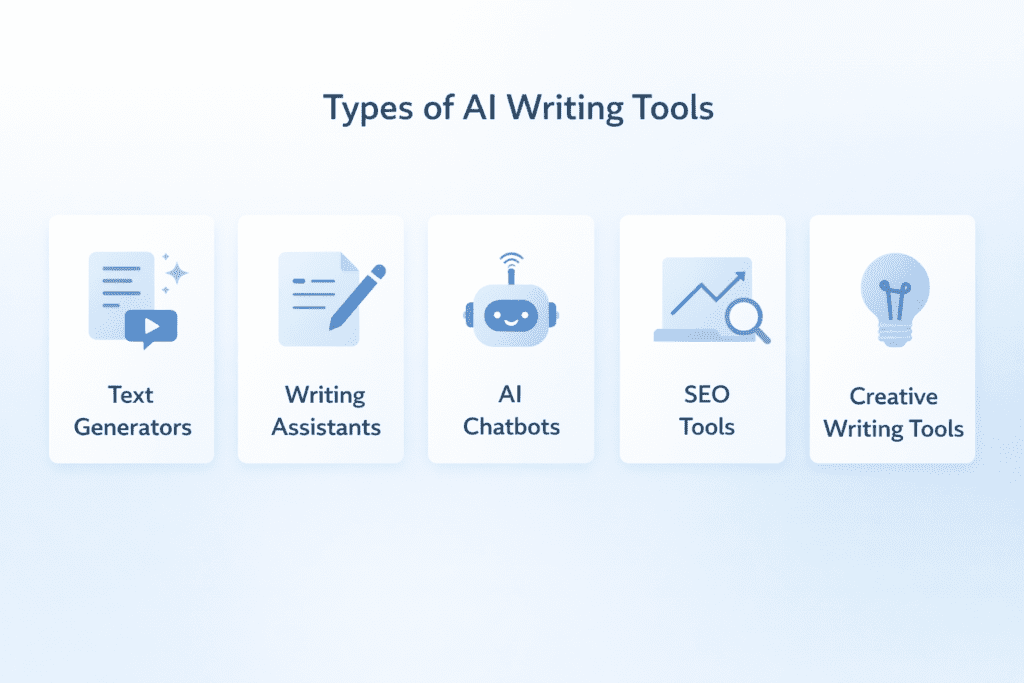
Main types of AI writing tools:
• AI text generator tools: Focus on fast content generation for blogs and marketing copy
• AI writing assistants: Help improve your writing with suggestions and edits
• AI chatbots: Flexible tools that respond to prompts and handle multiple writing tasks
• SEO tools with AI: Combine content writing with optimization features
• Creative writing tools: Built for storytelling and creative writing
That said, choosing the right type matters more than choosing the most popular ai tool.
How to Use an AI Content Writing Tool Step by Step
Using an ai writing tool sounds simple, but the way you use it makes a big difference.
Let’s keep it practical.
If you just type a vague prompt, you’ll usually get vague output. But if you guide the tool properly, it can generate content that’s much closer to what you need.
Step-by-step process:
• Choose a tool: Pick the best ai writing tool based on your goal
• Enter a prompt: Be clear about topic, tone, and structure
• Generate content: Let the ai model create a draft
• Edit output: Improve clarity and remove generic sections
• Optimize SEO: Add keywords and structure properly
• Publish content: Finalize and upload
Now this is where people get stuck.
They skip the editing step. And that’s usually why the content feels robotic or thin.
Best Prompts to Generate High Quality AI Content
The quality of your output depends heavily on what you ask.
From my research, most beginners underestimate how important prompts are. They type one line and expect perfect content.
That’s not how it works.
Effective prompt examples:
• SEO blog prompt: Write an SEO blog post about [topic] with clear headings
• Editing prompt: Improve this content for clarity and engagement
• Idea prompt: Generate content marketing ideas for [industry]
Here’s what I noticed.
When you give more context, the ai model performs better. It understands your intent and produces more useful content.
Still, there are exceptions.
Even with a good prompt, you might need to adjust the output. That’s part of working with AI.
AI Content Writing vs Human Writing: What Actually Works Better
This is one of the most common questions.
Is AI better than human writing?
Honestly, it depends.
AI writing is fast and scalable. Human writing is creative and strategic. Both have strengths, and both have limitations.
AI writing strengths:
• Speed: Can generate content quickly
• Scalability: Helps produce content at scale
Human writing strengths:
• Creativity: Adds unique ideas and perspective
• Strategy: Aligns content with goals
Here’s the thing.
The best approach isn’t choosing one over the other. It’s combining both.
AI helps you generate content quickly. Humans refine it, add depth, and make it more engaging.
That balance is what usually leads to better results.
What Makes High Quality AI Content in 2026
Not all ai-generated content performs well.
Some pieces rank on Google, bring traffic, and actually help readers. Others just sit there. The difference usually comes down to how the content is created and refined.
Here’s what I noticed.
The best results don’t come from just using an ai content writing tool. They come from how you use it.
Key elements of high quality AI content:
• Clear structure: Content should be easy to read and logically organized
• SEO optimization: Proper keyword placement and formatting matter
• Human editing: Raw output needs refinement
• Unique insights: Adds value beyond generic information
• EEAT signals: Shows trust, credibility, and expertise
That said, this usually works, but not always.
Even strong AI content can struggle if it lacks originality or real context. That’s why editing is still essential.
Free vs Paid AI Content Writing Tool: When Should You Upgrade
A lot of people start with a free ai writing tool. And honestly, that makes sense.
But at some point, you might start wondering if upgrading is worth it.
Let’s keep it simple.
Free tools are good for testing and basic content creation. Paid tools offer more control, better output, and advanced features.
Free AI writing tools:
• Access level: Basic features with limited usage
• Best for: Beginners testing ai tools for writing
• Examples: Copy.ai, Rytr, ChatGPT free version
Paid AI writing tools:
• Access level: Full features and higher limits
• Best for: Content creators scaling content marketing
• Examples: Jasper AI, Surfer AI, Anyword
From my research, most users upgrade when they need better quality or want to create content at scale.
For example, a tool like Jasper starts at $69/month and is designed for more structured content creation. On the other hand, Surfer AI at $89/month focuses more on SEO performance.
That difference matters depending on your goal.
Signs You Are Using the Wrong AI Writing Tool
Sometimes the issue isn’t AI itself. It’s the tool you’re using.
Here’s where things get tricky.
People often stick with a tool even when it’s not giving good results. That leads to frustration and wasted time.
Warning signs:
• Generic output: Content feels repetitive or lacks depth
• Poor SEO support: No structure for ranking content
• Weak quality: Requires heavy editing every time
• Limited customization: Not enough control over tone or format
Personally, I feel this is where switching tools can make a big difference.
Not every ai writing tool fits every use case. And that’s completely normal.
AI Content Writing Mistakes That Kill SEO Rankings
This is something most beginners overlook.
Using AI doesn’t automatically mean your content will rank. In fact, some mistakes can hurt your rankings.
Let’s be real for a second.
Publishing raw ai-generated content is one of the biggest problems.
Common mistakes:
• No editing: Publishing content without human review
• Keyword stuffing: Overusing keywords unnaturally
• Thin content: Not adding enough value
• Over-reliance on AI: Skipping strategy and planning
Here’s the thing.
AI can help you generate content quickly, but it doesn’t replace strategy. You still need to think about structure, intent, and user experience.
Best Workflow to Combine AI Tools and Content Strategy
Using an ai content writing tool without a clear workflow usually leads to inconsistent results.
Here’s what I noticed.
People either rely too much on AI or don’t use it effectively at all. The balance sits somewhere in the middle.
Let’s keep it simple.
If you follow a structured process, AI can actually support your entire content creation process instead of just generating random drafts.
Recommended workflow:
• Keyword research: Identify what your audience is searching for
• Content brief: Define structure, intent, and key points
• Use ai tool: Generate the initial draft
• Content generation: Expand ideas and build sections
• Edit and optimize: Improve clarity and SEO
• Publish and analyze: Track how your content performs
Now this is where people get confused.
They skip the planning stage and jump straight into generating content. That’s usually why the output feels generic.
Best AI Content Writing Tool by Use Case
Not every ai writing tool works for every situation.
Choosing the right one depends on what type of content you want to create.
Best tools by use case:
• Blog content: Jasper AI works well for structured long-form content
• SEO articles: Surfer AI combines writing with strong seo tools
• Social media content: Copy.ai helps create short-form content quickly
• Creative writing: Sudowrite is designed for storytelling
That said, tools like ChatGPT are flexible and can handle multiple writing tasks, but they depend heavily on how you prompt them.
Top Trends Shaping AI Content Writing Tools
AI writing tools are evolving quickly, but some patterns are becoming clear.
From my research, most changes are focused on improving usability and output quality rather than just adding features.
Key trends:
• Advanced AI models: More accurate and context-aware outputs
• AI chatbots integration: Tools combining chat and writing features
• Personalized ai writing assistant: Adapting tone and style
• Smarter SEO tools: Better optimization suggestions
There’s a lot of ai-powered writing tools entering the market, but not all of them are useful.
In most cases, the tools that focus on solving specific problems tend to perform better than all-in-one platforms.
10 Best AI Content Writing Tool: Detailed Breakdown

Now let’s get into the actual tools.
Here’s the thing.
Features and pricing only tell part of the story. What really matters is how each ai content writing tool performs in real use.
Jasper AI – Best AI Content Writing Tool Overall
Jasper is one of the best ai writing tool options for content creation, especially if you’re working on long-form content.
It’s designed for structured workflows, which makes it useful for blogs, marketing content, and content marketing strategies.
Key features:
• AI writing assistant: Helps generate structured content
• Templates: Speeds up different writing tasks
• Brand voice: Maintains consistent tone
Pricing plans:
• Creator Plan: $69/month
• Pro Plan: $99/month
• Business Plan: Custom pricing
Pros:
• High-quality output: Produces more refined content
• Scalable: Works well for content at scale
Cons:
• No free plan: Requires paid access
From my research, jasper is often considered one of the best ai tools for content creators who want more control over their writing process.
Copy.ai – Best Free AI Writing Tool
Copy.ai is a popular ai writing tool for beginners.
It’s simple to use and works well if you want to generate content quickly without spending much.
Key features:
• AI text generator: Creates different types of content
• Workflows: Helps automate tasks
• Templates: Easy to start with
Pricing plans:
• Free Plan: $0
• Pro Plan: $49/month
• Team Plan: Custom
Pros:
• Easy to use: Beginner-friendly interface
• Best free option: Good starting point
Cons:
• Limited depth: Not ideal for complex content
Tools like Copy.ai are often used for quick drafts, especially for social media content or short-form writing.
Rytr – Best Budget AI Writing Tool
Rytr is a simple and affordable ai writing tool that focuses on helping you generate content without complexity.
If you’re just starting out or working with a limited budget, this is usually one of the first tools people try.
Key features:
• AI writing assistant: Helps with basic writing tasks
• Templates: Covers common content formats
• Tone options: Adjusts writing style
Pricing plans:
• Free Plan: $0
• Saver Plan: $9/month
• Unlimited Plan: $29/month
Pros:
• Affordable pricing: One of the lowest-cost tools
• Easy setup: Minimal learning curve
Cons:
• Limited depth: Not ideal for advanced content
From my research, Rytr works best when you need to generate content quickly for simple use cases.
Writesonic – Best AI Blog Writing Tool
Writesonic is built for flexibility. It supports blog writing, marketing content, and even chatbot-style interactions.
Here’s what I noticed.
It’s useful if you want one tool that handles multiple types of content, though it still requires editing for better results.
Key features:
• AI text generator: Creates different content formats
• Chatbot: Interactive content generation
• Templates: Speeds up writing tasks
Pricing plans:
• Free Plan: $0
• Individual Plan: $16/month
• Standard Plan: $79/month
Pros:
• Flexible usage: Works across different content types
• Multi-purpose: Suitable for various writing tasks
Cons:
• Needs editing: Output isn’t always polished
For bloggers and marketers, this can be a practical ai tool, especially when you’re handling different types of content.
Surfer AI – Best AI Writing Tool for SEO Content
Surfer AI is different from most tools because it focuses heavily on SEO.
Instead of just generating content, it helps optimize it based on data.
Now this is where people get confused.
Some expect it to work like a regular ai text generator, but it’s actually built for structured, SEO-driven content creation.
Key features:
• SEO tools: Built-in optimization features
• Content editor: Guides structure and keywords
• AI writing: Generates optimized drafts
Pricing plans:
• Essential Plan: $89/month
• Advanced Plan: $179/month
Pros:
• Strong SEO performance: Data-driven suggestions
• Structured output: Better for ranking content
Cons:
• Higher cost: More expensive than most tools
For SEO-focused users, especially those targeting US search traffic, this is often one of the best ai writing software options available.
Anyword – Best AI Tool for Conversion Focused Content
Anyword is designed for marketers who care about performance.
Instead of just generating content, it focuses on predicting how well your content might perform.
Personally, I feel this is useful, but not always necessary for everyone.
Key features:
• Performance scoring: Predicts engagement
• AI optimization: Improves messaging
• Data insights: Supports decision-making
Pricing plans:
• Starter Plan: $39/month
• Data Plan: $79/month
• Business Plan: Custom
Pros:
• Data-driven: Helps improve conversions
• Marketing focus: Built for campaigns
Cons:
• Expensive: Not ideal for beginners
If your goal is conversion rather than just content creation, this tool can help refine your approach.
GrammarlyGO – Best AI Writing Assistant for Editing
GrammarlyGO isn’t a full ai content writing tool in the traditional sense, but it plays an important role in improving content.
Here’s the thing.
Most AI tools focus on generating content, but GrammarlyGO focuses on improving it. That’s a different kind of value.
Key features:
• Writing assistant: Suggests improvements for clarity
• Grammar correction: Fixes errors automatically
• AI suggestions: Enhances tone and readability
Pricing plans:
• Free Plan: $0
• Premium Plan: $12/month
• Business Plan: $15/month per user
Pros:
• Improves quality: Helps refine ai-generated content
• Easy to use: Works in real-time
Cons:
• Not a generator: Doesn’t create full content
From my research, tools like this are best used alongside other ai writing tools rather than on their own.
Frase – Best AI Tool for Research and Writing
Frase is designed to combine research and content creation in one place.
Now this is where people get confused.
Some expect it to behave like a simple ai text generator, but it’s more focused on helping you build well-structured content with proper research.
Key features:
• SEO research: Helps analyze top-ranking content
• AI writing: Generates structured drafts
• Content briefs: Organizes ideas
Pricing plans:
• Solo Plan: $14/month
• Basic Plan: $44/month
Pros:
• Research-focused: Helps build better content
• Good SEO support: Useful for planning
Cons:
• Learning curve: Takes time to understand
For content creators who care about research and structure, this can be a useful ai tool to include in the workflow.
Sudowrite – Best AI Tool for Creative Writing
Sudowrite is built specifically for creative writing.
If you’re working on stories, scripts, or any kind of narrative content, this tool is designed for that purpose.
Here’s what I noticed.
It doesn’t try to compete with SEO tools or marketing tools. It focuses purely on creativity.
Key features:
• AI writing assistant: Supports storytelling
• Story generation: Helps expand ideas
• Creative tools: Adds depth to writing
Pricing plans:
• Hobby Plan: $10/month
• Professional Plan: $29/month
Pros:
• Creative focus: Great for storytelling
• Unique output: Less generic content
Cons:
• Not SEO-focused: Limited for blog content
This is a good example of how different ai tools are built for different use cases.
ChatGPT – Best AI Chatbot Writing Tool
ChatGPT is one of the most flexible ai tools available.
It’s not limited to one type of content, which makes it useful for a wide range of writing tasks.
But here’s the catch.
It depends heavily on how you use it.
Key features:
• AI model: Handles multiple content types
• Writing assistance: Supports various formats
• Multi-purpose: Works across different use cases
Pricing plans:
• Free Plan: $0
• Plus Plan: $20/month
Pros:
• Flexible: Can handle many writing tasks
• Powerful: Supports different content needs
Cons:
• Needs prompts: Output depends on input quality
Many people use ChatGPT alongside other ai writing apps to support their content creation process.
When You Should Not Use an AI Content Writing Tool
AI is useful, but it’s not always the right choice.
Let’s be real for a second.
There are situations where relying on an ai content writing tool can actually hurt your results.
Situations to avoid:
• Highly technical content: Requires deep expertise
• Sensitive topics: Needs accuracy and careful handling
• Unique creative work: Demands original thinking
In these cases, human writing usually performs better.
Common AI Content Writing Mistakes Beginners Make
Even with the best ai content writing tool, mistakes can still happen.
Here’s what I noticed.
Most issues don’t come from the tool itself. They come from how people use it.
Common mistakes:
• Over-reliance on AI: Depending fully on AI without editing
• Poor prompts: Giving unclear instructions
• Generic content: Not adding unique insights
• Skipping structure: Ignoring proper formatting
Now this is where people get frustrated.
They expect AI to deliver perfect results instantly. But in most cases, it needs guidance and refinement.
Frequently Asked Questions About AI Content Writing Tool
What is the best ai content writing tool for beginners?
The best ai content writing tool for beginners is one with a simple interface and a free trial so you can try the ai features before buying.
Can an ai writer really speed up content production?
Yes, an ai content generator speeds up content by creating drafts fast, but you should edit the piece of content to fit your voice.
Are there free trial options for ai copywriting tool platforms?
Many ai writers offer a free trial so you can test ai text generation and writing with ai before committing.
How good is ai text generation for SEO?
Ai seo tools can help with keyword ideas and structure, though you’ll still need to check relevance and accuracy.
What makes a great ai content generator?
A great ai tool blends strong ai writing capabilities, easy prompts, and editing features to generate content in various formats.
Can ai assistants replace human writers?
Ai assistants can help and speed writing, but they’re a tool to support writers, not fully replace human creativity.
Which text generation tools are best for blog posts?
Look for ai text generator tools designed for writing long-form content and with ai seo features to boost visibility.
How do ai search engines and ai writers work together?
Ai search engines can find topic ideas while the ai writer uses that input to generate and refine your content.
Is it safe to use ai copywriting tools for sensitive topics?
Use caution-ai can generate plausible content, but still an ai and may need strong supervision for sensitive subjects.
Do ai writing tools support multiple content types?
Yes, many ai writing tools can generate content in various formats like emails, posts, and ads to help your marketing.
How do I get better results when I ask the ai to write?
Give clear prompts, examples, and edits so the ai writer understands your tone and can produce content you like.
Are there software tools that combine ai content generation and seo tools?
Yes, some best ai text generator platforms bundle ai content generation with ai seo features to improve ranking and readability.

Final Verdict: Best AI Content Writing Tool in 2026
So what does this mean for you?
Choosing the right ai content writing tool depends on your goals. Some tools are better for SEO, some for creative work, and others for general content creation.
Top picks recap:
• Best overall: Jasper AI for high-quality content
• Best free option: Copy.ai for beginners
• Best for SEO: Surfer AI for optimized content
Here’s the thing.
Using AI is no longer just an option. It’s becoming part of how content is created at scale.
But tools alone aren’t enough.
The real results come from how you use AI, how you edit the output, and how you build your content strategy around it.
Bottom line?
If you’re serious about content creation, using the right ai writing tool can help you create content faster and improve your overall workflow.
And if you’re just starting out in the US, this can be one of the simplest ways to take your content to the next level.