

Ever felt like your current AI writing tool just isn’t quite hitting the mark? Maybe you’re finding its features a bit limited for your growing needs, or perhaps the pricing structure isn’t aligning with your budget anymore. It’s a common hidden frustration for many digital marketers and content creators who rely on AI to streamline their workflow. While Writesonic is a powerful platform, the AI writing landscape is evolving rapidly, and what worked yesterday might not be the absolute best fit for your business today.
The good news is, you don’t have to settle. There are numerous fantastic AI writing platforms out there, each with its own strengths, specialties, and pricing models. This guide is designed to cut through the noise and help you pinpoint the best Writesonic alternatives that can genuinely elevate your content creation, optimize your marketing efforts, and ultimately save you time and money. We’ll compare the top AI writing tools on the market, helping you find the perfect replacement that aligns with your specific goals.
Quick Verdict: Top Writesonic Alternatives
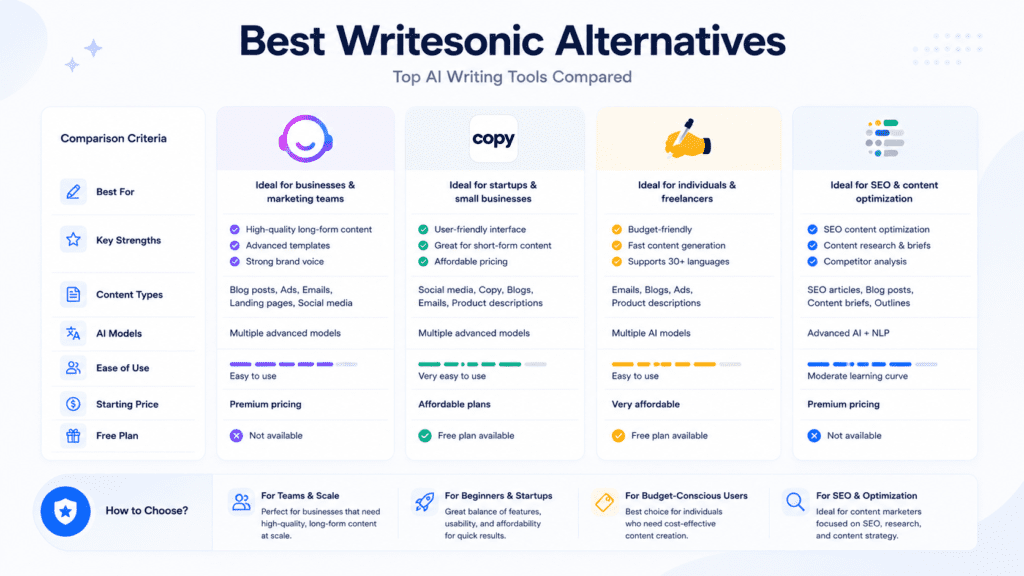
Complete Verdict Table
| Alternative | Best For | Key Strength | Starting Price |
|---|---|---|---|
| Jasper | Marketing Teams & Content Creators | Brand Voice & Advanced Workflows | $49/month |
| Copy.ai | Sales & Marketing Professionals | Go-to-Market Workflows | $49/month |
| Rytr | Budget-Conscious Users & Beginners | Simplicity & Value | $9/month |
| Frase.io | SEO Content Strategists | AI Writing + SEO Optimization | $14.99/month |
| ClosersCopy | Copywriters & Sales Funnel Experts | Advanced Copywriting Models | $49.99/month |
Best For
- Best Overall Alternative: Jasper. This platform shines for its comprehensive feature set, robust brand voice management, and strong team collaboration capabilities. It’s a powerhouse for agencies and larger content teams looking for an all-in-one solution.
- Best for SEO Content: Frase.io. If your primary goal is to rank higher on Google, Frase.io offers a unique combination of AI writing and deep content optimization features, helping you craft SEO-friendly articles from the ground up.
- Best Budget-Friendly Option: Rytr. For those just starting out or working with tighter budgets, Rytr provides a generous free plan and incredibly affordable paid tiers. It delivers solid core AI writing quality without breaking the bank.
Not Ideal For
- Users who need Writesonic’s specific features like Chatsonic (an AI chatbot) or Photosonic (an AI image generator) and find these integrated tools irreplaceable for their workflow.
- Individuals who are perfectly satisfied with Writesonic’s current pricing, word limits, and feature set, and aren’t experiencing any significant pain points.
Bottom Line
While Writesonic remains a powerful and versatile AI writer, the market offers compelling alternatives that might better suit specific needs. For instance, Jasper offers superior brand voice control and advanced workflows for teams, making it a strong contender for those prioritizing consistency and scale. Frase.io provides an integrated SEO workflow that’s hard to beat if search engine visibility is your main driver. And for those focused on cost-effectiveness, Rytr delivers exceptional value for beginners and small businesses. Your ideal choice among the best Writesonic alternatives ultimately depends on whether you prioritize marketing workflows, deep SEO optimization, or a budget-friendly entry point.
Why Look for a Writesonic Alternative? (Common User Pain Points)
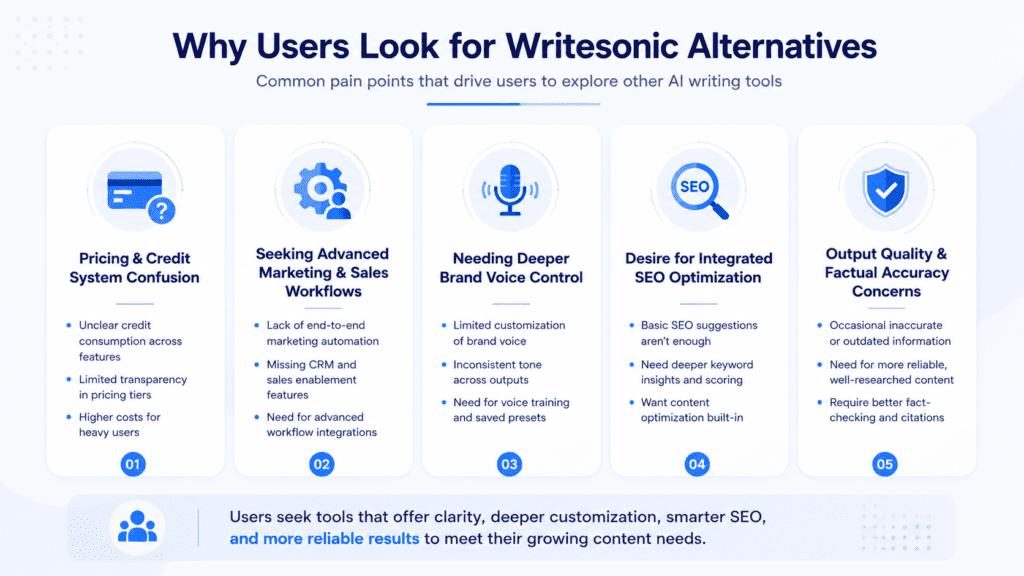
Even with its robust features, Writesonic isn’t a perfect fit for every user or business. Many content creators and marketing teams eventually find themselves exploring the best Writesonic alternatives due to specific pain points that arise as their needs evolve or scale. Understanding these common frustrations can help clarify if another AI writing tool might be a better match for your workflow.
Pricing & Credit System Confusion
One of the most frequent reasons users seek a different platform is the complexity and perceived limitations of Writesonic’s pricing and credit system. While Writesonic offers various plans, including a free tier, its credit-based model for generating content, especially for higher quality outputs or premium features, can become a significant hurdle. For high-volume users, the credits can deplete surprisingly fast, leading to unexpected costs or the need to constantly monitor usage.
The core frustration often stems from the lack of predictability. It’s not always clear how many credits a specific piece of content will consume, particularly for long-form articles or when using advanced modes. This uncertainty makes budgeting difficult and can interrupt a smooth content creation workflow. Users might find themselves regenerating content multiple times to get the desired quality, inadvertently burning through credits faster than anticipated. This contrasts with some of the best Writesonic alternatives that offer unlimited word counts on certain plans, providing a more straightforward and predictable cost structure for businesses with extensive content needs. For a blogger publishing daily or an agency managing multiple client campaigns, this credit-based system can quickly become a hidden frustration, pushing them to look for more transparent and scalable pricing models.
Seeking Advanced Marketing & Sales Workflows
While Writesonic excels at generating a wide array of individual content pieces, from blog posts to ad copy, some users require a more integrated, workflow-centric approach for their marketing and sales efforts. Writesonic’s strength lies in its diverse template library, but it often requires users to manually stitch together different outputs to form a cohesive campaign.
Digital marketing agencies, e-commerce businesses, and sales teams frequently need tools that can guide them through an entire go-to-market strategy, generating interconnected assets like email sequences, social media campaigns, and landing page copy from a single brief. They’re looking for platforms that don’t just create content, but help orchestrate entire marketing funnels. Writesonic, while versatile, may not offer the deep, guided workflows necessary for these more complex, multi-stage marketing and sales processes, leading users to explore alternatives built specifically for these integrated campaign needs.
Needing Deeper Brand Voice Control
Maintaining a consistent brand voice is paramount for businesses, especially as they scale their content production or manage multiple brands. While Writesonic offers some tone options, it may not provide the granular control required to truly embed a specific brand’s unique style, vocabulary, and messaging guidelines into every piece of AI-generated content.
For larger marketing teams or agencies, ensuring that every blog post, social media update, and email reflects a precise brand identity can be challenging with a tool that primarily relies on general tone settings. They need an AI that can be “trained” on their existing content, style guides, and brand assets to learn and replicate their unique voice consistently. When Writesonic’s brand voice features aren’t robust enough to meet these stringent requirements, users often turn to the best Writesonic alternatives that offer advanced brand voice management, allowing for a higher degree of customization and consistency across all outputs. This becomes critical for protecting brand integrity and ensuring a unified customer experience.
Desire for Integrated SEO Optimization
Content creation isn’t just about writing; it’s about writing content that ranks. Many Writesonic users find that while the tool can generate text, they still need to rely on separate SEO tools (like Surfer SEO or Frase.io) for keyword research, outlining, and on-page optimization. This often creates a disjointed workflow, requiring users to switch between multiple platforms, copy-pasting content, and manually checking optimization scores.
The inefficiency of this multi-tool approach can be a significant pain point for SEO content strategists and content marketers whose primary goal is organic traffic. They desire an all-in-one solution where they can research keywords, generate content outlines, write drafts, and optimize for search engines all within a single interface. This streamlined process saves time, reduces errors, and ensures that content is not only well-written but also strategically positioned to rank. For these users, the best Writesonic alternatives often include platforms that natively integrate robust SEO features, making the entire content lifecycle more efficient.
Output Quality & Factual Accuracy Concerns
A universal challenge with AI writing tools, including Writesonic, is the occasional struggle with output quality and factual accuracy, especially for long-form content or niche topics. While AI has made incredible strides, it can still “hallucinate” information, generate repetitive phrases, or produce content that requires significant human editing and fact-checking.
Users might find that Writesonic’s output, while a great starting point, often needs substantial refinement to meet their specific quality standards or to ensure complete factual correctness. This can be particularly frustrating for those creating educational content, technical articles, or anything where precision is paramount. The need for heavy post-editing can negate some of the time-saving benefits of using an AI writer. Consequently, users often seek the best Writesonic alternatives that promise higher quality, more nuanced, or more factually reliable outputs, even if it means a different approach to prompting or a higher price point. They are looking for tools that minimize the “clean-up” work and deliver content that is closer to publish-ready.
Jasper vs. Writesonic: The Best Alternative for Marketing Teams
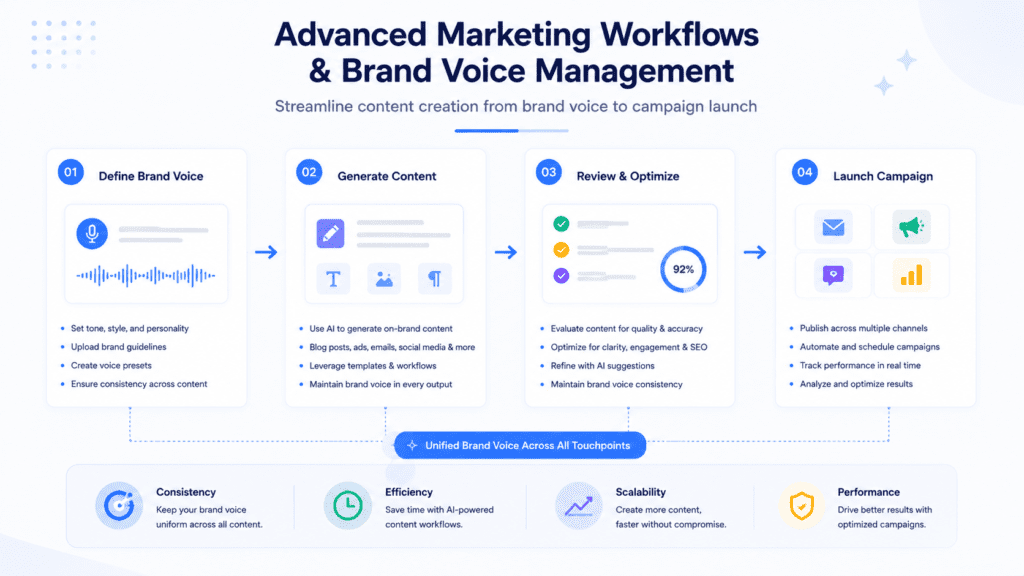
When marketing teams look for the best Writesonic alternatives, Jasper often emerges as a top contender, particularly for those prioritizing brand consistency, advanced workflows, and collaborative scaling. While both are powerful AI writing tools, Jasper’s architecture and feature set are specifically tailored to meet the demands of larger teams and more complex marketing strategies.
Feature Deep Dive: Comparing Jasper’s Brand Voice/Memory and Campaign Workflows to Writesonic’s templates.
This is where Jasper truly differentiates itself for marketing teams. Writesonic offers an extensive library of templates, covering everything from blog post ideas to ad copy. These templates are excellent for generating individual pieces of content quickly. However, when it comes to maintaining a unified brand identity across a vast array of content or orchestrating multi-channel campaigns, Writesonic’s template-driven approach can feel somewhat disconnected. Users often have to manually ensure consistency by carefully guiding each template output.
Jasper, on the other hand, introduces Brand Voice/Memory and Campaign Workflows, which are game-changers for teams. Jasper’s Brand Voice feature allows users to “teach” the AI their specific brand guidelines. You can upload style guides, provide examples of past content, and define key messaging points. Jasper then learns your brand’s unique tone, vocabulary, and phrasing, applying it consistently across all generated content. This isn’t just about selecting a “friendly” or “professional” tone; it’s about embedding your brand’s DNA into the AI’s output. For a marketing team managing multiple clients or a large in-house brand, this ensures every piece of copy, from a social media caption to a long-form article, sounds authentically “them.” This feature significantly reduces the need for extensive post-editing to align content with brand standards, a common frustration with more generic AI tools.
Furthermore, Jasper’s Campaign Workflows enable teams to generate a series of interconnected content pieces around a central theme or brief. Instead of creating a blog post, then an email, then a social media post as separate tasks, Jasper can help orchestrate them as part of a cohesive campaign. For example, a team launching a new product can use Jasper to generate a product description, email sequence, ad variations, and social media posts, all stemming from the same core brief and adhering to the established brand voice. This integrated approach ensures consistency in messaging and tone across all touchpoints, streamlining the entire content production process for marketing teams. This level of interconnectedness and brand-specific training is a key reason why Jasper is considered among the best Writesonic alternatives for professional marketing operations.
Output Quality & Control
Jasper’s command-based interface, particularly its “Boss Mode” and “Chat” features, offers a different level of control for experienced users compared to Writesonic’s more template-focused generation. While Writesonic provides various options and quality settings, Jasper allows for more direct, natural language commands, enabling users to steer the AI’s output with greater precision. This means you can tell Jasper exactly what you want, how you want it, and even provide specific instructions for tone, style, and content structure.
This iterative, command-driven approach often leads to higher quality, more tailored content with less post-editing. Users can refine and guide the AI through multiple steps, building complex pieces of content section by section, ensuring each part aligns with their vision. For marketing teams that need highly specific, nuanced content, this granular control is invaluable. Writesonic’s output is generally good, but its reliance on template inputs can sometimes result in more generic text if the prompts aren’t extremely detailed, often requiring more regeneration cycles to achieve the desired outcome.
Pricing & Value Proposition
Jasper is generally positioned as a premium AI writing tool, and its pricing reflects its advanced features and team-centric capabilities. While Writesonic offers more accessible entry points, including a free plan and paid plans starting around $16/month for unlimited words on its long-form plan, Jasper’s plans typically start higher. For instance, Jasper’s Creator plan might begin around $49/month, with Team plans starting closer to $125/month, depending on word count and features.
The value proposition for Jasper lies in its ability to scale content production while maintaining brand consistency and facilitating team collaboration. For marketing teams where brand integrity, advanced workflows, and efficient content generation are critical for ROI, Jasper’s higher cost is often justified. It’s an investment in a more sophisticated content infrastructure that can handle the complexities of large-scale marketing operations, making it a strong contender among the best Writesonic alternatives for those with the budget and specific needs.
Who Should Choose Jasper over Writesonic?
Jasper is the ideal choice for marketing teams, agencies, and mid-to-large businesses that need to scale their content production significantly while maintaining a consistent and distinct brand voice across all channels.
- You manage multiple brands or clients: Jasper’s Brand Voice feature is invaluable for ensuring each brand’s unique identity is reflected consistently.
- You require complex, multi-channel campaigns: Jasper’s Campaign Workflows streamline the creation of interconnected assets like email sequences, ad copy, and social media posts.
- Collaboration is key: Jasper offers features designed for team environments, allowing multiple users to work together efficiently.
- You prioritize granular control over AI output: The command-based interface allows for more precise guidance and iterative refinement of content.
- You have a dedicated budget for premium AI tools: Jasper’s pricing is higher, but the return on investment comes from increased efficiency, brand consistency, and higher-quality, tailored content.
For a marketing team that needs to produce high volumes of content, maintain strict brand guidelines, and streamline collaborative workflows, Jasper stands out as one of the best Writesonic alternatives.
Copy.ai vs. Writesonic: The Go-to-Market Alternative
For sales and marketing professionals whose primary goal is to generate conversion-focused copy for specific campaigns, Copy.ai presents itself as a compelling alternative to Writesonic. While Writesonic offers a broad range of content generation tools, Copy.ai’s strength lies in its specialized, workflow-centric approach designed to accelerate go-to-market strategies.
Workflow-Centric Approach
Copy.ai distinguishes itself with a strong focus on sales and marketing workflows, which differs significantly from Writesonic’s broader content generation capabilities. While Writesonic provides numerous templates for individual content types, Copy.ai is built around guiding users through the entire process of creating a marketing or sales campaign. Its “Workflows” feature is a prime example: instead of just generating a single email, Copy.ai can walk you through creating an entire email sequence for a product launch, complete with subject lines, body copy, and calls to action. Similarly, it can help generate multiple ad variations for A/B testing or create a landing page with accompanying social media copy, all within a cohesive framework.
This approach is less about providing a tool for every possible writing task and more about offering a structured journey for specific marketing objectives. For a small business owner needing to launch a new service or a digital marketer crafting a lead generation campaign, Copy.ai’s guided workflows can save significant time and ensure consistency across all assets. Writesonic, while versatile, often requires users to jump between different templates and manually piece together content for a full campaign, making Copy.ai one of the best Writesonic alternatives for those who value a more integrated, step-by-step content creation process for their go-to-market efforts.
Ease of Use & Interface
A direct comparison of the user experience often highlights Copy.ai’s intuitive and guided interface, especially when leveraging its workflow builder. Copy.ai aims to make the content creation process as straightforward as possible, even for beginners. Its workflows prompt users through each step, asking relevant questions to gather necessary information before generating content. This structured approach can reduce the learning curve and help users produce effective copy without needing extensive AI prompting experience.
Writesonic also boasts a clean interface and is generally easy to use, with its template library being well-organized. However, for complex, multi-stage marketing tasks, its template-driven nature might feel less “guided.” Users might need to have a clearer idea of which templates to use and how to combine their outputs to achieve a comprehensive campaign. Copy.ai’s workflows, by contrast, act as a virtual assistant, leading users from concept to complete campaign assets, which can be a significant advantage for sales and marketing professionals who need to quickly generate assets for specific campaigns without getting bogged down in tool selection.
Chat Feature Showdown
Both Copy.ai and Writesonic offer chat-based AI assistants, but their integration and primary use cases within their respective platforms differ. Writesonic features Chatsonic, which is a powerful conversational AI capable of real-time data access, image generation, and general content creation. It’s a versatile tool for brainstorming, research, and generating quick pieces of content.
Copy.ai, on the other hand, offers Copy.ai Chat, which is deeply integrated into its marketing and sales workflows. While it can also brainstorm and generate content, its strength lies in how it seamlessly assists users within the context of their marketing tasks. For example, you can use Copy.ai Chat to quickly generate ideas for an email subject line within an email sequence workflow, or to refine a call-to-action for an ad campaign you’re building. The key difference is the *contextual integration* with Copy.ai’s core marketing-centric features. While Chatsonic is a robust standalone chat tool, Copy.ai Chat often feels more like a direct assistant for specific marketing and sales content generation needs, making it a more focused and efficient tool for its target audience.
Who Should Choose Copy.ai over Writesonic?
Copy.ai is the preferred choice for sales and marketing professionals, small business owners, and e-commerce managers who need to quickly generate a wide array of assets for specific campaigns and value a guided, workflow-centric approach.
- You need to build entire marketing campaigns quickly: Copy.ai’s workflows are designed to generate cohesive sets of assets (emails, ads, social media posts) from a single brief.
- Your focus is on conversion-driven copy: The platform is optimized for generating effective sales and marketing copy for various stages of the customer journey.
- You prefer a guided user experience: Copy.ai’s interface and workflows lead you through the content creation process step-by-step, making it easy for beginners.
- You frequently A/B test different copy variations: Copy.ai excels at generating multiple options for ads, headlines, and other short-form copy.
- You prioritize efficiency in go-to-market strategies: The tool helps streamline the creation of assets needed for product launches, promotions, and lead generation.
For those whose primary need is to rapidly produce high-quality, conversion-focused marketing and sales assets within a structured workflow, Copy.ai stands out as one of the best Writesonic alternatives.
Rytr vs. Writesonic: The Best Budget-Friendly Alternative
When you’re searching for the best Writesonic alternatives that won’t break the bank, Rytr often comes up as a top contender. It’s built for users who prioritize simplicity and cost-effectiveness without sacrificing core AI writing capabilities. While Writesonic offers a broad suite of tools, Rytr carves out its niche by focusing on straightforward content generation.
Simplicity and Speed
Rytr’s interface is incredibly clean and intuitive, making it a breeze for beginners to get started. You won’t find a lot of bells and whistles, which can be a huge plus if you’re easily overwhelmed by complex dashboards. This minimalist design translates directly into speed; you can often generate short-form content like social media posts, ad copy, or email subject lines in just a few clicks. For a freelancer juggling multiple projects or a small business owner with limited time, this streamlined workflow is a significant advantage. What might take a few steps in a more feature-rich platform, Rytr often accomplishes with directness. It’s less about exploring advanced features and more about getting the job done quickly and efficiently.
Pricing Model & Generosity
This is where Rytr truly shines as a budget-friendly alternative. Unlike Writesonic’s credit-based system, which can sometimes feel like you’re constantly monitoring your word count, Rytr offers a more predictable model. It has a generous free plan that gives you 10,000 characters per month, which is perfect for trying it out or for very light usage. For those needing more, Rytr’s paid plans are remarkably affordable. The “Saver” plan typically starts around $9 per month for 100,000 characters, and their “Unlimited” plan, which removes character limits entirely, is generally priced around $29 per month.
This contrasts with Writesonic, whose free plan offers 10,000 words (which is generally more content than 10,000 characters) but whose paid plans start at $19 per month for 200,000 words. The key difference isn’t just the price tag, but the unit of measurement (characters vs. words). For short, punchy content, Rytr’s character-based system can be very cost-effective. However, if you’re generating longer articles, Writesonic’s word count might stretch further for a similar price point. The transparency and lower entry cost of Rytr’s plans make it an attractive option for those who need consistent content without unexpected overage charges.
Use Case Focus
Rytr excels at generating short-form content that’s often needed for daily marketing tasks. Think social media captions, product descriptions for an e-commerce store, email subject lines, ad copy variations, or quick blog post outlines. It’s less about crafting lengthy, in-depth articles and more about providing quick, usable snippets. This focus makes it ideal for beginners who are just dipping their toes into AI writing, or solopreneurs who need to quickly populate various marketing channels. While it can generate longer pieces, its core strength lies in its ability to produce concise, impactful text efficiently.
Who Should Choose Rytr over Writesonic?
Rytr is the ideal choice for freelancers, bloggers, and small business owners operating on a tight budget who need a simple, effective AI writer primarily for short-form content. If you’re a solopreneur managing your own social media, email marketing, and website copy, Rytr provides excellent value. It’s also a fantastic starting point for anyone new to AI writing tools, offering a low-risk way to experiment with the technology. If your main goal is to generate quick, high-quality text for everyday marketing needs without a steep learning curve or a hefty monthly fee, Rytr is likely one of the best Writesonic alternatives for you.
Frase.io vs. Writesonic: The SEO Content Powerhouse
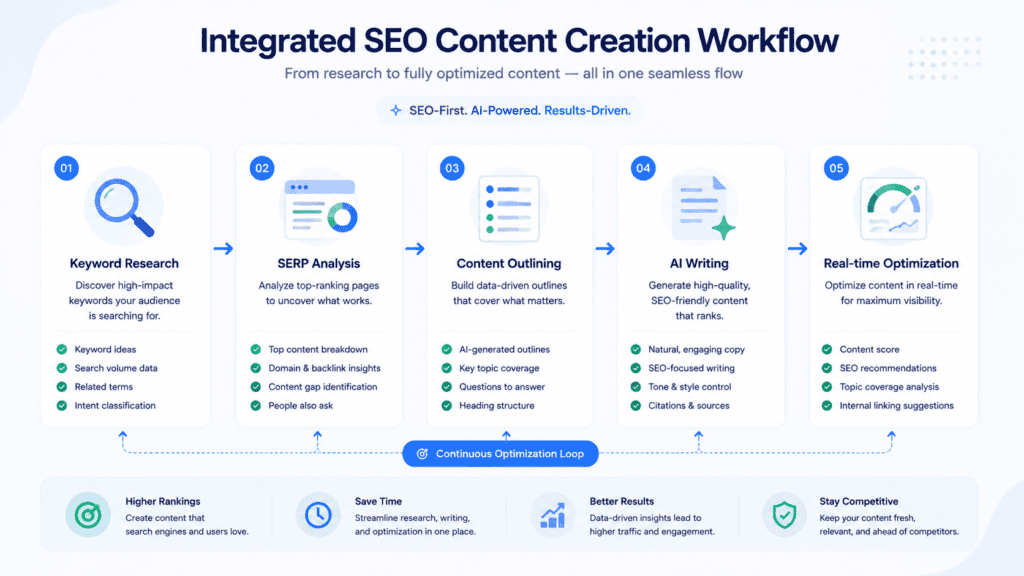
When your primary goal is to create content that ranks high on search engines, Frase.io emerges as a compelling alternative to Writesonic. While Writesonic offers AI writing, Frase.io integrates AI generation directly into a robust SEO workflow, making it a favorite among content strategists and SEO professionals.
The All-in-One SEO Workflow
Frase.io isn’t just an AI writer; it’s a comprehensive content optimization platform. Its core strength lies in its ability to streamline the entire SEO content creation process from research to writing. When you start a new document in Frase.io, it immediately analyzes the top-ranking search results (SERP) for your target keyword. It then pulls in relevant topics, questions, and statistics from these competitors, helping you build a detailed content outline. This means you’re not just writing; you’re writing with a data-backed strategy from the very beginning.
This integrated approach is a game-changer for anyone serious about organic traffic. Instead of using one tool for keyword research, another for outlining, and then a third for AI writing, Frase.io brings it all under one roof. This significantly reduces friction in the content workflow, saving valuable time and ensuring that every piece of content is strategically aligned with SEO best practices. For content teams, this means a more consistent and efficient process for producing high-ranking articles.
Content Optimization Features
Beyond just generating content, Frase.io provides powerful features to optimize it. As you write, it offers a real-time content score, comparing your draft against the top-ranking articles for your target keyword. It highlights missing keywords, related topics, and questions that your competitors are covering, guiding you to create more comprehensive and authoritative content. This isn’t just about keyword stuffing; it’s about ensuring your article thoroughly addresses the user’s search intent and covers all relevant subtopics.
These optimization capabilities are largely absent in Writesonic, which focuses more on content generation itself rather than deep SEO analysis and scoring. Frase.io’s ability to show you exactly where your content stands against the competition and suggest improvements based on real-time SERP data is invaluable. It helps you identify gaps, refine your messaging, and ultimately craft content that Google is more likely to favor. This proactive approach to optimization is a key differentiator and a major reason why many SEOs consider it one of the best Writesonic alternatives for their specific needs.
AI Writing Quality for Long-Form
While Frase.io’s AI writing capabilities might not be as broad or template-rich as Writesonic’s for every conceivable content type, it excels in generating long-form content that is specifically designed for SEO. Its AI features, often called “AI Write” or “AI Outline,” are geared towards expanding on research-backed outlines and filling in sections with relevant, keyword-rich text. The quality of the output is generally strong for informational content, especially when guided by the research data Frase.io provides.
However, it’s important to note that Frase.io’s AI is best utilized as an assistant to a human writer, not a complete replacement. It helps overcome writer’s block, generates initial drafts, and expands on ideas, but a human touch is still crucial for factual accuracy, nuanced arguments, and maintaining a unique brand voice. For long-form blog posts and articles where SEO is paramount, Frase.io’s AI is highly effective because it’s working within a pre-optimized framework.
Who Should Choose Frase.io over Writesonic?
Frase.io is the clear choice for SEO specialists, content strategists, digital marketing agencies, and anyone whose primary goal is to create top-ranking, long-form articles. If your content strategy revolves around organic search visibility and you need a tool that combines research, outlining, AI writing, and real-time optimization into a single workflow, Frase.io is a powerful Writesonic alternative. It’s less about quick, varied content generation and more about systematic, data-driven content that drives traffic. If you’re constantly asking “How can I rank higher?” then Frase.io is built for you.
Honest Take: The Hidden Trade-Offs of Switching from Writesonic
Deciding to switch from Writesonic to one of its alternatives isn’t always a straightforward upgrade. While you might gain specific features or a better pricing model, there are often hidden trade-offs that can impact your workflow and overall experience. Understanding these can help you set realistic expectations and avoid frustration down the line.
Losing Integrated Tools
One of Writesonic’s strengths is its all-in-one approach, offering tools like Chatsonic (an AI chatbot), Photosonic (an AI image generator), and Audiosonic (an AI voice generator) within the same subscription. When you move to an alternative, you’ll likely lose the convenience of having these diverse tools integrated. For example, if you switch to Frase.io for SEO, you’ll gain powerful optimization features but lose the ability to generate AI images or audio directly within the platform. This often means you’ll need to subscribe to separate services or find different solutions for those specific needs, potentially increasing your overall software stack and monthly expenses. The “one-stop shop” convenience of Writesonic is a significant factor that many users only appreciate after they’ve moved away.
The Learning Curve
Every new software, especially complex AI tools, comes with a learning curve. Moving to a platform like Jasper, which offers advanced brand voice management and campaign workflows, or ClosersCopy, with its intricate copywriting models, means investing time and effort into learning a new interface, understanding different commands, and adapting to a new workflow. What might seem like a minor inconvenience can actually slow down your initial productivity significantly. You’ll need to figure out how to achieve the same results you got in Writesonic, but with different tools and processes. This isn’t just about finding buttons; it’s about understanding the underlying logic and best practices of the new platform. For busy professionals, this initial dip in efficiency can be a real frustration.
Feature Mismatches
No single alternative perfectly replicates Writesonic’s complete feature set. A switch almost always means trading one set of features for another. For instance, you might gain Frase.io’s deep SEO analysis but lose Writesonic’s specific ad copy templates or its built-in image generation. Or, you might get Copy.ai’s robust sales workflows but miss Writesonic’s blog post writer’s specific output style. It’s rare to find a tool that’s an exact clone with just the “missing” features added. You’ll need to carefully evaluate which features are truly essential for your business and be prepared to let go of others, or find alternative solutions for them. This isn’t necessarily a bad thing, but it requires a clear understanding of your priorities.
Potential Cost Increases
While budget-friendly options like Rytr exist, switching to a more powerful, team-oriented tool like Jasper or a specialized platform like Frase.io could result in a higher monthly expense. These tools often come with more advanced features, higher word limits, or team collaboration capabilities that justify a premium price. If you’re moving from Writesonic’s “Unlimited” plan (which starts around $19/month for 200,000 words) to a Jasper plan that offers similar word counts and advanced features, you might be looking at $59/month or more. It’s crucial to compare not just the base price, but also what you get for that price in terms of word count, features, and user limits. Don’t assume an alternative will automatically be cheaper or offer more for the same cost; sometimes, getting more means paying more.
How to Choose the Right Writesonic Alternative for Your Needs

Selecting the ideal AI writing assistant involves more than just comparing feature lists; it requires a clear understanding of your own operational needs and strategic goals. This framework will guide you through a structured decision-making process.
Step 1: Define Your Primary Use Case
Begin by identifying the core types of content you need to generate most frequently. Are you primarily focused on short-form content like social media posts, ad copy, and product descriptions? Or is your main objective to produce long-form articles, blog posts, and comprehensive guides? Your answer here will heavily influence whether a tool optimized for brevity and speed (like Rytr) or one built for depth and research (like Frase.io) is a better fit. Consider if sales-focused copy (where Copy.ai excels) or general marketing content is your priority.
Step 2: Assess Your Budget & Team Size
Your financial constraints and the scale of your operations are critical factors. If you’re a solopreneur or a small business with a tight budget, a cost-effective solution with a generous free tier, such as Rytr, might be paramount. Conversely, if you manage a larger marketing team, you might prioritize collaboration features, advanced workflows, and robust integrations that come with a higher price point, often found in platforms like Jasper. Evaluate if the potential cost increase of switching, as discussed in the “Hidden Trade-Offs” section, aligns with your budget.
Step 3: Evaluate Your Need for SEO Integration
For businesses and content creators whose success hinges on organic search visibility, the level of SEO integration in an AI writing tool is non-negotiable. If SERP analysis, content scoring, and keyword optimization are essential components of your content strategy, a platform like Frase.io, which builds these capabilities directly into its workflow, will offer significant advantages over tools that lack such features. If SEO is a secondary concern, you might prioritize other aspects like content variety or ease of use.
Step 4: Test with a Free Trial
The most effective way to determine if an AI writing tool meets your expectations is to experience it firsthand. Leverage the free trials offered by various platforms. Use these trials to generate actual content relevant to your specific needs. Pay close attention to the quality of the output, the intuitiveness of the interface, the speed of generation, and how well the tool integrates into your existing workflow. This practical evaluation will provide invaluable insights that specifications alone cannot.
Final Recommendation
While Writesonic remains a powerful and versatile AI writing tool, the landscape of AI content generation is rich with alternatives, each excelling in different niches. The optimal choice for you depends entirely on your specific requirements and strategic priorities.
- For marketing teams needing brand consistency and advanced workflows, Jasper is the superior choice, offering robust features for scalability and collaboration.
- For SEO professionals focused on ranking content, Frase.io offers an unbeatable integrated workflow, combining research, writing, and optimization seamlessly.
- For beginners and users on a strict budget, Rytr provides the best value and simplicity, making it an excellent entry point into AI content creation.
- For sales-focused users, Copy.ai‘s go-to-market workflows are a powerful asset, designed to convert and drive business outcomes.
We strongly advise you to apply the “How to Choose” framework outlined above and thoroughly utilize free trials to make an informed decision that aligns perfectly with your unique needs.
Frequently Asked Questions (FAQ)
Is there a free alternative to Writesonic?
Yes, Rytr offers a very generous free plan that allows you to generate a significant amount of content each month, making it a strong free alternative. Many other platforms also provide free trials.
Which Writesonic alternative produces the most human-like content?
While subjective, Jasper and Copy.ai are frequently cited for their ability to generate highly natural and nuanced content, particularly for longer-form or more creative outputs.
Can these alternatives write long-form content like ebooks?
Yes, several alternatives are well-suited for long-form content; Frase.io excels at SEO-optimized articles, and Jasper is highly capable of generating comprehensive blog posts, reports, and even chapters for ebooks.
How does the pricing of these alternatives compare to Writesonic?
Pricing varies significantly; Rytr is generally more budget-friendly, while tools like Jasper and Frase.io can be more expensive, especially for advanced features or higher usage tiers, as discussed in earlier sections.
Which alternative has the best fact-checking capabilities?
No AI writing tool inherently performs factual verification; users must always fact-check the generated content independently. Frase.io assists with content *relevance* to SERP, but not factual accuracy.
Do any of these alternatives offer an API like Writesonic?
Yes, many professional-grade AI writing platforms, including Jasper, provide API access for developers to integrate their AI capabilities into custom applications and workflows.