
In today’s fast-paced digital landscape, content is king, but creating it efficiently can feel like a constant uphill battle. Many businesses, from solo bloggers to growing marketing agencies, find themselves evaluating AI writing tools to keep up with demand. The challenge often isn’t just picking an AI, but understanding the nuances between different plans and versions of the same tool as their needs evolve.
If you’re currently weighing your options for scaling content creation, you might be looking at Writesonic and wondering which version truly fits your workflow. This guide cuts through the noise, offering a direct comparison of Writesonic’s current plans, features, and versions. We’ll clarify the differences between the Free, Business, and Enterprise tiers, helping you decide which version of Writesonic is the right investment for your specific needs in 2026.
Quick Verdict: Which Writesonic Plan Should You Choose?
Deciding on the right AI writing assistant can feel like a big commitment, especially when you’re trying to balance features, quality, and cost. When it comes to Writesonic vs Writesonic plans, the core decision often boils down to your scale of operation and the depth of features you truly need. This quick verdict aims to simplify that choice, highlighting the strengths and limitations of each tier so you can make an informed decision without getting bogged down in every single detail.
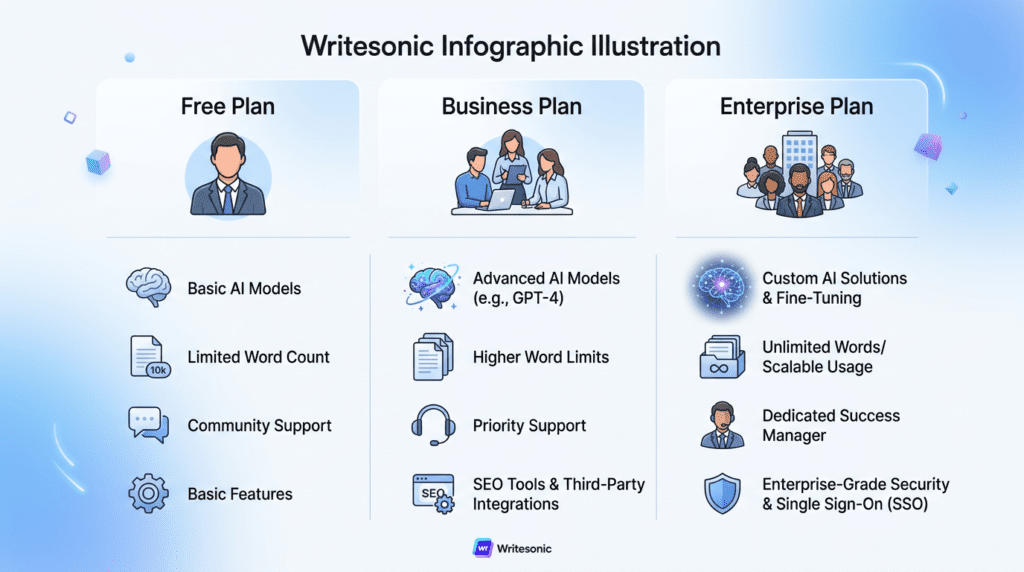
Complete Verdict Table
| Factor | Free Plan | Business Plan | Enterprise Plan |
|---|---|---|---|
| Best For: | Casual users, students, testing the platform | Solo creators, marketers, small teams | Large teams, agencies, high-volume needs |
| Core AI Model | GPT-3.5 (Standard) | GPT-4 (Advanced) & GPT-4o | GPT-4o, Custom Models |
| Word Limit | 10,000 words/month (Standard quality) | Unlimited words (Premium quality) | Custom, high-volume limits |
| Key Features | Basic tools, AI Article Writer 4.0 | Photosonic, Audiosonic, Chatsonic Pro | SSO, Custom Branding, API Access |
| Pricing | $0 | Starts at ~$19/month | Custom Quote |
| Verdict | Excellent for trial, not for professional use. | The best value for most professional users. | Essential for scaled, secure operations. |
Best For
For the vast majority of content creators, marketers, and small business owners, the Business Plan stands out as the clear winner. It offers an exceptional balance of powerful features and cost-effectiveness. With unlimited words generated at premium quality using advanced AI models like GPT-4 and GPT-4o, you won’t hit frustrating content limits just when you’re getting into a rhythm. Features like Photosonic for AI image generation, Audiosonic for audio content, and Chatsonic Pro for advanced conversational AI make it a comprehensive toolkit for modern content creation. This plan is designed for those who need to produce consistent, high-quality content without breaking the bank or constantly worrying about credit consumption. It’s truly the workhorse for anyone serious about their content strategy.
Not Ideal For
While the Free Plan is a fantastic way to kick the tires and see what Writesonic can do, it’s simply not built for professional content production. Its 10,000-word limit (at standard quality) and reliance on the older GPT-3.5 model mean you’ll quickly run into limitations if you’re trying to generate anything substantial, like long-form blog posts or multiple marketing campaigns. It’s great for a student project or a quick test, but it won’t sustain a business. On the other end of the spectrum, the Enterprise Plan is overkill for individuals or small teams. While it offers advanced features like Single Sign-On (SSO), custom branding, and API access, these are typically only necessary for large organizations with specific security, integration, and team management requirements. Investing in Enterprise without those specific needs would mean paying for features you simply won’t use, making it an inefficient choice.
Bottom Line
When you’re serious about leveraging AI for your content, the choice ultimately comes down to the Business and Enterprise plans. For individuals, freelancers, small marketing teams, and growing businesses, the Business Plan offers the best balance of power, premium features, and an accessible price point, typically starting around $19/month. It provides the unlimited, high-quality content generation capabilities that are crucial for scaling. You should only consider upgrading to the Enterprise Plan when your organization reaches a size where advanced security protocols (like SSO), deep system integrations (via API), custom AI model training, or extensive team management features become non-negotiable operational necessities.
Understanding the Core Differences: How Writesonic Tiers Vary in 2026
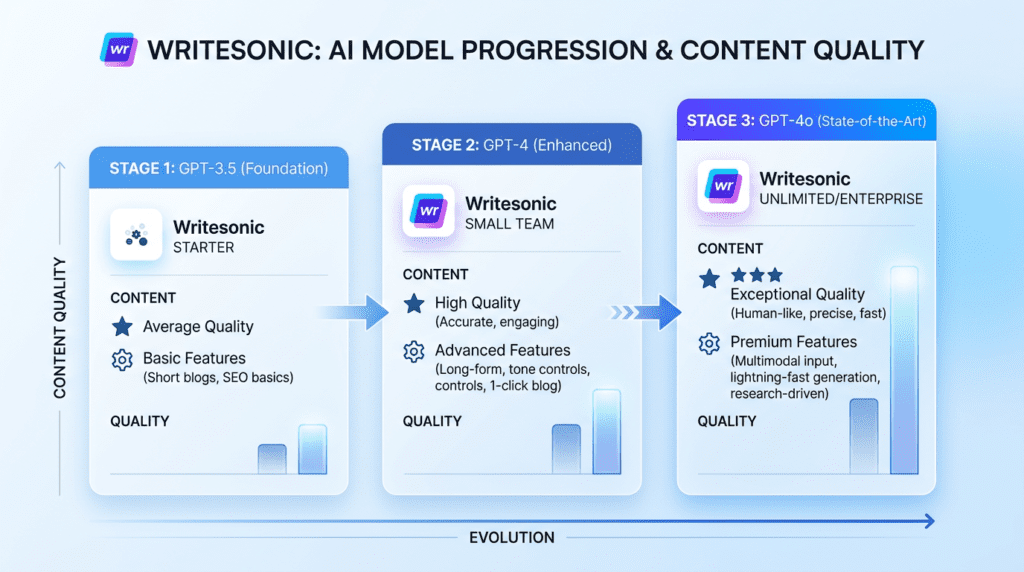
This section breaks down the fundamental distinctions between Writesonic’s plans. We’ll move beyond the pricing page to explain what these differences mean for your daily workflow and content quality.
The AI Engine Divide: GPT-3.5 vs. GPT-4 vs. GPT-4o
The core difference in Writesonic’s plans, and arguably the most impactful, lies in the underlying AI models powering the content generation. The Free plan primarily leverages GPT-3.5, while the Business and Enterprise plans gain access to the more advanced GPT-4 and the latest GPT-4o models. This isn’t just a version number change; it’s a significant leap in capability.
For users on the Free plan, GPT-3.5 offers a solid foundation for basic content needs. It’s capable of generating coherent text, but you’ll often find the output less nuanced, occasionally repetitive, and sometimes lacking the depth required for complex topics or highly engaging marketing copy. Beginners might not immediately spot these subtle differences, but as you use the tool more, you’ll notice the need for more editing and fact-checking.
Upgrading to a Business or Enterprise plan unlocks GPT-4 and GPT-4o. These models excel at understanding complex prompts, generating more creative and human-like text, and maintaining better factual accuracy. For instance, when generating long-form content or intricate marketing campaigns, GPT-4o can produce drafts that require significantly less editing. This translates directly into time savings and higher quality output, which is crucial for professional content creators. The trade-off, of course, is the increased cost, but for those whose business relies on high-quality content, the efficiency gains often justify the investment. What marketing pages often don’t emphasize enough is how much easier it becomes to get *exactly* what you want from the AI when using these advanced models, reducing the frustration of constant re-generation.
Word Quality vs. Word Count: What “Unlimited Words” Really Means
Writesonic’s approach to “words” isn’t just about quantity; it’s deeply tied to quality. While the Free plan offers a limited number of “Standard” quality words (around 10,000 per month), the Business plan boasts “unlimited words” at “Premium” quality. This distinction is vital for understanding the true value proposition of each tier.
“Standard” quality words, typically generated by GPT-3.5, are suitable for quick drafts, brainstorming, or simple social media posts. However, relying on them for critical content like blog posts, landing pages, or email sequences can lead to significant editing overhead. You might find the language less sophisticated, the arguments less compelling, or even minor factual inaccuracies that require manual correction. This can be a hidden frustration for users trying to scale their content efforts on a free or lower-tier plan, as the time saved by AI generation is then spent on extensive human refinement.
“Premium” quality words, powered by GPT-4 and GPT-4o, are designed to be much closer to publication-ready. They exhibit better coherence, stronger argumentation, and a more natural flow. For a solo blogger or a small marketing team, having access to unlimited premium words means you can generate multiple variations, experiment with different angles, and produce high-volume, high-quality content without constantly worrying about hitting a word limit or sacrificing output excellence. This is where the Business plan truly shines, offering a practical solution for consistent content production. The long-term consequence of choosing premium quality is a more efficient content workflow and a higher standard of published material, which directly impacts SEO and audience engagement.
Feature Access: Which Tools Are Locked Behind Higher Tiers?
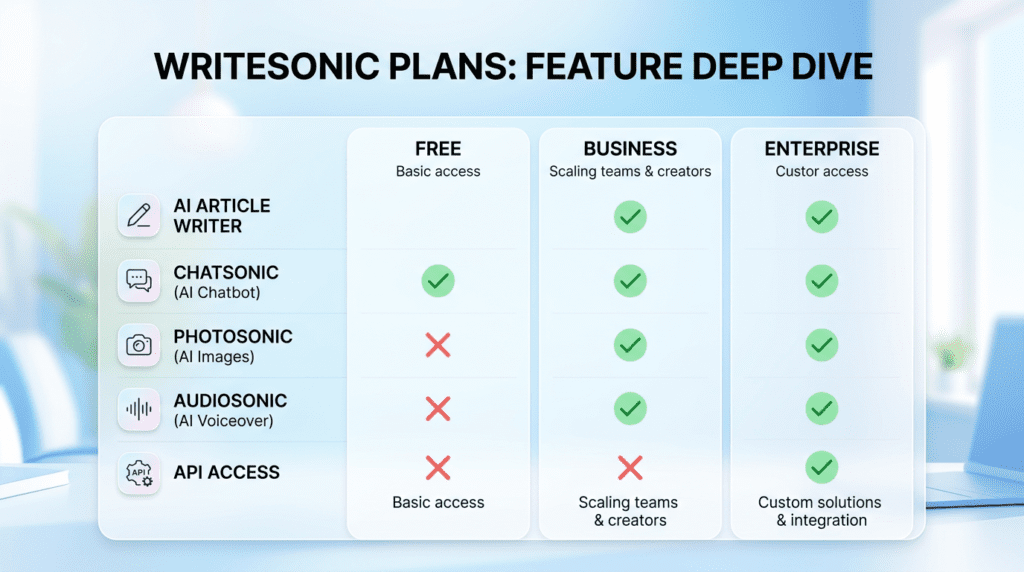
Beyond the core AI engine, Writesonic strategically gates access to several powerful tools based on your subscription level. While the Free plan provides basic access to the AI Article Writer 4.0 and a limited version of Chatsonic, the Business and Enterprise plans unlock a suite of integrated functionalities that significantly enhance the content creation workflow.
For instance, tools like Photosonic (AI image generator) and Audiosonic (AI audio generator) are exclusive to paid plans. For a content creator, this means that on a Free plan, you’d need to use separate, potentially paid, tools for your visual and audio needs, adding complexity and cost to your overall process. With a Business plan, these tools are integrated, streamlining your workflow. Chatsonic also gets a significant upgrade to Chatsonic Pro, offering real-time data access and more sophisticated conversational AI capabilities, which we’ll explore further.
Other critical features like advanced Brand Voice customization, bulk processing, and API access are reserved for the Enterprise tier. This means that while a small business might manage with the features in the Business plan, larger organizations or agencies with specific integration needs or strict brand guidelines will find the Enterprise plan essential. The practical implication is that if your content strategy requires multimedia, real-time data, or deep integration with existing systems, you’ll quickly outgrow the Free plan and likely need to consider the Business or Enterprise options.
User Seats and Team Collaboration Capabilities
For any business beyond a solo operation, team collaboration features become a critical consideration. Writesonic’s plans reflect this need, with varying levels of support for multiple users and collaborative workflows.
The Free plan is inherently designed for individual use, offering no specific team features. This works fine for a single user exploring the platform, but it quickly becomes a bottleneck if you need to share access, manage projects, or collaborate on content with colleagues.
The Business plan introduces basic team functionality, allowing for multiple user seats. This is a significant upgrade for small marketing teams, agencies, or even a blogger working with a virtual assistant. It means everyone can access the same account, share credits (or words, in the new model), and work within a unified Writesonic environment. However, these features are generally focused on shared access rather than advanced project management or granular permissions.
For large organizations, agencies, or enterprises, the Enterprise plan offers robust team collaboration capabilities. This includes features like Single Sign-On (SSO) for enhanced security and simplified access management, custom branding options for internal use, and more sophisticated user role management. These features are crucial for maintaining security, compliance, and efficient workflows across large, distributed teams. Without these advanced capabilities, managing a growing team on a lower-tier plan can lead to significant administrative overhead, security risks, and a fragmented content creation process. The decision to upgrade to Enterprise often comes down to these operational efficiencies and security requirements, rather than just content generation volume.
Pricing and Value Breakdown: Is a Paid Writesonic Plan Worth It?
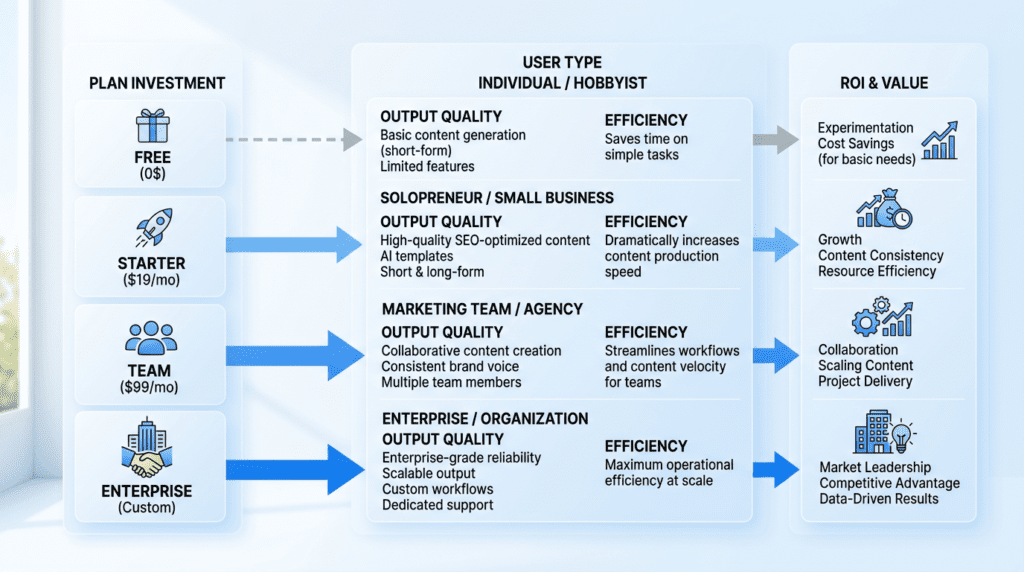
A detailed look at the cost structure of each Writesonic plan. We’ll analyze not just the monthly price but the long-term value you get, helping you determine the ROI for your specific use case.
The Free Plan’s True Cost: Limitations and Opportunity Costs
While the Writesonic Free plan proudly displays a $0 price tag, it’s crucial to understand its true cost, especially for anyone serious about content creation. The primary limitation is the word count (around 10,000 “Standard” quality words per month) and the reliance on the older GPT-3.5 model. For a beginner, this might seem generous, but for a professional, it quickly becomes restrictive.
The “true cost” of the Free plan isn’t monetary; it’s measured in time and opportunity. Generating content with GPT-3.5 often requires more extensive editing, fact-checking, and re-generation to achieve a professional standard. This means you’re spending valuable hours refining AI output that could have been near-perfect from the start with a more advanced model. For a blogger, this could mean fewer articles published; for a marketer, it could mean slower campaign launches or lower-performing copy. The opportunity cost is the revenue or growth you miss out on due to slower, lower-quality content production. While excellent for testing the waters or for very casual use, relying on the Free plan for professional output is often a false economy.
Analyzing the Business Plan’s Price-to-Feature Ratio
The Business plan, starting around ~$19/month, represents the sweet spot for most professional users, offering an exceptional price-to-feature ratio. Its core value proposition is “unlimited words” at “Premium” quality, powered by GPT-4 and GPT-4o. This alone is a game-changer for anyone generating significant volumes of content.
Beyond the word count, the Business plan unlocks critical features like Photosonic, Audiosonic, and Chatsonic Pro. For ~$19/month, you’re not just getting an AI writer; you’re getting an integrated content creation suite. Consider the cost of separate subscriptions for an AI image generator, an AI audio tool, and a premium conversational AI. The Business plan bundles these, offering a streamlined workflow and considerable savings compared to piecing together individual tools. For a solo entrepreneur, a small marketing team, or an agency, this plan provides the power to produce high-quality, diverse content efficiently, directly impacting their ability to attract and engage audiences. The ROI is clear: faster content creation, higher quality output, and access to a broader range of tools, all for a manageable monthly fee.
When Does the Enterprise Plan Become Cost-Effective?
The Enterprise plan, available via custom quote, is not for everyone. It becomes cost-effective when your organization reaches a scale or has specific requirements that the Business plan cannot adequately address. This typically includes large teams, agencies managing multiple client accounts, or businesses with stringent security and compliance needs.
Key features that justify the Enterprise investment include Single Sign-On (SSO), custom branding, advanced API access, and dedicated account management. If your team consists of dozens or hundreds of users, SSO is essential for security and ease of access. If you need to deeply integrate Writesonic’s AI capabilities into your existing custom software or content management systems, the API access is non-negotiable. Furthermore, for businesses that require custom AI model training or specific legal/compliance frameworks, the Enterprise plan offers the flexibility and support to meet those demands. For these specific use cases, the custom pricing reflects the tailored solutions and advanced infrastructure provided, making it a necessary and cost-effective solution for large-scale operations. For anyone else, it would be an unnecessary expense.
Understanding Billing Cycles: Annual vs. Monthly Savings
Writesonic, like many SaaS platforms, offers different billing cycles that can significantly impact your overall cost. While monthly billing provides flexibility, annual billing almost always comes with a substantial discount.
Typically, opting for an annual subscription can save users anywhere from 15% to 25% compared to paying month-to-month. For a Business plan costing ~$19/month, an annual commitment could bring the effective monthly cost down to around $15-$16. This might seem like a small difference, but over a year, it adds up to a saving of $36-$48. For businesses operating on tight budgets or looking to maximize their software investments, these savings are not insignificant. The decision often comes down to cash flow versus long-term commitment. If you’re confident in your long-term use of Writesonic, paying annually is a straightforward way to reduce your operational expenses. However, if you’re still evaluating the tool or prefer maximum flexibility, monthly billing allows you to cancel anytime without a larger upfront investment.
Feature Deep Dive: Comparing Key Writesonic Tools Across Plans
Here, we compare how the most important Writesonic features function differently depending on your subscription level. This goes beyond a simple checklist to evaluate practical performance.
AI Article Writer (4.0 vs. 5.0): Is the Upgrade Noticeable?
The AI Article Writer is a cornerstone feature for many Writesonic users, and the distinction between version 4.0 (available on Free and some older plans) and 5.0 (primarily on Business and Enterprise plans) is more than just an incremental update. It represents a significant leap in the quality and efficiency of long-form content generation.
AI Article Writer 4.0 is competent for generating basic blog posts or articles. It can structure content, provide headings, and fill in paragraphs. However, users often find that the output can be somewhat generic, occasionally repetitive, and might require substantial editing to achieve a unique voice or specific factual accuracy. It’s a good starting point, but it demands more human intervention to elevate the content.
AI Article Writer 5.0, powered by the latest GPT-4o models, offers a noticeably superior experience. It excels at generating more coherent, engaging, and contextually relevant long-form content. The articles produced by 5.0 tend to have better flow, more sophisticated language, and a stronger grasp of complex topics. This means less time spent on editing, rephrasing, and fact-checking for the user. For instance, a marketer needing a 2,000-word SEO-optimized article will find that 5.0 delivers a draft much closer to publication-ready, often incorporating better keyword integration and a more natural tone. This upgrade is particularly noticeable in how it handles nuance and avoids the “AI-generated” feel that can sometimes plague older models. For anyone serious about producing high-quality, long-form content efficiently, the upgrade to 5.0 is not just noticeable; it’s a game-changer for their workflow.
Chatsonic vs. Chatsonic Pro: Everyday Search and Creation Differences
Chatsonic is Writesonic’s AI chatbot, designed for conversational AI tasks, research, and quick content generation. While a basic version is available on the Free plan, Chatsonic Pro, included with Business and Enterprise plans, offers significant enhancements that impact everyday use.
The standard Chatsonic provides a conversational interface for basic queries and content generation. You can ask it to write short paragraphs, brainstorm ideas, or answer general questions. However, its knowledge base might be limited to its training data cutoff, meaning it might not have access to the most current information.
Chatsonic Pro elevates this experience by integrating real-time data access. This means it can pull information directly from the internet, making it incredibly useful for up-to-date research, current event summaries, or generating content based on recent trends. For example, if you need to write about a recent industry development, Chatsonic Pro can access the latest news, whereas the standard version might provide outdated information. Additionally, Pro often handles more complex prompts with greater accuracy and creativity, making it a more powerful tool for brainstorming, content outlining, and even generating creative copy variations. For users who rely on current information or need a more sophisticated AI companion for their daily tasks, the upgrade to Chatsonic Pro is invaluable.
Audiosonic & Photosonic: Are They Included and Are They Any Good?
Audiosonic (AI audio generation) and Photosonic (AI image generation) are multimedia tools that extend Writesonic’s capabilities beyond text. These features are exclusive to the Business and Enterprise plans, adding significant value for content creators looking for an all-in-one solution.
Photosonic allows users to generate images from text prompts, similar to other popular AI art tools. For a blogger needing a quick header image, a social media manager creating visual posts, or a small business owner needing simple graphics, Photosonic can be incredibly useful. It’s generally “good enough” for many common use cases, providing a convenient way to add visuals without needing to source stock photos or hire a designer for every small task. However, it’s important to set realistic expectations; while capable, it may not replace a professional graphic designer for highly specific, branded, or complex visual needs.
Audiosonic, on the other hand, focuses on generating audio content, such as voiceovers or short sound clips. This can be beneficial for creating quick podcast intros, video narrations, or even adding voice elements to presentations. Like Photosonic, its utility lies in its convenience and integration. For quick, functional audio, it performs well. However, for highly polished, professional-grade voiceovers or complex sound design, dedicated audio production tools and human voice talent will likely still be superior. The value of both Audiosonic and Photosonic lies in their ability to streamline the content creation process by offering integrated multimedia capabilities, reducing the need for separate subscriptions or external tools for basic needs.
Brand Voice: How Customization Varies Between Business and Enterprise
Maintaining a consistent brand voice across all content is crucial for brand identity and recognition. Writesonic offers features to help with this, but the depth of customization varies between the Business and Enterprise plans.
On the Business plan, users can typically define a basic brand voice. This might involve setting parameters for tone (e.g., professional, friendly, witty), style (e.g., formal, casual), and perhaps some key phrases or words to include or avoid. This level of customization is generally sufficient for individual creators or small teams to ensure their AI-generated content aligns with their brand’s personality. It helps prevent the AI from sounding generic or off-brand.
The Enterprise plan takes brand voice customization to a much more granular and sophisticated level. This can include the ability to upload extensive brand guidelines, style guides, and even existing content samples for the AI to learn from. Enterprise users might also have access to custom AI model training, allowing the AI to truly internalize the brand’s unique linguistic patterns, jargon, and communication nuances. This level of control is essential for large organizations with strict brand governance, multiple content teams, or agencies managing diverse client brands. It ensures that every piece of AI-generated content, regardless of who creates it, adheres perfectly to the established brand identity, minimizing the need for manual brand compliance checks and maintaining a consistent customer experience.
API Access: A Critical Feature Only for Enterprise Users
API (Application Programming Interface) access is a powerful feature that allows users to integrate Writesonic’s AI capabilities directly into their own applications, workflows, or custom systems. This is a critical feature, but it’s exclusively available to Enterprise plan users.
For most individual users or small businesses, API access isn’t necessary. They interact with Writesonic through its web interface. However, for large organizations, software developers, or agencies looking to automate content generation at scale or embed AI writing into their proprietary platforms, API access is indispensable.
With API access, an Enterprise user can, for example, automatically generate product descriptions directly within their e-commerce platform, create dynamic marketing copy for ad campaigns based on real-time data, or integrate AI content generation into their internal content management system. This allows for unparalleled automation and customization, transforming Writesonic from a standalone tool into a core component of a larger digital ecosystem. The long-term consequence of having API access is the ability to build highly efficient, custom content workflows that can scale seamlessly with business growth. Without it, these advanced integrations and automations simply aren’t possible, making the Enterprise plan a non-negotiable choice for those with specific development or large-scale automation needs.
Real-World Scenarios: Which Writesonic Plan Fits Your Role?
Choosing the right Writesonic plan isn’t just about features and pricing; it’s about how the tool integrates into your daily workflow and supports your specific goals. This section puts you in the shoes of different professionals, illustrating which Writesonic plan makes the most sense for various use cases in 2026. Understanding these real-world implications is key to making an informed decision when comparing Writesonic vs Writesonic plans.
For the Solo Blogger or Affiliate Marketer: Business is the Clear Winner
If you’re a solo blogger, affiliate marketer, or content creator, your primary need is often high-quality, long-form content generated efficiently. You’re likely juggling multiple tasks and don’t have time to constantly edit subpar AI output. For you, the Writesonic Business Plan is the undisputed champion.
Why? Because it offers truly *unlimited words* with access to the advanced GPT-4 and GPT-4o models. This means you can generate entire blog posts, detailed product reviews, or comprehensive affiliate guides without worrying about hitting a credit limit. The AI Article Writer 5.0, exclusive to paid plans, significantly improves the quality and coherence of long-form content, reducing your editing time. Beginners often struggle with the sheer volume of content needed to rank, and the Business plan removes that barrier. While the Free plan might seem appealing for testing, its reliance on GPT-3.5 and strict word limits quickly become a hidden frustration for anyone serious about SEO and consistent publishing. The Enterprise plan, with its custom models and API access, is simply overkill and an unnecessary expense for a single user.
For the Small Marketing Team: Why the Business Plan is Your Starting Point
For a small marketing team – perhaps 2-5 people managing social media, email campaigns, and blog content – the Writesonic Business Plan serves as an excellent foundation. It provides the core AI writing capabilities needed for diverse content creation tasks, from crafting compelling ad copy to drafting initial blog post outlines.
The “unlimited words” feature is crucial here, as multiple team members will be generating content simultaneously, preventing credit-based bottlenecks. While the Business plan doesn’t offer the advanced team management features like Single Sign-On (SSO) or granular user roles found in Enterprise, it typically allows for multiple user seats, enabling shared access to the powerful AI tools. This means everyone can leverage GPT-4o for high-quality output. However, as your team grows or if you require stricter access controls and integrated workflows, you’ll start to feel the collaboration gap. The Business plan is a strong starting point, but be aware that scaling limitations related to team management might eventually push you towards the Enterprise tier.
For the Large Agency or Content Department: Making the Case for Enterprise
For large marketing agencies, content departments within enterprises, or high-volume content factories, the Writesonic Enterprise Plan isn’t just an option; it’s a necessity. These organizations operate at a scale where standard plans simply can’t keep up with demand or meet stringent operational requirements.
The Enterprise plan offers custom word limits, ensuring you never run out of capacity, even with hundreds of articles or thousands of pieces of marketing copy generated monthly. Critically, it provides features like API access, allowing seamless integration of Writesonic’s AI capabilities directly into your existing content management systems or proprietary tools. This is invaluable for automating content generation at scale. Furthermore, Enterprise plans often include custom AI models tailored to your brand voice and specific industry jargon, ensuring consistent, high-quality output that aligns perfectly with your brand guidelines. Security features like SSO and dedicated account management are also paramount for large organizations, addressing compliance and administrative needs that smaller plans overlook. The initial investment is higher, but the long-term benefits in efficiency, customization, and security make it cost-effective for high-volume, complex operations.
For the Student or Casual User: Maximizing the Free Plan
If you’re a student experimenting with AI for essays (with caution!), a hobbyist blogger, or someone just curious about what an AI content generator can do, the Writesonic Free Plan is perfectly suited for you. It’s designed for exploration and low-volume, non-commercial use.
The Free plan gives you a taste of Writesonic’s capabilities, offering a decent word count (typically around 10,000 words per month, though this can vary) using the GPT-3.5 model. This is enough to generate short social media captions, brainstorm blog post ideas, or draft quick outlines. It’s an excellent way to learn the interface and understand the basics of AI writing without any financial commitment. However, it’s crucial to understand its limitations. The quality ceiling of GPT-3.5 means the output won’t be as nuanced or as ready for publication as content from GPT-4o. You’ll also quickly hit the word limits if you attempt any serious content creation. For important academic work or professional projects, relying solely on the Free plan would be a significant trade-off in quality and efficiency.
The Hidden Trade-Offs: What You Give Up With Each Plan
Every decision, especially when it comes to software subscriptions, involves trade-offs. While marketing pages highlight benefits, it’s equally important to understand the less obvious downsides and limitations of each Writesonic plan. This honest look at what you might be giving up can prevent future frustrations and ensure your chosen plan truly aligns with your long-term needs.
The Free Plan’s Quality Ceiling: Why You Can’t Rely on It for Important Work
While the Writesonic Free Plan is fantastic for getting started, its biggest hidden trade-off is the quality ceiling imposed by its reliance on older AI models, primarily GPT-3.5. What you give up here is the nuanced, higher-quality output that comes from GPT-4 and GPT-4o. For important work – whether it’s a critical blog post, a sales page, or a client report – content generated with GPT-3.5 often lacks the depth, accuracy, and natural flow required to truly engage an audience or rank well in search engines.
Beginners might not immediately notice this, but as usage grows, the difference becomes stark. You’ll find yourself spending significantly more time editing, fact-checking, and rewriting to bring the content up to a professional standard. This “opportunity cost” of your time can quickly outweigh the benefit of a free tool. Marketing pages often tout “AI writing,” but they rarely emphasize the generational gap in AI model performance. Relying on the Free plan for anything beyond basic brainstorming or casual use means sacrificing potential SEO gains, reader engagement, and ultimately, your brand’s credibility.
The Business Plan’s Collaboration Gap: When It Becomes a Bottleneck
The Writesonic Business Plan is excellent for individuals and small teams, but its hidden trade-off emerges as your team expands or your operational complexity increases. What you’re giving up here are the advanced collaboration and administrative features that become critical for larger organizations.
While the Business plan typically allows for multiple user seats, it often lacks sophisticated team management tools like Single Sign-On (SSO), granular role-based permissions, or centralized billing and usage reporting. For a small team of 2-3, this might not be an issue; everyone shares an account or has basic access. However, once you hit 5+ users, or if you’re an agency managing multiple clients, the lack of these features can become a significant bottleneck. Managing user access manually, ensuring consistent brand voice across different team members without custom models, or tracking individual content generation can become a frustrating administrative burden. This is where the Business plan’s simplicity, which is a strength for solo users, becomes a limitation for growing teams. You’ll find yourself wishing for the streamlined workflows and enhanced security that the Enterprise plan offers.
The Enterprise Plan’s Complexity: Is It More Than You Need to Manage?
The Writesonic Enterprise Plan offers unparalleled power, customization, and scalability, but its hidden trade-off is its inherent complexity and the resources required to fully leverage it. What you give up by opting for Enterprise when you don’t truly need it is simplicity and cost-effectiveness.
For a small business or even a medium-sized team, the Enterprise plan can be more than you need to manage. Setting up API integrations, configuring custom AI models, and navigating advanced security features like SSO requires technical expertise and dedicated resources. It’s not a “plug and play” solution in the same way the Business plan is. You might find yourself paying for features you don’t use or struggling to implement the advanced capabilities that justify its higher price point. The cost, which is often a custom quote, reflects this complexity and the level of support provided. If your content volume isn’t massive, your team isn’t large, and your security needs aren’t exceptionally stringent, the Enterprise plan can introduce unnecessary overhead and a steeper learning curve, making the Business plan a far more practical and efficient choice.
The Decision Guide: How to Choose Your Writesonic Plan in 5 Minutes
Making the right choice between Writesonic’s plans doesn’t have to be complicated. By focusing on a few key factors, you can quickly narrow down the options and select the plan that best fits your current needs and future growth. This isn’t a final recommendation for the entire article, but a practical framework to guide your decision-making process for Writesonic vs Writesonic plans.
Step 1: Define Your Monthly Content Volume
The first and most critical step is to honestly assess how much content you plan to generate each month. Think about:
- Blog posts: How many full articles do you aim to publish?
- Social media updates: How many posts across different platforms?
- Product descriptions: If you’re an e-commerce business, how many new products or updates?
- Email campaigns: How many emails and sequences?
If your needs are minimal – a few short pieces here and there – the Free Plan might suffice for testing. However, if you’re looking to produce consistent, high-quality content for SEO or marketing, you’ll quickly exceed the Free plan’s limits. The “unlimited words” feature of the Business Plan is a game-changer for anyone with moderate to high volume needs, eliminating the constant worry about credit consumption. For agencies or large content departments generating hundreds of thousands of words, the custom limits of the Enterprise Plan are essential.
Step 2: Assess Your Need for Advanced Features (Photosonic, API)
Next, consider which specific Writesonic features are non-negotiable for your workflow. Don’t just look at what’s available; think about what you’ll *actually use*.
- AI Article Writer 5.0: If long-form content is your bread and butter, the advanced article writer in paid plans is crucial for better quality and less editing.
- Photosonic & Audiosonic: Do you need an integrated AI image generator or audio content creation? These are typically premium features, often found in Business or Enterprise plans.
- Chatsonic Pro: For advanced AI chat capabilities beyond basic queries, the Pro version offers more power and context.
- API Access: This is a major differentiator. If you need to integrate Writesonic’s AI directly into your custom applications, CRM, or CMS for automated content generation, the Enterprise Plan is your only option. This is a clear indicator for large-scale operations.
If you only need core AI writing tools, the Business plan offers a robust suite. If you require specialized tools or deep integration, you’re looking at Enterprise.
Step 3: Evaluate Your Team Size and Security Needs (SSO, Roles)
Finally, consider your team structure and any security or administrative requirements.
- Solo User/Small Team (1-3 users): The Business Plan is usually sufficient. You can manage users manually, and advanced security features aren’t typically a high priority.
- Growing Team/Medium Business (4-10+ users): You might start feeling the pinch of the Business plan’s collaboration limitations. While it offers multiple seats, the lack of SSO (Single Sign-On) and granular user roles can become an administrative headache.
- Large Agency/Enterprise (10+ users, strict compliance): This is where the Enterprise Plan shines. Features like SSO for secure login, custom user roles and permissions, and dedicated account management become critical for maintaining security, compliance, and efficient workflows across a large organization. If data security and streamlined team management are paramount, Enterprise is the clear choice.
Step 4: Match Your Needs to the Right Plan
By answering the questions in the previous steps, you should have a clear picture of your requirements:
- Low Volume, Basic Needs, Testing: Free Plan
- High Volume, Quality Content, Solo/Small Team, Core Features: Business Plan
- Very High Volume, Large Team, API Integration, Custom Models, Advanced Security: Enterprise Plan
This structured approach helps you cut through the noise and confidently choose the Writesonic plan that aligns perfectly with your operational scale, content ambitions, and budget.
Final Recommendation: The Definitive Answer for Most Users

For most professional users – from individual creators and marketers to small businesses and content teams – the Writesonic Business Plan offers the most compelling combination of power, features, and value. It removes the restrictive limits of the Free plan and provides unlimited access to the high-quality AI models and tools needed for serious content production without the significant cost and complexity of the Enterprise plan. Start with the Business plan; you’ll only need to consider Enterprise when your team’s scale and security requirements make it an absolute necessity.
Frequently Asked Questions (FAQ)
Can I upgrade or downgrade my Writesonic plan later?
Yes, you can easily upgrade or downgrade your Writesonic plan at any time directly from your account settings.
Do my 10,000 free words roll over each month on the Free plan?
No, the 10,000 free words provided with the Free plan reset monthly and do not roll over.
Is there a free trial for the Writesonic Business plan?
Writesonic does not offer a separate free trial for the Business plan; instead, the Free plan serves as an extended trial for the platform’s core features.
What’s the main difference between “Standard” and “Premium” quality words?
Premium quality words are generated using Writesonic’s most advanced AI models, offering higher accuracy, coherence, and nuance compared to Standard quality words.
Does the Business plan include API access?
No, API access is typically reserved for Writesonic’s Enterprise plan, catering to larger-scale integration needs.
How many user seats are included in the Business plan?
The Writesonic Business plan typically includes a single user seat, with additional seats available as an add-on or through the Enterprise plan.