

Many bloggers hit a wall when trying to scale their content. The ideas flow, but the actual writing process often becomes a massive bottleneck, slowing down publishing schedules and limiting growth. This is where AI writing tools promise to supercharge your content creation, but for bloggers specifically, is Writesonic for Bloggers truly the game-changer it claims to be, or just another shiny tool that complicates your workflow?
This guide is specifically for bloggers evaluating if Writesonic is the right AI writing tool to speed up their content creation, from initial ideas to final polished articles. We’ll cover the specific features, workflows, and real-world trade-offs relevant to blogging, helping you decide if it’s the right investment for your content strategy.
Quick Verdict: Is Writesonic the Right AI Writer for Your Blog?

Deciding on an AI writing tool can feel like a big commitment, especially when your blog’s growth depends on it. For bloggers, the key isn’t just generating words, but generating *good* words that rank, engage, and convert. This quick verdict cuts straight to the chase, outlining where Writesonic shines and where it might not be the perfect fit for your specific blogging needs. We’ve assessed its core features and how they translate to real-world blogging challenges, keeping the focus keyword, Writesonic for Bloggers, in mind.
Complete Verdict Table
| Factor | Writesonic for Bloggers | Rating | Summary |
|---|---|---|---|
| Blog Post Generation | AI Article Writer 5.0 | 9/10 | Excellent for creating long-form, SEO-optimized articles with minimal input, often generating a solid first draft. |
| Content Ideation | Topic Ideas, Blog Intros | 8/10 | Strong tools for overcoming writer's block, generating fresh angles, and outlining content quickly. |
| SEO Optimization | Surfer SEO & Semrush Integration | 9/10 | Powerful native integrations for on-page SEO, a major advantage for ranking content effectively. |
| Factual Accuracy | Factual & Custom Knowledge | 8/10 | Good for general topics, but always requires human fact-checking, especially for complex or niche subjects. |
| Ease of Use | User Interface & Workflow | 8.5/10 | Intuitive and easy to navigate, making it suitable for beginners to AI tools and experienced users alike. |
| Pricing & Value | Plans & Word Limits | 7.5/10 | Can get expensive for high-volume publishers; word quality tiers can be confusing, impacting cost predictability. |
Best For
Writesonic for Bloggers is an excellent choice for content creators who want to significantly increase their content output, especially those focused on creating SEO-driven articles and leveraging integrations like Surfer SEO. It’s particularly powerful for solo bloggers, small teams, or agencies who need an all-in-one tool for ideation, drafting, and optimizing content without juggling multiple platforms. If you’re looking to publish more frequently and improve your search engine rankings, Writesonic offers a robust solution.
Not Ideal For
Bloggers on a very tight budget or those who publish a massive volume of content daily (think hundreds of articles per month) might find the high-tier plans costly. While it’s great for generating drafts, it’s also less suitable for journalists or bloggers in highly technical, medical, or legal niches where absolute factual accuracy is non-negotiable without extensive expert review. If your content demands 100% unassisted factual precision, AI tools like Writesonic are still primarily assistants, not replacements for human expertise.
Bottom Line
Writesonic is a powerful and versatile AI writing assistant that can dramatically speed up a blogger’s workflow, making it a strong contender for scaling content. Its standout features are the AI Article Writer 5.0, which excels at long-form content generation, and its deep SEO integrations, which are crucial for driving organic traffic. For many bloggers, it represents a significant leap in productivity and content quality, offering a practical path to publishing more high-quality, SEO-optimized articles.
How Writesonic’s Core Features Translate to a Faster Blogging Workflow
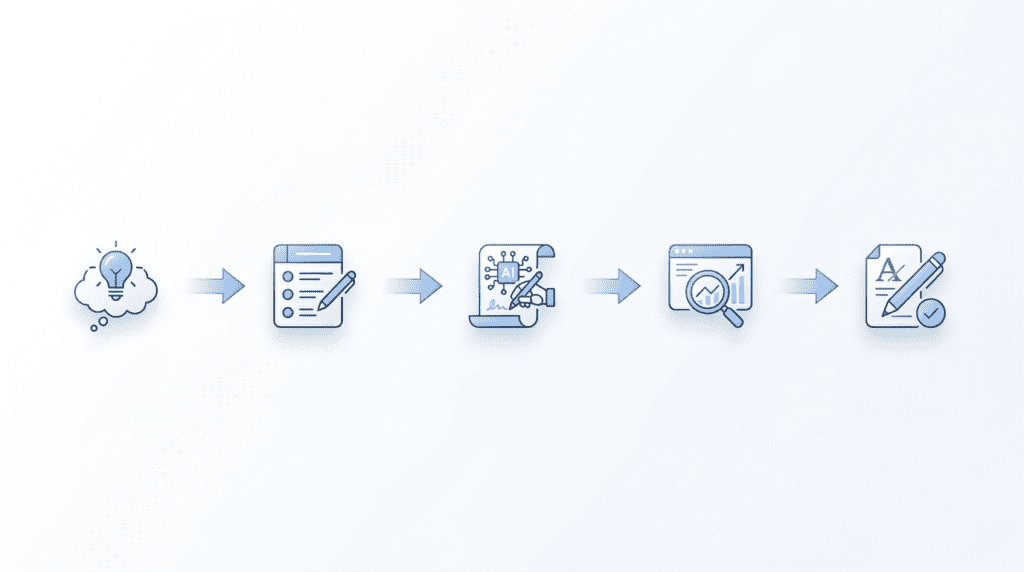
This section breaks down the specific tools inside Writesonic and explains their practical application for a blogger.
From Idea to Outline: Using Writesonic for Content Ideation
One of the biggest hurdles for any blogger is consistently coming up with fresh, engaging content ideas. Writesonic tackles this head-on, streamlining the initial, often frustrating, stages of content creation.
- Generating compelling blog post ideas with the Topic Ideas tool.
For bloggers staring at a blank content calendar, the Topic Ideas tool is a lifesaver. You simply input a broad keyword or topic, and Writesonic generates a list of potential blog post titles and concepts. This isn’t just about throwing out random ideas; it often provides unique angles or questions your target audience might be asking. For a new blogger, this can overcome writer’s block, while established niche site owners can use it to uncover underserved subtopics, ensuring their content calendar stays full and relevant. It saves hours of manual brainstorming and keyword research for initial concepts.
- Crafting engaging introductions that hook readers using Blog Intros.
The introduction is where you either grab a reader’s attention or lose them. Many beginners struggle to write compelling intros that clearly state the article’s purpose and promise value. With Writesonic’s Blog Intros tool, you provide your article title and a brief description, and it generates several introductory paragraphs. This allows you to quickly choose the most impactful one, or even combine elements from multiple options. It’s a significant time-saver and helps ensure your articles start strong, reducing bounce rates and encouraging readers to delve deeper into your content.
- Building a structured article framework with the Blog Outlines feature.
A well-structured outline is the backbone of any good blog post, guiding both the writer and the reader. The Blog Outlines feature takes your chosen topic or title and generates a logical flow of headings and subheadings. This ensures topical completeness and helps you cover all the essential points your audience expects. While the AI-generated outline provides a solid starting point, it’s crucial for bloggers to review and refine it, adding their unique insights or adjusting for specific SEO targets. For complex topics, you might still need to do some manual tweaking, but it dramatically cuts down the initial structuring time, allowing you to move to drafting much faster.
The Heart of Your Workflow: Drafting with AI Article Writer 5.0
This is where Writesonic truly shines for bloggers, transforming the laborious process of writing long-form content into a much faster, more efficient workflow.
- How to generate a full-length, SEO-friendly article from a single keyword.
The AI Article Writer 5.0 is a game-changer for Writesonic for Bloggers. It’s designed to take a single keyword and, through a guided, multi-step process, produce a comprehensive article draft. You start with your target keyword, then the tool helps you generate a compelling title, followed by a detailed outline. Once the outline is approved, it crafts an introduction, and finally, generates the full article section by section. This process can produce a substantial first draft in minutes, significantly reducing the time commitment for creating long-form content. For bloggers aiming to scale their content output, especially those who find the initial drafting process daunting, this feature is invaluable. However, it’s important to remember that this is a *draft* and will always require human review and refinement to add nuance, personal voice, and ensure factual accuracy.
- Leveraging Factual & Custom Knowledge to improve accuracy and brand voice.
A common frustration with AI writing tools is their tendency to produce generic or occasionally inaccurate content. Writesonic addresses this with its Factual and Custom Knowledge features. The Factual feature allows the AI to pull information from reliable web sources, making the generated content more grounded in reality. Even more powerful for Writesonic for Bloggers is Custom Knowledge, where you can upload your own documents, brand guidelines, or specific information about your niche. This trains the AI to write in your brand’s voice and incorporate proprietary information, leading to content that feels less like AI and more like a human expert wrote it. This is crucial for maintaining authority and consistency across your blog.
- Editing and refining the AI-generated draft within the Sonic Editor.
Generating a draft is only half the battle; the real work often lies in editing. The Sonic Editor is Writesonic’s built-in workspace where you can refine the AI’s output. Here, you can rewrite sentences, expand on ideas, shorten verbose paragraphs, and even check for plagiarism directly. What gets easier over time is learning how to prompt the AI more effectively to get closer to your desired output, reducing editing time. However, a common pitfall is over-relying on the AI without critical review. Bloggers must still act as the editor-in-chief, ensuring the content aligns with their expertise, tone, and audience expectations. This human touch is what elevates an AI-generated draft into a high-quality, publish-ready blog post.
- Example: Generating a 1,500-word “Best Indoor Plants for Beginners” post in under 10 minutes.
Imagine you’re a gardening blogger. You input “Best Indoor Plants for Beginners” into the AI Article Writer 5.0. Within moments, Writesonic suggests several titles. You pick one, then it generates a comprehensive outline covering topics like “Low-Maintenance Options,” “Lighting Needs,” and “Watering Tips.” After a quick review of the outline, you hit “Generate.” In less than ten minutes, you have a 1,500-word draft covering all these points. While this draft won’t be publish-ready immediately – you’ll need to add personal anecdotes, specific product recommendations, and your unique voice – it provides an incredibly strong foundation, saving you hours compared to starting from scratch.
Optimizing for Search: Leveraging Surfer & Semrush Integrations
For any blogger focused on organic traffic, SEO is paramount. Writesonic’s integrations with industry-leading SEO tools are a major differentiator, embedding optimization directly into your content creation workflow.
- Connecting your Surfer SEO account to optimize content in real-time.
The native integration with Surfer SEO is a powerful feature for Writesonic for Bloggers. Once connected, Writesonic can analyze your target keyword and provide real-time feedback on your content’s SEO score directly within the Sonic Editor. This means as you write or edit, you’re guided on how to improve your content’s topical completeness, keyword density, and overall relevance to rank higher in search results. This eliminates the need to constantly switch between tools, making the optimization process seamless and highly efficient for SEO-focused bloggers and affiliate marketers.
- Using the integration to ensure topical completeness and keyword density.
Surfer SEO’s core strength lies in analyzing top-ranking content for your target keyword and identifying common terms, phrases, and topics that Google expects to see. The integration within Writesonic leverages this data to help you ensure your article covers all necessary subtopics and uses relevant keywords naturally. This isn’t about keyword stuffing; it’s about achieving topical completeness, which signals to search engines that your content is comprehensive and authoritative. For bloggers, this means less guesswork and more data-driven decisions in crafting content that truly resonates with search intent.
- How the Semrush integration helps with keyword research and competitive analysis directly within your workflow.
Beyond Surfer, Writesonic also offers integration with Semrush, another powerhouse in the SEO world. This allows bloggers to tap into Semrush’s vast keyword research and competitive analysis data without leaving the Writesonic platform. You can identify high-volume, low-competition keywords, analyze what your competitors are ranking for, and discover content gaps directly within your content planning process. This integration helps inform your content strategy from the very beginning, ensuring you’re targeting keywords with real potential and creating content that stands out. It’s an upgrade consideration that adds significant strategic value for serious niche site owners.
Beyond the Blog Post: Other Useful Tools for Bloggers
While the AI Article Writer is central, Writesonic offers a suite of other tools that support a blogger’s broader content marketing efforts.
- Creating social media copy to promote your articles with Social Media Ads.
After spending hours crafting a fantastic blog post, you need to promote it. Writesonic’s Social Media Ads tool isn’t just for paid ads; it can generate compelling captions, headlines, and descriptions for organic social media posts across platforms like Facebook, Instagram, and LinkedIn. This ensures your promotional efforts are as engaging as your content, driving more traffic back to your blog without the added time of writing unique copy for each platform. It’s particularly useful for solo bloggers managing their own social media presence.
- Writing compelling email newsletters with the Email V2 tool.
Email marketing is a powerful way to engage your audience and drive repeat traffic. The Email V2 tool helps bloggers craft engaging newsletters, promotional emails, or even welcome sequences. You can input the topic of your blog post, and it will generate subject lines and body copy designed to entice subscribers to click through and read your latest article. This consistency in messaging across your blog and email channels helps build audience loyalty and ensures your content gets seen by your most dedicated readers.
- Generating meta descriptions and SEO titles that improve click-through rates.
Even if your article ranks well, a weak meta description or title tag can deter clicks. Writesonic offers dedicated tools for generating SEO titles and meta descriptions. You input your article’s main keyword and a brief summary, and it provides several optimized options. These aren’t just keyword-stuffed; they’re designed to be concise, compelling, and informative, encouraging users to choose your link over competitors in the search results. For beginners, writing these short, impactful snippets can be tricky, and this tool provides a quick way to A/B test different approaches.
A Realistic Look at Writesonic’s Pricing for Bloggers

Understanding Writesonic’s pricing goes beyond just looking at a table; it’s about calculating the real-world cost and value for your specific blogging needs.
Decoding the Plans: Freelancer, Small Team, and Enterprise
Writesonic offers several plans, each designed for different scales of content creation. For Writesonic for Bloggers, the key differentiators are word count, the quality of words, and the number of user seats.
- A clear breakdown of what each plan offers.
The Freelancer plan typically starts around $19 per month when billed annually, offering a substantial amount of “Premium” quality words – often 100,000 words or more. This plan is usually for a single user and includes access to the AI Article Writer 5.0 and basic integrations. The Small Team plan, often starting around $49 per month (billed annually), significantly increases the word count, usually to 250,000 “Premium” words or more, and allows for multiple user seats. This plan also unlocks more advanced features like custom brand voices and potentially higher quality word tiers. The Enterprise plan is custom-priced, designed for large agencies or publishers with very high volume needs, offering unlimited words, dedicated support, and advanced features. It’s crucial to check Writesonic’s current pricing page, as these figures can change.
- Explaining the “Premium,” “Superior,” and “Ultimate” word quality tiers and when each is necessary.
This is a critical aspect of Writesonic’s pricing model that many users overlook. “Premium” words are the standard, good for generating initial drafts, social media copy, or less critical content. They consume words at a 1:1 ratio. “Superior” words offer better quality, often more nuanced and human-like, but they consume your word allowance at a faster rate (e.g., 2-3 Premium words for every 1 Superior word). “Ultimate” words are the highest quality, designed to be almost indistinguishable from human writing, but they consume words at the fastest rate (e.g., 5-6 Premium words for every 1 Ultimate word). For bloggers, “Premium” is fine for initial drafts, but “Superior” or “Ultimate” might be necessary for client work, high-stakes articles, or content where tone and accuracy are paramount. This tiered system means your effective word count can vary significantly based on the quality you choose.
- The impact of user seats and brand voices on plan selection.
If you’re a solo blogger, a single user seat on the Freelancer plan is sufficient. However, if you run a small agency, have virtual assistants helping with content, or collaborate with other writers, the Small Team plan’s multiple user seats become essential. Similarly, if you manage content for several different niche sites or clients, the ability to create multiple “brand voices” (available on higher plans) ensures that the AI generates content consistent with each brand’s unique tone and style. This avoids the hidden frustration of having to manually edit every piece of content to fit a specific brand.
What’s the True Cost? Calculating Your Monthly Spend
Moving beyond the advertised price, understanding your actual monthly expenditure requires a look at your specific content volume and quality needs.
Scenario 1: The Part-Time Blogger (4-6 posts/month) – Which plan makes sense?
A part-time blogger publishing 4-6 articles per month, each averaging 1,000-1,500 words, might generate around 6,000-9,000 words of final content. However, with drafts, rewrites, outlines, and intros, their actual “Premium” word consumption could easily be 20,000-30,000 words. In this case, the Freelancer plan, typically offering 100,000+ Premium words for around $19/month (billed annually), is usually more than enough. This plan makes sense for those just starting out or testing the waters with AI writing, providing ample room to experiment without breaking the bank.
- Scenario 2: The Full-Time Niche Site Owner (15-20 posts/month) – When an upgrade becomes necessary.
A full-time niche site owner publishing 15-20 articles monthly, often aiming for higher quality and more revisions, will quickly exceed the Freelancer plan’s practical limits. If they’re frequently using “Superior” or “Ultimate” quality words, their effective word count will deplete much faster. For example, 20 articles at 1,500 words each is 30,000 words of final content. But with higher quality settings and multiple drafts, their consumption could easily hit 150,000-200,000 “Premium” equivalent words. Here, the Small Team plan, starting around $49/month (billed annually) for 250,000+ Premium words, becomes a necessity. A hidden frustration for these bloggers is running out of high-quality words mid-month, forcing them to either wait or upgrade prematurely. Upgrading makes sense when you consistently hit your word limits or when the quality of “Premium” words is no longer sufficient for your audience or clients.
- Identifying potential hidden costs or limitations (e.g., running out of high-quality words).
The primary “hidden cost” in Writesonic’s pricing model is the tiered word quality. While a plan might advertise 250,000 words, if you’re primarily generating “Ultimate” quality content, that 250,000 “Premium” word allowance could translate to only 40,000-50,000 “Ultimate” words. This can lead to unexpected upgrades or the need to purchase additional word credits. Bloggers must carefully consider their desired output quality and adjust their plan selection accordingly. As content volume grows, the cost per word can increase if you’re constantly pushing for the highest quality output.
Is Writesonic a Good Value for the Money?
Ultimately, the value of Writesonic for Bloggers comes down to a trade-off between cost and the tangible benefits it provides.
- Comparing the cost to the time saved in content creation.
For many bloggers, time is money. If writing a 1,500-word article manually takes 4-6 hours, and Writesonic can help you produce a high-quality draft in under an hour (plus 1-2 hours for human editing and refinement), you’re saving 2-4 hours per article. If you publish 10 articles a month, that’s 20-40 hours saved. At a conservative hourly rate of $25, that’s $500-$1,000 in saved labor. Compared to a Small Team plan costing around $49/month, the return on investment in terms of time saved is substantial. This allows bloggers to focus on other high-value tasks like promotion, keyword research, or product development.
- How the SEO integrations add value that might justify a higher price over competitors.
The integrated Surfer SEO and Semrush functionalities are significant value-adds. A standalone Surfer SEO subscription can cost upwards of $89 per month, and Semrush plans start even higher. While Writesonic’s integrations might not offer the full depth of these dedicated tools, they provide crucial on-page SEO guidance and keyword insights directly within your writing workflow. For a blogger who might otherwise need to subscribe to these tools separately, the integrated features within Writesonic can consolidate costs and streamline their process. This added SEO capability can lead to better-ranking content, more organic traffic, and ultimately, higher revenue, making the investment in Writesonic a strategic one for long-term growth.
Real-World Scenarios: How Different Bloggers Can Use Writesonic

Understanding how a tool fits into your daily grind is key. Let’s look at a few common blogging scenarios and see how Writesonic for bloggers can make a real difference. These examples show not just what the tool does, but how it impacts workflow and results.
Scenario 1: The Niche Site Builder Scaling Content
For niche site builders, the name of the game is volume and relevance. You’re often trying to rank for hundreds, if not thousands, of long-tail keywords. This means a constant need for fresh, SEO-optimized content.
- Goal: Quickly populate a new site with dozens of informational and affiliate articles.
- Workflow: Imagine you’ve done your keyword research and have a list of 50 article topics. Instead of spending days or weeks writing each one from scratch, a niche site builder can feed these topics into Writesonic’s AI Article Writer 5.0. With the Surfer SEO integration, you can generate an entire article draft that’s already optimized for your target keyword, complete with headings, internal links, and a good content score. This isn’t just about speed; it’s about generating content that has a real chance to rank.
- Outcome: This workflow drastically reduces the time-to-rank. By rapidly building topical authority with a large volume of optimized content, your site can start attracting organic traffic much faster than if you were writing everything manually. It frees up time to focus on link building, site structure, and monetization strategies, rather than being stuck in the content creation treadmill.
Scenario 2: The Solo Creator Overcoming Writer’s Block
Every solo blogger knows the pain of staring at a blank screen, the cursor blinking mockingly. Writer’s block can derail a consistent publishing schedule and lead to burnout.
- Goal: Maintain a consistent publishing schedule despite creative slumps.
- Workflow: When ideas dry up, the solo creator can turn to Writesonic’s Topic Ideas tool to brainstorm fresh angles or keywords. Once a topic is chosen, the Blog Outlines feature helps structure the article, giving a clear roadmap. If a draft feels stale or lacks punch, the Paraphrasing and Content Rephraser tools become invaluable. Instead of struggling for hours, you can feed in your existing thoughts or a rough paragraph and get several fresh ways to express it, injecting new life and flow into your writing.
- Outcome: This approach ensures consistent content output, even when creativity wanes. It transforms a daunting task into a manageable one, allowing the solo creator to spend more time on promotion, engaging with their audience, or simply enjoying a much-needed break. It’s about maintaining momentum and avoiding the frustration that often leads to giving up.
Scenario 3: The Agency Blogger Managing Multiple Clients
Agencies face a unique challenge: producing high-quality, on-brand content for multiple clients, each with their own voice, style, and niche. Efficiency and consistency are paramount.
- Goal: Efficiently produce content for various clients with different brand voices.
- Workflow: An agency blogger can leverage Writesonic’s Brand Voices feature to define and save specific tones and styles for each client. When generating content, they simply select the relevant brand voice, ensuring that the AI-generated draft aligns with the client’s established identity. The Sonic Editor then allows for quick adjustments, adding client-specific details, and preparing drafts for internal review or direct client approval. This streamlines the entire content production process from initial draft to final delivery.
- Outcome: This workflow leads to increased client capacity and significantly faster turnaround times. Agencies can take on more projects without sacrificing quality or brand consistency, ultimately boosting profitability and client satisfaction. It removes the manual effort of constantly switching mental gears to match different client styles.
Honest Take: The Hidden Trade-Offs of Using Writesonic for Blogging
While Writesonic for bloggers offers incredible advantages, it’s crucial to approach it with realistic expectations. Like any powerful tool, it comes with its own set of trade-offs. Understanding these can help you maximize its benefits and avoid common pitfalls.
The Factual Accuracy Check: A Non-Negotiable Step
One of the biggest misconceptions about AI writing tools is that they’re infallible. They’re not. AI models learn from vast amounts of data, but they don’t “understand” facts in the human sense.
- Why you can’t “set it and forget it,” especially for E-E-A-T sensitive topics: For topics where Experience, Expertise, Authoritativeness, and Trustworthiness (E-E-A-T) are critical – think health, finance, legal advice, or even detailed product reviews – you absolutely cannot rely solely on AI-generated content. The AI might pull outdated statistics, misinterpret complex concepts, or even “hallucinate” information that sounds plausible but is entirely false.
- Examples of common factual errors AI can make and how to spot them: AI might cite a study that doesn’t exist, attribute a quote to the wrong person, or present a widely debunked theory as fact. Always cross-reference any statistics, names, dates, or technical details. If something sounds too good to be true, or just a little “off,” it probably is.
- The importance of adding personal experience and unique insights to AI drafts: This is where human bloggers truly shine. AI can generate a competent article, but it can’t share your unique perspective, personal anecdotes, or hard-won lessons. After generating a draft, infuse it with your voice, real-world examples, and expert commentary. This not only improves accuracy but also makes the content more engaging and trustworthy for your audience.
The “AI Voice” Problem and How to Overcome It
AI-generated text, especially in its raw form, can often sound generic, repetitive, or even a bit robotic. It lacks the nuance, humor, and distinct personality that makes human writing engaging.
- Tips for editing AI-generated text to sound more human and align with your personal brand: Don’t just accept the first draft. Read it aloud. Does it sound like you? Look for repetitive sentence structures, overly formal language, or clichés. Inject your unique vocabulary, add personal stories, use contractions naturally, and vary sentence lengths. Think of the AI as a very efficient research assistant and first drafter, not the final author.
- Using the Paraphrasing Tool and Content Rephraser to inject personality: Writesonic’s own tools can be your allies here. If a paragraph feels stiff, use the Paraphrasing Tool to get alternative phrasings. The Content Rephraser can help you experiment with different tones or simplify complex sentences, allowing you to gradually mold the AI’s output into something that genuinely reflects your brand’s voice. It’s an iterative process of generation and refinement.
Understanding Word Credit Consumption
Writesonic, like many AI tools, operates on a credit system. While this provides flexibility, it can also be a source of frustration if you don’t understand how credits are used.
- How different tools and quality settings burn through your monthly credits at different rates: Not all words are created equal. Generating a full article with AI Article Writer 5.0, especially at “Ultimate” quality, will consume significantly more credits than generating a short social media caption or a few blog ideas. Experimenting with different quality settings (Premium, Superior, Ultimate) can also dramatically impact your credit usage. Higher quality often means more credits per word.
- A warning about the cost of extensive re-generation and experimentation: It’s easy to get carried away. If you generate an article, then decide you don’t like a section and re-generate it multiple times, those credits add up quickly. Similarly, if you’re constantly experimenting with different prompts or tools without a clear plan, you might find your credit balance dwindling faster than expected. Plan your content generation, be precise with your prompts, and try to get it right in fewer attempts to make your credits last.
How Writesonic Stacks Up Against Other AI Writers for Bloggers

The AI writing landscape is crowded, and it can be tough to pick the right tool. Let’s see how Writesonic for bloggers compares to some of its main competitors, focusing on what matters most to content creators.
Writesonic vs. Jasper for Long-Form Content
Both Writesonic and Jasper are powerhouses for long-form content, but they have different philosophies and strengths.
- Comparing Jasper’s workflow and “One-Shot Blog Post” feature to Writesonic’s AI Article Writer 5.0: Jasper’s “Boss Mode” and “Recipes” offer a highly flexible, command-driven approach, allowing users to string together various templates to build long-form content. Its “One-Shot Blog Post” is a quick way to get a draft. Writesonic’s AI Article Writer 5.0, on the other hand, is a more guided, step-by-step process that often produces a more structured and SEO-ready first draft, especially with its built-in Surfer SEO integration.
- Key differences in user interface, pricing models, and community support: Jasper’s interface is often praised for its flexibility, while Writesonic’s is more streamlined and focused on specific content types. Pricing-wise, both can get expensive for high volume. Jasper’s community and educational resources are very strong, offering many user-created “recipes.” Writesonic’s strength lies in its direct SEO integrations and focus on article generation.
Who should choose Writesonic?
Bloggers primarily focused on generating SEO-optimized informational articles at scale, especially those already using or planning to use Surfer SEO or Semrush. Its structured Article Writer 5.0 is excellent for getting a solid first draft quickly.
Who should choose Jasper?
Marketers and bloggers who need more creative flexibility, a wider range of short-form marketing copy, and enjoy a more command-driven, customizable workflow. Jasper is also great for those who value a strong community and extensive “recipes” for various content types.
Writesonic vs. Copy.ai for Creative Flexibility
Copy.ai excels in creative brainstorming and generating diverse marketing copy, while Writesonic leans into structured, SEO-focused content.
- Evaluating Copy.ai’s strength in creative brainstorming and tone of voice against Writesonic’s structured, SEO-focused approach: Copy.ai boasts a vast library of templates for everything from ad copy and social media posts to sales emails and creative story ideas. It’s fantastic for generating many variations and exploring different tones. Writesonic, while having many templates too, truly shines when it comes to generating full-length articles and integrating with SEO tools.
- Which tool is better for top-of-funnel, creative content vs. bottom-of-funnel, informational content: Copy.ai is often superior for top-of-funnel content that aims to grab attention, generate leads, or brainstorm creative angles. Think catchy headlines, ad copy, or social media posts. Writesonic is generally better for bottom-of-funnel, informational content that aims to educate, answer specific questions, and rank in search engines.
Who should choose Writesonic?
Bloggers whose primary goal is to produce high volumes of SEO-friendly blog posts and articles, especially those needing deep integration with SEO tools.
Who should choose Copy.ai?
Bloggers or marketers who need a tool for creative brainstorming, generating diverse marketing copy (ads, social media, emails), and exploring different tones of voice for shorter content pieces.
Writesonic vs. Surfer’s Native AI for SEO Blogging
This comparison is particularly relevant for bloggers already invested in Surfer SEO or those looking for the ultimate SEO content solution. Surfer now has its own AI writing capabilities.
- A direct comparison for bloggers already using Surfer: If you’re a Surfer SEO user, you know its power for content optimization. Surfer’s native AI writing features allow you to generate paragraphs, outlines, and even full articles directly within the Surfer editor, guided by its content score. This offers a highly integrated experience.
Is the Writesonic integration more powerful than using Surfer’s own built-in AI writing tools?
Writesonic’s AI Article Writer 5.0, when integrated with Surfer, often provides a more robust and comprehensive initial draft. It can generate longer sections and entire articles with less manual prompting than Surfer’s native AI, which tends to be more paragraph-by-paragraph or section-by-section. The Writesonic AI is designed for generation, while Surfer’s AI is designed for *optimization within its framework*.
- Discussing the trade-offs in features and cost between the two options:
- Writesonic + Surfer Integration: This combination gives you the best of both worlds: Writesonic’s powerful article generation capabilities and Surfer’s deep on-page SEO analysis and optimization. The trade-off is the cost of two separate subscriptions.
- Surfer’s Native AI: This is a more streamlined, single-tool approach. If your content generation needs are simpler, or you prefer to guide the AI more closely within the optimization process, Surfer’s native AI might suffice. It’s often a more cost-effective option if you only want one subscription.
Who should choose Writesonic + Surfer?
Bloggers who want maximum efficiency in both content generation and SEO optimization, and are willing to invest in two best-in-class tools for a truly powerful workflow.
Who should choose Surfer’s Native AI?
Bloggers already committed to Surfer SEO who want an integrated AI writing solution without adding another subscription. It’s a good choice for those who prefer to generate content section by section while actively monitoring their content score.
Final Recommendation: Should You Use Writesonic for Your Blog?
After examining its capabilities, real-world applications, and inherent trade-offs, the decision to integrate Writesonic into your blogging workflow hinges on your specific goals and resources. Writesonic is a powerful tool, but like any AI, it performs best when paired with informed human oversight.
You Should Use Writesonic If…
- Your primary goal is to increase the volume of SEO-optimized blog posts, particularly for informational content designed to capture search traffic.
- You already use or plan to use Surfer SEO and want a seamless workflow that combines AI writing with robust on-page optimization.
- You are comfortable with an AI-assisted drafting process that still requires human editing, fact-checking, and the injection of unique insights and brand voice. This includes dedicating time to refine the “AI voice” and ensure factual accuracy, as discussed previously.
You Should Consider an Alternative If…
- You are on an extremely limited budget and publish infrequently, as the credit consumption model might not be cost-effective for very low volume.
- Your blog requires deep, investigative journalism, highly technical content demanding absolute precision, or nuanced topics where AI’s current limitations in original thought and complex reasoning would be a significant hurdle.
- You prefer a more hands-on, manual writing process and only need AI for occasional brainstorming or minor content rephrasing, rather than full article generation.
Frequently Asked Questions (FAQs)
Can Google detect content written by Writesonic?
Google’s stance emphasizes the helpfulness and quality of content, not its origin; therefore, well-edited, valuable content created with Writesonic is unlikely to be penalized simply for being AI-generated.
How long does it take to write a blog post with Writesonic?
While a rough draft can be generated in as little as 15-20 minutes using AI Article Writer 5.0, a fully edited, fact-checked, and personalized blog post ready for publication typically takes 1 to 2 hours, depending on length and complexity.
Is Writesonic’s AI Article Writer 5.0 good enough to publish directly?
No, content generated by AI Article Writer 5.0 should never be published directly without thorough human review, editing for factual accuracy, tone, and the addition of unique insights.
Does Writesonic handle plagiarism?
Writesonic includes a built-in plagiarism checker, and its AI-generated text is generally original, drawing from its training data to create new content rather than copying existing phrases.
Can I use Writesonic to update old blog posts?
Yes, Writesonic is excellent for updating old blog posts by using tools like the Content Rephraser to refresh existing text, or by generating new sections and expanding on topics to improve comprehensiveness and SEO.