

Running a successful online business today often feels like a constant race to produce high-quality content that actually ranks. Many content teams and solo entrepreneurs find themselves stuck, either churning out generic articles that never see the light of day on Google, or spending countless hours on manual SEO tasks that don’t scale. The core challenge isn’t just writing more; it’s writing *smarter*, ensuring every piece of content is optimized to capture organic traffic and convert readers.
This is where AI writing tools like Writesonic come into play, offering a powerful way to streamline your content creation process. But simply generating text isn’t enough for search engine success. To truly leverage Writesonic for SEO, you need a strategic approach that integrates its AI capabilities with proven search engine optimization techniques. This article will walk you through building a practical, results-driven workflow to help your content rank higher and attract more visitors.
How to Build a Complete SEO Content Workflow in Writesonic
Creating content that consistently ranks on Google requires more than just good writing; it demands a structured approach that covers everything from initial keyword discovery to final on-page optimization. Writesonic isn’t just a content generator; it’s a suite of tools that, when used correctly, can support your entire SEO content workflow. Let’s break down how to integrate its features into a seamless process designed to boost your organic traffic.
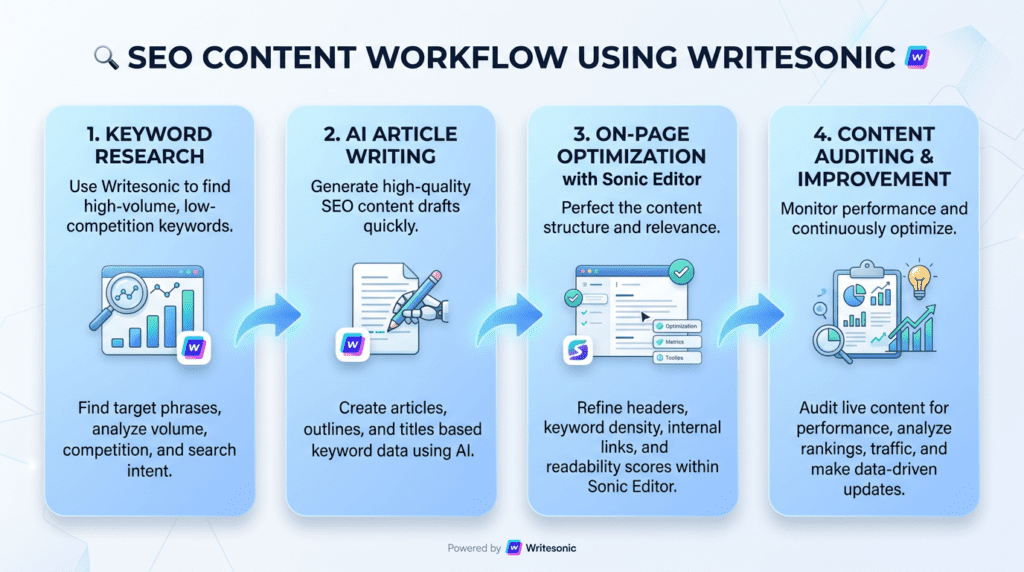
Step 1: Uncovering SEO Opportunities with Keyword Research
Before you write a single word, you need to know what your audience is searching for. This foundational step is often overlooked or rushed, leading to content that misses the mark. Writesonic offers a built-in Keyword Research tool that can help you pinpoint valuable opportunities.
When you dive into Writesonic’s keyword tool, don’t just look for high-volume terms. Pay close attention to “long-tail” keywords and related phrases (often called LSI keywords) that reveal specific user intent. For example, instead of just targeting “email marketing,” you might find “best email marketing software for small business” or “email marketing automation for e-commerce.” These longer, more specific phrases often have less competition and higher conversion potential. The tool also provides insights into search volume and difficulty, helping you prioritize. Building a content plan around clusters of related keywords, rather than isolated terms, helps Google understand your topical authority and can significantly improve your overall ranking potential.
Step 2: Crafting SEO-Optimized Articles with the AI Article Writer
Once you have your target keywords, it’s time to generate the content. Writesonic’s AI Article Writer is a powerful feature, but it needs careful guidance to produce truly SEO-optimized output. This isn’t a “set it and forget it” tool; it’s a co-pilot.
Start by inputting your primary target keyword and any secondary keywords you want to include. Crucially, don’t skip the “brand voice” or “tone” settings if available. Guiding the AI to match your brand’s style from the outset saves significant editing time later. When generating, pay close attention to the “Factual & Relevant” setting. While AI can pull information, it’s your job to ensure accuracy and provide context. This is especially true for complex topics or those requiring up-to-date statistics.
One common mistake beginners make is accepting the first draft without critical review. Instead, think of the AI as providing a strong first pass. Your role is to guide its structure and flow. If the initial outline isn’t quite right, adjust it. If a section feels thin, prompt the AI to expand on it. For example, if you’re writing about “project management software,” and the AI only lists features, you might prompt it with “Expand on how project management software improves team collaboration and reduces workflow bottlenecks.” This iterative process, where you direct the AI, is key to producing high-quality, SEO-friendly articles that resonate with both search engines and human readers. It’s about combining the AI’s speed with your strategic insight to create content that’s not just well-written, but also well-structured for search intent and readability.
Step 3: Enhancing On-Page SEO with the Sonic Editor
After generating your draft, the real optimization work begins in Writesonic’s Sonic Editor. This isn’t just a text editor; it’s an optimization hub. The built-in SEO score is your immediate feedback loop, highlighting areas where your content might be falling short.
Use this score as a guide, not a rigid rule. It’ll often point out missing keywords, suggest internal or external links, and flag readability issues. A critical step here is to incorporate competitor keywords and questions. Look at what your top-ranking competitors are covering and ensure your article addresses those points, often in more depth or with a unique angle. Refining your meta titles, meta descriptions, and headings is also crucial. These elements are your content’s first impression on the search results page. Ensure your H1, H2s, and H3s clearly communicate the topic and include relevant keywords, while also enticing clicks by matching user search intent. A compelling meta description can significantly improve your click-through rate, even if your ranking isn’t #1.
Step 4: Auditing and Improving Existing Content for a Quick SEO Boost
Sometimes, the fastest way to gain traffic isn’t by creating new content, but by improving what you already have. Writesonic can be a powerful ally in your content audit strategy.
Use the Article Rewriter to refresh outdated blog posts. If you have an article from a few years ago that’s still getting some traffic but isn’t ranking well, feeding it into the rewriter can give it a new lease on life. This isn’t about spinning content; it’s about updating information, improving flow, and incorporating new SEO best practices. Similarly, if you have “thin content” – pages with very little text that offer minimal value – you can use the AI to expand these sections. Prompt it to add more details, examples, or answer related questions. Always, always check for factual accuracy and add E-E-A-T (Experience, Expertise, Authoritativeness, Trustworthiness) signals. This might mean adding author bios, citing sources, or linking to reputable external sites. Google values fresh, comprehensive, and trustworthy content, and Writesonic can help you achieve that without starting from scratch.
Which Writesonic Features Are Most Valuable for SEO?
Moving beyond the step-by-step workflow, it’s essential to understand which specific Writesonic features offer the most tangible SEO benefits and how they stack up against specialized alternatives. Not all features contribute equally to your search engine ranking goals.
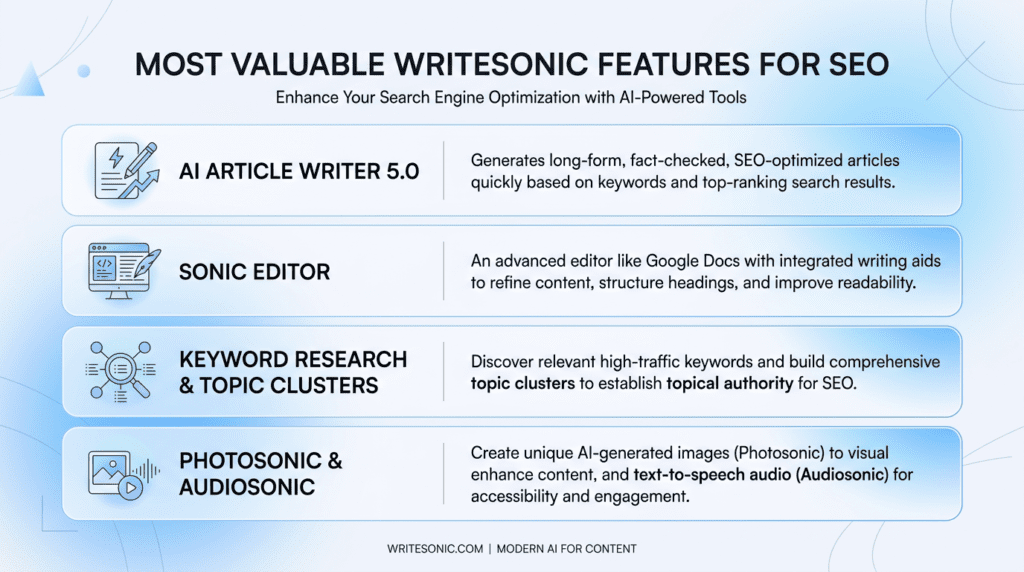
AI Article Writer 5.0: The Core Content Engine
The AI Article Writer 5.0 is arguably Writesonic’s flagship feature for anyone focused on content creation. Its primary value for Writesonic for SEO lies in its ability to quickly generate long-form content drafts. It can produce comprehensive articles, blog posts, and even landing page copy, significantly reducing the time spent on initial content generation. For a blogger needing to cover many related topics or an agency scaling client content, this speed is a game-changer.
When it comes to handling different content types, the Article Writer 5.0 is quite versatile. You can guide it to create anything from informational blog posts designed to rank for specific keywords to persuasive landing page copy aimed at conversions. The key is in the initial input: providing a clear topic, target keywords, and a brief outline helps the AI stay on track. This means it’s not just churning out generic text; with proper guidance, it can align with your content strategy.
However, it’s crucial to understand its limitations. While it excels at generating a strong first draft, human oversight is non-negotiable for truly high-quality, SEO-optimized content. Beginners often struggle with the misconception that the AI will produce a publish-ready piece. In reality, the AI, despite its advancements, can sometimes generate repetitive phrases, lack deep factual nuance, or miss the subtle tone of your brand voice. Scaling content production without a robust human editing process can lead to a flood of generic content that Google’s Helpful Content System might flag. Experienced SEOs know that the AI is a powerful assistant, not a replacement for unique insights, E-E-A-T (Experience, Expertise, Authoritativeness, Trustworthiness), and a human touch that resonates with readers. The real workflow implication is that you’re trading initial writing time for dedicated editing and optimization time.
Sonic Editor: Your On-Page Optimization Hub
The Sonic Editor acts as Writesonic’s integrated on-page SEO tool, providing real-time feedback as you refine your content. It’s designed to help you optimize your text for target keywords, readability, and overall structure. For users who don’t have a separate subscription to a dedicated SEO content optimization tool like Surfer SEO or Clearscope, the Sonic Editor offers a convenient, all-in-one solution within the Writesonic ecosystem.
Its integrated competitor analysis is a significant value add. By analyzing top-ranking articles for your target keyword, the Sonic Editor can suggest relevant terms, questions, and headings that your content should include. This helps ensure your article covers the same semantic breadth as high-ranking pages, signaling to search engines that your content is comprehensive and relevant.
To maximize your SEO score within the Sonic Editor, focus on the suggestions for keyword density, related terms, and word count. Don’t just blindly stuff keywords; integrate them naturally. Pay close attention to the recommended headings and questions, as these often reflect common search queries and help structure your content logically. While it might not offer the same depth of analysis as a specialized tool, it’s an excellent starting point for ensuring your content meets fundamental on-page SEO requirements. It’s particularly beneficial for content creators who need a quick, integrated way to check their work without leaving the platform.
Keyword Research & Topic Clusters: The Strategic Foundation
Writesonic’s Keyword Research tool aims to provide the foundational data needed for any successful SEO strategy. It helps users identify primary keywords, long-tail variations, and related terms, which are crucial for understanding search intent and planning content. For building topical authority, the tool can suggest clusters of related keywords, allowing you to create a series of interconnected articles that comprehensively cover a subject. This approach signals to search engines that your site is a valuable resource for a particular topic, potentially boosting your overall domain authority.
However, when evaluating its depth and accuracy, it’s important to set realistic expectations. While it’s a capable tool for initial keyword discovery and understanding basic search volume and difficulty, it typically won’t offer the same granular data, competitive insights, or advanced filtering capabilities as standalone, enterprise-grade tools like Ahrefs or Semrush. Those dedicated platforms provide extensive backlink analysis, historical data, and more sophisticated competitive intelligence.
For beginners, Writesonic’s tool is a great entry point, simplifying the process of finding relevant keywords without overwhelming them with complex metrics. For more experienced SEOs or larger businesses, it serves well for quick checks or brainstorming, but they’ll likely still rely on their primary SEO suites for in-depth strategic planning and competitive analysis. The trade-off here is convenience and integration versus the comprehensive power of specialized tools.
Photosonic & Audiosonic: Adding Multimedia SEO Signals
While often overlooked in traditional SEO discussions, Photosonic and Audiosonic contribute to modern SEO performance by enhancing user experience and engagement. Photosonic allows you to generate unique, AI-powered images that can break up text, illustrate points, and make your content more visually appealing. Unique visuals can improve user engagement metrics like dwell time and reduce bounce rates, which are indirect but important SEO signals. Furthermore, properly optimized images (with descriptive alt text and appropriate file sizes) directly contribute to image search rankings and overall page speed.
Audiosonic takes this a step further by creating audio versions of your articles. This feature directly addresses accessibility, allowing users with visual impairments or those who prefer listening to content (e.g., during commutes) to consume your articles. Increased accessibility broadens your audience and can lead to longer dwell times, as users might listen to an entire article. Both multimedia elements contribute to a richer user experience, which Google increasingly prioritizes.
The impact of multimedia on modern SEO performance is growing. Search engines are looking for signals of high-quality, engaging content that satisfies user intent. Providing diverse content formats (text, images, audio) caters to different preferences and can improve how users interact with your site. For content creators without dedicated graphic designers or voiceover artists, these tools offer an efficient way to add valuable multimedia elements, potentially giving their content an edge in competitive search results.
Reality Check: What Writesonic Can and Cannot Do for Your SEO
It’s easy to get swept up in the promise of AI, but a grounded understanding of Writesonic’s capabilities and limitations is crucial for any effective Writesonic for SEO strategy. This isn’t about discrediting the tool, but rather about setting realistic expectations to avoid common pitfalls.

Where Writesonic Excels: Speed, Scale, and Idea Generation
Writesonic truly shines in its ability to deliver speed and scale to content creation workflows. For anyone struggling with writer’s block, it’s an invaluable assistant, capable of generating outlines, intros, and even full first drafts for blog posts and landing pages in minutes. This rapid production capability means you can move from a blank page to a structured, keyword-rich draft significantly faster than traditional manual writing. For a small business owner juggling multiple tasks, or a content manager needing to quickly populate a new website section, this efficiency is a major benefit.
The tool is particularly adept at scaling content production. Agencies managing numerous client accounts or large content teams aiming for high-volume output can leverage Writesonic to generate a substantial quantity of initial content. This allows human writers and editors to focus on refinement, fact-checking, and adding unique insights rather than spending hours on preliminary drafting. It’s about optimizing the content pipeline, allowing for a higher volume of content to be pushed through the editorial process, ultimately leading to more potential ranking opportunities.
The Hidden Trade-Offs: The Need for Human Expertise
Despite its impressive capabilities, the biggest hidden trade-off with Writesonic, and AI writing tools in general, is the absolute necessity of human expertise. While it can generate content quickly, it cannot replace the strategic thinking of an SEO professional or the nuanced understanding of a skilled writer. Beginners often fall into the trap of thinking AI content is “set it and forget it,” leading to generic, “soulless” content that lacks a distinct brand voice or genuine human connection. This can be a significant long-term consequence, as Google’s algorithms increasingly prioritize helpful, human-first content.
The risk of factual inaccuracies is another major concern. AI models, while vast, can sometimes “hallucinate” information or present outdated data as fact. Without rigorous human fact-checking, publishing such content can damage your credibility and lead to negative user experiences. Furthermore, maintaining a consistent brand voice across numerous AI-generated pieces requires careful editing and a strong style guide. What marketing pages often ignore is the significant amount of human editing time still required to transform an AI draft into a truly high-quality, SEO-optimized, and brand-aligned piece. This editing bottleneck can become a scaling limitation if not properly managed, as the time saved in drafting is then spent in meticulous review. An SEO strategist is still essential to guide the AI, interpret search intent, and ensure the content aligns with broader business goals, preventing the creation of content that simply fills space rather than drives results.
Who Benefits Most vs. Who Should Be Cautious
Understanding who truly benefits from Writesonic for SEO versus who should approach it with caution is key to making an informed decision.
Ideal for:
- Content Teams and SEO Agencies: These groups can leverage Writesonic for rapid first-draft generation, allowing their human talent to focus on higher-level strategy, deep research, and expert editing. It helps them scale content output for multiple clients or projects.
- Bloggers Looking to Scale: Individuals or small teams aiming to increase their content volume without hiring a large writing staff will find Writesonic invaluable for overcoming writer’s block and producing a consistent stream of articles.
- Businesses with Established SEO Knowledge: Users who already understand SEO principles can effectively guide the AI, identify its shortcomings, and apply the necessary human polish to ensure high-quality, ranking content.
Caution for:
- Beginners Without SEO Knowledge: If you’re new to SEO, relying solely on Writesonic without understanding keyword research, search intent, or on-page optimization best practices can lead to ineffective content. You might produce a lot of content, but it won’t necessarily rank or drive traffic.
- Brands Requiring Deep Technical Accuracy or Unique Expertise: Industries that demand highly specialized, fact-checked, or proprietary information (e.g., medical, legal, advanced engineering) will find Writesonic’s output requires extensive human review and often lacks the depth of true subject matter expertise. The AI can provide a framework, but the critical, unique insights must come from human experts.
- Those Expecting a “Magic Button” Solution: Writesonic is a powerful tool, but it’s not a substitute for strategic thinking, human creativity, or diligent editing. Expecting it to handle your entire SEO content strategy autonomously will likely lead to disappointment and suboptimal results.
Real-World Scenario: Using Writesonic to Rank a New Blog Post
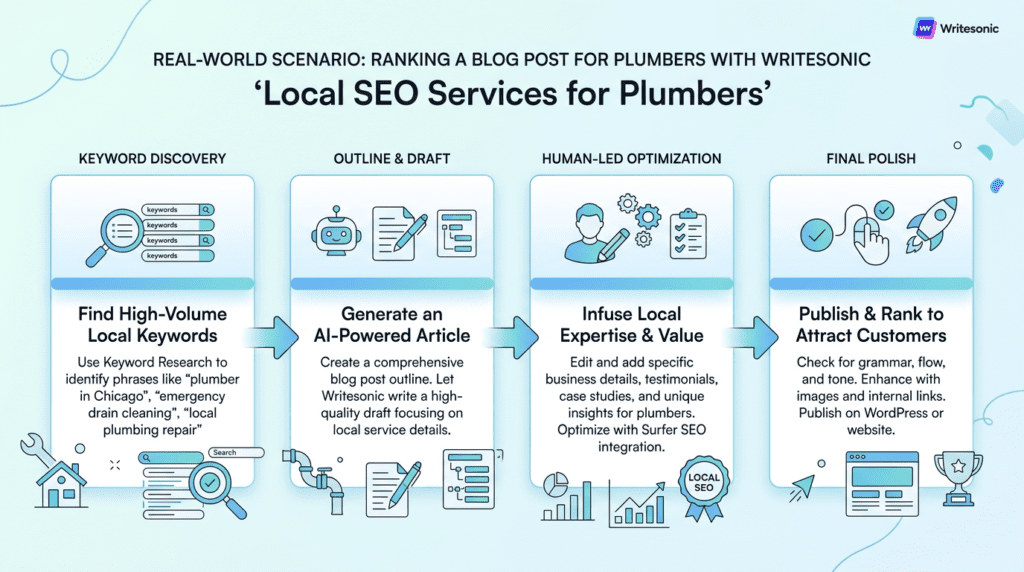
Understanding how a tool works in theory is one thing; seeing it in action for a specific goal, like ranking a new blog post, is another. This real-world scenario demonstrates how a small business can leverage Writesonic for SEO to create content that stands a chance in competitive search results, blending AI speed with essential human insight.
Scenario: A Small Business Targeting “Local SEO Services for Plumbers”
Imagine a small digital marketing agency, “Local Rank Pros,” looking to attract new clients. They decide to target the niche keyword “local SEO services for plumbers” to rank a new blog post. Here’s how they’d use Writesonic:
- Step 1: Keyword Discovery: Local Rank Pros starts by using Writesonic’s Keyword Research tool. Instead of just typing “local SEO for plumbers,” they explore related long-tail variations like “best local SEO for plumbing companies,” “plumber SEO marketing tips,” and “how to get more plumbing leads online.” They also look for common questions plumbers ask about marketing. This helps them understand the search intent beyond the main keyword and build a comprehensive list of secondary keywords and topics to cover. The tool quickly surfaces terms they might have missed, ensuring their content is topically rich and addresses a wider range of user queries.
- Step 2: Outline & Draft: With a solid keyword list, they move to the AI Article Writer 5.0. They input “local SEO services for plumbers” as the primary keyword, select a professional tone, and feed in some of the key questions and subtopics identified in Step 1. Writesonic quickly generates a detailed outline, including headings like “Why Plumbers Need Local SEO,” “Key Local SEO Strategies for Plumbing Businesses,” and “Choosing the Right Local SEO Partner.” The AI then drafts the initial content for each section. This first draft is fast, providing a strong foundation and overcoming the blank page syndrome. However, it’s a generic starting point, lacking the unique insights and local flavor that will make it truly stand out.
- Step 3: Human-Led Optimization: This is where the SEO expert at Local Rank Pros steps in, using the Sonic Editor. They don’t just proofread; they infuse the article with real-world value. They add specific examples of local plumbing businesses they’ve helped, include anonymized case studies demonstrating ROI, and incorporate local market nuances (e.g., “Why Google My Business is critical for plumbers in bustling city centers”). They also refine the language to match their agency’s unique brand voice, ensuring it sounds authoritative and trustworthy, not generic AI text. The Sonic Editor’s built-in SEO score guides them, prompting them to naturally integrate more of the long-tail keywords and answer related questions in depth, ensuring the content is comprehensive and highly relevant to the target audience. This human touch transforms a decent AI draft into a compelling, expert-level piece.
- Step 4: Final Polish: Before publishing, the team uses Writesonic’s tools for final optimization. They craft an engaging meta description that includes the target keyword and a strong call to action, aiming for a higher click-through rate in search results. They then use Photosonic to generate a unique, high-quality image for the blog post’s header, ensuring it’s visually appealing and relevant, which can improve user engagement and dwell time – both positive SEO signals. After a final check for readability and factual accuracy, the article is ready to go live.
- Outcome: By combining Writesonic’s speed and content generation capabilities with the strategic input and unique expertise of their SEO specialist, Local Rank Pros publishes an article that is not only well-optimized for “local SEO services for plumbers” but also genuinely helpful and authoritative. This approach significantly increases its chances of ranking well in search results, attracting qualified leads, and ultimately growing their business. It demonstrates that effective Writesonic for SEO isn’t about replacing humans, but empowering them.
How Writesonic’s SEO Capabilities Compare to Alternatives
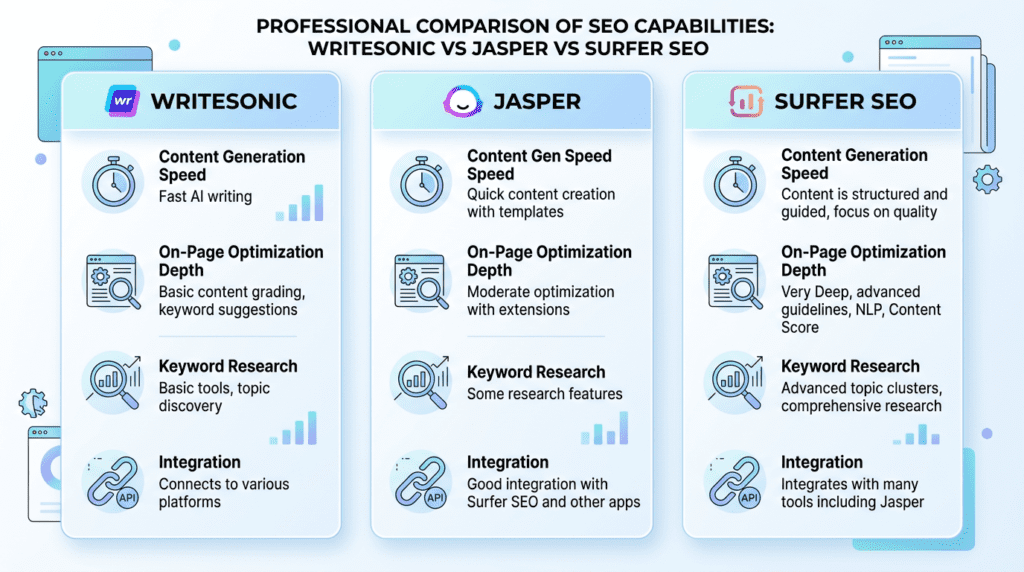
When considering Writesonic for SEO, it’s natural to wonder how it stacks up against other popular tools in the market. Each platform has its strengths, and understanding these differences helps you make an informed decision based on your specific needs and workflow.
Writesonic vs. Jasper (formerly Jarvis): Content Quality and Workflows
Both Writesonic and Jasper are powerful AI writing assistants, but they often cater to slightly different needs, especially when it comes to SEO.
- Content Quality and Output: Jasper, particularly with its “Boss Mode,” has historically been lauded for its ability to generate longer, more creative, and often more engaging content, especially for marketing copy and brand storytelling. Users often find Jasper’s output to be more fluid and less repetitive in its raw form. Writesonic, on the other hand, particularly with its AI Article Writer 5.0, focuses heavily on structure and SEO optimization from the outset. While its output can be excellent, some users might find it slightly more formulaic if not guided carefully, prioritizing keyword inclusion and topical coverage.
- Ease of Use for SEO-Specific Tasks: This is where Writesonic often shines. Its integrated Keyword Research tool and Sonic Editor provide a more direct, all-in-one workflow for SEO content creation. You can research, outline, draft, and optimize within the same platform. Jasper, while capable of generating SEO-friendly content, typically requires more manual input for keyword integration and often relies on third-party integrations (like Surfer SEO) for deep on-page optimization feedback.
Which is better for structured, repeatable SEO content creation?
For businesses or agencies that need to produce a high volume of structured, SEO-optimized blog posts, product descriptions, or landing page copy with an emphasis on specific keywords and topical completeness, Writesonic often provides a more streamlined and integrated workflow. If your primary goal is creative content generation, brand voice consistency across various marketing assets, and you’re comfortable integrating with other SEO tools, Jasper might be a better fit. Writesonic’s built-in SEO features make it a strong contender for those prioritizing an efficient Writesonic for SEO workflow.
Writesonic vs. Surfer SEO: On-Page Optimization Power
This comparison is less about direct competition and more about complementary tools, as Surfer SEO is a dedicated content optimization platform, whereas Writesonic is a broader AI writing suite with strong SEO features.
- Depth of SEO Suggestions and Data Sources: Surfer SEO is a market leader in on-page optimization. It analyzes the top-ranking pages for your target keyword, providing highly granular recommendations based on real-time SERP data. This includes specific keyword density suggestions, ideal word counts, NLP (Natural Language Processing) terms to include, heading structures, and internal/external link suggestions. Writesonic’s Sonic Editor offers valuable real-time SEO feedback and a score, but its depth of analysis and data sources are generally not as extensive as Surfer’s. Writesonic’s suggestions are more generalized, focusing on keyword inclusion, readability, and basic structural elements.
- Writesonic’s Integrated Approach vs. Surfer’s Specialized Focus: Writesonic aims to be an all-in-one solution for content creation, from idea generation to drafting and basic optimization. This integrated approach is convenient and efficient, especially for smaller teams or those on a budget who want to handle most tasks within one platform. Surfer SEO, on the other hand, is a specialized tool. It doesn’t write content from scratch but provides the precise blueprint for optimizing existing or AI-generated content.
- When to use Writesonic alone vs. when to pair it with Surfer SEO:
- Use Writesonic alone when: You need to rapidly generate first drafts and perform basic on-page optimization. This is ideal for content velocity, covering a wide range of topics, or for less competitive keywords where deep, granular optimization isn’t absolutely critical. It’s also a cost-effective solution if you’re looking for a single tool to handle both writing and initial SEO.
- Pair Writesonic with Surfer SEO when: You’re tackling highly competitive keywords, require the absolute best on-page optimization, or need to ensure your content is as comprehensive and semantically rich as possible. Many SEO professionals use Writesonic (or another AI writer) to generate a high-quality first draft, then export that draft into Surfer SEO for a final, data-driven optimization pass. This combination leverages Writesonic’s speed for content generation and Surfer’s precision for ranking, creating a powerful Writesonic for SEO strategy for top-tier results.
Final Recommendation: Is Writesonic a Smart Choice for Your SEO Strategy?
Writesonic presents a compelling proposition for modern SEO strategies, acting as a powerful force multiplier rather than a standalone solution. Its utility is most pronounced for those looking to streamline content creation and enhance on-page optimization efforts.
Key Strengths for SEO Professionals
Writesonic excels in offering an integrated workflow that significantly accelerates content production. From initial keyword discovery, as demonstrated in our “Local SEO Services for Plumbers” scenario, to generating an optimized draft, it consolidates several steps into a single platform. This capability translates into significant time savings, allowing content teams to scale their output efficiently. Furthermore, features like the Sonic Editor for refining content and Photosonic for generating relevant images directly contribute to stronger on-page signals, improving the overall quality and appeal of published assets.
Critical Weaknesses to Consider
While powerful, Writesonic is not without its limitations. The data provided by its internal keyword tool, while useful for initial ideation, is less comprehensive and robust compared to dedicated, specialized platforms. Crucially, content generated by AI, including Writesonic, always requires substantial human oversight to ensure E-E-A-T (Experience, Expertise, Authoritativeness, Trustworthiness) and factual accuracy. As highlighted in our earlier example, human-led optimization is indispensable for adding unique insights and brand voice. Ultimately, Writesonic’s SEO recommendations serve as valuable guidance but cannot replace the nuanced strategic expertise of an experienced SEO professional.
The Bottom Line
Writesonic is a powerful SEO *accelerator*, not an autopilot system. It’s an excellent choice for content teams and SEOs who understand search principles and want to scale their output without compromising on foundational quality. However, it is not a magic bullet that can replace the need for a human strategist to guide content direction, verify facts, and infuse unique perspectives essential for true search engine success.
Frequently Asked Questions (FAQs)
Can Google detect and penalize content written with Writesonic?
No, Google’s guidelines focus on the quality and helpfulness of the content to users, not the tool used to create it; the key is ensuring human oversight and optimization for E-E-A-T.
How does Writesonic’s pricing compare for SEO use cases?
Writesonic offers competitive pricing tiers, as detailed in our earlier section on pricing, which generally provide good value for its comprehensive SEO-focused features, especially for scaling content production.
Does Writesonic integrate with other SEO tools like Google Search Console?
Writesonic primarily focuses on content generation and optimization within its platform and does not offer direct, real-time integrations with external analytics tools like Google Search Console for data pulling.
How much editing does Writesonic content typically require to be ready for SEO?
The amount of editing varies, but significant human review is always recommended for SEO readiness, focusing on factual accuracy, unique insights, brand voice, and strategic alignment.
Is Writesonic good for creating programmatic SEO content?
Yes, Writesonic can be a valuable tool for programmatic SEO, particularly for generating variations of content at scale by leveraging its API and bulk generation capabilities to create numerous similar pages based on templates and data.