

In today’s fast-paced digital landscape, content creation often feels like a constant uphill battle. Businesses, marketers, and individual creators are always looking for ways to produce high-quality content faster and more efficiently, but the sheer volume needed can quickly become a major workflow bottleneck. That’s where AI writing tools come in, promising to revolutionize how we generate everything from blog posts to ad copy. However, with so many options emerging, choosing the right one can be a challenge.
Two of the most prominent players in this space are Writesonic and ChatGPT. While both leverage powerful artificial intelligence to generate text, they cater to different needs and excel in distinct areas. Understanding these differences isn’t just about comparing features; it’s about identifying which tool genuinely fits your operational goals and helps you overcome your specific content challenges.
Quick Verdict: Writesonic vs. ChatGPT
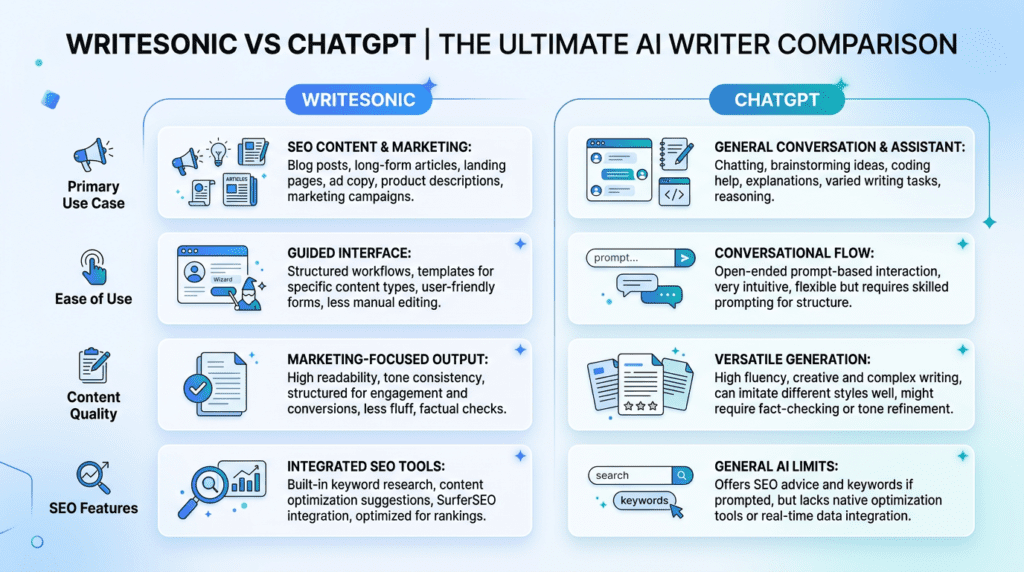
When you’re trying to decide between two powerful AI tools like Writesonic vs ChatGPT, a quick summary can cut through the noise. This section offers an immediate, high-level comparison to help you grasp their core strengths and ideal applications right away.
Complete Verdict Table
| Factor | Writesonic | ChatGPT (GPT-4) | Winner |
|---|---|---|---|
| Primary Use Case | Guided content creation for marketing & SEO | General-purpose AI assistant & creative partner | Tie (Depends on need) |
| Ease of Use | High (Template-driven) | Moderate (Requires prompting skill) | Writesonic |
| Content Quality | Good to Great (Structured, optimized) | Good to Excellent (Creative, conversational) | ChatGPT |
| SEO Features | Excellent (Built-in tools, Surfer integration) | None (Requires external tools & expertise) | Writesonic |
| Specialized Tools | Chatsonic, Photosonic, Audiosonic | DALL-E 3, Advanced Data Analysis, Browse | ChatGPT |
| Value for Money | Good (Tiered plans for specific outputs) | Excellent (Broad capabilities for a flat fee) | ChatGPT |
| Best For | Marketers, SEOs, agencies needing structured content | Developers, writers, researchers needing flexibility | - |
Best For
If you’re a marketing professional, an SEO specialist, a blogger, or running an agency, Writesonic is often your best bet. It’s built from the ground up to help you generate structured, optimized content like blog posts, ad copy, product descriptions, and landing page text with remarkable speed. Its template-driven approach means you get a guided experience, which is fantastic for teams that need consistent output for their content marketing strategy. For instance, an e-commerce business needing hundreds of unique product descriptions or a content agency scaling blog article generation will find Writesonic’s workflow incredibly efficient. It streamlines the process, making it easier to produce content that’s ready for search engines.
On the other hand, ChatGPT shines as a versatile and powerful AI partner for writers, developers, researchers, and creative professionals. If your workflow involves extensive brainstorming, complex problem-solving, coding assistance, or generating highly nuanced and creative text that requires deep conversational abilities, ChatGPT’s flexibility is unmatched. A freelance writer might use it to develop character backstories, a developer for debugging code, or a researcher for summarizing complex papers. Its strength lies in its adaptability and ability to handle a wide array of open-ended tasks, making it a true creative collaborator.
Not Ideal For
While powerful, Writesonic isn’t the right choice if your main need is deep conversational abilities, complex coding assistance, or open-ended creative exploration without much structure. If you’re looking for an AI to act as a free-form brainstorming partner for novel ideas or to help you write a screenplay from scratch, its template-based system might feel restrictive. It’s designed for specific commercial content generation, not for unconstrained creative writing or highly interactive problem-solving.
Conversely, ChatGPT might not be the ideal, turnkey solution for teams focused purely on producing SEO-optimized blog posts or marketing copy without significant manual prompting and editing. While it can generate these types of content, it lacks the built-in SEO tools and structured templates that Writesonic offers. You’ll need a strong understanding of prompt engineering and potentially external SEO tools to get the same level of optimization, which can add extra steps and expertise requirements to your content workflow. It’s a powerful engine, but you’re the one building the car.
Bottom Line
Ultimately, the choice between Writesonic vs ChatGPT comes down to your primary objectives. Choose Writesonic if your core goal is to streamline and scale the production of marketing and SEO content, especially if you value guided workflows and built-in optimization features. Opt for ChatGPT if you need a versatile and powerful AI assistant for a wide range of creative, analytical, and conversational tasks, and you’re comfortable with more open-ended prompting to achieve your desired output.
How Writesonic and ChatGPT Differ in Core Functionality
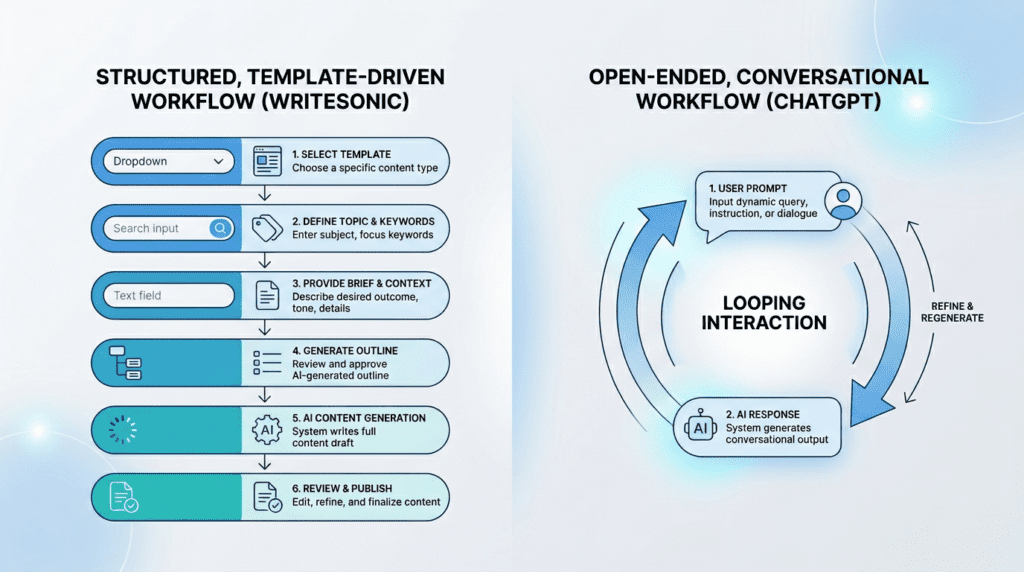
Moving beyond the simple label of “AI writer,” Writesonic and ChatGPT approach content generation from fundamentally different angles. Understanding this core distinction is crucial for deciding which tool aligns best with your workflow and goals. It’s not just about what they can do, but *how* they do it.
Writesonic’s Structured, Template-Driven Approach
Writesonic operates like a highly specialized content factory, guiding users through specific, pre-defined workflows. Think of it as having a team of expert copywriters, each trained for a particular task, ready to produce content based on a structured brief. For instance, its “AI Article Writer 5.0” isn’t just a blank text box; it’s a multi-step process that prompts you for a topic, keywords, and an outline, then generates sections piece by piece. This structured approach is incredibly efficient for specific content types.
For a blogger or an affiliate marketer needing to churn out product reviews or informational articles, Writesonic’s templates for landing pages, ad copy, social media posts, and even product descriptions are a huge time-saver. You select a template, input your core information, and the AI generates output tailored to that format. What beginners often struggle with in other tools – knowing where to start or how to structure content – becomes much easier here. The trade-off, however, is less creative freedom; you’re largely working within the confines of the template. While marketing pages often highlight the speed, they sometimes gloss over the fact that truly unique or highly nuanced content might still require significant human oversight and editing to break free from the template’s inherent structure. For agencies managing multiple clients with similar content needs, this structured approach allows for remarkable consistency and scalability.
ChatGPT’s Open-Ended, Conversational Model
In stark contrast, ChatGPT functions as an open-ended, conversational AI. It’s a blank canvas, a highly intelligent chatbot ready to discuss anything you throw at it. The quality and relevance of its output are almost entirely dependent on the user’s ability to craft effective prompts. This is where the concept of “prompt engineering” comes into play. You’re not filling out a form; you’re having a conversation, refining your requests, and guiding the AI towards the desired outcome.
For a developer needing a Python script, a researcher summarizing complex data, or a writer brainstorming plot points for a novel, ChatGPT’s flexibility is its greatest strength. Beginners often face a steep learning curve here, struggling with what to ask or how to phrase requests to get useful results. It can be frustrating when the AI misunderstands your intent, leading to generic or off-topic responses. However, as users gain experience, they learn to “talk” to ChatGPT more effectively, leading to increasingly sophisticated and tailored output. What starts as a challenge often becomes a powerful skill, allowing for deep exploration and highly customized content. This model is less about speed for specific content types and more about versatility and intellectual partnership.
The Key Takeaway
The fundamental difference is clear: Writesonic is a specialized tool designed for efficient, guided content creation, particularly in marketing and SEO. It excels when you know exactly what type of content you need and want to produce it quickly within established formats. ChatGPT, on the other hand, is a general-purpose utility, a versatile AI assistant that thrives on open-ended interaction and complex problem-solving. This core distinction dictates who will get the most value from each platform. If your business primarily needs to scale marketing content, Writesonic offers a more direct path. If you need a flexible AI partner for a wide array of tasks, from coding to creative writing, ChatGPT provides unparalleled breadth.
Comparing Content Generation Quality and Control
Beyond their core functionality, the actual quality and the level of control you have over the generated content are critical factors. This section evaluates how each tool performs across common business and creative tasks.
Long-Form Article Generation
When it comes to generating a substantial piece like a 1500-word blog post, both tools can produce content, but their strengths and weaknesses become apparent. Writesonic’s “AI Article Writer 5.0” often delivers a well-structured article, complete with headings, subheadings, and a logical flow, especially if you provide a detailed outline. The output tends to be SEO-friendly by design, focusing on keyword integration and readability. However, the prose can sometimes feel a bit formulaic or lack the unique voice that distinguishes human writing. Factual accuracy, while generally good, still requires human verification, as AI models can “hallucinate” information. The level of editing required typically focuses on refining the narrative, adding unique insights, and checking for repetition.
ChatGPT, particularly with GPT-4, can generate incredibly detailed and creative long-form content. Its ability to maintain context over longer passages means it can produce more cohesive and nuanced articles. However, it requires more hands-on guidance. Without a meticulously crafted prompt and iterative refinement, ChatGPT’s long-form output can sometimes wander off-topic, lack a strong central thesis, or become repetitive. Factual accuracy is a bigger concern here; ChatGPT pulls from a vast dataset but doesn’t inherently “know” facts in real-time, making thorough fact-checking essential. For a beginner, generating a coherent 1500-word article with ChatGPT can be a frustrating exercise in prompt engineering, whereas Writesonic offers a more predictable, albeit less flexible, path. For experienced content creators, ChatGPT offers the potential for higher quality, more unique content, but demands more time in the prompting and editing phases.
Marketing & Ad Copy Performance
For the specific demands of marketing and ad copy, Writesonic often has an edge due to its specialized templates. Whether you need Facebook ad headlines, Google Ads descriptions, or compelling product descriptions, Writesonic’s algorithms are trained on vast amounts of high-performing marketing copy. This means the output is frequently optimized for conversion, includes strong calls to action, and adheres to character limits and best practices for various platforms. For an e-commerce business owner or a digital marketer, this translates to faster, more effective copy generation that often requires less tweaking to be campaign-ready.
ChatGPT can certainly generate marketing copy, and with the right prompts, it can produce highly creative and persuasive text. However, it lacks the inherent structure and optimization built into Writesonic’s templates. You’d need to explicitly instruct ChatGPT on character limits, desired tone, target audience, and specific marketing angles. While it can adapt to a brand voice if prompted effectively, achieving consistent, high-converting ad copy across multiple campaigns with ChatGPT demands a higher level of prompt engineering skill and more iterative refinement compared to Writesonic’s more direct approach. For landing page copy, Writesonic’s structured inputs often lead to a more complete and conversion-focused page layout, whereas ChatGPT would require you to build the structure from scratch through prompts.
Creative and Technical Writing Capabilities
This is where ChatGPT truly shines and Writesonic largely falls short. ChatGPT’s open-ended nature makes it an invaluable tool for creative writing tasks like generating a short story, drafting poetry, or even outlining a screenplay. Its ability to understand and generate complex narratives, character dialogues, and descriptive prose far surpasses Writesonic’s template-driven capabilities. Similarly, for technical tasks, ChatGPT can write or debug code snippets (like a Python script), explain complex concepts, or draft detailed technical emails.
Writesonic, while excellent for its intended purpose, is not designed for these types of tasks. Attempting to generate a Python script or a short story within Writesonic would be like trying to hammer a nail with a screwdriver – possible, but inefficient and ineffective. This highlights ChatGPT’s immense flexibility as a general-purpose AI, making it a powerful asset for developers, academic researchers, and creative professionals who need an AI partner beyond marketing content.
Maintaining Brand Voice and Tone
Consistency in brand voice and tone is paramount for any business. Writesonic addresses this with a dedicated “Brand Voice” feature, allowing users to input guidelines, examples, and preferred stylistic elements. Once configured, this feature aims to infuse all generated content with that specific voice, offering a more “set it and forget it” solution for maintaining consistency across various content types. This can be a significant advantage for larger teams or agencies needing to ensure brand alignment across numerous pieces of content.
ChatGPT can also adapt to a specific brand voice and tone, but it relies entirely on the user’s prompt engineering skills. You need to explicitly describe the desired tone (e.g., “professional yet approachable,” “witty and irreverent”), provide examples of existing brand copy, and consistently reinforce these instructions in your prompts. While highly skilled users can achieve excellent results, it demands continuous attention and discipline. The long-term consequence of inconsistent prompting in ChatGPT is a fragmented brand voice, which can be a hidden frustration for growing businesses trying to scale their content efforts. Writesonic’s feature, while not perfect, offers a more automated guardrail against such inconsistencies.
The SEO Advantage: Why Writesonic Leads for Search-Focused Content
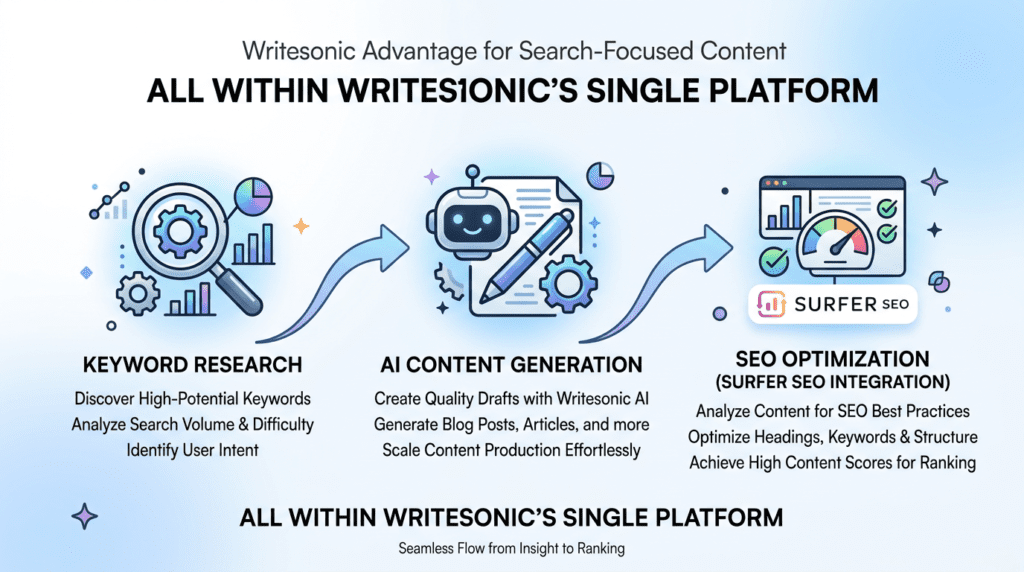
For many businesses, the primary goal of content creation is to rank higher in search engine results. In this critical area, Writesonic offers a distinct and integrated advantage that ChatGPT, by itself, simply cannot match. This isn’t to say ChatGPT can’t be part of an SEO strategy, but Writesonic provides a more streamlined, purpose-built solution.
Built-in Keyword Research and Optimization
Writesonic integrates basic keyword research and optimization directly into its content generation workflow. When you use its article writer, for example, it prompts you to enter target keywords and even suggests related terms. It then attempts to incorporate these keywords naturally throughout the generated content. This feature is particularly valuable for beginners or small businesses without dedicated SEO tools, as it removes a significant barrier to creating search-optimized content. It helps users understand *why* certain words matter and *when* to use them, making the content more likely to resonate with search engine algorithms from the outset. For a freelance blogger trying to rank for specific niches, this built-in guidance is a practical time-saver.
The Power of Surfer SEO Integration
Perhaps the most compelling reason Writesonic leads for search-focused content is its deep integration with Surfer SEO. This isn’t just a superficial connection; it’s a powerful, real-time content optimization engine built directly into the Writesonic editor. When you generate an article in Writesonic, you can activate the Surfer SEO integration, which then analyzes the top-ranking content for your target keyword. It provides a real-time content score, suggesting missing keywords, optimal word count, heading structure improvements, and even internal linking opportunities.
This integration is a game-changer for content marketers and SEO professionals. Instead of generating content in one tool, exporting it, pasting it into Surfer SEO, optimizing it, and then moving it to a CMS, the entire process happens within Writesonic. This drastically reduces workflow friction and ensures that content is optimized *as it’s being written*. For an agency managing hundreds of articles a month, this means significant time savings and a higher probability of ranking success. It directly addresses the hidden frustration of juggling multiple tools and the scaling limitation of manual optimization. The practical implication is that teams can produce high-quality, SEO-optimized content much faster and more consistently, giving them a competitive advantage in crowded search results. This feature alone can justify the investment for businesses where organic traffic is a primary revenue driver.
Can ChatGPT Be Used for SEO?
Yes, ChatGPT can certainly be *used* for SEO, but it requires a manual, multi-step process. ChatGPT itself has no inherent SEO capabilities. To create SEO-optimized content with ChatGPT, you would first need to perform keyword research using a third-party tool (like Ahrefs, Semrush, or Surfer SEO). Then, you would craft detailed prompts for ChatGPT, feeding it the keywords, desired structure, and competitive insights you gathered. After ChatGPT generates the content, you would then take that output and run it through another SEO optimization tool to check for keyword density, content gaps, and overall optimization score. This iterative process adds significant time and complexity to the workflow.
For example, an affiliate marketer might use Semrush to find keywords, then ask ChatGPT to write a blog post using those keywords, and finally paste the output into Surfer SEO for optimization before publishing. This multi-tool approach is effective but far less efficient than Writesonic’s integrated solution.
Reality Check
For teams focused on ranking content at scale, Writesonic’s integrated workflow is a significant time-saver and competitive advantage. The ability to research, generate, and optimize content for SEO all within a single platform streamlines operations, reduces errors, and accelerates publishing cycles. While ChatGPT offers incredible versatility, its lack of native SEO features means that businesses prioritizing search engine visibility will find Writesonic’s specialized tools and Surfer SEO integration to be a more direct and efficient path to achieving their ranking goals. The decision isn’t about whether ChatGPT *can* help with SEO, but whether its manual, multi-tool approach is sustainable and efficient for your specific business needs compared to Writesonic’s purpose-built solution.
Pricing and Value Proposition: Which Model Fits Your Budget?
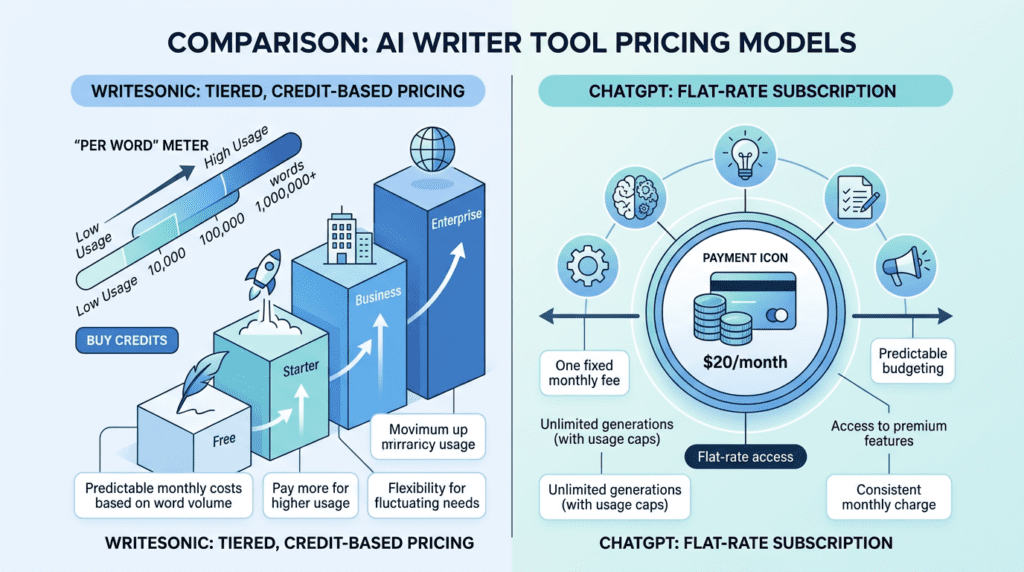
When choosing an AI writing tool, the cost isn’t just about the monthly fee; it’s about the value you get for that investment over time. Understanding the pricing models of Writesonic vs ChatGPT is crucial for budgeting and long-term planning, especially as your content needs grow.
Writesonic’s Tiered Pricing Explained
Writesonic typically operates on a credit-based system, which can feel a bit like a prepaid phone plan. They offer a Free plan that lets you try out basic features, usually with a limited number of words or credits per month (e.g., 10,000 words using GPT-3.5). This is great for beginners to test the waters without commitment.
Beyond the free tier, Writesonic offers paid plans that scale up based on the number of words you need and the quality of the AI model (GPT-3.5 vs. GPT-4). For instance, a “Small Team” plan might start around $19–$49/month for a certain word count (e.g., 100,000–200,000 words using GPT-4 quality) and include features like brand voice and more user seats. As you move to Enterprise plans, pricing becomes custom, offering unlimited words, dedicated account managers, and advanced integrations.
The main thing to understand with Writesonic is that your usage directly impacts your monthly cost. If you exceed your word credits, you’ll either need to upgrade your plan or pay for overage charges, which can add up quickly. This model works well for users with predictable content needs but can become a hidden frustration for those whose output fluctuates wildly. For a solo blogger, a plan around $19/month might be perfect, but an agency generating hundreds of articles could easily spend hundreds of dollars.
ChatGPT’s Subscription Model (Plus vs. Team)
ChatGPT, on the other hand, generally offers a more “all-you-can-eat” approach, though with fair usage policies. The most common paid option for individuals is ChatGPT Plus, which typically costs $20/month. This flat fee provides access to the latest models (like GPT-4 and DALL-E 3), web browsing, data analysis, and custom GPTs, often with higher usage limits than free users. The beauty here is its simplicity: you pay one price, and you get a vast array of capabilities.
For businesses, OpenAI offers ChatGPT Team, which is priced around $25/user/month (billed annually) or $30/user/month (billed monthly) for a minimum of two users. This tier includes higher usage limits, administrative controls, and a dedicated workspace, making it suitable for small to medium-sized teams. The key difference from Writesonic is that you’re not paying per word; you’re paying for access to the underlying powerful AI models and their integrated features. This model is particularly appealing to users who value flexibility and broad AI capabilities without constantly monitoring word counts.
Calculating the True Cost-Per-Article
Let’s consider a scenario: you need to produce 10 blog posts per month, each averaging 1,500 words, for a total of 15,000 words.
With Writesonic, if you’re using GPT-4 quality, a plan offering 15,000 words might cost you around $15–$20/month, depending on the specific plan tiers available at the time. If you also need SEO features like Surfer integration, that might push you into a higher tier or require an additional Surfer subscription. The cost is directly tied to the word count, so if you suddenly need 20,000 words, your cost increases.
With ChatGPT Plus, you’d pay a flat $20/month. For that, you get access to GPT-4, DALL-E 3, and all other features. While there isn’t a direct “word count” for ChatGPT, generating 15,000 words of content is well within typical fair usage limits for the Plus plan. The “cost-per-article” here is effectively negligible once you’ve paid your monthly subscription, as long as you stay within the general usage guidelines.
This comparison highlights a core trade-off: Writesonic’s cost scales with output, while ChatGPT’s cost is more fixed, offering more flexibility once subscribed. For high-volume content creators, ChatGPT’s flat fee can often lead to a lower effective cost per word, provided they’re willing to put in the prompting effort.
Hidden Costs and Long-Term Value
The “hidden costs” often emerge as your needs evolve. With Writesonic, the primary hidden cost can be overage charges or the need to constantly upgrade plans as your content volume increases. What starts as an affordable $19/month plan can quickly become $99/month if your team starts producing more. The long-term value, however, comes from its integrated workflow and specialized SEO tools. For a marketing team focused solely on ranking content, the time saved by Writesonic’s built-in optimization features can easily outweigh the higher per-word cost.
For ChatGPT, the hidden cost isn’t monetary but rather time and expertise. While the subscription is a flat fee, getting high-quality, SEO-optimized content often requires significant prompt engineering skill and potentially additional subscriptions to SEO tools (like Surfer SEO or Ahrefs) for keyword research and optimization. This means a marketing team might save on the AI tool itself but invest more in training staff on advanced prompting or in other software. The long-term value of ChatGPT lies in its incredible versatility and its ability to act as a general-purpose AI assistant for a myriad of tasks beyond just writing, making it a powerful tool for innovation and problem-solving across different departments.
Beyond Writing: Comparing Specialized AI Tools
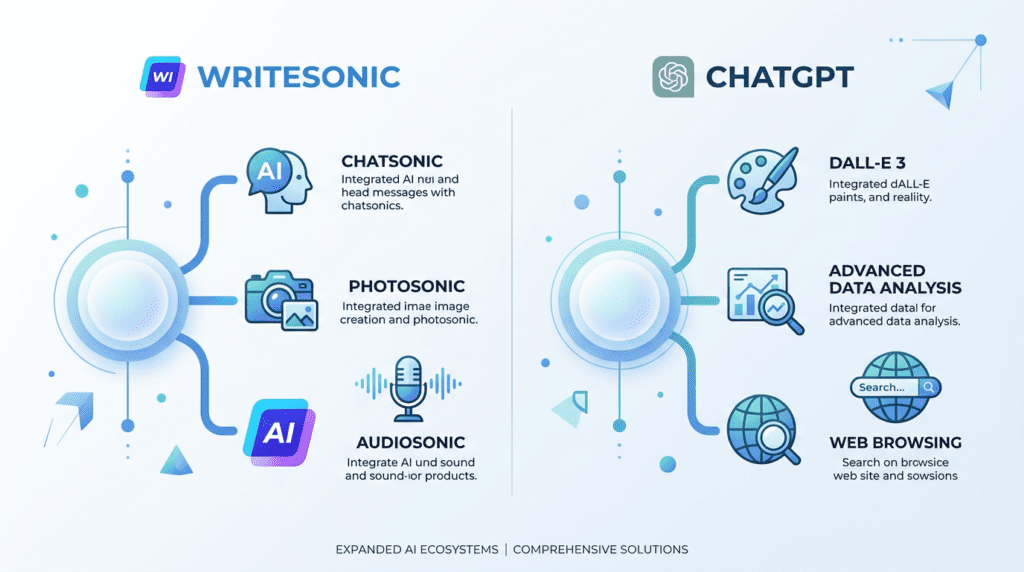
Both Writesonic and ChatGPT have evolved beyond simple text generation, offering a broader suite of AI-powered capabilities. Understanding these specialized tools helps determine which platform aligns better with your overall digital strategy.
Writesonic’s Suite: Chatsonic, Photosonic, and Audiosonic
Writesonic aims to be a comprehensive content creation hub, integrating various AI functionalities into its platform.
- Chatsonic: This is Writesonic’s conversational AI chatbot, designed to be an alternative to ChatGPT. It offers real-time data access (via Google Search integration), allowing it to provide more current information than older GPT models might. It’s useful for quick research, brainstorming, and generating short-form content. While it’s a solid conversational AI, its primary strength often lies in its integration within the Writesonic ecosystem, making it easy to transition from chat to article generation.
- Photosonic: This AI image generator allows users to create unique images from text prompts. For content creators, this means generating custom visuals for blog posts, social media, or ad campaigns without needing to source stock photos or hire a graphic designer. The quality can vary, but it’s a convenient feature for those who need quick, decent-quality images to accompany their text.
- Audiosonic: This tool converts text into natural-sounding speech. It’s particularly useful for creating audio versions of blog posts, podcasts, or voiceovers for videos. For businesses looking to repurpose content across different mediums, Audiosonic offers a straightforward way to expand reach without complex audio production.
The utility of Writesonic’s suite is its “all-in-one” nature. For a solo content creator or a small marketing team, having these tools under one roof simplifies the workflow. You can generate an article, create an image for it, and even produce an audio version, all within the same platform. However, while convenient, the quality of these specialized tools might not always match dedicated, best-in-class solutions for each specific task.
ChatGPT’s Advanced Features: DALL-E 3, Data Analysis, and Web Browsing
ChatGPT, especially with a Plus or Team subscription, transforms into a powerful research, analysis, and creative partner through its integrated advanced features.
- DALL-E 3: Integrated directly into the chat interface, DALL-E 3 allows users to generate high-quality images from text prompts. Unlike Photosonic, DALL-E 3 is known for its exceptional ability to understand nuanced prompts and generate visually stunning, contextually relevant images. You can ask ChatGPT to “create an image of a futuristic city at sunset with flying cars” and then refine it directly in the conversation. This makes it incredibly powerful for visual storytelling and marketing.
- Advanced Data Analysis (formerly Code Interpreter): This feature allows ChatGPT to upload and analyze data files (like CSVs, Excel spreadsheets, or JSON). You can ask it to clean data, perform statistical analysis, create charts, or even write Python scripts. For example, a marketing manager could upload a CSV of website traffic data and ask ChatGPT to “identify trends in user engagement over the last quarter and visualize them in a bar chart.” This capability is a game-changer for data-driven decision-making, offering insights without needing specialized software or coding knowledge.
- Web Browsing: ChatGPT can access the internet to retrieve current information, summarize articles, or research topics. This overcomes the knowledge cutoff limitation of its training data, making it a reliable tool for up-to-date research. For instance, you can ask it to “summarize the latest news on AI regulations” or “find recent statistics on e-commerce growth.”
These advanced features position ChatGPT as more than just a writer; it’s a versatile AI assistant capable of complex problem-solving, data interpretation, and creative generation across multiple modalities.
Which Ecosystem is More Useful?
The answer to which ecosystem is more useful largely depends on your primary workflow and role.
For a marketing manager whose main goal is to produce a high volume of SEO-optimized blog posts, ad copy, and social media content, Writesonic’s ecosystem might be more immediately useful. Its integrated tools for writing, image generation, and audio conversion streamline the content production pipeline, reducing the need to jump between different platforms. The focus is on efficiency and specialized content output.
However, for a data analyst or a researcher who also needs to generate reports, analyze large datasets, brainstorm complex problems, or even write code, ChatGPT’s ecosystem offers unparalleled utility. Its data analysis capabilities, combined with DALL-E 3 for visualizations and web browsing for up-to-date information, make it a powerful tool for deep dives and multifaceted projects. Even a content strategist might find ChatGPT more useful for market research, competitor analysis, and generating creative campaign ideas that go beyond simple text.
Ultimately, Writesonic provides a more curated, content-focused suite, while ChatGPT offers a broader, more flexible set of advanced AI capabilities that extend far beyond traditional writing tasks.
Real-World Scenarios: Which Tool is Right for Your Role?
Choosing between Writesonic and ChatGPT isn’t about finding a universally “better” tool; it’s about aligning the AI’s strengths with your specific needs and workflow. Let’s break down who benefits most from each.
For the Solo Blogger or Content Creator
Who should choose Writesonic: If you’re a solo blogger or content creator primarily focused on generating SEO-friendly articles, blog posts, and marketing copy, Writesonic is often the more straightforward choice. Its template-driven approach and built-in SEO features (like keyword research and Surfer SEO integration) mean you can produce optimized content faster, even if you’re not an SEO expert. It helps you structure your thoughts and ensures your content has a better chance of ranking. The free plan or a lower-tier paid plan can be very budget-friendly for consistent, moderate output. You’ll spend less time on prompt engineering and more time on editing and publishing.
Who should choose ChatGPT: If your content creation involves more creative writing, complex research, brainstorming unique ideas, or even dabbling in code for your website, ChatGPT offers incredible flexibility. For the same $20/month as ChatGPT Plus, you get access to DALL-E 3 for custom images, web browsing for up-to-date information, and advanced data analysis for understanding your audience or market. While you’ll need to master prompting to get the best results, the versatility means you’re not just getting an AI writer, but a powerful assistant for almost any digital task. It’s ideal if your workflow is less about high-volume, templated content and more about deep dives and creative exploration.
For the In-House Marketing Team
Who should choose Writesonic: An in-house marketing team focused on scaling content production for blogs, landing pages, ad campaigns, and social media will likely find Writesonic’s structured environment highly beneficial. Its brand voice feature helps maintain consistency across multiple writers and content types, which is critical for brand identity. The integrated SEO tools ensure that all generated content is optimized from the start, saving time on post-production SEO efforts. For teams needing to churn out diverse marketing copy efficiently and maintain a consistent brand message, Writesonic provides a more streamlined, collaborative workflow. It reduces the learning curve for new team members and ensures a baseline quality for all outputs.
Who should choose ChatGPT: A marketing team that needs a more versatile AI for strategic planning, market research, competitor analysis, or generating highly creative and unique campaign ideas might lean towards ChatGPT. Its advanced data analysis can help interpret campaign results, while DALL-E 3 can rapidly prototype visual concepts for ads. For teams that value deep insights, complex problem-solving, and pushing creative boundaries, ChatGPT offers a powerful, open-ended platform. However, they’ll need to invest in training their team on effective prompting and potentially integrate ChatGPT’s output with external SEO tools for optimal search performance.
For the SEO Agency
Who should choose Writesonic: For an SEO agency that manages content for multiple clients, Writesonic is a strong contender due to its efficiency and direct integration with SEO best practices. The ability to quickly generate high-quality, optimized long-form content, product descriptions, and meta tags at scale is invaluable. The Surfer SEO integration is a massive time-saver, allowing agencies to produce content that’s already scored for on-page SEO. This means less manual optimization and faster turnaround times for client deliverables, directly impacting profitability and client satisfaction. It’s built for volume and optimization.
Who should choose ChatGPT: An SEO agency might use ChatGPT as a supplementary tool for more complex tasks that Writesonic doesn’t cover. This could include generating detailed content briefs based on extensive research, analyzing large keyword datasets, creating custom Python scripts for SEO audits, or brainstorming highly creative link-building strategies. While ChatGPT can generate content, the agency would still need to manually apply SEO best practices and use external tools for optimization. It’s more of a powerful assistant for the SEO specialist rather than a turnkey content generation platform for SEO.
For the Developer or Technical User
Who should choose ChatGPT: This is where ChatGPT truly shines. For developers, engineers, or anyone working with code and technical documentation, ChatGPT is the undisputed champion. It can write code snippets in various languages, debug existing code, explain complex programming concepts, generate API documentation, and even help with system design. Its ability to understand and generate logical, structured technical responses is far superior to Writesonic’s capabilities in this domain. A developer can use ChatGPT to quickly prototype functions, troubleshoot errors, or learn new programming paradigms, making it an indispensable tool for productivity and learning.
Who should avoid Writesonic: Writesonic is not designed for technical users in this capacity. While it can generate marketing copy for software products, it lacks the deep understanding and functionality required for coding, debugging, or generating technical documentation. A developer would find little to no value in Writesonic for their core tasks.
Final Recommendation: Making the Right Choice in 2026
This is not about declaring one tool “better,” but about guiding the reader to the right choice for their specific context. Both Writesonic and ChatGPT have evolved significantly, offering distinct advantages that cater to different workflows and objectives. The optimal choice hinges on your primary needs, existing team structure, and how you envision AI integrating into your content strategy.
- Choose Writesonic if… you prioritize speed, structure, and built-in SEO capabilities for marketing content. It excels in generating specific content types like blog posts, ad copy, and product descriptions with minimal prompting, leveraging its extensive template library and integrations (as seen in our “SEO Agency” scenario). It’s the right choice for teams who need a reliable system to scale content production efficiently and maintain brand consistency across various marketing assets. If your goal is to streamline the creation of high-volume, optimized content with a clear workflow, Writesonic provides a more guided and often faster path from idea to publication.
- Choose ChatGPT if… you need a versatile, powerful, and creative AI partner for a wide range of tasks beyond just blog posts. Its strength lies in its conversational flexibility, advanced reasoning, and multimodal capabilities, including data analysis, code generation, and direct image creation with DALL-E 3 (as explored in “ChatGPT’s Advanced Features”). It’s the best choice for users who value flexibility, require deep research assistance, or engage in complex problem-solving, and are willing to invest time in mastering the art of prompting to unlock its full potential. For developers, researchers, or those needing a highly adaptable AI for exploratory tasks, ChatGPT offers unparalleled breadth.
- The Hybrid Approach: Can you use both? Absolutely. A highly effective workflow can involve leveraging ChatGPT for initial brainstorming, outlining complex topics, or generating unique angles and research summaries. Once the core ideas and structure are established, you can then transition to Writesonic to refine, optimize, and format the content using its specialized templates and SEO features, ensuring it’s ready for publication with minimal additional editing. This approach combines the creative power and analytical depth of ChatGPT with the structured efficiency and marketing-specific optimization of Writesonic.
Frequently Asked Questions (FAQ)
Can ChatGPT replace Writesonic for SEO?
No, not entirely. While ChatGPT can generate SEO-friendly content and assist with keyword research, Writesonic offers more specialized, built-in SEO features, including integration with tools like Surfer SEO, and templates designed specifically for optimizing content for search engines.
Is Writesonic’s content quality as good as ChatGPT-4?
The quality can be comparable, especially for structured marketing content where Writesonic’s templates guide the output. ChatGPT-4 often provides more nuanced, creative, and human-like responses for open-ended prompts, but may require more refinement to fit specific marketing formats.
Which tool is more cost-effective for a small business?
This depends heavily on usage patterns, as discussed in “Pricing and Value Proposition.” Writesonic’s tiered plans can be more predictable for specific content volumes, while ChatGPT’s flat-rate Plus or Team subscriptions might be more cost-effective for users with highly varied or extensive needs across its broader capabilities.
Do I still need a human editor if I use these tools?
Yes, absolutely. AI tools are powerful assistants but do not replace human oversight for factual accuracy, brand voice consistency, nuanced messaging, and final quality assurance.
How does Writesonic’s Chatsonic compare to the standard ChatGPT?
Chatsonic aims to provide real-time data access and specific content generation capabilities within a conversational interface, while standard ChatGPT (especially Plus/Team) offers broader conversational intelligence, advanced reasoning, and multimodal features like DALL-E 3 and data analysis.
Can I use my own OpenAI API key with Writesonic?
Writesonic operates as a standalone SaaS platform, managing its own API access to underlying AI models. Therefore, users cannot directly integrate or use their personal OpenAI API keys within Writesonic’s core features.